Visto n' Visa
Blog
Notícias e artigos
Destinations
Careers
Immigrants

Want to live and work in College?

Personalized immigration plan with eligible visas, costs, and next steps for your goal!

If you are not eligible, you will know exactly why and what to do to improve your approval chances.

Save up to 12 hours in meetings

No pointless assessments.

Save up to 90%

Save money on vague or unfocused consultations

Avoid Fraud and Mistakes

One mistake can cost you your visa

Total Impartiality

Zero commercial bias

Decide with peace of mind

No toxic urgency

Fast and Accurate

Answers in minutes, no guesswork

College population: students, faculty, and Arctic researchers

Strong presence of UAF students and researchers. Greater diversity than other interior neighborhoods, with Asian, Indian, and European communities.

College has the most diverse and educated population in interior Alaska. UAF attracts students and researchers from more than 50 countries, with strong Chinese, Indian, Japanese, Korean, German, and Russian communities, particularly in programs covering geophysics, Arctic climatology, biology, and engineering.

Permanent residents include university professors, researchers at the Geophysical Institute and the International Arctic Research Center, and administrative staff. Median income and educational attainment are higher than the interior Alaska average.

Graduate students in the natural sciences arrive from many countries. The Athabascan community (indigenous to the interior) also has a presence, supported by dedicated university programs for rural and indigenous students.

Languages spoken
  • English
  • Spanish
  • Mandarin
  • Korean
  • Hindi
  • +3 more
Main religions
  • No religion
  • Protestant Christian
  • Catholic
  • Buddhist
  • Hindu
  • +1 more

Cost of living in College: similar to Fairbanks, with relief for students

Follows Fairbanks standards. Students have access to more affordable university housing. No state income tax or sales tax in Alaska.

The cost of living in College mirrors Fairbanks: food and consumer goods cost more than elsewhere in the United States due to freight costs, gasoline runs above the national average, and home heating adds up significantly in winter. Electricity is provided by Golden Valley Electric Association.

Students can access UAF dormitories (more affordable) or share houses and cabins in the area. Renting a dry cabin (a cabin without indoor plumbing) is a common way to cut costs for students who embrace a more rustic lifestyle. Apartment and house rents in College vary by season.

As elsewhere in Alaska, there is no state income tax, and Fairbanks (and College, within the borough) collects no sales tax. Residents receive the annual Permanent Fund Dividend. International students typically do not receive the dividend in their early years of residency.

College

Housing in College: dormitories, historic homes, and student cabins

A mix of UAF dormitories, traditional houses near campus, and dry cabins (without indoor plumbing) along secondary roads.

Housing in College takes three main forms. The first is UAF dormitories and apartments, which accommodate thousands of undergraduate and graduate students. The second is residential houses in neighborhoods such as College Heights and near Farmers Loop Road, home to families and faculty.

The third, a defining feature of the region, is the dry cabin: a wood cabin without indoor plumbing, typically with a sauna or outhouse and water supplied by jugs. Dry cabins rent for considerably less and are popular among students willing to haul water from the UAF campus and shower at the campus recreation center. It is a lifestyle specific to interior Alaska.

Goldstream Valley, just to the north, has homes on large lots, some with radiant heating systems fueled by wood. For rentals or purchases, sites such as Zillow, Craigslist, and the Fairbanks Daily News-Miner classifieds are the main sources.

Recommended neighborhoods
  • Near UAF (students and staff)
  • College Heights (traditional houses)
  • Farmers Loop (residential, convenient)
  • Goldstream Valley (cabins, more rural)
  • Sheep Creek Road (hillside homes)

Job market in College: UAF at the center, Fairbanks 5 minutes away

The University of Alaska Fairbanks employs hundreds. For other positions, Fairbanks offers healthcare, government, and retail just minutes away.

The University of Alaska Fairbanks (UAF) is the largest local employer. It hires faculty, researchers, lab technicians, administrators, maintenance staff, and students through scholarship programs. Strong fields include geophysics, Arctic climatology, biology, mining, and engineering.

For employment outside UAF, College residents commute to Fairbanks, a 5-to-10-minute drive. Fairbanks Memorial Hospital, the school district, state government, retail, and Eielson Air Force Base (farther south) absorb most of the remaining workforce. Fort Wainwright military base also employs civilians.

Northern lights tourism has grown considerably in recent years. Lodges, nighttime tours, sky-view hotels, and cultural centers hire intensively from September through March. Some local businesses offer seasonal work to students.

Dominant sectors
  • University and Arctic research
  • Healthcare
  • K-12 education
  • Tourism (northern lights)
  • Government
  • +2 more
Major employers
  • University of Alaska Fairbanks (UAF)
  • Geophysical Institute (UAF)
  • Fairbanks Memorial Hospital
  • Fairbanks North Star Borough School District
  • Fort Wainwright (Army)
  • +1 more

Education in College: UAF at the core, Fairbanks district schools nearby

The University of Alaska Fairbanks defines the area. Children attend schools in the Fairbanks North Star Borough School District.

The University of Alaska Fairbanks (UAF) is the educational engine. Founded in 1917, it is the oldest university in the state, with distinguished programs in geophysics, Arctic climatology, biology, mining, engineering, computer science, and Northern indigenous peoples studies. The Geophysical Institute operates research radars and studies the aurora borealis.

Children living in College attend schools in the Fairbanks North Star Borough School District, with nearby options such as Watershed School, University Park Elementary, and Lathrop High School (in Fairbanks). State-supported homeschooling and bilingual education options are also available.

For technical training, UAF Community and Technical College offers vocational courses in welding, mechanics, aviation, nursing, and the trades. Tuition for Alaska residents is significantly lower than for international students. Those arriving on an F-1 student visa must obtain a study permit before entering the United States.

Notable universities
  • University of Alaska Fairbanks (UAF)
  • UAF Geophysical Institute
  • UAF International Arctic Research Center
  • UAF Community and Technical College

Healthcare in College: Fairbanks Memorial nearby, UAF health centers on campus

Fairbanks Memorial Hospital is the main facility. Students access UAF's campus health services. Complex cases are transferred to Anchorage or Seattle.

The system follows the standard American model: private coverage through employer plans, Medicaid (DenaliCare), or the marketplace. UAF students have access to campus medical services. International students typically purchase a student insurance plan through the university.

Fairbanks Memorial Hospital, about 15 minutes away by car, is interior Alaska's primary hospital, offering an emergency department, maternity care, cardiology, and oncology. The Tanana Chiefs Conference operates the Chief Andrew Isaac Health Center for members of interior tribal communities.

For highly specialized procedures, patients are transferred to Anchorage (Providence or Alaska Native Medical Center) or Seattle. Mental health and substance use treatment are receiving growing attention, particularly for students managing the dark winter and geographic isolation.

Healthcare index60.0 / 100
  • Life expectancyyears at birth
    78.4yrs
  • Doctors per 1kpracticing physicians
    3.7
  • Health spendper capita, per year
    $13,473
  • Public systemoverall quality rating
    Fair

Safety in College: quiet, with attention to winter conditions and wildlife

A safe university neighborhood. The main concerns are extreme cold, wildlife on nearby trails, and alcohol-related incidents among students.

College is one of the safer areas within the Fairbanks region. Violent crime is rare, and most incidents involve minor theft, alcohol-related occurrences among students, and domestic disputes. Patrol is handled by UAF Police within campus and by Alaska State Troopers in surrounding areas.

Extreme winter cold is the greatest hazard. Going outside without proper clothing at -40°F (-40°C) can cause frostbite within minutes. Drivers on more isolated roads carry emergency kits with a blanket, food, water, a flashlight, and matches. Black ice catches unprepared drivers regularly.

On trails near campus (Goldstream Valley, Skarland Trails), moose, black bears, brown bears, and occasional wolves are regular presences. Bear spray is standard equipment. UAF sends SMS emergency alerts for wildlife incidents or severe weather on campus.

5.8
Homicides per 100k
per year
Safety index
48.0
Crime index
52.0
Safer neighborhoods
  • University of Alaska Fairbanks campus
  • Residential neighborhoods near College Road
  • Areas near Farmers Loop Road
  • Adjacent Goldstream Valley
Areas to avoid
  • Isolated stretches near forested areas at night

Transportation in College: walkable on campus, car useful beyond it

Those who work or study at UAF can manage without a car. For anything beyond campus, a car is practical. Fairbanks airport is nearby.

Within the UAF campus and College proper, car-free living is feasible. MACS Transit buses connect campus, central Fairbanks, hospitals, and the mall. Students walk and cycle frequently in summer, with added caution in winter.

For any activity beyond campus and the nearby shopping area, a car makes life considerably easier. Winter temperatures of -40°F (-40°C) discourage long walks, and owning a vehicle with a block heater is a standard part of life. Winter tires are essential from October through April.

Fairbanks International Airport (FAI) is about 15 minutes away by car, with daily flights to Anchorage, Seattle, and some seasonal destinations via Alaska Airlines. Bush planes depart from the same airport to remote Arctic destinations.

17 min
Avg commute
28
Walkability
Airports
  • FAI, Fairbanks International Airport (about 7 km)
  • Bike infrastructure

What the climate is like living in College

College has a subarctic climate, with very short summers of near-continuous daylight and long, severe winters where temperatures easily drop to -35°C (-31°F).

The local summer begins in June and runs through mid-August. Highs typically range between 18°C and 23°C (64°F to 73°F), with cool nights. The midnight sun at the June solstice shapes daily rhythms and draws residents to trails, fishing, and outdoor festivals.

Winter is the season that defines the community. From October through April, lows range between -25°C and -35°C (-13°F to -31°F), with extreme episodes dropping further. Snow covers the ground for months, and December sees fewer than four hours of sunlight per day. Robust heating, insulation, and cold-weather-ready vehicles are essential.

For those settling here, expect high heating bills, serious winter gear, and adjustment to limited daylight in the dark months. Technical clothing, double-pane windows, and attention to mental health during the long nights make a real difference. Air conditioning is unnecessary for nearly the entire year.

Sunny days / year130 days
Avg high (°F)
  • J
  • 10°F
  • 26°M
  • 39°A
  • 59°M
  • 69°J
  • 72°J
  • 65°A
  • 54°S
  • 36°O
  • 17°N
  • D
Avg low (°F)
  • -8°J
  • -6°F
  • M
  • 19°A
  • 38°M
  • 50°J
  • 54°J
  • 49°A
  • 38°S
  • 25°O
  • N
  • -6°D
Rainfall (")
  • 1"J
  • 1"F
  • 1"M
  • 1"A
  • 1"M
  • 2"J
  • 3"J
  • 4"A
  • 2"S
  • 1"O
  • 1"N
  • 2"D

Culture in College: academia, Arctic science, and outdoor life

Strong university culture with museums, public lectures, and festivals. Intense outdoor activity among students, including skiing, mushing, and northern lights viewing.

College's culture is defined by UAF. The Museum of the North is one of Alaska's finest museums, with exhibitions on indigenous art, Arctic biology, and state history. The Georgeson Botanical Garden, on campus, features experimental summer plantings that take advantage of the long days.

Scientific and cultural events take place year-round: the Festival of Native Arts in February, public lectures at the Geophysical Institute, recitals at Davis Concert Hall, and the Midnight Sun Baseball Game (a baseball game at midnight on the June solstice, played without artificial lighting).

Outdoor life is central to the community's identity. Students ski on UAF's well-maintained trail network, participate in mushing (dog sledding) teams, head out to view the northern lights in midwinter, and take short trips to Chena Hot Springs (about an hour's drive). Alaska Coffee Roasting and the Silver Gulch Brewery are local classics.

College

College, a university community at the heart of interior Alaska

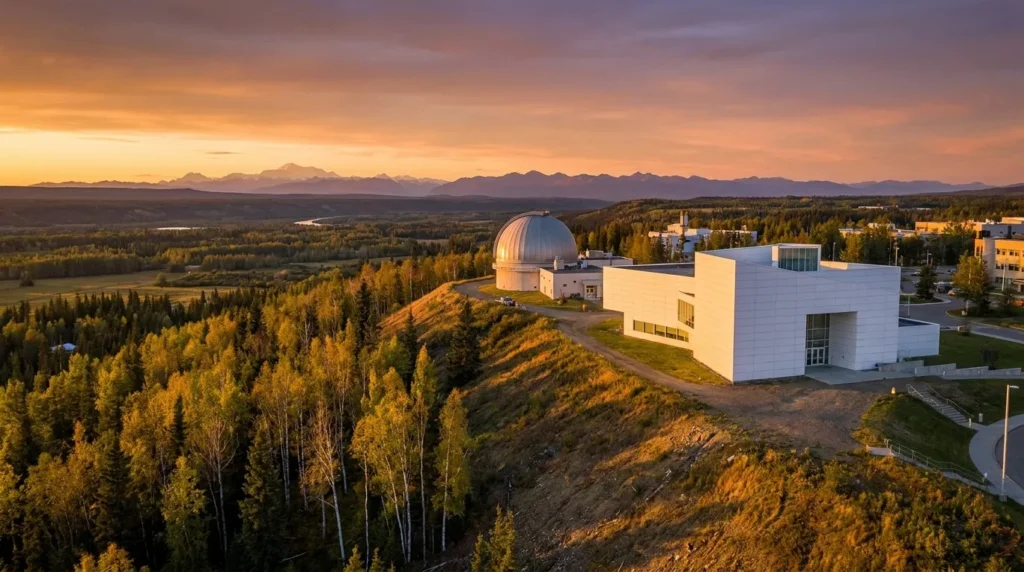
College is a CDP adjacent to Fairbanks, dominated by the University of Alaska Fairbanks campus. Cultural life is driven by the university and Arctic research.

The heart of College is the UAF campus, home to the Museum of the North, one of Alaska's most recognized museums, housing Indigenous art, paleontology, and the sound installation The Place Where You Go to Listen. The Georgeson Botanical Garden, operated by UAF, is a must-visit in summer. The Large Animal Research Station offers close-up views of muskoxen and caribou.

The Geophysical Institute conducts world-renowned aurora borealis research, and the Poker Flat Research Range to the north is the largest civilian rocket research launch site. In winter, College offers prime aurora viewing with dark skies away from Fairbanks' denser light pollution. Ester Dome nearby is a classic photography destination.

Fairbanks lies adjacent and expands the options: Pioneer Park, Riverboat Discovery, Chena Hot Springs (90 minutes away), and the World Ice Art Championships in March. The Tanana Valley Farmers' Market runs from May through September. Trails such as the Skarland Ski Trail at UAF are used for hiking in summer and cross-country skiing and fat biking in winter.

  1. 1["University of Alaska Museum of the North"
  2. 2"Georgeson Botanical Garden"
  3. 3"Large Animal Research Station (Reindeer Farm)"
  4. 4"Geophysical Institute (UAF)"
  5. 5"Creamer's Field Migratory Waterfowl Refuge (nearby)"
  6. 6"Pioneer Park (Fairbanks)"]
Nightlife3.0 / 10
Parks & green spaces
  • ["Georgeson Botanical Garden"
  • "Smith Lake Trails"
  • "UAF Trails System"
  • "Creamer's Field Migratory Waterfowl Refuge"
  • "Birch Hill Recreation Area"]

Latest posts

Posts about Alaska

Coverage and updates related to this destination.

Showing content from Alaska, as there is no specific data for College yet.