Visto n' Visa
Blog
Notícias e artigos
Destinations
Careers
Immigrants

Want to live and work in Anchorage?

Personalized immigration plan with eligible visas, costs, and next steps for your goal!

If you are not eligible, you will know exactly why and what to do to improve your approval chances.

Save up to 12 hours in meetings

No pointless assessments.

Save up to 90%

Save money on vague or unfocused consultations

Avoid Fraud and Mistakes

One mistake can cost you your visa

Total Impartiality

Zero commercial bias

Decide with peace of mind

No toxic urgency

Fast and Accurate

Answers in minutes, no guesswork

Anchorage population: a mix of Native, Asian, Latino, and military communities

A blend of European-descended residents, Alaska Native communities (Yupik, Inupiat, Athabascan), Filipinos, Samoans, and Latinos. Strong military presence.

Anchorage is more diverse than many outsiders assume. Around 60% of residents identify as white, but there are substantial communities of Alaska Natives (Yupik, Inupiat, Athabascan, Aleut), Filipinos, Samoans, Koreans, Hmong, and Hispanics. East High School has been cited as one of the most linguistically diverse schools in the United States.

The military presence is significant. Joint Base Elmendorf-Richardson, on the north side of the city, brings thousands of Air Force and Army families who rotate every few years. This explains the large number of residents originally from Texas, North Carolina, and California.

The Brazilian community is small but present, mostly connected to seasonal work in fishing, salmon processing, and tourism. Hispanics, primarily Mexican and Central American, are concentrated in Mountain View and Spenard, with grocery stores, taquerias, and Spanish-language churches serving the community.

Languages spoken
  • English
  • Spanish
  • Tagalog (Filipino)
  • Yupik
  • Korean
  • +3 more
Main religions
  • No religion (high rate in Alaska)
  • Protestant Christian (various denominations)
  • Catholic
  • Russian Orthodox (historical heritage)
  • Mormon (LDS)

Cost of living in Anchorage: high due to isolation, but no state income tax

Food and consumer goods cost more because of freight expenses. On the other hand, Alaska has no state income tax and no sales tax.

Living in Anchorage is more expensive than most of the United States, though it does not reach the levels of New York or San Francisco. Everything not produced locally arrives by ship or plane, so groceries, electronics, and clothing carry a premium. Fruits and dairy products are noticeably more expensive than elsewhere in the country.

Rent is the most significant expense. A one-bedroom apartment runs above the national average, especially in neighborhoods near downtown such as Downtown, South Addition, and Bootleggers Cove. In Mountain View and Fairview, prices drop considerably, though the surroundings are more modest.

The major financial relief comes from taxes. Alaska levies no state income tax and no state-level sales tax, and Anchorage also charges no municipal sales tax. Every resident who has lived in the state for more than a year receives the Permanent Fund Dividend, an annual check drawn from the state's oil fund, which typically ranges from USD 1,000 to USD 1,700 per person.

111Cost index (US = 100)11% above US average
CategorySingleCoupleFamily (2 + 2)
iHousing$1,442$1,663$2,106
iFood$421$843$1,530
iTransport$554$943$1,220
iHealthcare$311$621$1,164
iChildcare$2,018
iOther$943$1,697$2,384
Monthly total$3,671$5,767$10,422

Source: U.S. BLS Consumer Expenditure Survey 2023 + BEA Regional Price Parities 2023 · Estimates in USD, monthly.

Housing in Anchorage: wood-frame homes, condos, and cabins with views

Single-story and two-story houses dominate residential neighborhoods. Apartments are concentrated downtown and near military bases.

Most of the city consists of detached homes on generous lots, many with double garages built for snowy winters. Neighborhoods like Turnagain, Sand Lake, and Hillside are classic family areas with well-rated schools and quiet streets. Hillside sits at higher elevation, with larger homes facing the mountains and overlooking Cook Inlet.

Those seeking apartments look to Downtown, South Addition, or Spenard. Rental prices are lower in Mountain View, Fairview, and Muldoon, neighborhoods that are more modest and more diverse. Near the bases (JBER), many condos are rented to military families.

Landlords typically require proof of income, references, and one month's security deposit. Winter tends to offer lower rents, while summer (June through August) is more competitive, particularly among seasonal workers. Zillow, Apartments.com, and the Anchorage Daily News classifieds are the most widely used platforms.

Recommended neighborhoods
  • Turnagain (family-friendly, good schools)
  • South Addition (near downtown, charming)
  • Hillside (large homes, mountain views)
  • Sand Lake (family-friendly, west side)
  • Spenard (eclectic, restaurants and bars)
  • +2 more

Job market in Anchorage: oil, government, healthcare, and air cargo logistics

Oil and gas (ConocoPhillips, ExxonMobil), federal government and military, healthcare, and the cargo airport are the major employers.

The historical engine of Alaska is North Slope oil, and many companies in the sector maintain offices in Anchorage. ConocoPhillips Alaska, ExxonMobil, and Hilcorp employ engineers, geologists, and administrative staff at above-average wages. The industry cycles with global oil prices.

The second major employer is government, including federal agencies (US Postal Service, FAA, Forest Service), state agencies, and the municipality. Joint Base Elmendorf-Richardson employs thousands of civilians alongside uniformed personnel. Hospitals such as Providence Alaska Medical Center, Alaska Native Medical Center, and Alaska Regional drive demand for nursing, technical, and administrative roles.

Ted Stevens International Airport is one of the world's largest cargo hubs, with FedEx, UPS, Atlas Air, and Asian carriers operating there. This generates jobs in logistics, aircraft maintenance, and freight handling. Fishing, tourism, and heavy construction (roads, pipelines) also hire in large numbers, particularly in summer.

Dominant sectors
  • Oil and gas
  • Federal government and military
  • Healthcare and hospitals
  • Air freight logistics
  • Fishing and seafood processing
  • +2 more
Major employers
  • Joint Base Elmendorf-Richardson (JBER)
  • Providence Alaska Medical Center
  • ConocoPhillips Alaska
  • Alaska Native Medical Center
  • University of Alaska Anchorage (UAA)
  • +3 more

Education in Anchorage: a large school district and a public university

The Anchorage School District is the largest in Alaska. The University of Alaska Anchorage is the city's public higher education option.

Resident children have access to the Anchorage School District, which operates more than 80 public schools. Quality varies by neighborhood: South Anchorage High and Service High consistently rank among the strongest. Charter schools with focuses on arts, languages, and outdoor learning, such as Winterberry and Aquarian Charter School, are also available.

The University of Alaska Anchorage (UAA) is the city's largest institution, with strong programs in nursing, criminal justice, engineering, and Arctic studies. Alaska Pacific University (APU) is smaller and private, known for outdoor leadership and environmental science programs.

For technical training, the King Career Center offers vocational courses at the high school level. In-state tuition at UAA is substantially lower than out-of-state rates, and newcomers must establish one year of state residency to qualify for the reduced rate.

Notable universities
  • University of Alaska Anchorage (UAA)
  • Alaska Pacific University (APU)
  • Charter College
  • Alaska Career College
  • University of Alaska Fairbanks (Anchorage extension)

Healthcare in Anchorage: Alaska's primary medical hub

Anchorage concentrates the state's largest hospitals. Residents of remote villages are frequently airlifted here for treatment.

The American healthcare system applies here: private, insurance-based through employers or the marketplace. Those working for large companies or the government typically have reasonable coverage. Self-employed individuals face high premiums through Healthcare.gov or may qualify for Medicaid (Denali KidCare covers children).

The main hospitals are Providence Alaska Medical Center (the state's largest), Alaska Regional Hospital, and Alaska Native Medical Center, which serves tribal members. For emergencies in remote areas, medical helicopters and planes land in Anchorage daily transporting patients from across the state.

The main bottleneck is specialists. Cardiologists, neurologists, and oncologists are present in the city, but wait times can be long. For highly specific procedures, some patients travel to Seattle. Mental health and substance use services receive particular attention given the state's growing opioid and alcohol challenges.

Healthcare index62.0 / 100
  • Life expectancyyears at birth
    78.4yrs
  • Doctors per 1kpracticing physicians
    3.7
  • Health spendper capita, per year
    $13,473
  • Public systemoverall quality rating
    Fair

Safety in Anchorage: calm in residential areas, with some trouble spots

Residential neighborhoods are safe, with higher crime rates in Mountain View, Fairview, and parts of downtown at night.

Anchorage is safe in residential neighborhoods like Turnagain, Sand Lake, Hillside, and Eagle River. Walking downtown at night requires attention, especially near shelters and parks where the unhoused population concentrates. Homelessness, alcohol, and drug issues are visible, and the Anchorage Police Department responds to these situations daily.

The most common crimes are vehicle theft (nothing should be left visible in a car), break-ins, and domestic violence. Alaska has concerning rates of violence against women, particularly in Native communities. A common piece of advice for newcomers is to invest in an enclosed garage for winter.

Wildlife is also a safety factor. Moose charge people, especially cows with calves in spring, and bears appear on trails and near urban dumpsters in summer. Signs warning residents to stay at least 25 meters from moose and to carry bear spray on trails are common. The police department has a wildlife unit that works alongside the Alaska Department of Fish and Game (ADFG).

5.8
Homicides per 100k
per year
Safety index
33.0
Crime index
67.0
Safer neighborhoods
  • South Anchorage
  • Hillside
  • Turnagain
  • Sand Lake
  • Bayshore
  • Eagle River
Areas to avoid
  • Fairview at night
  • Mountain View
  • Spenard (some areas near 5th Avenue)
  • Areas near the Transit Center after dark

Transportation in Anchorage: a car-dependent city with summer bike trails

Almost everyone drives. The People Mover bus system covers the basics. In summer, bike paths and urban trails see heavy use.

Anchorage is built around the car. Distances are long, winter conditions make waiting for buses difficult, and parking is generally easy and affordable. Winter tires are nearly mandatory from October through April, and many residents drive 4x4 trucks or SUVs. The People Mover bus system exists but has limited routes and infrequent service.

A standout feature is the network of bike paths and urban trails, especially the Tony Knowles Coastal Trail, which runs 11 miles along the shoreline. In summer, the city fills with cyclists, runners, and skaters. In winter, the same trails become cross-country ski and fat bike routes.

Ted Stevens International Airport (ANC) offers direct flights to Seattle, Portland, Las Vegas, Chicago, Frankfurt, and numerous Alaska communities served by Alaska Airlines and Ravn. For villages with no road access, the vast majority of the state, Anchorage is the departure point for bush planes.

21 min
Avg commute
38
Walkability
Airports
  • ANC — Ted Stevens Anchorage International Airport
  • MRI — Merrill Field
  • International airport
  • Bike infrastructure

What the climate is like living in Anchorage

Anchorage has a subarctic climate with long, very cold winters, short mild summers, and highly variable daylight between seasons due to its high latitude.

Summer in Anchorage is brief, running from June through August, with temperatures rarely exceeding 70°F at their peak. Days grow extremely long at this latitude, with light lasting nearly until midnight in June. This is when the city comes alive outdoors, with hiking, fishing, and festivals making full use of the extended daylight.

Winter is the dominant season, lasting from October through April. Low temperatures typically range between 5°F and 23°F, with extreme cold snaps dropping below -13°F. Snowfall is substantial, exceeding 70 inches accumulated per year, and sunlight is scarce in December, with little more than five hours of daylight. Central heating is essential and energy bills weigh on household budgets.

For residents, planning means investing in a serious winter wardrobe (parka, insulated boots, layering), a vehicle prepared for ice and snow, and time to adjust to the unusual solar rhythm. Spring and fall are short. Air conditioning is unnecessary for most of the year.

Sunny days / year125 days
Avg high (°F)
  • 21°J
  • 26°F
  • 33°M
  • 45°A
  • 59°M
  • 68°J
  • 70°J
  • 67°A
  • 56°S
  • 43°O
  • 28°N
  • 22°D
Avg low (°F)
  • 12°J
  • 14°F
  • 19°M
  • 27°A
  • 41°M
  • 50°J
  • 54°J
  • 52°A
  • 44°S
  • 32°O
  • 19°N
  • 12°D
Rainfall (")
  • 2"J
  • 2"F
  • 2"M
  • 1"A
  • 2"M
  • 1"J
  • 3"J
  • 4"A
  • 5"S
  • 4"O
  • 4"N
  • 3"D

Anchorage culture: outdoor life, Alaska Native communities, and frontier spirit

Skiing, fishing, hunting, salmon, and Alaska Native art define local identity. Independent, frontier-minded character.

Anchorage culture is defined by outdoor life. Winter sports include cross-country skiing at Kincaid Park, alpine skiing at Alyeska Resort (about an hour from the city), dog mushing, and snowmachining. Summer brings salmon fishing on Ship Creek (right within city limits), kayaking on Eklutna Lake, and hiking on Flattop Mountain. Spotting a moose or bear in the backyard is not unusual.

Local cuisine revolves around what is caught and hunted: king, sockeye, and silver salmon, halibut, Dungeness and king crab, and moose meat. Spots like Moose's Tooth Pub and Pizzeria and Glacier BrewHouse are community gathering points. Kaladi Brothers Coffee has become a local institution.

The heritage of Alaska's First Nations appears at the Alaska Native Heritage Center and the Anchorage Museum. Events like the ceremonial Iditarod start in March, Fur Rendezvous in February, and the Bear Paw Festival in Eagle River anchor the community calendar.

Anchorage

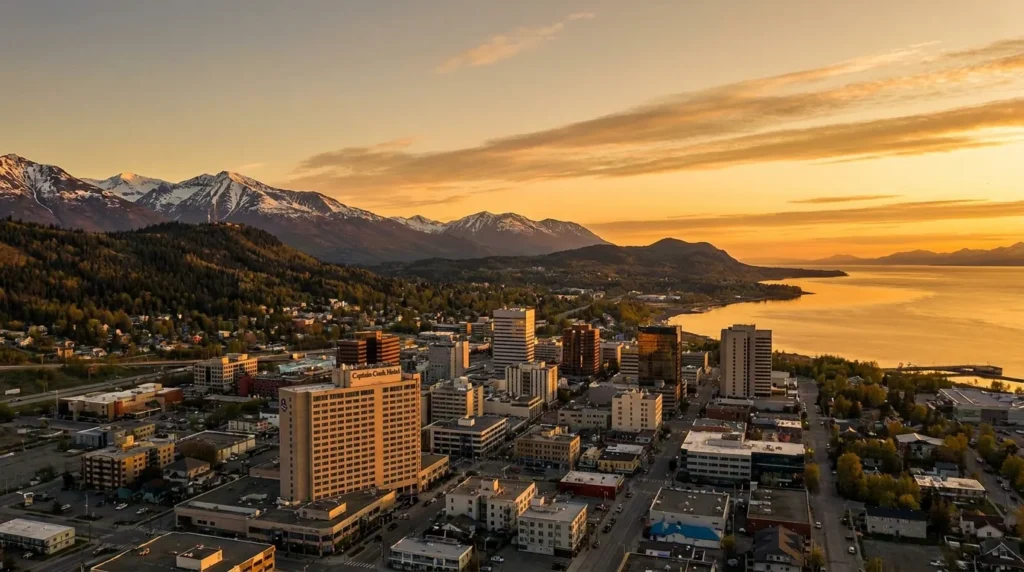
Anchorage, urban base between mountains and the Gulf of Alaska

Alaska's largest city, Anchorage serves as the gateway to Denali, Kenai Fjords, and Chugach State Park, with Indigenous culture on display at the Alaska Native Heritage Center and outdoor recreation throughout the surrounding region.

The Tony Knowles Coastal Trail runs 11 miles along the Cook Inlet shoreline and is the city's most photographed landmark, offering views of Mount Susitna and occasional moose sightings along the path. The Anchorage Museum, located downtown, features Indigenous art, Alaska history, and traveling exhibitions of national caliber.

The Alaska Native Heritage Center showcases traditional homes of the state's eleven Indigenous groups and hosts live dance and craft demonstrations. Chugach State Park, bordering the city, opens trails such as Flattop Mountain, the most climbed peak in Alaska. For wildlife, the Alaska Wildlife Conservation Center in Portage rehabilitates bears, moose, and musk oxen.

Summer concentrates the bulk of activities, with salmon running up Ship Creek right in the city center, and the Iditarod Trail Sled Dog Race ceremonially starting in Anchorage in early March. In winter, Alyeska Resort in Girdwood serves skiers. The Spenard Farmers Market and the Saturday Market draw weekend crowds.

  1. 1["Anchorage Museum at Rasmuson Center"
  2. 2"Alaska Native Heritage Center"
  3. 3"Tony Knowles Coastal Trail"
  4. 4"Flattop Mountain"
  5. 5"Earthquake Park"
  6. 6"Alaska Wildlife Conservation Center (nearby)"
Nightlife5.0 / 10
Parks & green spaces
  • ["Chugach State Park"
  • "Kincaid Park"
  • "Far North Bicentennial Park"
  • "Westchester Lagoon"
  • "Russian Jack Springs Park"
  • +1 more

Latest posts

Posts about Alaska

Coverage and updates related to this destination.

Showing content from Alaska, as there is no specific data for Anchorage yet.