Visto n' Visa
Blog
Notícias e artigos
Destinations
Careers
Immigrants

Want to live and work in Birmingham?

Personalized immigration plan with eligible visas, costs, and next steps for your goal!

If you are not eligible, you will know exactly why and what to do to improve your approval chances.

Save up to 12 hours in meetings

No pointless assessments.

Save up to 90%

Save money on vague or unfocused consultations

Avoid Fraud and Mistakes

One mistake can cost you your visa

Total Impartiality

Zero commercial bias

Decide with peace of mind

No toxic urgency

Fast and Accurate

Answers in minutes, no guesswork

Birmingham's population: majority Black in the city, predominantly white in the suburbs

The city proper is roughly 68% Black. Suburbs like Hoover, Vestavia, and Mountain Brook are predominantly white. The Hispanic community is growing.

Birmingham has a demographic profile that differs sharply between the urban core and the surrounding suburbs. The city proper is approximately 68% Black and 26% white, with one of the largest African American communities in the country. The surrounding suburbs (Hoover, Vestavia Hills, Mountain Brook, Homewood) are predominantly white and higher-income.

The Hispanic community has grown significantly over the past 20 years, primarily Mexican and Central American, concentrated in areas such as Avondale, Center Point, and parts of Crestwood. Vietnamese, Korean, and Indian communities are tied to the university and hospital system. Brazilians represent a small presence, generally students or professionals connected to UAB.

Religious life carries considerable weight, as throughout the South. Baptist (Black and white), Methodist, Presbyterian, and Catholic churches dominate. The 16th Street Baptist Church, a landmark of the civil rights movement, remains an active congregation. Sunday church attendance is the norm for most long-established families.

Languages spoken
  • English
  • Spanish
  • Vietnamese
  • Korean
  • Hindi and Telugu
  • +2 more
Main religions
  • Protestant Christian (Baptist, Methodist, AME)
  • Catholic Christian
  • Non-religious
  • Jewish (established community)
  • Hindu
  • +1 more

Cost of living in Birmingham: affordable by U.S. standards, especially housing

Renting and buying a home cost less than in most mid-sized American cities. Food and gas follow Southern norms, keeping prices low.

Birmingham is one of the most affordable mid-sized cities in the United States. A one-bedroom apartment rents for between USD 900 and USD 1,500 per month depending on the neighborhood. A three-bedroom house to rent runs between USD 1,300 and USD 2,000. Purchasing a home in desirable neighborhoods like Avondale, Crestwood, or Highland Park is considerably cheaper than in Atlanta, Nashville, or Charlotte.

Grocery shopping at Publix, Aldi, Whole Foods, Kroger, and Walmart is accessible. Birmingham has become a recognized dining destination in the South over the past 15 years: restaurants such as Highlands Bar and Grill (from chef Frank Stitt) and Hot and Hot Fish Club have received James Beard Awards. A meal at a casual restaurant runs USD 12 to USD 22.

Alabama levies a 5% state income tax and a combined sales tax that can reach 10% (state, county, and city combined). Summer electricity bills are high due to air conditioning. Employer-sponsored health insurance is the largest expense for those without workplace benefits, potentially exceeding USD 500 per month for a single adult.

77Cost index (US = 100)23% below US average
CategorySingleCoupleFamily (2 + 2)
iHousing$1,006$1,161$1,470
iFood$294$588$1,067
iTransport$387$657$851
iHealthcare$216$433$812
iChildcare$1,408
iOther$657$1,184$1,663
Monthly total$2,560$4,023$7,271

Source: U.S. BLS Consumer Expenditure Survey 2023 + BEA Regional Price Parities 2023 · Estimates in USD, monthly.

Housing in Birmingham: charming historic neighborhoods and family-oriented suburbs

Restored older homes in neighborhoods like Highland Park and Avondale. Suburbs like Hoover and Vestavia offer large homes and top-ranked schools.

Birmingham has historic neighborhoods with distinct character. Highland Park, Forest Park, and Crestwood South feature homes from the 1920s and 1940s, many restored, with porches and mature trees. Avondale has become a trendy neighborhood, home to breweries (Avondale Brewing), restaurants, and a park. Five Points South is lively with bars near UAB. Homewood, just over the mountain, has a more residential feel.

For those who prefer suburban living with larger homes, Hoover, Vestavia Hills, and Mountain Brook are the classic choices. These neighboring cities are wealthier, with public schools ranked among the best in the state. A three- to four-bedroom home costs USD 350,000 to USD 700,000 in Hoover, and more in Mountain Brook, one of the wealthiest communities in the South.

New apartment construction is expanding downtown (particularly in the Parkside District, near Railroad Park) and around the UAB campus. The rental market is generally accessible, with availability throughout the year. Zillow, Apartments.com, and HotPads are the dominant platforms. Landlords typically require an application, proof of income, and one month's security deposit.

Recommended neighborhoods
  • Avondale (revitalized neighborhood, breweries)
  • Highland Park (historic, charming homes)
  • Crestwood South (young professionals)
  • Forest Park (residential, tree-lined)
  • Homewood (suburban, families)
  • +3 more

Job market in Birmingham: healthcare, finance, insurance, and technology

UAB is the state's largest employer. Banks like Regions, insurers like Protective Life, and remaining industrial firms round out the landscape.

Birmingham has transitioned from a steel city to a medical hub. UAB (University of Alabama at Birmingham), with its hospital, medical school, and research center, is the largest employer in Alabama, with around 25,000 employees. Physicians, nurses, researchers, biomedical engineers, and administrative staff are hired year-round. Salaries are competitive by Southern standards.

The financial sector is the second pillar. Regions Financial Corporation is headquartered in Birmingham, with large offices from BBVA, PNC, ServisFirst, and regional firms. Protective Life Insurance is the largest local insurer. Technology is growing, with Shipt (delivery, owned by Target), Daxko, Fleetio, and smaller companies at the Innovation Depot.

Heavy industry still operates, with US Steel, Vulcan Materials, and Drummond Company (coal). For those with basic English skills, positions exist in construction, restaurants, hotels, cleaning services, and production lines. The minimum wage follows the federal rate of USD 7.25 per hour, though most employers pay above that due to competition for labor.

Dominant sectors
  • Healthcare and medical research
  • Finance and insurance
  • Technology and software
  • Heavy industry and mining
  • Higher education
  • +2 more
Major employers
  • UAB (University of Alabama at Birmingham and hospital)
  • Regions Financial Corporation
  • Protective Life Insurance
  • BBVA USA
  • Shipt (delivery, owned by Target)
  • +3 more

Education in Birmingham: schools vary by municipality, strong universities

Public schools in the city center face challenges. Suburbs like Mountain Brook and Vestavia have top-ranked schools. UAB and Samford are the standout universities.

Birmingham City Schools, the urban core district, performs below the state average, and many families choose to live in the suburbs for access to better schools. Mountain Brook Schools and Vestavia Hills City Schools rank among the top in Alabama. Homewood, Hoover, and Trussville also have well-regarded districts. Private schools such as Indian Springs and Altamont attract higher-income families.

UAB (University of Alabama at Birmingham) is a large public university with strengths in medicine, biomedical engineering, health sciences, and business administration. It has programs for international students and generates significant internship and employment opportunities within its own hospital system. Samford University, in the suburbs, is a private Christian institution with strong law and pharmacy programs.

Birmingham-Southern College and Miles College (HBCU) round out the university landscape. UAB tuition for international students runs around USD 26,000 per year, well below Atlanta or the East Coast. Community colleges such as Jefferson State and Lawson State offer technical programs and pathways to bachelor's degrees at low cost.

Notable universities
  • University of Alabama at Birmingham (UAB)
  • Samford University
  • Birmingham-Southern College
  • Miles College (HBCU)
  • Jefferson State Community College
  • Lawson State Community College

Healthcare in Birmingham: Alabama's medical capital, with reference hospitals

UAB Hospital is one of the largest in the South. The city draws patients from across the region for transplantation, oncology, and cardiology.

Birmingham is Alabama's primary medical destination. UAB Hospital has more than 1,100 beds and is a reference center for transplantation (the second-largest kidney transplant center in the country), oncology, cardiology, and neurology. Children's of Alabama, located nearby, is a regional pediatric reference. St. Vincent's and Brookwood Baptist complete the private network.

The system is private, with coverage provided through employer-sponsored plans or individual purchases. Employees at UAB, Regions, Protective Life, or the large construction firms typically receive solid coverage. For quick visits, walk-in clinics (American Family Care, MedHelp) are widely available. Specialists often require appointments scheduled weeks in advance.

Alabama has not expanded Medicaid, so low-income adults without dependents who earn above the poverty line may fall into a coverage gap. Community clinics (Cooper Green, Christ Health Center) operate on a sliding-fee scale. Generic medications are inexpensive at Walmart, Costco, and CVS. Those arriving from abroad should secure health insurance from day one.

Healthcare index65.0 / 100
  • Life expectancyyears at birth
    78.4yrs
  • Doctors per 1kpracticing physicians
    3.7
  • Health spendper capita, per year
    $13,473
  • Public systemoverall quality rating
    Good

Safety in Birmingham: wide variation by neighborhood, very safe in the suburbs

Parts of the urban core have high crime rates. Suburbs like Mountain Brook, Vestavia, and Homewood rank among the safest communities in the state.

Birmingham appears on lists of U.S. cities with high homicide rates, though the numbers are less alarming when the geography is understood. Much of the violence is concentrated in a few neighborhoods on the west and north sides of the urban core, linked to poverty and drug activity. Suburbs such as Mountain Brook, Vestavia, Homewood, Hoover, and Trussville are extremely safe.

Neighborhoods like Avondale, Forest Park, Highland Park, and Five Points South, within the city limits, have active nightlife and are reasonably safe, though it is worth staying alert to car break-ins and avoiding walking alone late at night. Downtown has revitalized and sees more foot traffic, especially near Railroad Park and Regions Field (the baseball stadium).

Property crimes (car break-ins, burglary of unoccupied homes, package theft) are the most commonly reported across all areas. Video doorbells (Ring, Nest) are standard equipment. Spring tornadoes are a genuine concern: having a shelter at home or a clear safety plan is important. A weather alert app on the phone is practically essential.

5.8
Homicides per 100k
per year
Safety index
28.0
Crime index
72.0
Safer neighborhoods
  • Mountain Brook
  • Homewood
  • Vestavia Hills
  • Highland Park
  • Forest Park
  • Avondale
Areas to avoid
  • Ensley at night
  • North Birmingham (some parts)
  • Pratt City
  • Sections of 1st Avenue North after dark
  • Industrial areas near Sloss Furnaces at night

Transportation in Birmingham: a spread-out city dependent on the car

Nearly everything requires a car. Buses exist but have limited coverage. Birmingham airport (BHM) serves nearby hubs, and Atlanta handles international connections.

Birmingham is a city spread across hills, and nearly every resident relies on a car. The main corridors are I-65 (north-south), I-20 (east-west), and I-459 (the outer loop). The Red Mountain Expressway cuts through the mountain, separating downtown from the southern suburbs. Traffic is lighter than in Atlanta, though the Red Mountain corridor gets congested during peak hours.

The MAX (Metro Area Express) bus system covers some central routes but sees limited ridership. A new BRT line (Birmingham Xpress) connects the east and west sides, and Uber and Lyft operate reliably. The Rotary Trail and downtown bike lanes are expanding, though the hilly topography limits daily cycling.

Birmingham-Shuttlesworth International Airport (BHM) offers direct flights to Atlanta, Charlotte, Dallas, Chicago, Denver, Houston, New York, and Washington. For international connections, most travelers use Atlanta (ATL), about two hours by car, or Nashville (BNA), about three hours away. Car rentals at BHM are convenient.

23 min
Avg commute
36
Walkability
Airports
  • BHM — Birmingham-Shuttlesworth International Airport
  • International airport
  • Bike infrastructure

What the Climate Is Like Living in Birmingham

Birmingham has a humid subtropical climate, with long, hot, and muggy summers, short and mild winters, and well-distributed rainfall with frequent afternoon storms in summer.

Summer is long and hot, running from May through September. High temperatures range between 86°F and 93°F (30°C to 34°C), with high humidity and heat index values above 100°F (38°C). Afternoon thunderstorms are common. Air conditioning runs nearly continuously in homes, offices, and vehicles.

Winter is short and mild, from December through February. Highs range between 52°F and 59°F (11°C to 15°C), with lows around 34°F to 39°F (1°C to 4°C). Brief freezes occur, but snow is rare. A mid-weight coat is sufficient, and central heating is used during short cold spells.

Birmingham sits within the so-called Dixie Alley, and spring brings a real tornado risk, especially in March and April. Annual rainfall exceeds 54 inches (1,370 mm), well distributed throughout the year. For residents, reliable air conditioning, an identified tornado shelter, and attention to weather alerts are practical necessities.

Sunny days / year209 days
Avg high (°F)
  • 55°J
  • 60°F
  • 67°M
  • 72°A
  • 81°M
  • 87°J
  • 89°J
  • 89°A
  • 85°S
  • 75°O
  • 64°N
  • 59°D
Avg low (°F)
  • 39°J
  • 43°F
  • 48°M
  • 52°A
  • 61°M
  • 69°J
  • 72°J
  • 72°A
  • 67°S
  • 57°O
  • 46°N
  • 42°D
Rainfall (")
  • 6"J
  • 7"F
  • 7"M
  • 5"A
  • 4"M
  • 6"J
  • 5"J
  • 5"A
  • 3"S
  • 4"O
  • 3"N
  • 4"D

Culture in Birmingham: civil rights history, award-winning food, and craft beer

A city shaped by civil rights history, with significant museums. A nationally recognized dining scene. Breweries and festivals energize a revitalized downtown.

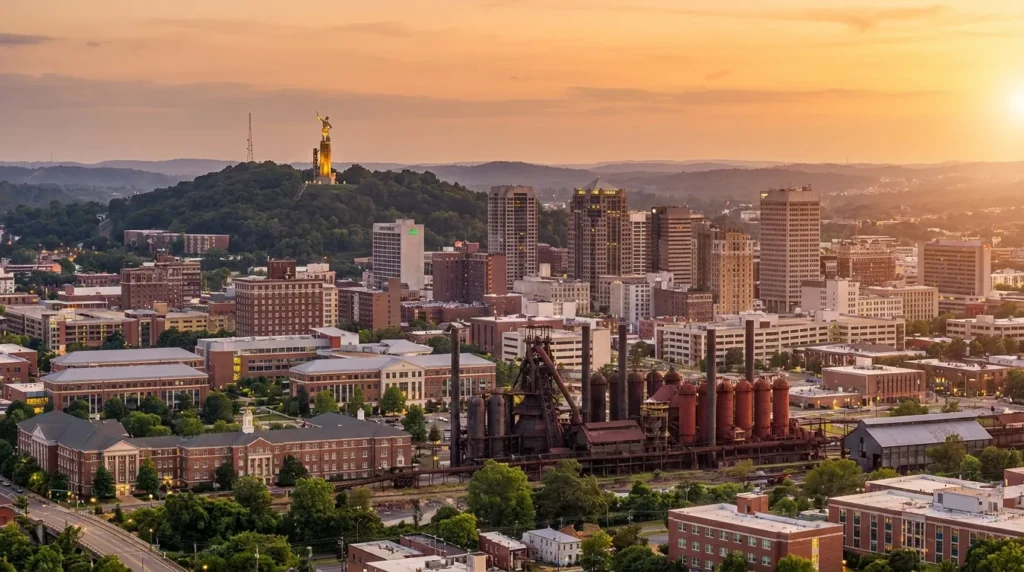
Birmingham's cultural identity is deeply tied to the memory of the civil rights movement. The Birmingham Civil Rights Institute, the 16th Street Baptist Church, and Kelly Ingram Park form a powerful circuit. The Birmingham Museum of Art holds a significant collection, and Sloss Furnaces, a former steel mill turned museum, preserves the city's industrial heritage.

The dining scene is one of the most respected in the South. Chef Frank Stitt, with Highlands Bar and Grill, Bottega, and Chez Fonfon, has become a national reference. Saw's Soul Kitchen and Niki's West serve the Southern soul. The Pizitz Food Hall, Pepper Place Market (Saturdays), and Avondale draw crowds to their bistros, breweries, and cafes.

College football (Auburn Tigers and Alabama Crimson Tide, both nearby) divides the city. The Iron Bowl, the annual rivalry game, brings the whole state to a standstill. Live music at Saturn, Iron City, and the Alabama Theatre is part of everyday life. Festivals like the Sidewalk Film Festival and the Magic City Art Connection draw visitors downtown.

Birmingham

What to Do in Birmingham, a Key City in Civil Rights History

Birmingham is Alabama's largest city and a national center of civil rights memory. It blends historic iron and steel heritage, award-winning cuisine, and a vibrant cultural scene in neighborhoods like Five Points South and Avondale.

The Birmingham Civil Rights District is essential: the Birmingham Civil Rights Institute, the 16th Street Baptist Church (target of the 1963 bombing), and Kelly Ingram Park document the movement that changed the United States. The area was incorporated into the Birmingham Civil Rights National Monument by the federal government and draws students, researchers, and visitors year-round.

For everyday life, Railroad Park in the city center serves as a green space with views of the skyline, and the adjacent Regions Field hosts Birmingham Barons baseball games. The Saturday Pepper Place Market is the region's largest farmers' market, and neighborhoods such as Avondale, Lakeview, Forest Park, and Five Points South are home to restaurants recognized by the James Beard Foundation, with chefs like Frank Stitt leading the way.

Families and weekend visitors often combine Vulcan Park (an overlook featuring the iron statue of the god Vulcan, the city's symbol), the Birmingham Zoo, McWane Science Center, and Birmingham Botanical Gardens. Tannehill and Oak Mountain State Park, 20 to 30 minutes away, offer trails, lakes, and camping for those looking to escape the urban environment.

  1. 1["Birmingham Civil Rights Institute"
  2. 2"16th Street Baptist Church"
  3. 3"Kelly Ingram Park"
  4. 4"Birmingham Museum of Art"
  5. 5"Sloss Furnaces National Historic Landmark"
  6. 6"Vulcan Park and Museum"
Nightlife6.0 / 10
Parks & green spaces
  • ["Birmingham Botanical Gardens"
  • "Railroad Park"
  • "Ruffner Mountain Nature Preserve"
  • "Red Mountain Park"
  • "Avondale Park"
  • +1 more

Latest posts

Posts about Alabama

Coverage and updates related to this destination.

Showing content from Alabama, as there is no specific data for Birmingham yet.