Visto n' Visa
Blog
Notícias e artigos
Destinations
Careers
Immigrants

Want to live and work in Auburn?

Personalized immigration plan with eligible visas, costs, and next steps for your goal!

If you are not eligible, you will know exactly why and what to do to improve your approval chances.

Save up to 12 hours in meetings

No pointless assessments.

Save up to 90%

Save money on vague or unfocused consultations

Avoid Fraud and Mistakes

One mistake can cost you your visa

Total Impartiality

Zero commercial bias

Decide with peace of mind

No toxic urgency

Fast and Accurate

Answers in minutes, no guesswork

Auburn's population: a college-town mix and rapid growth

About 70% white and 16% Black. Students from other states and abroad bring diversity. Chinese, Korean, and Indian communities tied to the university.

Auburn has a whiter demographic profile than other Alabama cities, with roughly 70% of the population identifying as white, 16% Black, 9% Asian, and 5% Hispanic. Auburn University draws students from across the country and the world, giving the city a more cosmopolitan and youthful character than one might expect from a small Southern city.

The Asian community is especially notable, connected to graduate programs in engineering and sciences at Auburn. Chinese, Korean, Indian, and Taiwanese students form active groups. Asian grocery stores and temples serve the community. The Hispanic community is smaller, linked to construction, restaurants, and some academic families. Brazilians are few, mostly graduate students in agricultural engineering, civil engineering, or animal sciences.

Religious life covers what one would expect in the South: Baptist, Methodist, Presbyterian, Catholic, and Episcopal churches. There is also a synagogue, a Hindu temple, and a small Buddhist center serving the international community. Atheist and agnostic students move through the city without much friction. Politically, the city leans more toward the center than other parts of Alabama due to the university's influence.

Languages spoken
  • English
  • Spanish
  • Mandarin
  • Korean
  • Hindi and Telugu
  • +1 more
Main religions
  • Protestant Christian (Baptist, Methodist, Presbyterian, Episcopal)
  • Catholic Christian
  • No religion
  • Hindu
  • Buddhist
  • +1 more

Cost of living in Auburn: reasonable by American standards

Rents have risen in recent years due to student demand. Food and gas follow Southern norms. Costs vary between the academic high and low seasons.

Auburn's cost of living is reasonable by American standards, though rents have risen considerably in recent years due to student demand. A one-bedroom apartment ranges from $900 to $1,400 per month. Studio units in newer buildings near campus, complete with pools, gyms, and Tiger Transit bus access, can reach $1,500. A three-bedroom rental house runs between $1,400 and $2,200.

Grocery shopping at Publix, Kroger, and Walmart is affordable. A meal at a popular restaurant costs between $12 and $22. Downtown restaurants such as Acre, Amsterdam Cafe, and The Hound serve both university students and working professionals. Gas prices tend to be among the lowest in the country.

Alabama levies a 5% state income tax, and Auburn's combined sales tax runs around 9%. Electricity bills are steep in summer due to air conditioning. Health insurance without employer coverage is the single largest expense. International students typically purchase a plan through the university, with monthly premiums between $150 and $300.

84Cost index (US = 100)16% below US average
CategorySingleCoupleFamily (2 + 2)
iHousing$1,097$1,266$1,603
iFood$321$641$1,164
iTransport$422$717$928
iHealthcare$236$472$886
iChildcare$1,536
iOther$717$1,291$1,814
Monthly total$2,793$4,387$7,931

Source: U.S. BLS Consumer Expenditure Survey 2023 + BEA Regional Price Parities 2023 · Estimates in USD, monthly.

Housing in Auburn: student complexes near campus and residential subdivisions

Student apartment buildings dominate near campus. Families prefer Yarbrough Farms, Asheton, and Cary Woods. Neighboring Opelika offers lower prices.

Auburn has many student-oriented apartment complexes featuring pools, gyms, grilling areas, and campus shuttle service. The Edge, Carlyle, and Park Place cater to this market. Those who prefer more residential surroundings look to neighborhoods such as Yarbrough Farms, Asheton, Cary Woods, and Solamere, with family homes and a suburban feel.

Lake Wilmore and Mimms Trail are newer developments to the west, with homes ranging from three to five bedrooms. National Village, adjacent to the Robert Trent Jones Golf Trail, attracts professionals from Auburn and GE Aviation. For more affordable prices, many families look to Opelika, the city that borders Auburn to the east, where prices are lower and the downtown has also been revitalized.

Rental activity follows the academic calendar: May (graduation season) and August (back to school) are the busiest periods in the market. Landlords typically require an application, proof of income, and one month's security deposit. International students often need a co-signer or must pay several months in advance due to the absence of a US credit history. Sites such as Zillow, Apartments.com, and Trulia offer good coverage of the local market.

Recommended neighborhoods
  • Yarbrough Farms (residential, near campus)
  • Asheton (families, schools nearby)
  • Cary Woods (traditional, older homes)
  • Solamere (suburban, newer)
  • Lake Wilmore (upscale, lakeside)
  • +2 more

Job market in Auburn: the university, GE Aviation, and a nearby Kia plant

Auburn University is the largest employer. GE Aviation and Briggs & Stratton operate plants in Auburn. Kia in West Point, GA, draws additional workers.

Auburn University is the city's largest employer, encompassing faculty, researchers, administrative staff, hospital employees (East Alabama Medical Center), and service workers. The university excels in engineering, agriculture, veterinary sciences, and business administration. Research in aviation, biotechnology, and materials science drives partnerships with industry.

GE Aviation operates a ceramic blade manufacturing facility for aircraft engines in Auburn, a pioneering project in the aerospace sector. Briggs & Stratton produces small-capacity engines. Hyundai Power Transformers and SiO2 Medical Products round out the industrial landscape. Kia Motors in West Point, Georgia, about 45 minutes away, attracts hundreds of workers from the Auburn area.

For those with basic English, positions are available at restaurants (especially on game days), hotels, construction, cleaning services, and general services. The minimum wage follows the federal rate of $7.25 per hour, though restaurants typically pay above that due to high demand on game weekends. East Alabama Medical Center in Opelika is a major healthcare employer for the region.

Dominant sectors
  • Higher education
  • Healthcare
  • Aerospace industry (GE Aviation)
  • Research and development
  • Automotive industry (Kia nearby)
  • +1 more
Major employers
  • Auburn University
  • East Alabama Medical Center (in Opelika)
  • GE Aviation (ceramic blade plant)
  • Briggs & Stratton
  • Hyundai Power Transformers
  • +2 more

Education in Auburn: a major university and top-ranked public schools

Auburn University is one of the leading public universities in the South. Auburn City Schools ranks among the best districts in Alabama.

Auburn City Schools, the city's district, ranks among the best in Alabama. Auburn High School is large, with strong AP course offerings and athletics, and sends graduates to Auburn, Alabama, Vanderbilt, and Ivy League universities. Drake Middle School and Auburn Junior High are also well rated. As a result, property values in the city are closely tied to school zone boundaries.

Auburn University, with more than 33,000 students, is one of the leading public universities in the South. It excels in engineering (especially aerospace and electrical), agriculture, veterinary medicine (one of the best programs in the country), and business administration. Robust programs serve international students. Annual tuition for international students runs around $33,000.

Tuskegee University, a historically Black college and university (HBCU), is just 25 minutes to the west in Tuskegee. It is where Booker T. Washington led the institution, where George Washington Carver conducted research, and where the Tuskegee Airmen were trained during World War II. Southern Union State Community College in Opelika offers technical programs and a pathway to a bachelor's degree.

Notable universities
  • Auburn University
  • Tuskegee University (HBCU, nearby)
  • Southern Union State Community College (Opelika)
  • Auburn University at Montgomery (nearby)

Healthcare in Auburn: regional hospital in Opelika serves the area

East Alabama Medical Center in Opelika is the main hospital. Auburn has clinics and specialist offices. Standard US private healthcare system.

East Alabama Medical Center (EAMC) in Opelika, 15 minutes from Auburn, is the region's main hospital, with approximately 350 beds, 24-hour emergency care, and cardiovascular, oncology, and maternal-infant centers. Auburn proper has clinics, specialist offices, and walk-in clinics such as American Family Care and Auburn Urgent Care.

The system is private and insurance-based. Those employed by the university, GE Aviation, or the hospital receive coverage as an employment benefit. For complex cases, many residents travel to UAB in Birmingham (two hours) or Emory in Atlanta (two and a half hours). Telemedicine is widely used for routine matters.

Alabama did not expand Medicaid, so adults without dependents who earn above the poverty line but lack employer coverage may find themselves without insurance. Community health clinics such as Auburn Community Health Center operate on a sliding fee scale. International students should enroll in a university health plan from their first day. Generic medications are available at low cost at Walmart, Sam's Club, Costco, and CVS.

Healthcare index60.0 / 100
  • Life expectancyyears at birth
    78.4yrs
  • Doctors per 1kpracticing physicians
    3.7
  • Health spendper capita, per year
    $13,473
  • Public systemoverall quality rating
    Fair

Safety in Auburn: one of the safest cities in Alabama

Quiet city by college-town standards. Most common offenses involve theft near campus. Tornadoes are a real concern.

Auburn is considered one of the safest cities in Alabama. The violent crime rate is well below the state and national averages. Family neighborhoods such as Yarbrough Farms, Asheton, Cary Woods, Solamere, and National Village are quiet. Walking downtown at night is safe, particularly in the busier areas near campus.

The most common offenses are theft from unlocked student apartments, bicycle theft, and vehicle break-ins. Public intoxication and disorderly conduct at student parties on game days generate police calls, but rarely involve serious violence. The Auburn Police Department (APD) and the Auburn University Police Division (AUPD) patrol campus and the surrounding area.

The greater concern is meteorological. Spring tornadoes (March through May) and early-fall systems move through central Alabama, and Auburn has been affected in past events. Having a shelter at home, whether an interior bathroom, a basement, or a dedicated tornado shelter, is advisable, as is keeping a weather alert app on a mobile device. Minor flooding in low-lying areas after heavy rain also occurs.

5.8
Homicides per 100k
per year
Safety index
68.0
Crime index
32.0
Safer neighborhoods
  • Downtown Auburn
  • Cary Woods
  • Yarbrough Farms
  • Moores Mill
  • Hampton Hall
  • Areas near Auburn University
Areas to avoid
  • Isolated commercial stretches along Opelika Road at night
  • Some industrial areas near I-85

Transportation in Auburn: university buses for students, a car for everything else

Tiger Transit serves the campus. The city is designed around the car. Atlanta and Montgomery handle international flights. Local airport is small.

Auburn operates Tiger Transit, the university's free bus system serving dormitories, campus, and surrounding apartment complexes. It is essential for students without a car. For the rest of the city, driving is practically mandatory. There is no public bus system for residents in general. Uber and Lyft operate reliably, particularly on evenings and game days.

Main corridors include I-85 (linking Montgomery to Atlanta), US-280, and US-29. Traffic is light outside of game days, but on football Saturdays congestion becomes legendary, with vehicles arriving from Atlanta, Birmingham, Nashville, and Florida. Parking near the stadium on game day is nearly impossible.

Auburn-Opelika Regional Airport (AUO) is small and has no scheduled commercial service. Most travelers use Hartsfield-Jackson Atlanta International Airport (ATL), two hours to the east, or Montgomery Regional Airport (MGM), an hour to the west. For direct flights to Brazil or Europe, Atlanta is the natural hub.

18 min
Avg commute
35
Walkability
Airports
  • AUO — Auburn University Regional Airport
  • ATL — Hartsfield-Jackson Atlanta International (approximately 109 miles away)
  • Bike infrastructure

What the Climate Is Like Living in Auburn

Auburn has a humid subtropical climate, with long, hot, and muggy summers, short and mild winters, and rainfall distributed fairly evenly throughout the year.

Summer is long and hot, stretching from May through September. Highs typically reach 86 to 93 F (30 to 34 C), with humidity pushing the heat index near 100 F (38 C) in July. Afternoon thunderstorms are common. Air conditioning is essential and runs almost continuously indoors and in vehicles.

Winter is short and mild, from December through February. Daytime highs range from 54 to 61 F (12 to 16 C) and overnight lows hover around 36 to 41 F (2 to 5 C), with occasional frost. Snow is extremely rare. A medium-weight coat handles most winter days, and central heating sees limited use each year.

Annual rainfall totals around 55 inches (1,400 mm), distributed fairly evenly throughout the year. Spring and fall offer the most comfortable seasons. For residents, air conditioning is the top priority, along with moisture protection and awareness of periodic severe weather, including tornado risk in spring.

Sunny days / year217 days
Avg high (°F)
  • 58°J
  • 63°F
  • 69°M
  • 75°A
  • 82°M
  • 87°J
  • 90°J
  • 90°A
  • 86°S
  • 76°O
  • 66°N
  • 60°D
Avg low (°F)
  • 41°J
  • 46°F
  • 50°M
  • 54°A
  • 62°M
  • 69°J
  • 72°J
  • 72°A
  • 67°S
  • 58°O
  • 47°N
  • 44°D
Rainfall (")
  • 5"J
  • 5"F
  • 6"M
  • 5"A
  • 4"M
  • 6"J
  • 4"J
  • 4"A
  • 3"S
  • 3"O
  • 3"N
  • 4"D

Culture in Auburn: football, Toomer's Corner, and university tradition

Fall Saturdays are sacred: Tigers game day. Toomer's Corner becomes a celebration park after a victory. Revitalized downtown, restaurants, and breweries.

War Eagle is the battle cry. On game Saturdays, Auburn fills with fans in orange and navy, tailgates on the Quad (the campus central green), and the team's procession during Tiger Walk. After a major victory, especially over rival Alabama, fans crowd Toomer's Corner and throw toilet paper into the two historic oak trees. The Iron Bowl, in November, brings the state to a halt.

Auburn's revitalized downtown features restaurants such as Acre, Amsterdam Cafe, Niffer's, and Toomer's Drugs (renowned for its lemonade). Local breweries including Red Clay Brewing and Auburn Brewery serve the adult crowd. The Jule Collins Smith Museum of Fine Art and the Telfair Peet Theatre, both on campus, offer year-round cultural programming.

The Auburn University Marching Band, Tiger cheerleaders, and the AUMP percussion ensemble are part of the game-day spectacle. Festivals such as CityFest and Auburn Cityfest (arts) animate the downtown. Neighboring Opelika features an older historic core and Railroad Avenue lined with bistros and cafes.

What Auburn Has to Offer Beyond Auburn University Games

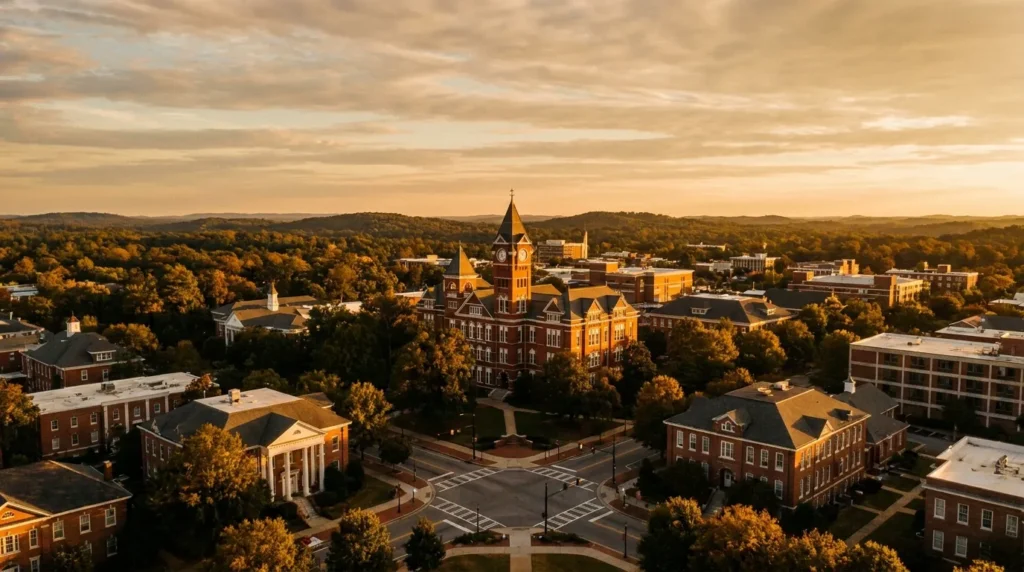
Auburn is a college town in eastern Alabama defined by Auburn University and Jordan-Hare Stadium, with daily life centered around downtown and Toomer's Corner.

The symbolic heart of the city is Toomer's Corner, the intersection of College Street and Magnolia Avenue, where fans wrap the live oak trees with toilet paper after football victories. A short walk away are Auburn Arena, Jordan-Hare Stadium, and the Jule Collins Smith Museum of Fine Art, which is free and open to the public.

The Kreher Preserve and Nature Center, maintained by the university, offers short trails and children's programming. Town Creek Park hosts outdoor concerts, a playground, and serves as the starting point for the Town Creek Greenway trail. Auburn-Opelika Tourism operates the historic Tiger Transit trolley during select events.

For shopping and dining, Auburn Mall and Tichenor Avenue feature chain options, but downtown remains the main gathering spot, with Hound, Acre, Amsterdam Cafe, and the iconic Toomer's Drugs, known for its fresh lemonade since 1896. The Auburn Performing Arts Center brings touring musicals during the academic year.

  1. 1["Jordan-Hare Stadium"
  2. 2"Toomer's Corner and Toomer's Drugs"
  3. 3"Auburn University Museum of Art"
  4. 4"Jule Collins Smith Museum of Fine Art"
  5. 5"Donald E. Davis Arboretum"
  6. 6"Kreher Preserve and Nature Center"
Nightlife5.0 / 10
Parks & green spaces
  • ["Chewacla State Park"
  • "Kreher Preserve and Nature Center"
  • "Donald E. Davis Arboretum"
  • "Town Creek Park"
  • "Kiesel Park"
  • +1 more

Latest posts

Posts about Alabama

Coverage and updates related to this destination.

Showing content from Alabama, as there is no specific data for Auburn yet.