English
 Português
 Español


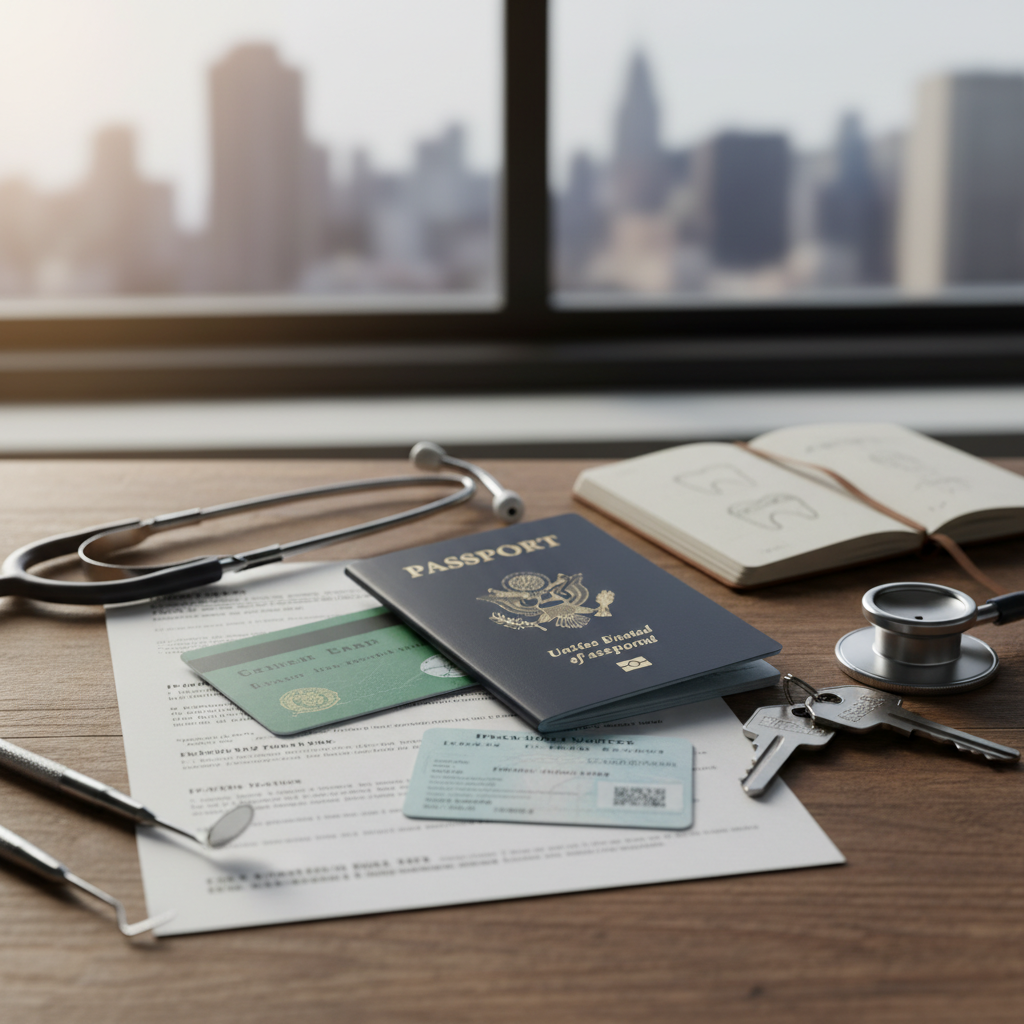
The United States is facing a growing shortage of dental professionals, especially in underserved communities and rural areas. According to the Health Resources and Services Administration (HRSA), millions of Americans live in areas designated as Dental Health Professional Shortage Areas. For foreign-trained dentists, this scenario opens multiple immigration pathways, both temporary and permanent, to practice in the United States.
The choice between a temporary work visa and a green card depends on your long-term goals. Many dentists start with a nonimmigrant visa and transition to permanent residency during their stay. Each pathway has specific requirements, timelines, and costs that deserve careful analysis before starting the process.
H-1B for Dentists
The H-1B is the most common work visa for foreign dentists in the US. To qualify, the professional needs a job offer in a specialty occupation and at least the equivalent of a bachelor’s degree in the field. Since dentistry requires advanced training (D.D.S. or D.M.D.), dentists generally meet this requirement easily.
The H-1B is subject to an annual cap of 85,000 beneficiaries, divided into two categories: 65,000 in the regular cap (bachelor’s or higher) and 20,000 in the master’s cap (advanced degrees). Starting FY2027, USCIS implemented a wage-level weighted selection system, effective from February 27, 2026. In this new system, each registration receives entries proportional to the wage level offered: Level I gets 1 entry, Level II gets 2, Level III gets 3, and Level IV gets 4 entries in the lottery.
An additional significant change is the $100,000 fee for H-1B petitions requiring consular processing, established by presidential proclamation for petitions filed after September 21, 2025. F-1 students adjusting status from within the US are exempt from this fee. Dentists with advanced degrees have an advantage by participating in both the regular cap and the master’s cap, increasing their chances of selection.
Eligibility Requirements
- D.D.S. (Doctor of Dental Surgery) or D.M.D. (Doctor of Medicine in Dentistry) degree
- Credential evaluation if the degree is from a non-US institution
- Passing the National Board Dental Examination (NBDE) or the Integrated National Board Dental Examination (INBDE)
- Valid state license in the state where you intend to practice
- State-specific clinical exams, when applicable
The employer cannot file the petition before April 1 of the desired fiscal year, and the beneficiary can only start work on October 1. The H-1B allows a stay of up to six years (initial period of three years, renewable for another three). As a dual intent visa, the dentist can pursue a green card while maintaining H-1B status.
Dentists employed by higher education institutions, university hospitals, or nonprofit research centers may be eligible for cap-exempt positions, which are not subject to the annual cap and can be filed at any time.
TN Visa
For dentists with Canadian or Mexican citizenship, the TN visa offers a more accessible alternative to the H-1B. Created under the USMCA (formerly NAFTA), the TN has no numerical cap and does not require participation in a lottery. Dentistry is expressly listed among the qualifying professions.
The TN is issued in three-year periods under the USMCA, with unlimited renewals in three-year increments. To qualify, the dentist must present one of the following:
- Doctor of Dental Surgery (D.D.S.) or Doctor of Medicine in Dentistry (D.M.D.)
- Doctor en Odontología or Doctor en Cirugía Dental
- Valid state or provincial license
The main limitation is that the TN is not a dual intent visa. The holder must maintain the intention to return to their home country at the end of their stay. Pursuing a green card while in TN status can create serious immigration complications and requires specialized legal guidance to navigate the transition without jeopardizing current status.
J-1 Visa
The J-1 is used by dentists in exchange, residency, or research programs in the US. Unlike the H-1B, the J-1 requires a sponsor program, not an employer. The program determines the work conditions and duration of stay.
The main restriction is the two-year home residency requirement: after the program ends, the J-1 holder must spend two years in their home country before applying for certain visas or adjustment of status. There are five ways to obtain a waiver of this requirement:
- No objection statement from the home country government
- Request from a US federal agency asking for the waiver
- Demonstration of likely persecution upon return to the home country
- Proof that return would cause extreme hardship to a US citizen or permanent resident spouse or child
- Request by a state public health department (Conrad State 30 Program), especially relevant for dentists willing to serve in underserved areas
It is possible to file for a green card during or after the J-1 period, but adjustment of status will not be processed until the residency requirement is fulfilled or waived.
EB-2 Green Card
The EB-2 category is one of the most common green card pathways for dentists. To qualify, the professional must have an advanced degree (master’s or equivalent) or demonstrate exceptional ability in their field. Most dentists meet the advanced degree requirement by holding a D.D.S. or D.M.D. The traditional EB-2 route requires a formal job offer and PERM labor certification, a process that can take an additional 12 to 18 months.
EB-2 NIW for Dentists
The EB-2 NIW (National Interest Waiver) waives both the job offer and PERM certification, allowing the dentist to self-petition. This route is especially attractive for professionals who wish to open their own practice in the US.
Under the Dhanasar framework, the dentist must demonstrate three points: that their endeavor has substantial merit and national importance; that they are well positioned to advance it; and that waiving the traditional requirements benefits the US. Effective arguments for dentists include serving rural or low-income communities without access to dental care, research in new dental treatments or technologies, and improving the quality and accessibility of dental care in the country.
Government fees in 2026: I-140 $715 plus Asylum Program Fee of $300 (self-petition). Optional premium processing for $2,965 guarantees USCIS action within 45 business days. Standard processing takes between 18 and 26 months.
EB-3 Green Card
The EB-3 category requires at least the equivalent of a US bachelor’s degree and a job offer with labor certification. Although dentists qualify, the EB-3 generally has longer wait times on the Visa Bulletin compared to the EB-2, and does not offer a self-petition option. For most dentists, the EB-2 or EB-2 NIW are more advantageous routes.
Which Pathway to Choose?
| Pathway | Type | Employer | Highlight |
|---|---|---|---|
| H-1B | Temporary | Required | Dual intent; subject to lottery and $100K consular fee |
| TN | Temporary | Required | Canada/Mexico only; no lottery; not dual intent |
| J-1 | Temporary | Program | Residencies and exchange; requires home residency or waiver |
| EB-2 | Permanent | Required | Requires PERM; advanced degree mandatory |
| EB-2 NIW | Permanent | No | Self-petition; ideal for own practice |
| EB-3 | Permanent | Required | Requires PERM; longer wait on Visa Bulletin |
The ideal pathway depends on citizenship, qualifications, long-term goals, and willingness to face processes with greater uncertainty. Dentists with Canadian or Mexican citizenship may prefer the TN as a quick entry point. Professionals with robust experience and plans for their own practice will find the EB-2 NIW the most direct route to permanent residency. In all cases, early planning of the transition between temporary and permanent status is essential to avoid gaps in work authorization.
Learn more about EB-2
- Category
- EB-2 Green Card (2nd priority)
- PERM
- Generally required
- Requirement
- Advanced degree or equivalent
- Processing
- 1-5 years
About the author

Victoria Harper
Editor-in-Chief
As a journalist and lead editor at Visto n’ Visa, Victoria helps ensure that immigration topics are covered in a clear, trustworthy, and easy-to-understand way. Her focus is on delivering useful, human, and relevant content for people exploring new paths abroad.