English
 Português
 Español


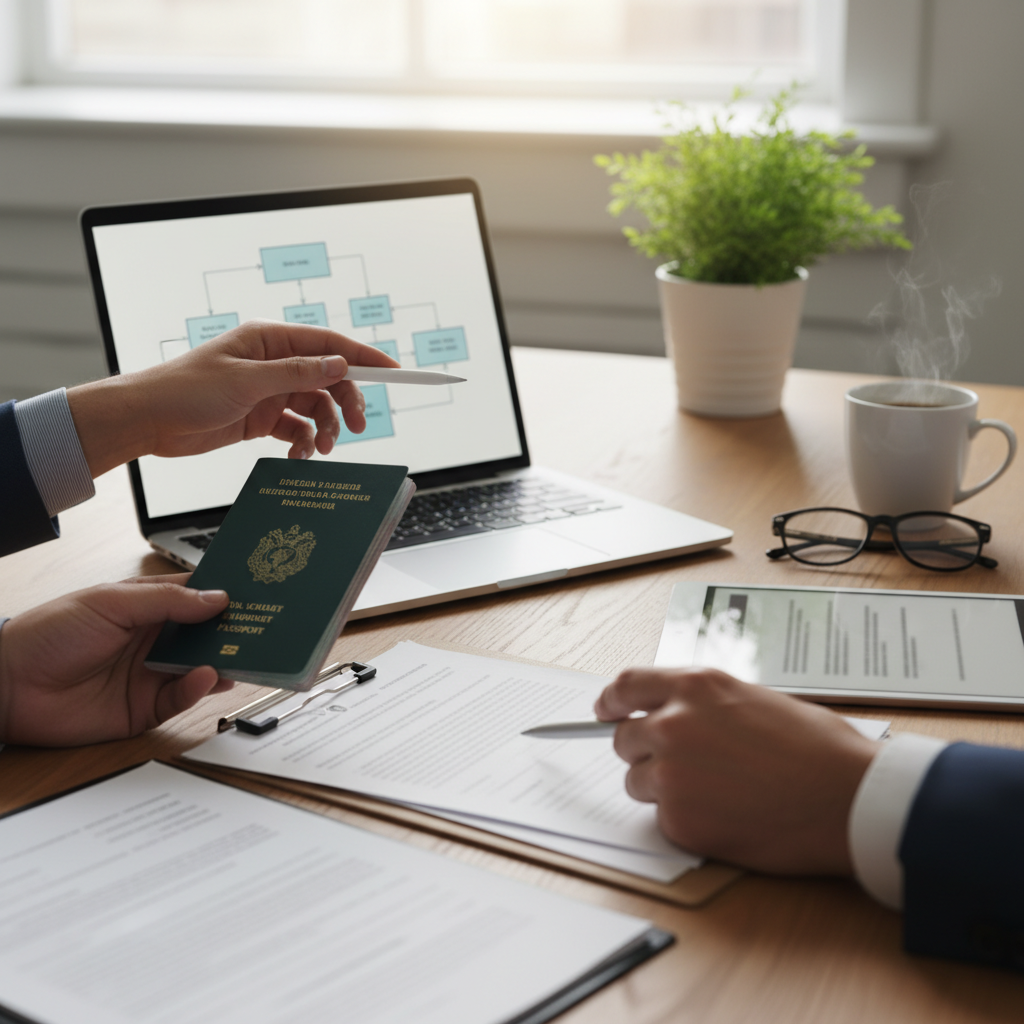
The interview with a Customs and Border Protection officer is the final checkpoint before you actually set foot on U.S. soil. Even with a valid visa stamped in your passport, admission to the United States is decided right there at the counter — a conversation that can last two minutes or stretch into hours of secondary inspection. Knowing what to expect — and how to answer — is the difference between a smooth arrival and a forced return home.
This practical guide organizes the most common CBP questions by traveler profile: permanent residents, students, work visa holders, tourists, and business visitors. It also explains what happens if you are referred to secondary inspection and which documents to print before you board.
Why CBP Interviews Every Traveler
Having a visa does not guarantee entry. A visa authorizes you to present yourself at a port of entry; it is the CBP officer who decides — under INA §235 and the admissibility regulations of 8 CFR 235 — whether you meet the requirements to be admitted that day, in that status. The interview verifies three things: identity, travel purpose consistent with the visa category, and the absence of grounds of inadmissibility.
The officer cross-references your answers in real time against the TECS system, which contains your immigration history, alerts, and biographical data. Inconsistencies between what you say and what the system shows are the primary trigger for secondary inspection.
Questions That Apply to All Travelers
Some questions come up at nearly every port of entry, regardless of visa type. Answer directly and keep your responses brief.
- What is the purpose of your trip? State it in one sentence: tourism, returning home, professional conference, resuming studies. Do not mix intentions.
- How long will you be staying? Have specific dates. Answers like “a few months” raise suspicion.
- Where will you be staying? Know the full address of your hotel, the home you will be at, or your Airbnb.
- Who are you visiting? Name, relationship, and the city where the person lives.
- Have you ever been arrested or convicted? Criminal history, even expunged records, can trigger inadmissibility under INA §212(a)(2). Lying here constitutes fraud and carries worse consequences than the underlying conviction.
- Are you bringing more than US$10,000 in currency? Above that amount, a declaration via FinCEN Form 105 is required under 31 CFR 1010.340. Failure to declare results in confiscation and fines.
- Are you bringing food, plants, or animal products? Declare them. USDA enforcement is strict, but the penalty for not declaring is far worse than losing the cheese in your bag.
For Permanent Residents with a Green Card
Green Card holders must demonstrate that they maintain the United States as their primary residence. Extended absences are the leading source of problems.
- How long were you outside the United States?
- What was the reason for your trip?
- Where is your U.S. residence located?
- Did you work abroad during your absence?
- Do you have your Green Card with you?
The practical rule: absences longer than six consecutive months give the officer grounds to question abandonment of residence. Absences of more than one year without a reentry permit (Form I-131) may result in the card being deemed abandoned and the resident referred to an immigration judge. For planned long trips, the I-131 must be filed before departing the United States.
Bring physical proof of ties: a recent federal income tax return, a lease or deed, utility bills in your name, pay stubs, and children’s school enrollment records. Those who live abroad and visit the United States sporadically are, in practice, at growing risk with each entry.
For Students with F-1, M-1, or J-1 Visas
Students must prove they are still enrolled and that the trip is consistent with their academic status.
- What institution do you attend?
- What is your program and what semester are you in?
- Can you show the Form I-20 (or DS-2019 for J-1) signed by your DSO or Responsible Officer?
- Did you pay the SEVIS I-901 fee?
- Are you returning to resume classes?
Documents to keep accessible in your carry-on: valid passport with visa, I-20 or DS-2019 signed within the last 12 months, proof of enrollment for the upcoming semester, SEVIS I-901 receipt, and proof of financial support. Students may not enter more than 30 days before the program start date, pursuant to 8 CFR 214.2(f)(5).
Watch Out: OPT and CPT
Those on OPT or STEM OPT should also carry their EAD (Form I-766) and an employer letter. Extended absences during OPT may be interpreted as an interruption of practical training.
For Work Visa Holders
Holders of H-1B, L-1, O-1, TN, E-2, and similar visas must demonstrate that they will perform exactly the duties approved in the petition.
- Who is your U.S. employer?
- What is your job title and work location?
- Can you present the approval Form I-797?
- What is the duration of your contract?
- Where will you actually be performing services — the employer’s own office or a client site?
For H-1B holders in a consulting model with client placement, bring a client letter and itinerary as required by the USCIS 2018 Memorandum on third-party placements. For L-1, bring evidence of the qualifying relationship between the foreign and U.S. entities. For TN, the service agreement listing activities that correspond to your profession under USMCA Annex 16-A is essential.
For B-2 Tourists and B-1 Business Visitors
This is the most scrutinized profile. The B-1/B-2 visa is also the most commonly misused — for working, studying, or overstaying — and officers approach it with greater skepticism.
- What do you plan to do in the United States?
- Do you have a return ticket?
- Where do you work in your home country?
- How are you financing your trip?
- Where will you be staying?
- Have you been to the United States before? How long did you stay?
Demonstrating ties to your home country (nonimmigrant intent) is the key point. Useful documents: recent pay stubs, employment verification letter, bank statement, proof of university enrollment, property deed, birth certificates of young children in your home country. For B-1, bring an invitation letter from the U.S. company describing the activities — which must be limited to meetings, training, negotiations, and event attendance, never productive work compensated by a U.S. entity.
Your Authorized Stay Is Determined at the Port of Entry
The CBP officer can grant up to six months of admission for B-1/B-2, but may also grant a shorter period if the purpose of the trip warrants it. The stamp in your passport and the electronic record in the I-94 (check at i94.cbp.dhs.gov) are the official references — not the visa expiration date.
Secondary Inspection: What Changes
Secondary inspection is triggered when answers are inconsistent, intent is in question, deeper document review is needed, or a system alert is present. The traveler is directed to a separate room for a more detailed interview.
At that stage, the officer can search luggage, request access to your phone and electronic devices (CBP has authority to inspect without a warrant at ports of entry under CBP Directive 3340-049A), and request additional documents. Some practical guidelines:
- Do not delete content from your phone during the trip or while in line — destroying evidence makes the situation significantly worse.
- Answer only what is asked, without volunteering extra context.
- Have printed copies of your I-20, I-797, contracts, hotel reservations, and return ticket.
- If English is not comfortable for you, request an interpreter; it is your right.
- Do not sign documents you do not understand — especially Form I-275 (withdrawal of application for admission), which terminates your attempt to enter.
Mistakes That Cost You Admission
Most denials at ports of entry follow recurring patterns: statements inconsistent with travel history, actual intent to immigrate on a tourist visa, prior stays that approached or exceeded the authorized period, work without authorization detected on social media or on a device, undisclosed criminal history from prior interviews, and falsified documents.
If entry is denied, options vary by category. In cases of expedited removal (INA §235(b)(1)), a five-year bar on return applies, unless the traveler expresses a credible fear of persecution and is referred to the asylum process. Withdrawal of application for admission, when offered by the officer, is less damaging because it does not trigger an automatic bar — but it must be accepted knowingly.
How to Prepare in the 48 Hours Before Your Flight
Print and keep in an easily accessible folder: your passport, visa, the applicable approval document (I-20, DS-2019, I-797, I-131), proof of ties to your home country if traveling on B-1/B-2, accommodation confirmation, and return ticket. Verify dates, align your story with any travel companions, and review your I-94 from your last entry to confirm there was no prior overstay.
The CBP interview is not a bureaucratic formality. It is the last point at which your admission can be reversed — and, at the same time, it is entirely predictable for anyone who has prepared. Clear answers, organized documentation, and consistency between your visa and the actual purpose of your trip resolve 99% of interviews in under five minutes.
About the author

Victoria Harper
Editor-in-Chief
As a journalist and lead editor at Visto n’ Visa, Victoria helps ensure that immigration topics are covered in a clear, trustworthy, and easy-to-understand way. Her focus is on delivering useful, human, and relevant content for people exploring new paths abroad.