Visto n' Visa
Blog
Notícias e artigos
Destinations
Careers
Immigrants

Want to live and work in Three Rivers?

Personalized immigration plan with eligible visas, costs, and next steps for your goal!

If you are not eligible, you will know exactly why and what to do to improve your approval chances.

Save up to 12 hours in meetings

No pointless assessments.

Save up to 90%

Save money on vague or unfocused consultations

Avoid Fraud and Mistakes

One mistake can cost you your visa

Total Impartiality

Zero commercial bias

Decide with peace of mind

No toxic urgency

Fast and Accurate

Answers in minutes, no guesswork

Who Lives in Three Rivers: Predominantly White, Scottish and Acadian Roots, Mi'kmaq Community

Small population predominantly white, descendants of Scottish and Irish settlers, with a historic Acadian presence and the Abegweit Mi'kmaq First Nation.

The population is predominantly white, made up of descendants of Scottish, Irish, and English settlers who arrived on the island between the 18th and 19th centuries. English is the language of daily life, and few residents speak Acadian French, which is more common in the western part of the province. There is a historic presence of the Abegweit Mi'kmaq First Nation, with reserves such as Scotchfort and Morell located nearby.

International immigration is small compared to Charlottetown. Some Filipino, Indian, and Chinese families have settled in Montague in recent years, generally connected to jobs at the hospital, in restaurants, and in the fishing industry. A Brazilian community is virtually absent, with presence concentrated in the capital.

The population is aging, with a high average age. Young families are a minority, and many young people from the area migrate to Charlottetown, Halifax, or Toronto in search of education and work. The dominant religion is Christian, with Presbyterian, United Church, and Catholic congregations in various communities.

Languages spoken
  • English
  • Mi'kmaq (Abegweit First Nation, nearby)
  • Tagalog (Filipino, small community)
  • Mandarin (rare)
  • Scottish Gaelic (cultural preservation)
Main religions
  • Presbyterian
  • Roman Catholic
  • United Church of Canada
  • Anglican
  • Baptist
  • +1 more

Cost of Living in Three Rivers: The Most Affordable on the Island for Housing, but a Car Is Essential

Renting and buying a home are quite affordable by Canadian standards. In return, owning at least one vehicle per household is practically the norm.

Three Rivers is one of the most affordable regions of Prince Edward Island for housing. Renting a 2- or 3-bedroom home in Montague or Georgetown typically ranges from CAD 1,200 to CAD 1,800 per month. Purchasing a country home with land is reasonably accessible by Atlantic Canadian standards, with mortgages available from a 20% down payment for residents.

Grocery options in Montague include Sobeys and Co-op, along with smaller markets. Prices follow the island standard, with fruits and dairy more expensive in winter. For larger purchases or specific brands, many residents drive to Charlottetown (40 minutes). Local restaurants cost around CAD 18 to CAD 25 per person, with a strong focus on fish and potatoes.

The hidden cost is transportation. Without a car, daily life is practically impossible. Fuel, insurance, and maintenance become fixed budget items. Heating in winter (fuel oil or electricity) can exceed CAD 300 per month in January. The 15% HST applies to most purchases, but basic groceries are exempt.

Three Rivers

Housing in Three Rivers: Rural Homes, Farms, and Large Lots

The city is dominated by country homes, waterfront properties, and wooden houses in villages. There are almost no apartment buildings. Rental supply is limited.

The housing profile in Three Rivers is family homes with generous land. In Montague, homes are closer together on streets such as Main Street and Queens Road, but even there yards are large. In Georgetown, Cardigan, and the more rural areas, farmhouses, country properties, and waterfront estates dominate the landscape.

For those seeking lower prices or a rural lifestyle, farms with land and country homes are available at values that would be unthinkable in Charlottetown or Halifax. Buyers from Ontario and England commonly purchase rural properties here. Those who work in Charlottetown often choose to live in Montague, accepting the 40-minute commute.

Renting is harder than buying. Inventory is small, and landlords typically require proof of income, references, and generally a half-month deposit. Sites such as Kijiji, Facebook Marketplace, and the PEI Rental Registry are the main listing sources. Newcomers often rent an Airbnb for a few weeks while searching for a home.

Recommended neighborhoods
  • Montague (commercial center, schools, hospital)
  • Georgetown (historic port, Victorian homes)
  • Cardigan (rural, riverside)
  • Brudenell (golf courses, waterfront homes)
  • Lower Montague (homes with views)
  • +1 more

Job Market in Three Rivers: Fishing, Agriculture, Tourism, and Public Services

The local economy revolves around lobster fishing, potato farming, summer tourism, and public sector jobs in health and education.

Three Rivers has a strongly seasonal economy. Lobster fishing between May and June is the economic engine of Georgetown, Cardigan, and Annandale-Little Pond, with small fishing vessels and local cooperatives. Mussels and oysters are also cultivated in the rivers and bays of the region. Potato, soybean, and livestock farming complement the rural economy.

Tourism drives hotels, inns, restaurants, and golf courses from June to September. Brudenell River Resort and Dundarave Golf are well-known destinations across Canada. Outside the season, many of these jobs disappear or become part-time. The Confederation Trail for cycling also attracts visitors to the area.

Stable employment comes from the public sector. Kings County Memorial Hospital in Montague employs nurses, doctors, and administrative staff. Public schools, provincial government offices, and municipal services round out the picture. Average salaries range from CAD 38,000 to CAD 60,000 per year, lower than in Charlottetown or Halifax, but with a significantly lower cost of living.

Dominant sectors
  • Fishing (lobster, mussel, oyster)
  • Agriculture (potatoes, livestock, soybeans)
  • Seasonal tourism and hospitality
  • Local public health
  • Education
  • +2 more
Major employers
  • Kings County Memorial Hospital (Health PEI)
  • Government of Prince Edward Island (regional offices)
  • Brudenell River Resort
  • Local fishing cooperatives
  • Sobeys (Montague)
  • +1 more

Education in Three Rivers: Rural Public Schools, University in Charlottetown

Children have public schools in Montague and surrounding areas. For higher education, students go to UPEI or Holland College in Charlottetown.

Resident children have free access to the Public Schools Branch system. Schools such as Montague Intermediate, Montague Regional High, and Belfast Consolidated serve the region. Rural schools tend to be smaller, with reduced class sizes, which can be positive (more individual attention) or challenging (fewer classmates and extracurricular activities).

There is no university campus in Three Rivers. For higher education, students attend the University of Prince Edward Island (UPEI) in Charlottetown, which has strong programs in veterinary medicine, nursing, and business, or Holland College, with technical programs in culinary arts, law enforcement, design, and hospitality.

Many young people from the region end up migrating to Charlottetown, Halifax (Dalhousie, Saint Mary's), or New Brunswick (UNB, Mount Allison) to study and tend to stay. This youth exodus is one of the reasons Three Rivers has an aging population and slow growth.

Notable universities
  • University of Prince Edward Island (UPEI, in Charlottetown)
  • Holland College (in Charlottetown)
  • Atlantic Veterinary College (part of UPEI)

Healthcare in Three Rivers: Small Hospital in Montague and Referrals to Charlottetown

Kings County Memorial Hospital handles basic emergencies. Complex cases are referred to Charlottetown or Halifax.

The system is universal under Health PEI, free for permanent residents and work permit holders with more than six months of residency, after a three-month waiting period. Private insurance is recommended during the first months after arriving in the province.

Kings County Memorial Hospital in Montague handles basic emergencies, short-term admissions, and limited maternity services. For complex cases (major surgeries, oncology, cardiology), patients are transferred to Queen Elizabeth Hospital in Charlottetown, 40 minutes away. For very serious situations, patients are sent to Halifax.

Finding a family doctor is a chronic problem, especially in rural areas. Walk-in clinics in Montague handle simple cases, and telemedicine via Maple provides additional access. Medications are not covered by default, so employer health plans make a significant difference. The nearest dentist is typically in Montague or Charlottetown.

Healthcare index65.0 / 100
  • Life expectancyyears at birth
    81.6yrs
  • Doctors per 1kpracticing physicians
    2.8
  • Health spendper capita, per year
    $6,187
  • Public systemoverall quality rating
    Fair

Safety in Three Rivers: Quiet Rural Life, Very Low Crime

Violent crime is practically nonexistent. The real risk is winter, with snow and ice-covered rural roads.

Three Rivers has one of the lowest crime rates in the province. Violent crime is extremely rare, and residents in rural areas commonly leave their doors unlocked. Life is noticeably calm, with neighbors who know each other, shared gardens, and children moving freely on residential streets in Montague and Georgetown.

Policing is handled by the RCMP (Royal Canadian Mounted Police), which covers the entire region. Response times vary depending on distance from the detachment in Montague, but are generally prompt. The most reported crimes are petty theft, occasional vandalism, and isolated drug incidents, particularly methamphetamine, which has grown across the province in recent years.

The real risk is winter: snowstorms, ice on rural roads, power outages from falling trees, and Atlantic winds exceeding 100 km/h. In January and February, secondary roads commonly become impassable for a few hours until the plows come through. Winter tires and an emergency kit in the vehicle are practically essential.

2.0
Homicides per 100k
per year
Safety index
72.0
Crime index
28.0
Safer neighborhoods
  • Montague downtown
  • Georgetown waterfront
  • Cardigan village
  • Brudenell area
  • Lower Montague
  • Murray Harbour
Areas to avoid
  • Isolated rural roads late at night
  • Industrial port areas after business hours
  • Remote trails outside daylight hours

Transportation in Three Rivers: Car Essential, Public Transit Nearly Nonexistent

There is no regular public transportation. Residents need a car. Charlottetown is 40 minutes away via the Trans-Canada Highway.

Three Rivers is typical rural Canada: no regular public transit. T3 Transit does not cover the area with the same frequency as Stratford or Cornwall. Some community vans serve seniors and people with limited mobility, but for daily life, everyone drives.

The main road is the Trans-Canada Highway, connecting Montague to Charlottetown in about 40 minutes. Smaller provincial routes cross the region connecting Georgetown, Cardigan, and rural villages. In winter, snow and ice can close secondary roads for a few hours until the plows come through.

For flights, Charlottetown Airport (YYG) is the nearest option, about 45 minutes by car. Direct flights are available to Toronto, Montreal, Halifax, and Ottawa. The Confederation Trail, a former railway converted into a multi-use path, runs through Three Rivers and is popular for cycling, walking, and snowmobiling in winter.

12 min
Avg commute
25
Walkability
Airports
  • YYG — Charlottetown Airport (approximately 60 km away)

What the climate is like living in Three Rivers

Three Rivers is a rural municipality in eastern PEI with an Atlantic oceanic climate: cool summers, long and windy winters, and heavy snowfall.

Summer in Three Rivers is cool and pastoral. From June through September, daily highs range between 22 and 25 degrees Celsius, with coastal breezes and green fields throughout. Red sand beaches and Brudenell River Provincial Park are seasonal highlights. Air conditioning is rarely needed.

Winter is long. From December through March, highs range between -3 and 1 degree Celsius, with lows frequently reaching -15. The area receives around 290 centimeters of snow annually. Winds off the water intensify the wind chill, and rural roads can close during storms.

Homes in Three Rivers are largely rural, heated by oil or wood, with heat pumps becoming more common. Waterproof outerwear, a heavy parka, thermal boots, and an emergency generator (power outages are frequent during storms) are standard parts of life here. The community is small, rural, and close-knit.

Sunny days / year275 days
Avg high (°F)
  • 45°J
  • 44°F
  • 48°M
  • 53°A
  • 66°M
  • 75°J
  • 80°J
  • 81°A
  • 76°S
  • 67°O
  • 61°N
  • 54°D
Avg low (°F)
  • J
  • F
  • M
  • 24°A
  • 32°M
  • 44°J
  • 55°J
  • 57°A
  • 49°S
  • 40°O
  • 25°N
  • 16°D
Rainfall (")
  • 4"J
  • 3"F
  • 2"M
  • 3"A
  • 3"M
  • 4"J
  • 4"J
  • 3"A
  • 4"S
  • 3"O
  • 4"N
  • 4"D

Culture of Three Rivers: Celtic Music, Lobster Festivals, and Summer Theatre

Local culture blends Scottish, Irish, and maritime roots. Summer brings music festivals, food events, and the King's Playhouse in Georgetown.

Local culture has a strong Celtic flavor. Fiddle music, bagpipes, and Scottish dance appear in pubs and community events. The King's Playhouse in Georgetown, one of the province's oldest theatres, presents plays, concerts, and festivals during the summer. The Cardigan Heritage Centre displays artifacts and photographs from local history.

Cuisine revolves around sea and land. Lobster boiled in butter, Cardigan oysters, fresh mussels, baked PEI potatoes, fish and chips, and traditional sweets such as molasses cake. In May and June, community lobster suppers are held in churches and local halls, with affordable prices and a family atmosphere.

Festivals include the Georgetown Festival of the Arts and smaller events in Montague and Cardigan. In winter, the calendar quiets and life moves indoors, with hockey at local arenas, church suppers, and Royal Canadian Legion club gatherings. It is small-community life, where nearly everyone knows one another.

2
Major museums
Notable dishes
  • Georgetown lobster roll
  • Malpeque oysters
  • Fresh mussels
  • Seafood chowder
  • PEI potatoes
  • +3 more
Annual events
  • King's Playhouse summer theatre season in Georgetown
  • Montague Welcome Festival
  • Montague Rotary Riverfront Festival
  • Cardigan River Festival
  • Brudenell Highland Games
  • +1 more

What to do in Three Rivers, from Montague Harbour to Basin Head

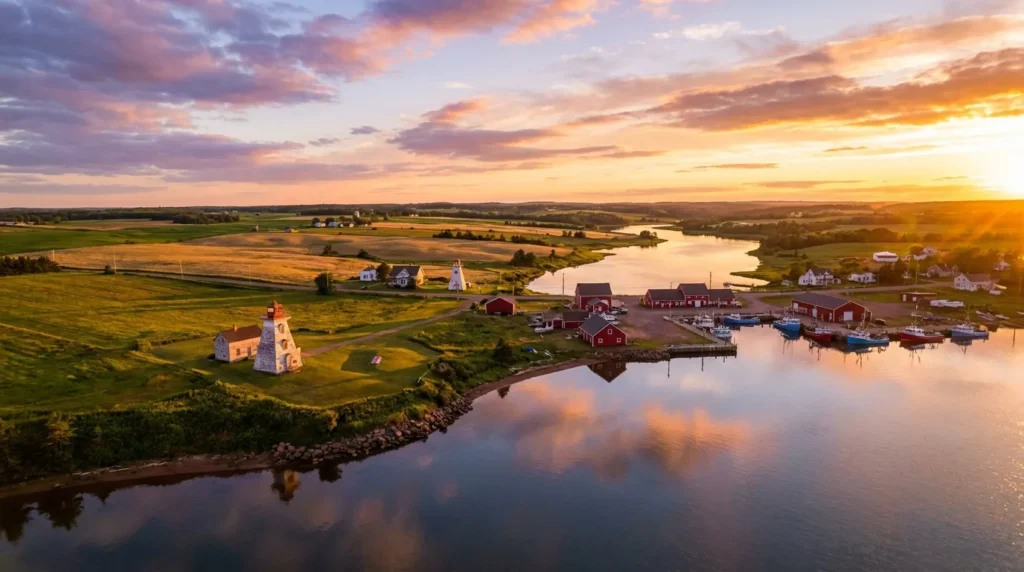
Three Rivers is a municipality formed in 2018 by the merger of Montague, Georgetown, and surrounding villages. Life revolves around the estuary, farmland, and lobster fishing.

Montague serves as the commercial hub of the region, with the Garden of the Gulf Museum documenting the island's rural history and Montague Riverfront Park functioning as an open-air gathering space for the community. Georgetown, at the tip of the peninsula, is home to Kings Playhouse, a historic theatre rebuilt after a fire, offering a summer program of traditional music. Small boatyards and the fishing harbour set the pace of daily life, and the neighbouring Brudenell River Provincial Park features a nationally recognized golf course.

The area has a strong tradition of local producers and regional cuisine. The Annandale Lobster Pound serves directly off the boat, and the markets at Cardigan and Murray Harbour operate on Saturday mornings throughout summer. To understand the Acadian and Scottish heritage, Orwell Corner Historic Village to the west recreates a late-19th-century settlement with a working farm. The restored Panmure Island lighthouse is one of Prince Edward Island's most photographed landmarks and sits alongside one of the finest beaches in the east.

A coastal rhythm defines both tourism and everyday life. Basin Head Provincial Park, along the scenic route toward East Point, is celebrated for its singing sand and relatively warm water by Canadian standards. The Singing Sands Trail and the Brudenell trail network offer accessible hiking options. In winter, snowmobiling and skating on frozen ponds replace the beach, and the PEI Mutual Festival of Small Halls brings intimate concerts to community halls throughout the region.

  1. 1["King's Playhouse"
  2. 2"Brudenell River Provincial Park"
  3. 3"Garden of the Gulf Museum"
  4. 4"Buffaland Park"
  5. 5"Panmure Island Lighthouse"
  6. 6"Montague Marina"
Nightlife1.0 / 10
Parks & green spaces
  • ["Brudenell River Provincial Park"
  • "Panmure Island Provincial Park"
  • "Buffaland Park"
  • "Montague Town Park"
  • "Cardigan Riverfront"
  • +1 more

Latest posts

Straight from the blog

There are no posts specifically about Three Rivers yet. In the meantime, check out our latest posts.