Visto n' Visa
Blog
Notícias e artigos
Destinations
Careers
Immigrants

Want to live and work in Mt. Edward?

Personalized immigration plan with eligible visas, costs, and next steps for your goal!

If you are not eligible, you will know exactly why and what to do to improve your approval chances.

Save up to 12 hours in meetings

No pointless assessments.

Save up to 90%

Save money on vague or unfocused consultations

Avoid Fraud and Mistakes

One mistake can cost you your visa

Total Impartiality

Zero commercial bias

Decide with peace of mind

No toxic urgency

Fast and Accurate

Answers in minutes, no guesswork

Who lives in Mt. Edward

A small, mostly English-speaking community with a growing presence of recent immigrants drawn to Prince Edward Island.

The population of Mt. Edward is small, made up mainly of long-established Prince Edward Island families, descendants of British, Irish, Scottish, and Acadian settlers. The age profile is balanced, with a strong presence of families with children and retirees who chose the region for its calm.

In recent years, the province has become an immigration destination through the Provincial Nominee Program and the Atlantic Immigration Program, and some newcomers have settled around Charlottetown, including in rural communities like Mt. Edward. Even so, the day-to-day ethnic diversity here is lower than in more central neighborhoods of the capital.

English is the language of almost everything: school, commerce, medical care, and social life. Those arriving without command of the language need to plan for ESL classes in Charlottetown, because options within the community itself are limited.

Languages spoken
  • English
  • French
  • Mandarin
  • Tagalog
  • Arabic
  • +1 more
Main religions
  • Christianity (Catholic)
  • Christianity (Protestant)
  • No religion
  • Islam
  • Hinduism

Cost of living: affordable by Canadian standards, but with catches

Rent and home prices below the national average, but energy, heating, and groceries tend to weigh more than in larger cities.

The cost of living in Mt. Edward is one of the region's strong points. Buying or renting a home with land here costs much less than in Toronto, Vancouver, Montreal, or even Halifax. Families selling property in larger centers gain immediate space when moving to Prince Edward Island.

On the other hand, the long winter pushes heating bills up for several months of the year, especially in older homes with fuel oil. Electricity in the province is among the most expensive in Canada, and groceries also suffer from shipping costs, since this is an island, so imported items run pricier than on the mainland.

Transportation is another factor to consider. Without frequent bus service at the doorstep, nearly every adult resident needs a car, with insurance, fuel, and maintenance figuring into the monthly budget. Even so, the balance is usually positive for those who prioritize spacious housing and safety.

Mt. Edward

Housing: homes with land and few apartment buildings

Single-family homes with yards dominate, along with some larger rural lots and almost no apartments within the community.

The housing stock in Mt. Edward is dominated by single-family homes, many with finished basements, garages, and generous yards. Apartments and condos barely exist within the community; those who want that format need to look at Charlottetown or Stratford, across the river.

The market has heated up in recent years with the arrival of new residents from the rest of Canada and abroad, so prices have risen compared to the previous decade, but they remain competitive by Canadian standards. Whole-house rentals are scarce, and those who prefer to rent usually find more supply in neighboring areas.

Before buying, it pays to check the heating system (oil, electric, or heat pump), whether there is a septic tank and private well, and the condition of the roof, because strong winter winds and snow accumulation test everything. A professional inspection before closing is local practice and strongly recommended.

Recommended neighborhoods
  • Mt. Edward Road
  • St. Peters Road (rural stretch)
  • West Royalty (neighboring)
  • Sherwood (neighboring)
  • Charlottetown East (neighboring)

Work: almost everything is in Charlottetown

Formal employment is in the neighboring capital, with openings in healthcare, public service, agribusiness, technology, and seasonal tourism.

Mt. Edward itself does not concentrate employers, so the effective job market is Charlottetown and its surroundings. The capital of Prince Edward Island hosts the provincial government headquarters, the reference hospital (Queen Elizabeth Hospital), the university (UPEI), call centers for banks and insurers, and bioscience companies tied to fisheries and agriculture.

Sectors that hire the most recent immigrants include healthcare (nursing, caregivers, technicians), seafood processing, construction, freight transport, hospitality, restaurants, and information technology. Provincial programs such as the PEI PNP and the Atlantic Immigration Program offer pathways to permanent residency tied to a local job offer.

Average salaries are lower than in western Canada, but paired with lower housing costs. Those who work remotely for employers outside the province often have the best combination of high income and low expenses by living in communities like Mt. Edward.

Dominant sectors
  • Healthcare and social services
  • Public administration
  • Agriculture and fisheries
  • Tourism and hospitality
  • Technology and bioscience
  • +1 more
Major employers
  • Health PEI
  • Government of Prince Edward Island
  • University of Prince Edward Island
  • Holland College
  • BioVectra
  • +1 more

Education: nearby public schools and UPEI right next door

Children attend public schools in the province's English-language system, with a university and a technical college in Charlottetown.

Basic education in Mt. Edward is served by the Public Schools Branch, the English-language public network of Prince Edward Island. Children are typically distributed across nearby schools in Charlottetown, Sherwood, or West Royalty, with free school transportation for eligible residents.

For francophone families, there is the province's Commission scolaire de langue française, with schools at specific locations, requiring a longer commute. There are also private and religious options in Charlottetown for those seeking alternatives to the public system.

In higher education, the University of Prince Edward Island (UPEI) and Holland College, both in Charlottetown, offer university courses, technical programs, and English as a second language. UPEI has recognized programs in veterinary medicine, nursing, sciences, business, and education, and attracts international students from many countries.

Notable universities
  • University of Prince Edward Island (UPEI)
  • Holland College
  • Maritime Christian College

Healthcare: the province's reference hospital is nearby

Primary care comes from Queen Elizabeth Hospital in Charlottetown, with waiting lists for family doctors and provincial coverage after residency.

Healthcare is covered by the provincial public system, managed by Health PEI. The reference hospital for the region is Queen Elizabeth Hospital in Charlottetown, with an emergency room, inpatient care, maternity, oncology, and other specialties, just minutes from Mt. Edward.

Securing a family physician is a challenge throughout Prince Edward Island. Newcomers usually join the PEI Patient Registry and wait months or years for an opening. In the meantime, they rely on walk-in clinics, provincial telehealth (Maple or similar), and the emergency room itself for urgent matters.

Permanent residents must complete a three-month waiting period before receiving the PEI Health Card. During that period, private health insurance is mandatory. Pharmacies are widely spread across Charlottetown, but medications not covered by a specific program come out of pocket or from an employer plan.

Mt. Edward

Safety: low crime and a peaceful life

A quiet community with low crime rates, served by the RCMP, with occasional risks tied to rural traffic and winter weather.

Mt. Edward is a quiet community with low crime rates by Canadian standards. Violent crimes are rare, and daily life revolves around minor incidents such as opportunistic theft, occasional vandalism, and traffic infractions. Policing is handled by the Royal Canadian Mounted Police (RCMP), which covers much of rural Prince Edward Island.

The main risks are not criminal but environmental. Rural roads become slippery in winter, with black ice, accumulated snow, and reduced visibility during storms. Accidents involving vehicles and animals (deer, foxes) happen on less illuminated stretches.

It is also worth following coastal storm alerts, especially in late summer and fall, when remnants of Atlantic hurricanes can hit the island, causing strong winds, fallen trees, and power outages for hours or days.

Safer neighborhoods
  • Mt. Edward Road
  • Sherwood
  • West Royalty
  • Stratford
  • Cornwall
Areas to avoid
  • Isolated stretches of St. Peters Road during winter storms
  • Unlit rural roads at night

Transportation: a car is practically mandatory

Without a dense bus network, a regional airport nearby, and a road link to the rest of Canada via the Confederation Bridge.

Mt. Edward is crossed by rural roads that connect to the Trans-Canada Highway and downtown Charlottetown within minutes. T3 Transit, the capital's bus system, mainly serves denser neighborhoods, so residents here generally depend on their own car for work, shopping, and the kids' school.

For regional travel, Charlottetown Airport (YYG) is a short distance away and offers direct flights to Toronto, Montreal, Halifax, and Ottawa, connecting to the rest of the world via hubs. The road link with the mainland is the Confederation Bridge to New Brunswick, one of the longest bridges over icy water in the world.

Structured bike lanes are limited, although the Confederation Trail, an old rail line converted into a path, runs nearby and is excellent for leisure, walking, and biking in the summer. In winter, snow and ice greatly restrict bike use as a means of transportation.

Airports
  • YYG, Charlottetown Airport

Climate

Mt. Edward

Culture: maritime tradition and Celtic influence

Cultural life happens in Charlottetown, with strong Scottish, Irish, and Acadian heritage, seafood, and summer festivals.

Local culture is heavily influenced by Scottish, Irish, English, and Acadian settlers. Traditional music with fiddle and step dancing shows up in pubs and community festivals, and it is common to find ceilidhs (informal musical gatherings) at churches and community centers in the region.

The cuisine revolves around the sea and the land: lobster, Malpeque mussels, oysters, potatoes (the island is a world reference in production), and homemade pies. In summer, restaurants in Charlottetown and the coastal villages fill with tourists looking for exactly these dishes.

Charlottetown takes pride in having hosted the conference that gave rise to the Canadian Confederation in 1864, and the city celebrates this heritage at the Confederation Centre of the Arts, which hosts the famous Anne of Green Gables musical every summer. For Mt. Edward residents, these venues are less than fifteen minutes away by car.

Notable dishes
  • Boiled lobster (PEI lobster)
  • Malpeque mussels
  • Malpeque oysters
  • Roasted and fried PEI potatoes
  • Mussel chowder
  • +1 more
Annual events
  • Charlottetown Festival
  • PEI International Shellfish Festival
  • Old Home Week
  • Fall Flavours Festival
  • Festival of Small Halls

What to do nearby

Red-sand beaches, national parks, historic Charlottetown, and the Confederation Trail are all a short distance away.

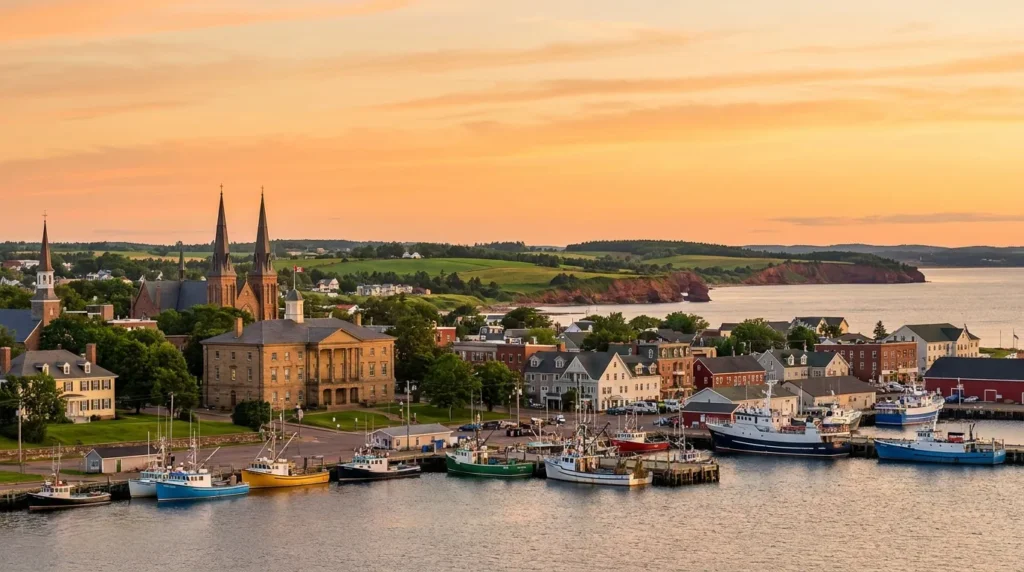
Although Mt. Edward has no attractions of its own, it is surrounded by some of the main tourist points of Prince Edward Island. Charlottetown's historic downtown, with Province House National Historic Site, the Confederation Centre of the Arts, and the Victoria Park waterfront, is just minutes away by car.

Famous beaches such as Brackley, Cavendish, and Stanhope, within Prince Edward Island National Park, are a short distance away and offer pinkish-red sand, dunes, and cold sea water in summer. The Cavendish area also welcomes fans of the Anne of Green Gables novel, with a house museum dedicated to author Lucy Maud Montgomery.

For daily life, the Confederation Trail is ideal for walking and biking, crossing the island from end to end. Farmers' markets such as the Charlottetown Farmers Market, urban parks, and small wineries and craft breweries round out the range of activities accessible just minutes from Mt. Edward.

  1. 1Province House National Historic Site
  2. 2Confederation Centre of the Arts
  3. 3Victoria Park (Charlottetown)
  4. 4Prince Edward Island National Park
  5. 5Cavendish Beach
  6. 6Green Gables Heritage Place
Parks & green spaces
  • Victoria Park
  • Confederation Landing Park
  • Joe Ghiz Memorial Park
  • Confederation Trail
  • Brackley Beach (PEI National Park)

Immigrant communities in the region

Recent growth in immigration through provincial programs, with notable Chinese, Filipino, Indian, Syrian, and Ukrainian presence in Charlottetown.

Prince Edward Island has received a growing flow of immigrants over the past two decades, driven by the PEI Provincial Nominee Program and the Atlantic Immigration Program. The most visible groups in the Charlottetown metropolitan area include Chinese, Filipinos, Indians, Syrians, Ukrainians, Nigerians, and Iranians, each with its own community network.

Mt. Edward, being small and rural, is home to only a few families from these communities, but all the gathering points are in Charlottetown: temples, ethnic churches, Asian markets, cultural restaurants, and community centers such as the PEI Association for Newcomers to Canada. Community social life mainly happens there.

For consular services, the island generally falls under the jurisdiction of consulates in Halifax, Montreal, or Toronto. Urgent cases usually require a trip to the mainland. Settlement support, English classes, help with professional credentialing, and job search assistance are widely offered by local nonprofits, free of charge for permanent residents and refugees.

200
Foreign-born residents
estimated
Top countries of origin
  • China
  • Philippines
  • India
  • Syria
  • United Kingdom
  • United States
  • Ukraine
  • Nigeria
Foreign consulates
  • Honorary British Consulate in Charlottetown
  • Consulate General of France in Halifax (jurisdiction)
  • Consulate General of China in Montreal (jurisdiction)
  • Consulate General of the Philippines in Toronto (jurisdiction)
  • Consulate General of India in Toronto (jurisdiction)
Community organizations
  • PEI Association for Newcomers to Canada (PEIANC)
  • Immigrant & Refugee Services Association PEI
  • Catholic Family Services Bureau
  • Chinese Society of PEI
  • Black Cultural Society of PEI

Latest posts

Straight from the blog

There are no posts specifically about Mt. Edward yet. In the meantime, check out our latest posts.