Visto n' Visa
Blog
Notícias e artigos
Destinations
Careers
Immigrants

Want to live and work in Charlottetown?

Personalized immigration plan with eligible visas, costs, and next steps for your goal!

If you are not eligible, you will know exactly why and what to do to improve your approval chances.

Save up to 12 hours in meetings

No pointless assessments.

Save up to 90%

Save money on vague or unfocused consultations

Avoid Fraud and Mistakes

One mistake can cost you your visa

Total Impartiality

Zero commercial bias

Decide with peace of mind

No toxic urgency

Fast and Accurate

Answers in minutes, no guesswork

Who lives in Charlottetown: an English-speaking majority, with growing immigration from the Philippines and China

A predominantly white population of Irish, Scottish, and English descent, alongside a recent wave of immigrants from the Philippines, China, and India.

Historically, Charlottetown has been a city of Irish, Scottish, and English descent, alongside a small Acadian (French) population and the Mi'kmaq First Nations communities. English is the language of virtually everyone, and almost no one speaks French in daily life, even though Canada is officially bilingual.

The major recent change has been the arrival of immigrants through the Provincial Nominee Program (PNP) and study programs. Today there is a visible Filipino community, with its own shops and restaurants, as well as Chinese, Indian, and Nigerian residents. International students from UPEI and Holland College have brought diversity from Korea, Vietnam, and Arab countries. Brazilians are few, generally tied to English-language programs or seasonal restaurant jobs.

The population is older than the national average. Young families tend to live in Stratford or Cornwall, while the downtown area is home to many retirees and students. The dominant religion is Christianity, with a strong Catholic and United Church of Canada presence.

Languages spoken
  • English
  • Tagalog (Filipino)
  • Mandarin
  • Arabic
  • French (Acadian minority)
  • +3 more
Main religions
  • Roman Catholic
  • United Church of Canada
  • Anglican
  • Presbyterian
  • No religion (growing)
  • +2 more

Cost of living in Charlottetown: cheaper than Toronto and Vancouver, but rising fast

Rents have increased significantly in recent years with the arrival of immigrants and students. Groceries are reasonable; public transit is limited.

Charlottetown used to be known as one of Canada's most affordable provincial capitals, but that has changed. Renting a one-bedroom apartment downtown now costs between CAD 1,500 and CAD 1,900 per month, with two-bedroom units exceeding CAD 2,000. Rooms in shared houses, common among students, run between CAD 700 and CAD 1,000.

Grocery shopping at chains such as Sobeys, Superstore, and Walmart is comparable to the rest of Atlantic Canada, with produce being expensive in winter as nearly everything is shipped from outside the island. A meal at a casual restaurant costs between CAD 18 and CAD 28 per person. Fresh lobster at seasonal markets (May and June) is one of the few local bargains.

With no SkyTrain or subway, those who live far from the center need a car. Fuel, insurance, and maintenance add up. The provincial tax (HST) is 15%, which already includes the federal portion, but electricity and heating (most homes use heating oil or electricity) can bring surprises in winter.

Housing in Charlottetown: wooden houses, few tall buildings, tight supply

A city dominated by single-story and two-story wooden homes. Tall buildings are rare. Rental supply has been scarce in recent years.

Most of Charlottetown consists of painted wooden houses with yards and basements. Tall buildings are rare and concentrated near Queen Street and the harbor. The most sought-after neighborhoods for their historic charm are Brighton, Spring Park, and the Downtown, with tree-lined streets, Victorian homes, and easy access to the city center.

West Royalty, Sherwood, Parkdale, and East Royalty are newer residential neighborhoods with larger homes and lower prices per square meter. Families with children tend to prefer Stratford (across the harbor) or Cornwall (to the west), which offer good schools and larger lots but require a car.

Renting has become a challenge. Vacancy rates have dropped, the PEI Housing waitlist has grown, and landlords ask for proof of income, references, and generally a half-month deposit in advance. Newcomers typically use Kijiji, Facebook Marketplace, and the PEI Rental Registry page. Buying property is straightforward for foreigners, with no restrictions, and financing is available from a 20% down payment for residents.

Recommended neighborhoods
  • Downtown (historic center, Victorian homes)
  • Brighton (near the water, quiet, family-friendly)
  • Spring Park (residential, close to downtown)
  • West Royalty (larger, newer homes)
  • Sherwood (established neighborhood)
  • +2 more

Job market in Charlottetown: government, tourism, biotechnology, and fisheries

Economy driven by public service, hospitality, the biofood industry (BioFoodTech), and the fishing sector. Salaries are lower than the rest of Canada.

Charlottetown is the provincial capital, so the provincial government and Health PEI are the largest employers. Positions exist in office work, client services, nursing, social services, and information technology linked to the public sector. Average salaries range from CAD 45,000 to CAD 70,000 per year, below what is paid in Halifax, Toronto, or Vancouver.

Tourism drives the economy between May and October. Hotels in the downtown core, harbor restaurants, and cruise ships docking at Confederation Pier hire front desk staff, cooks, servers, and guides. Outside the season, many of these jobs disappear or become part-time.

The province has invested in biotechnology and biofood. Companies such as BioVectra, Sekisui Diagnostics, and the BioCommons Research Park cluster employ technicians, biologists, and pharmacists. UPEI and Holland College are also major employers. Outside the city, on the broader island, lobster, mussel, and oyster fishing drives seasonal employment.

Dominant sectors
  • Provincial government and public services
  • Healthcare (Health PEI)
  • Tourism and hospitality
  • Biotechnology and biofood
  • Education (UPEI, Holland College)
  • +2 more
Major employers
  • Government of Prince Edward Island
  • Health PEI (public health network)
  • University of Prince Edward Island (UPEI)
  • Holland College
  • BioVectra
  • +2 more

Education in Charlottetown: public schools, UPEI, and Holland College

Children have access to a reasonably good public school system. The city is home to the University of Prince Edward Island (UPEI) and Holland College.

Resident children have free access to the public system through the Public Schools Branch. Schools such as West Royalty Elementary, Stratford Elementary, and Birchwood Intermediate are among the most sought-after. French-language instruction is also offered by the Commission Scolaire de Langue Française, and French Immersion programs are available for English speakers who want their children to be bilingual.

The University of Prince Edward Island (UPEI) is the province's only university. Small, with about 5,500 students, it is strong in veterinary medicine (Atlantic Veterinary College, a Canadian reference), nutrition, nursing, and business. Tuition for international students ranges from approximately CAD 15,000 to CAD 25,000 per year, below the national average.

Holland College is the province's community college, offering one- to two-year technical programs in culinary arts, policing, design, hospitality, and construction. It attracts many international students who later apply for permanent residency through the Atlantic Immigration Program or the PEI PNP.

Notable universities
  • University of Prince Edward Island (UPEI)
  • Atlantic Veterinary College (part of UPEI)
  • Holland College
  • Maritime Christian College
  • Collège de l'Île (French-language campus in Charlottetown)

Healthcare in Charlottetown: provincial hospital and long waits for a family doctor

Queen Elizabeth Hospital serves emergencies and surgeries for the entire island. Finding a family doctor takes time.

The system is universal through Health PEI, free for permanent residents and holders of work permits of more than six months, after a three-month waiting period. Private insurance is recommended for the first months after arriving.

Queen Elizabeth Hospital, north of downtown, is the island's main hospital, with a 24-hour emergency department, maternity ward, and surgical services. For complex cases such as advanced oncology or transplants, patients are transferred to Halifax. Hillsborough Hospital serves mental health, and Prince County Hospital is located in Summerside.

Finding a family doctor has become a crisis. The PEI Patient Registry maintains a long waiting list, with people waiting months or years. Walk-in clinics and Maple (telemedicine) help with simple cases. Medications are not covered as standard, so an employer health plan makes a difference for dental care, physiotherapy, and prescriptions.

Healthcare index68.0 / 100
  • Life expectancyyears at birth
    81.6yrs
  • Doctors per 1kpracticing physicians
    2.8
  • Health spendper capita, per year
    $6,187
  • Public systemoverall quality rating
    Fair

Safety in Charlottetown: one of Canada's most peaceful cities

Violent crime is rare. The most common issues are petty theft, vandalism, and weekend pub fights in the downtown area.

Charlottetown consistently ranks among Canada's safest provincial capitals. Violent crime is rare, and residents often leave their doors unlocked in residential neighborhoods. Walking at night in Brighton, Spring Park, or the Downtown is safe, even for those accustomed to larger cities.

The most commonly reported issues are vehicle break-ins (nothing should be left visible), occasional vandalism, and pub fights at closing time on summer weekends, particularly near Kent Street and Victoria Row. Charlottetown Police Services and the RCMP in the surrounding area respond quickly.

The real risk is not crime but winter: snowstorms, icy sidewalks, and Atlantic winds that can cause fallen trees and power outages. In January and February, it is common for the city to shut down for a day or two following a heavy snowfall.

2.0
Homicides per 100k
per year
Safety index
70.0
Crime index
30.0
Safer neighborhoods
  • Brighton
  • Spring Park
  • West Royalty
  • Sherwood
  • East Royalty
  • Downtown near Victoria Row
Areas to avoid
  • Areas near the industrial port late at night
  • Some isolated streets along Allen Street after dark
  • Empty shopping center parking lots after closing hours

Transportation in Charlottetown: on foot, by car, and limited bus service

The downtown core is walkable. Beyond it, a car is practically required. Public buses exist but are basic, and the local airport is small.

Charlottetown's downtown is compact and easy to navigate on foot. The walk from Confederation Centre to the harbor takes about 15 minutes. Cycling paths run along the waterfront and Joe Ghiz Park, though the cycling network is still small compared to Halifax or Montreal.

T3 Transit operates public buses, with routes connecting the downtown to surrounding neighborhoods and to Stratford and Cornwall. Schedules are limited, with low frequency at night and on weekends, so most families own a car. Car rental and insurance are affordable by Canadian standards.

Charlottetown Airport (YYG) is a 10-minute drive from the center and offers direct flights to Toronto, Montreal, Halifax, and Ottawa, operated mainly by Air Canada and WestJet. International flights generally require a connection in Toronto or Montreal. Those who prefer to drive cross the Confederation Bridge to New Brunswick (about 1 hour from downtown) and continue overland.

15 min
Avg commute
60
Walkability
Airports
  • YYG — Charlottetown Airport
  • International airport
  • Bike infrastructure

What the Climate Is Like Living in Charlottetown

Charlottetown has a humid oceanic climate influenced by the Atlantic: cool summers with sea breezes, and long winters with rain, snow, and wind.

Summer in Charlottetown is cool and charming. From June to September, highs range between 22 °C and 25 °C (72–77 °F), with steady breezes off the estuary and long days. The island turns green and draws tourists, with red sand beaches and the Anne of Green Gables festival. Air conditioning is not essential.

Winter is long and variable. From December to March, highs range between -3 °C and 1 °C, with lows frequently reaching -15 °C. The city receives around 290 cm of snow per year. The Confederation Bridge may close during storms due to extreme winds.

Homes in Charlottetown are heated with oil (still common on PEI) or electricity. Heat pumps are growing in adoption. Quality waterproof outerwear, a heavy parka, and thermal boots are essential. The island is quiet, with a strong community life and an agricultural rhythm.

Sunny days / year280 days
Avg high (°F)
  • 44°J
  • 43°F
  • 48°M
  • 55°A
  • 68°M
  • 76°J
  • 81°J
  • 81°A
  • 76°S
  • 67°O
  • 61°N
  • 53°D
Avg low (°F)
  • J
  • -3°F
  • M
  • 24°A
  • 32°M
  • 45°J
  • 56°J
  • 57°A
  • 49°S
  • 39°O
  • 23°N
  • 15°D
Rainfall (")
  • 4"J
  • 3"F
  • 2"M
  • 3"A
  • 3"M
  • 4"J
  • 4"J
  • 3"A
  • 4"S
  • 3"O
  • 4"N
  • 3"D

Culture in Charlottetown: Anne of Green Gables, summer theatre, and waterfront festivals

A city shaped by its Confederation history and the worldwide fame of Anne of Green Gables. Summer brings theatre, food festivals, and live music.

The island's greatest cultural symbol is Anne of Green Gables, the novel by Lucy Maud Montgomery, who was born in PEI and whose work has been translated into dozens of languages. In Charlottetown, the Confederation Centre of the Arts has staged the namesake musical for decades, drawing Japanese, Korean, and European visitors on pilgrimage to the settings in Cavendish, in the island's north.

Summer concentrates cultural life. The Charlottetown Festival brings musicals, plays, and concerts between June and September. Old Home Week, in August, is a traditional agricultural fair. The PEI International Shellfish Festival celebrates oysters, mussels, and lobster with competitions and live music. Pubs such as Olde Dublin and Peakes Quay feature live music nearly every night.

The food scene revolves around Atlantic seafood. Boiled lobster, Malpeque oysters, island-farmed mussels, potatoes (PEI is a world reference for potato production), and the famous COWS Ice Cream, a local creamery founded in Charlottetown and now sold across Canada.

6
Major museums
Notable dishes
  • Prince Edward Island lobster roll
  • Gratinéed mussels
  • Cow's Creamery ice cream
  • Malpeque PEI oysters
  • Fish and chips with local cod
  • +3 more
Annual events
  • Charlottetown Festival at the Confederation Centre of the Arts
  • PEI International Shellfish Festival
  • Old Home Week
  • Festival of Small Halls
  • Fall Flavours Festival
  • +3 more

Charlottetown Attractions: Birthplace of Confederation and Maritime Capital

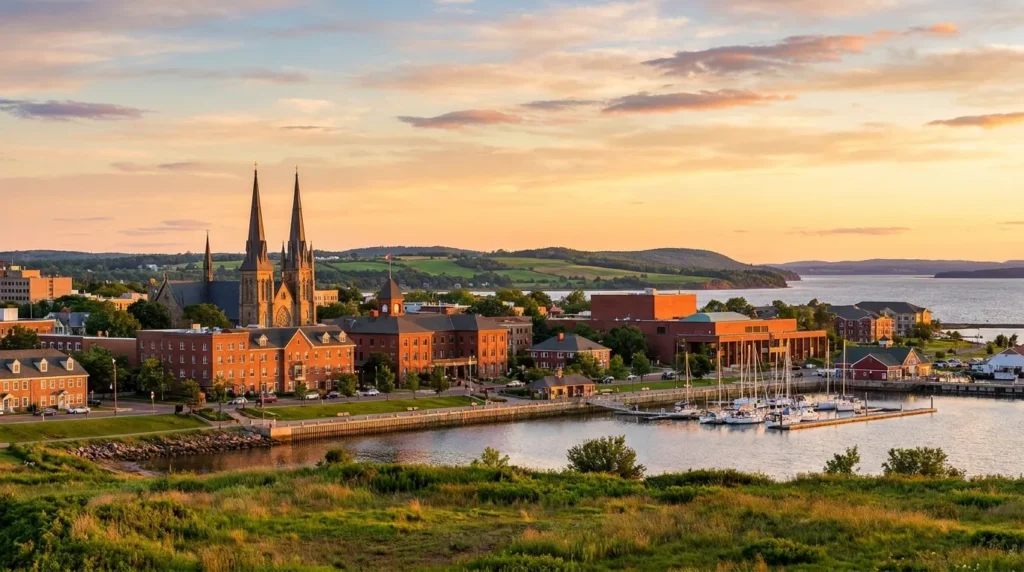
Charlottetown is the capital of Prince Edward Island and the city where Canadian Confederation was born in 1864. Its attractions blend history, theatre, and coastal life at a walkable scale.

The tourist heart of the city is the Province House National Historic Site, where the meeting that created Canada was held, and the Confederation Centre of the Arts, home to the Charlottetown Festival and the annual Anne of Green Gables musical. Victoria Row, a pedestrian stretch of Richmond Street, concentrates restaurants, shops, and live music in summer.

Peake's Wharf on Charlottetown Harbour is the departure point for boat tours, seal watching, and visits to Founders' Hall. Beaconsfield Historic House and St. Dunstan's Basilica round out the architectural circuit downtown. For residents, the calendar revolves around Old Home Week in August and PEI Fall Flavours in September.

Outside the city, Prince Edward Island National Park on the north shore offers red sand beaches, dunes, and Green Gables Heritage Place in Cavendish. The Confederation Bridge, stretching 12.9 km, connects the island to the mainland and serves as both a logistical reference and a landmark for residents.

  1. 1["Province House National Historic Site"
  2. 2"Confederation Centre of the Arts"
  3. 3"Victoria Row"
  4. 4"Peake's Wharf"
  5. 5"St. Dunstan's Basilica"
  6. 6"Founders' Hall"
Nightlife4.0 / 10
Parks & green spaces
  • ["Victoria Park"
  • "Confederation Landing Park"
  • "Joe Ghiz Memorial Park"
  • "Hillsborough Park"
  • "Simmons Sport Centre Park"
  • +1 more

Latest posts

Straight from the blog

There are no posts specifically about Charlottetown yet. In the meantime, check out our latest posts.