Visto n' Visa
Blog
Notícias e artigos
Destinations
Careers
Immigrants

Want to live and work in Baker Lake?

Personalized immigration plan with eligible visas, costs, and next steps for your goal!

If you are not eligible, you will know exactly why and what to do to improve your approval chances.

Save up to 12 hours in meetings

No pointless assessments.

Save up to 90%

Save money on vague or unfocused consultations

Avoid Fraud and Mistakes

One mistake can cost you your visa

Total Impartiality

Zero commercial bias

Decide with peace of mind

No toxic urgency

Fast and Accurate

Answers in minutes, no guesswork

Baker Lake Population: Predominantly Caribou Inuit

About 90% of the population is Caribou Inuit (Hauniqtuurmiut), a community historically dependent on inland caribou hunting. The remainder are Qallunaat professionals.

Baker Lake is the homeland of the Caribou Inuit (Hauniqtuurmiut), a group that historically lived inland, relying on caribou hunting for everything: food, clothing, and shelter. About 90% of the current population is Inuit, and the hunting tradition remains strong. The rest, Qallunaat, are government, mining, health, and education professionals who have come from the south on contract.

Inuktitut, in its local Kivalliq variety, is the primary language at home and on the streets. Schooling begins in Inuktitut and introduces English gradually. English dominates government work and interactions with Qallunaat. There is no significant concentration of immigrants from Brazil, Latin America, or Asia.

The population is young, with large families and multiple generations living nearby. The presence of mining has brought technical professionals from other Inuit communities and from the south. There is a steady flow of residents between Baker Lake and Rankin Inlet, and family ties extend across all of Kivalliq.

Languages spoken
  • Kivalliq dialect Inuktitut
  • English
Main religions
  • Anglican
  • Roman Catholic
  • Pentecostal and Evangelical
  • No religion
  • Traditional Inuit spirituality

Cost of Living in Baker Lake: Expensive, but with Mining Wages

Food and housing costs are high, in line with Nunavut standards. The presence of the Meadowbank mine means many residents earn above-average wages.

Baker Lake has cost-of-living levels typical of Nunavut: food at twice or three times the price of southern Canada, high heating fuel costs, and air freight for everything that does not arrive by sealift. The Northern and Co-op stores are the main supermarkets, with partial subsidies from the Nutrition North program for basic items.

Private rental housing is scarce. Most of the housing stock consists of public units managed by the Kivalliq Housing Association. Professionals arriving through the mine, government, or hospital typically have employer-provided housing, with rent deducted from their pay.

The distinguishing factor in Baker Lake is mining income. Operators, mechanics, and technicians at Agnico Eagle earn well above the Nunavut average, with flights, accommodation, and meals covered by the company during shifts. This improves the purchasing power of families with members employed at the mine, even though overall costs remain high.

Baker Lake

Housing in Baker Lake: Public Stock Dominates, Mining Pressure Adds Strain

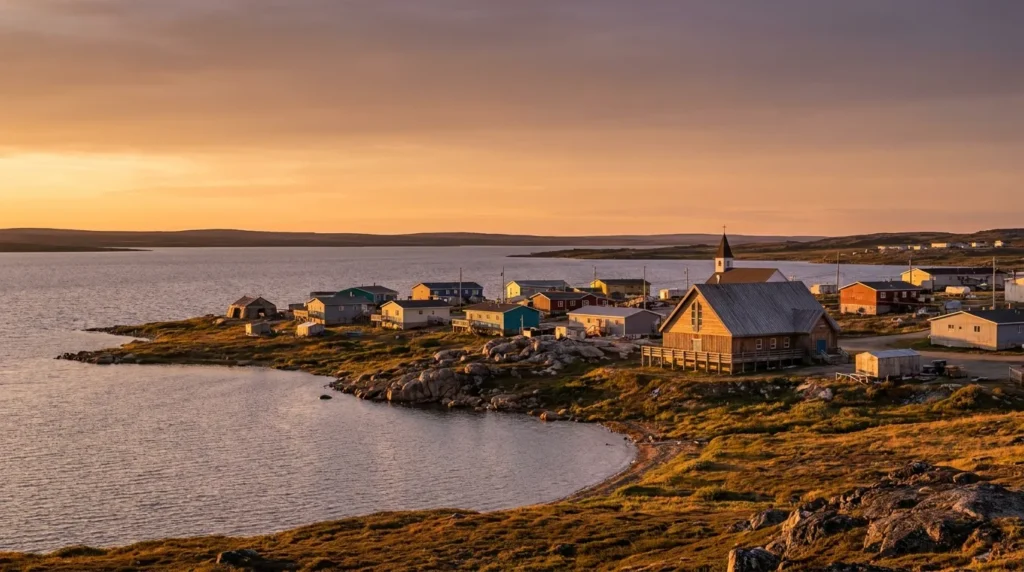
Modular homes on pilings, mostly government-owned. The mine's presence and incoming workers put additional pressure on the market.

Baker Lake features gravel streets lined with modular homes on pilings, the standard for Nunavut communities. The housing stock is predominantly government-owned, rented through the Kivalliq Housing Association on an income-based scale. The waitlist is long and overcrowding is a persistent problem.

The private market is minimal. A few rental units exist for mining staff and government contractors, but at high prices. Those arriving to work in schools, the hospital, or the municipal government typically receive staff housing provided by the employer.

Construction is limited by the summer sealift, which brings materials and prefabricated modules. The territory is investing in new housing blocks to reduce the waitlist and overcrowding, but demand grows faster than supply. Purchasing private property is rare and carries risk, given the lack of a resale market.

Recommended neighborhoods
  • Downtown (near government offices and the grocery store)
  • Lakeside (traditional homes)
  • North sector (recent expansion)
  • Jonah Amitnaaq School area

Job Market in Baker Lake: The Meadowbank Gold Mine Drives Employment

Agnico Eagle's mine, 110 km from the hamlet, dominates local employment. Government, schools, and health services round out the options.

Baker Lake is the logistics base for the Meadowbank gold mine, owned by Agnico Eagle, which has been in operation since 2010. The mine hires operators, mechanics, drivers, cooks, and technicians on a fly-in fly-out schedule, using Baker Lake as its base. Many Inuit residents hold positions secured through local hiring programs. Wages for operators exceed CAD 90,000 per year.

Government employment comes second: the Hamlet of Baker Lake, territorial departments for education, health, justice, and community services. The Jonah Amitnaaq Secondary School and Rachel Arngnammaktiq Elementary School hire teachers from the south with relocation packages. The local Health Centre employs nurses on rotation.

There is also work in retail (Northern, Co-op), air transport (Calm Air), seasonal summer construction, and fishing tourism. Sport fishing on Baker Lake attracts American and southern Canadian visitors who pay premium rates for multi-week packages. The local Sanavik Cooperative trades in Inuit art.

Dominant sectors
  • Gold mining (fly-in fly-out)
  • Territorial and municipal government
  • Education
  • Health (local health center)
  • Air transportation
  • +2 more
Major employers
  • Agnico Eagle (Meadowbank mine)
  • Hamlet of Baker Lake
  • Government of Nunavut
  • Jonah Amitnaaq Secondary School
  • Rachel Arngnammaktiq Elementary School
  • +3 more

Education in Baker Lake: Inuktitut Schools and an Arctic College Campus

Two public schools with bilingual Inuktitut-English instruction. Nunavut Arctic College maintains a local unit with technical programs.

Children in Baker Lake attend Rachel Arngnammaktiq Elementary School, from kindergarten through grade 6, and Jonah Amitnaaq Secondary School, from grades 7 through 12. Early instruction is in Inuktitut, with English introduced as a second language in later grades. Inuit cultural activities, including hunting, sewing, and art, are part of the curriculum.

Nunavut Arctic College maintains a unit in Baker Lake (Community Learning Centre), with programs in Inuktitut instruction, administrative management, mining technician training, and trades. For nursing and post-secondary education, young people travel to the main campus in Rankin Inlet or Iqaluit, or to partner universities in Manitoba.

Completing a full university degree requires relocating to Winnipeg, Ottawa, or other cities. Territorial government scholarships and grants are available to Nunavut residents. Many graduates return to work as teachers, nurses, municipal managers, or in technical positions in the mining sector.

Notable universities
  • Nunavut Arctic College (Community Learning Centre, Baker Lake)
  • Nunavut Arctic College (Kivalliq Campus, Rankin Inlet)
  • University of Manitoba (partner institution)

Healthcare in Baker Lake: Local Health Centre and Transfers to Rankin or Winnipeg

Health Centre staffed by rotating nurses. Serious cases are transferred to the Rankin Inlet hospital or to Winnipeg by medevac.

The Baker Lake Health Centre provides basic consultations, vaccinations, urgent care, and prenatal services. It is operated by the Government of Nunavut, staffed by nurses from the south on short-term contracts. A resident physician is not always available, and many consultations rely on telemedicine with professionals in Rankin Inlet.

More complex cases are transferred to the Kivalliq Health Centre in Rankin Inlet, or directly to Winnipeg, Manitoba, by medical evacuation flight. Surgeries, oncology, high-risk deliveries, and advanced imaging are not available in the hamlet. Workers injured at the mine are typically flown directly to Winnipeg.

The system is free for residents under the territorial health plan. Inuit residents have additional coverage through the federal Non-Insured Health Benefits program for dental care, eyewear, medications, and medical travel. Mental health and suicide prevention are growing priorities, given the elevated rates in Arctic communities.

Healthcare index50.0 / 100
  • Life expectancyyears at birth
    81.6yrs
  • Doctors per 1kpracticing physicians
    2.8
  • Health spendper capita, per year
    $6,187
  • Public systemoverall quality rating
    Fair

Safety in Baker Lake: Quiet Community with Social Challenges

Crimes against strangers are rare. Domestic violence, alcohol, and suicide are ongoing issues common throughout Nunavut. Extreme weather poses the greatest practical risk.

Baker Lake is a small community where most people know one another. Crimes against strangers are rare, and professionals arriving on contract generally move around freely. The RCMP maintains a local detachment with both Inuit and southern officers. The relationship with the community is generally close.

As in other Nunavut communities, domestic violence, alcohol-related assaults, and suicide rates are high compared to southern Canada. The roots lie in the intergenerational trauma of residential schools, the housing crisis, and a lack of opportunities for young people. The hamlet has beverage control restrictions during certain periods.

The greatest practical risk is the climate. Winter blizzards can shut everything down within hours, and setting out by snowmobile without proper equipment is dangerous. Experienced hunters (elders) always guide younger community members on how to read the weather. Polar bears do not reach Baker Lake, which is inland and far from the coast, but wolves and brown bears do appear.

2.0
Homicides per 100k
per year
Safety index
35.0
Crime index
65.0
Safer neighborhoods
  • Residential center near the Jessie Oonark Centre
  • Areas around Jonah Amitnaaq school
  • Neighborhoods surrounding the Co-op
Areas to avoid
  • Remote tundra outside the center at night
  • Lake shores after dark
  • Isolated areas in winter without proper preparation

Transportation in Baker Lake: Regional Airport and Summer Sealift

No road connection to the outside. The airport receives flights from Calm Air originating in Winnipeg and Rankin Inlet. A sealift travels up the Chesterfield Inlet in summer.

Baker Lake has no highway connecting it to the rest of Canada. The local airport receives daily flights from Calm Air, originating in Winnipeg, Manitoba, with stops at Rankin Inlet. Mining workers have their own charter flights arranged by Agnico Eagle between the mine site and hubs in Winnipeg and other Kivalliq communities.

The annual sealift travels up the Chesterfield Inlet between July and October, bringing containers of food, fuel, construction materials, and vehicles. This is the most cost-effective channel for large cargo, but the window is narrow. Missing a southern departure means waiting another year.

Within the hamlet, the gravel streets are few and short. The community is walkable, though extreme cold in winter makes snowmobile use common. In summer, ATVs dominate. For hunting and fishing, Inuit families travel the lake by boat in summer and by snowmobile in winter.

7 min
Avg commute
38
Walkability
Airports
  • YBK — Baker Lake Airport

What the climate is like living in Baker Lake

The only inland settlement in Nunavut, near the geographic center of Canada. Continental tundra climate with extreme winters and short, cool summers.

Summer is brief. From June to August, highs reach 14 to 16 degrees Celsius on good days, with nights near freezing. The midnight sun lights the sky in June. Baker Lake becomes navigable for a few weeks, and the community takes advantage of the season for fishing and boat trips to nearby points.

Winter is long and severe. From October through May, regular lows range from 35 to 40 degrees below zero Celsius, with occasional episodes below minus 45. Wind amplifies the wind chill. Houses are built on pilings with oil heating, and streets have anchor posts for rope lines during blizzards.

Annual precipitation is around 260 mm, largely as snow. The northern lights are frequent in winter thanks to the high latitude and clear skies. Daily life requires extreme cold-weather technical clothing and strict discipline about going outside only when wind conditions allow.

Sunny days / year130 days
Avg high (°F)
  • J
  • -3°F
  • 15°M
  • 30°A
  • 40°M
  • 69°J
  • 71°J
  • 71°A
  • 55°S
  • 40°O
  • 15°N
  • 10°D
Avg low (°F)
  • -52°J
  • -55°F
  • -44°M
  • -29°A
  • M
  • 28°J
  • 39°J
  • 33°A
  • 23°S
  • -7°O
  • -41°N
  • -51°D
Rainfall (")
  • 1"J
  • 0"F
  • 1"M
  • 1"A
  • 2"M
  • 3"J
  • 4"J
  • 4"A
  • 3"S
  • 3"O
  • 1"N
  • 1"D

Culture in Baker Lake: Internationally Recognized Inuit Art

A strong tradition of printmaking, wall hangings, and sculpture. The Sanavik Cooperative and the Jessie Oonark Centre export to galleries across Canada and abroad.

Baker Lake is one of the most important centers of Inuit art in Canada. The name Jessie Oonark, an artist born in the region who passed away in 1985, is a world reference in wall hangings and printmaking. The Jessie Oonark Centre continues training artists, and the Sanavik Cooperative sells works to galleries in Toronto, Winnipeg, New York, and Tokyo.

The Caribou Inuit tradition is alive: caribou hunting in autumn and spring, hide preparation for clothing, sewing traditional parkas (amauti), and boots (kamiit). Fishing on Baker Lake is a family practice both in summer by boat and in winter through the ice. Caribou meat is the foundation of the traditional diet, shared throughout the community.

The calendar includes Hamlet Days at the end of summer, with igloo-building competitions, dog racing, traditional Inuit games, and country food dinners. Religious events at the Anglican, Catholic, and Pentecostal churches mobilize part of the population. CBC North radio broadcasting in Inuktitut connects the community to the rest of Kivalliq.

1
Major museums
Notable dishes
  • Caribou (staple food)
  • Lake trout
  • Arctic char
  • Bannock
  • Smoked whitefish
  • +2 more
Annual events
  • Baker Lake Music Festival
  • Hamlet Days
  • Nunavut Day Celebration
  • National Indigenous Peoples Day
  • Inuit Art Festival
  • +1 more

What to see in Baker Lake, Nunavut's central Inuit community

Baker Lake (Qamani'tuaq) is the only inland community in Nunavut, at the geographic center of Canada. Living Inuit culture, internationally recognized art, and endless tundra.

Baker Lake is world-renowned for its tradition of Inuit tapestry and printmaking. The Inuit Heritage Centre displays works by local artists such as Jessie Oonark, Marion Tuu'luq, and the Anguhadluq brothers, with a collection of prints, soapstone sculptures, and wool tapestries. The Sanavik Cooperative serves as the community's hub for art production and sales.

Baker Lake, covering more than 1,800 square kilometers, is the heart of local life. Arctic char fishing, caribou hunting, northern lights viewing from September through April, and crossings by snowmobile and qamutiit (sleds) are part of daily life. About 175 km to the northwest lies the Thelon Wildlife Sanctuary, a refuge for muskox and caribou.

Annual events include Hamlet Day in June, featuring igloo-building competitions, sewing, hunting, and traditional Inuit games. The community speaks Inuktitut and English. Access is by air only, via Rankin Inlet. Visiting Baker Lake means entering a rhythm where the season, the light, and the ice determine what is possible on any given day.

  1. 1["Jessie Oonark Centre (Inuit art gallery)"
  2. 2"Inuit Heritage Centre"
  3. 3"Baker Lake (the lake)"
  4. 4"Thelon Wildlife Sanctuary (accessible by bush plane)"
  5. 5"Pre-Dorset and Thule archaeological sites"
  6. 6"Kazan River (nearby)"]
Nightlife1.0 / 10
Parks & green spaces
  • ["Baker Lake shoreline"
  • "Tundra trails around the community"
  • "Prince River area"
  • "Thelon River area (nearby)"]

Latest posts

Straight from the blog

There are no posts specifically about Baker Lake yet. In the meantime, check out our latest posts.