Visto n' Visa
Blog
Notícias e artigos
Destinations
Careers
Immigrants

Want to live and work in Sydney Mines?

Personalized immigration plan with eligible visas, costs, and next steps for your goal!

If you are not eligible, you will know exactly why and what to do to improve your approval chances.

Save up to 12 hours in meetings

No pointless assessments.

Save up to 90%

Save money on vague or unfocused consultations

Avoid Fraud and Mistakes

One mistake can cost you your visa

Total Impartiality

Zero commercial bias

Decide with peace of mind

No toxic urgency

Fast and Accurate

Answers in minutes, no guesswork

A small community with Scottish and Irish roots

Sydney Mines has about 15,000 residents within the broader Cape Breton metro area, with strong Celtic heritage and recent growth from Asian immigration.

The population is mostly of British, Scottish, Irish, and French Acadian origin, with a historic Mi'kmaq presence across the island. Throughout the 20th century, Italian, Polish, and Ukrainian communities arrived to work in the mines and left their mark on family names, churches, and local cuisine.

Over the past fifteen years, Nova Scotia has attracted immigrants through the Atlantic Immigration Program. Cape Breton receives families from the Philippines, India, China, and Eastern European countries, drawn by provincial programs that grant permanent residency in exchange for a local job offer. Cape Breton University, in Sydney, is the main engine of this recent flow, bringing international students who often settle in the region.

The age profile is more mature than the Canadian average, with many retirees and few young residents. English is the absolute dominant language in daily life, with Scottish Gaelic preserved in festivals and some churches. Community life revolves around parishes, legions, sports clubs, and seasonal events.

Languages spoken
  • English
  • Scottish Gaelic
  • Acadian French
  • Mi'kmaq
  • Tagalog
  • +1 more
Main religions
  • Roman Catholicism
  • Anglicanism
  • United Church of Canada
  • Presbyterianism
  • No religion

One of the lowest costs in Canada

Cape Breton offers housing, energy, and groceries significantly below the Canadian average, with winter heating as the main extra expense.

Sydney Mines is one of the most affordable places to live in Canada. Detached three-bedroom houses sell for sums that would not even cover a studio in Toronto or Vancouver. Monthly rent for a small house is modest, and apartments are rare because the dominant supply is single-family homes with yards.

Groceries are reasonable. Chains such as Sobeys, Atlantic Superstore, and Walmart cover the basics, with prices in line with the Atlantic regional average. Fresh fish and shellfish are cheap straight from the harbor. Restaurants are few and simple, with pubs and diners dominating. Dining out does not weigh heavily on the budget.

The expense that surprises newcomers is heating. Winter in Cape Breton is long, and houses running on oil or electricity can rack up high monthly bills between December and March. It pays off to prioritize homes with heat pumps or wood stoves. A car is practically mandatory, and auto insurance in Nova Scotia is mid-range.

Sydney Mines

Cheap wooden houses, limited rental supply

The market is dominated by the purchase of well-kept century-old homes; formal rentals are scarce and rely heavily on local referrals.

The housing stock in Sydney Mines is almost entirely single-story or two-story wooden homes, built for miners' families between 1900 and 1950. Many have been well renovated, with updated insulation and modern kitchens. Central neighborhoods sit close to Main Street, the harbor, and schools, on flat, tree-lined streets.

Buying tends to pay off more than renting because the rental supply is small and informal. Sites like Realtor.ca, Kijiji, and local Facebook groups concentrate listings. Those arriving via the Atlantic Immigration Program usually find housing through their employer or a regional immigration agent. A Canadian mortgage requires 5 to 20 percent down, and banks such as Scotiabank, RBC, and CIBC serve the region.

The most sought-after neighborhoods are downtown Sydney Mines, North Sydney (the neighboring town next door), and the coastal strip of Cranberry Head. For those seeking isolation, rural communities to the north such as Bras d'Or offer large lots for little money.

Recommended neighborhoods
  • Downtown Sydney Mines
  • North Sydney
  • Cranberry Head
  • Bras d'Or
  • Florence
  • +1 more

Healthcare, retail, and tourism sustain the local economy

The mines have closed, but the hospital, public services, Cape Breton tourism, and remote work keep employment going in the region.

The Sydney Mines job market is modest and concentrated in a few sectors. Northside General Hospital is a major local employer, along with nursing homes and clinics. The Cape Breton Regional Municipality hires in public services, education, and infrastructure. Retail along Main Street and at the metro Sydney area's shopping centers rounds it out.

Tourism along the Cabot Trail and at the Fortress of Louisbourg sustains hotels, restaurants, and tour operators between May and October. Marine Atlantic operates the ferry terminal in North Sydney, with crossings to Newfoundland that generate logistics jobs. Small-scale fishing and seafood processing still exist, on a reduced scale.

Skilled professionals in technology, finance, or healthcare often work remotely for employers in Halifax, Toronto, or the US. The province eases licensing for foreign doctors and nurses through Nova Scotia Health, the main entry point for immigrants in healthcare.

Dominant sectors
  • Healthcare and social services
  • Retail
  • Public administration
  • Tourism and hospitality
  • Fishing
  • +1 more
Major employers
  • Nova Scotia Health (Northside General Hospital)
  • Cape Breton Regional Municipality
  • Marine Atlantic
  • Cape Breton University
  • Sobeys
  • +2 more

Community schools and a nearby university in Sydney

Public K-12 education is centralized under the Cape Breton-Victoria Regional Centre; higher education concentrates at Cape Breton University.

The K-12 system is free and run by the Cape Breton-Victoria Regional Centre for Education. Sydney Mines has elementary schools and Memorial High School, which takes students from neighboring villages. Schools tend to be small, with reduced class sizes and strong community ties. Immigrants are entitled to English as a second language support services.

For higher education, the reference is Cape Breton University, in Sydney, about 20 minutes by car. The university has grown substantially in recent years with the arrival of students from India, the Philippines, Bangladesh, and Nigeria, and offers undergraduate programs, MBAs, and technical courses through the Nova Scotia Community College. The campus has dorms, a joint public library, and career centers.

Families that prioritize more robust schools or private institutions usually consider Halifax, but for immigrants who value a safe environment and low costs, Sydney Mines works well from kindergarten through high school.

Notable universities
  • Cape Breton University
  • Nova Scotia Community College (Marconi Campus)
  • Dalhousie University (Halifax)
  • Saint Mary's University (Halifax)

A local hospital, but finding a family doctor remains a problem

Nova Scotia Health provides free care through the Health Card; the bottleneck is the wait list for a family physician, as everywhere in Canada.

Healthcare is free for residents through the Nova Scotia Health Card, obtained a few months after arriving as a permanent resident. Sydney Mines has Northside General Hospital, with emergency, inpatient, and basic diagnostic services. More complex specialties are referred to the Cape Breton Regional Hospital in Sydney, or the QEII Health Sciences Centre in Halifax.

The major bottleneck, as nearly everywhere in Canada, is finding a family doctor. Nova Scotia has a centralized wait list, and newcomers may wait months or years. In the meantime, basic care is handled at walk-in clinics, the 811 telehealth line, and pharmacies with prescribing pharmacists for simple cases.

For families with children or elderly members with chronic conditions, it is worth planning arrival with enough medication for several months and immediately registering with the Need a Family Practice Registry. Private dental and vision plans are recommended, since the public system does not cover them.

Sydney Mines

A quiet town with low violent crime rates

Sydney Mines is considered safe by North American standards; concerns are opportunistic theft, drugs in specific areas, and wildlife in rural zones.

Sydney Mines has low rates of violent crime. Most incidents involve theft from unlocked cars, occasional vandalism, and drug-related offenses in specific neighborhoods. Policing is provided by the Cape Breton Regional Police Service, with a visible presence and community proximity.

As in every Atlantic region that faced deindustrialization, there are pockets with social problems linked to opioid use, especially on streets near former port areas and in more isolated sections. These places are not dangerous for visitors during the day, but it is wise to avoid walking alone at night on poorly lit streets.

Typical Cape Breton risks include wildlife encounters on rural roads, especially moose and deer, and severe winter conditions with blizzards and icy roads. Keeping snow tires, an emergency kit in the car, and respecting Nova Scotia 511 advisories avoids most problems.

Safer neighborhoods
  • Downtown Sydney Mines
  • Cranberry Head
  • Florence
  • Downtown North Sydney
  • Point Aconi
Areas to avoid
  • Abandoned industrial areas near the old port
  • Isolated stretches of Pitt Street at night

A car is essential, the ferry connects to Newfoundland

There is no subway or train, and public transit is limited to regional buses. A ferry in North Sydney links Cape Breton to Newfoundland.

Sydney Mines depends on a car for practically everything. Highway 125 and the Trans-Canada Highway 105 cut through the region and connect to Sydney, Glace Bay, and the rest of Nova Scotia. Internal distances are short: reaching downtown Sydney takes 15 minutes, the regional airport about 25, and Halifax roughly four and a half hours.

Transit Cape Breton runs regional bus lines with low frequency, useful for occasional trips but impractical for daily commutes. Sidewalks exist downtown, but winter cold and snow discourage long walks for much of the year. Cycling is feasible in summer on secondary roads, though there is still no formal bike lane network.

The Marine Atlantic terminal in North Sydney handles daily ferries to Port aux Basques and seasonal service to Argentia, in Newfoundland. For flights, the JA Douglas McCurdy Sydney Airport (YQY) offers connections to Halifax and Toronto. For international flights, Halifax Stanfield (YHZ) is the regional benchmark.

Airports
  • YQY, JA Douglas McCurdy Sydney Airport
  • YHZ, Halifax Stanfield International Airport

Climate

Sydney Mines

Celtic music, kitchen parties, and mining heritage

Cape Breton thrives on traditional music, community festivals, and a strong identity tied to the sea, coal, and Scottish immigration.

Cape Breton's culture is heavily musical. Scottish fiddle, bagpipes, square dancing, and Gaelic singing show up in pubs, churches, and festivals year-round. So-called kitchen parties, informal gatherings in homes with live music and food, are part of the local social fabric and any newcomer is welcome.

The calendar includes the Celtic Colours International Festival in October, one of the largest Celtic music events in the world, spread across dozens of villages. In summer there are concerts at the harbor, seafood festivals, and Action Week in Sydney Mines, with community activities, fireworks, and a parade. Local cuisine prizes fish and chips, lobster rolls, oat cakes, meat pies, and Acadian fricot.

Pubs and legions are central gathering points. The mining heritage is celebrated with tours of the old collieries, monuments to accident victims, and museums that tell the story of the generations who came from Scotland, Italy, and Poland for coal.

Notable dishes
  • Lobster roll
  • Fish and chips with fresh cod
  • Oat cakes
  • Meat pies
  • Acadian fricot
  • +2 more
Annual events
  • Celtic Colours International Festival
  • Action Week Sydney Mines
  • Cape Breton Lobster Festival
  • Royal Nova Scotia International Tattoo (Halifax)
  • KitchenFest!

Sea, mining, and a gateway to the Cabot Trail

The town is a practical base for exploring Atlantic Canada's most famous landscape, with museums, coastal trails, and fishing harbors.

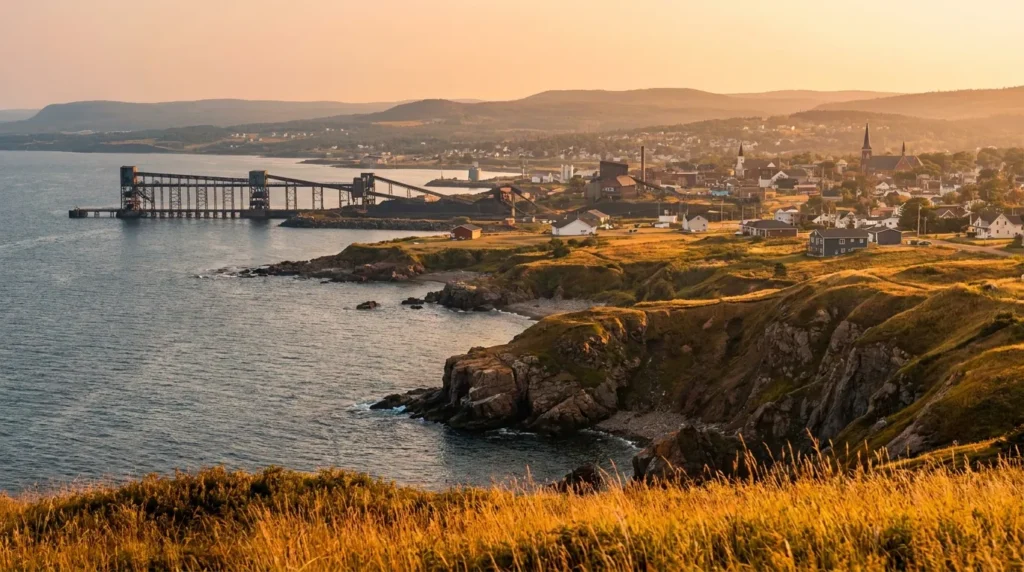
Sydney Mines itself offers a small downtown with historic churches, Victorian buildings, and the Cape Breton Miners Memorial Garden. The Sydney Mines Heritage Museum, housed in a former railway station, tells the story of the Princess and Florence mines. The waterfront features short trails, lookouts, and the Low Point lighthouse.

The main attraction is what surrounds the town. About 45 minutes away, the Cabot Trail begins, voted one of the most beautiful roads in the world, crossing Cape Breton Highlands National Park with cliffs, whales, and fishing villages. To the south, the Fortress of Louisbourg, an 18th-century French national historic site, is one of the largest historical reconstructions in North America.

In summer, beaches such as Dominion Beach and Ingonish Beach fill up. In winter, there is skiing at Ski Cape Smokey. For dining, Baddeck and Sydney concentrate the more sophisticated restaurants, farmers' markets, and cafés.

  1. 1Sydney Mines Heritage Museum
  2. 2Cape Breton Miners Memorial Garden
  3. 3Cabot Trail
  4. 4Cape Breton Highlands National Park
  5. 5Fortress of Louisbourg
  6. 6Alexander Graham Bell National Historic Site
Parks & green spaces
  • Cranberry Head Trail
  • Sydney Mines Waterfront Park
  • Dominion Beach Provincial Park
  • Petersfield Provincial Park
  • Cape Breton Highlands National Park

A small but growing immigrant community driven by provincial programs

Cape Breton receives immigrants through the Atlantic Immigration Program, with the Philippines, India, and China leading recent arrivals, on top of Scottish, Irish, and Acadian heritage.

The foreign-born population in Sydney Mines is small in absolute numbers but growing in share. Most arrived in the past fifteen years through the Atlantic Immigration Program and the Nova Scotia Nominee Program, which offer permanent residency to professionals with a local job offer. Cape Breton University is the main vector of this flow.

Filipinos form the most visible community, especially in healthcare and services. Indians, Chinese, Nigerians, and Bangladeshis arrive primarily as international students and stay after graduating. There is also a historic presence of descendants of Italians, Ukrainians, and Poles who came for the mines in the early 20th century. European immigration continues with British and Eastern European newcomers on a smaller scale.

Institutional support is coordinated by the YMCA of Cape Breton Newcomer Services and the Cape Breton Local Immigration Partnership, with free English classes, help validating diplomas, and mentorships. Churches, Hindu temples in Sydney, and mosques in Halifax serve the religious side.

1,800
Foreign-born residents
estimated
Top countries of origin
  • Philippines
  • India
  • China
  • United Kingdom
  • Nigeria
  • Bangladesh
  • United States
Foreign consulates
  • Honorary Consulate of Italy (Sydney)
  • Consulate General of the United Kingdom (Halifax)
  • Consulate General of the United States (Halifax)
  • Consulate General of France (Halifax)
  • Honorary Consulate of Germany (Halifax)
  • +1 more
Community organizations
  • YMCA of Cape Breton Newcomer Services
  • Cape Breton Local Immigration Partnership
  • Cape Breton University International Student Office
  • Immigrant Services Association of Nova Scotia (ISANS)
  • Catholic Charities Cape Breton

Latest posts

Straight from the blog

There are no posts specifically about Sydney Mines yet. In the meantime, check out our latest posts.