Visto n' Visa
Blog
Notícias e artigos
Destinations
Careers
Immigrants

Want to live and work in Halifax North End?

Personalized immigration plan with eligible visas, costs, and next steps for your goal!

If you are not eligible, you will know exactly why and what to do to improve your approval chances.

Save up to 12 hours in meetings

No pointless assessments.

Save up to 90%

Save money on vague or unfocused consultations

Avoid Fraud and Mistakes

One mistake can cost you your visa

Total Impartiality

Zero commercial bias

Decide with peace of mind

No toxic urgency

Fast and Accurate

Answers in minutes, no guesswork

Who lives in Halifax North End

A mix of a historically rooted Black community, young professionals, Dalhousie students, and recent immigrants from a range of origins.

The North End is one of the most diverse neighborhoods in Halifax. The African Nova Scotian community, descended from Black Loyalists and refugees from the Anglo-American wars, has deep roots in the area, especially around the Cornwallis Street Baptist Church and the Uniacke Square neighborhood. It is one of the oldest Black communities in Canada.

Layered onto that historic base, the neighborhood welcomes students from Dalhousie and Saint Mary's, young professionals in tech and healthcare, and recent immigrants from Syria, the Philippines, India, China, and African countries such as Eritrea, Ethiopia, and Nigeria. Over the past decade, the arrival of Syrian refugees has brought new restaurants, markets, and bakeries to the neighborhood.

English dominates, but French appears in some public services due to federal bilingualism policy. Religiously, there is historic Protestantism in the African Nova Scotian Baptist churches, Catholicism, a growing Muslim presence among immigrants from the Middle East and North Africa, and a large unaffiliated share among younger residents.

Languages spoken
  • English
  • Arabic
  • Tagalog
  • Mandarin
  • French
  • +1 more
Main religions
  • Protestant Christianity
  • Catholicism
  • Islam
  • No religion
  • Hinduism

Cost of living in the North End: still affordable, but rising fast

Cheaper than downtown Halifax and the South End, but the pace of rent increases over the past five years has been among the most aggressive in Atlantic Canada.

The North End is still the most affordable way to live on the Halifax peninsula. Compared with neighborhoods such as the South End, Quinpool, or downtown itself, it remains possible to find one-bedroom apartments and row houses at more accessible prices, especially on streets further north, closer to Fairview and Bedford Basin.

The problem is how quickly prices have climbed. Between 2020 and 2025, Halifax was one of the Canadian cities with the steepest rent increases, and the North End felt the direct impact. Apartments that once rented for less than a thousand Canadian dollars now sit well above that mark, and family homes near Gottingen have multiplied in value.

Groceries are reasonable: there are larger supermarkets on Young Street and small ethnic markets scattered around. Eating out is expensive, as it is almost everywhere in Canada, but the North End concentrates more affordable options than downtown. Winter heating is the big expense, especially in older, poorly insulated houses.

Halifax North End

Housing in the North End: historic homes, new condos, and rental pressure

A mix of century-old wooden houses, low-rise buildings, and a recent wave of new condos along Gottingen and Robie, with a competitive market and low vacancy.

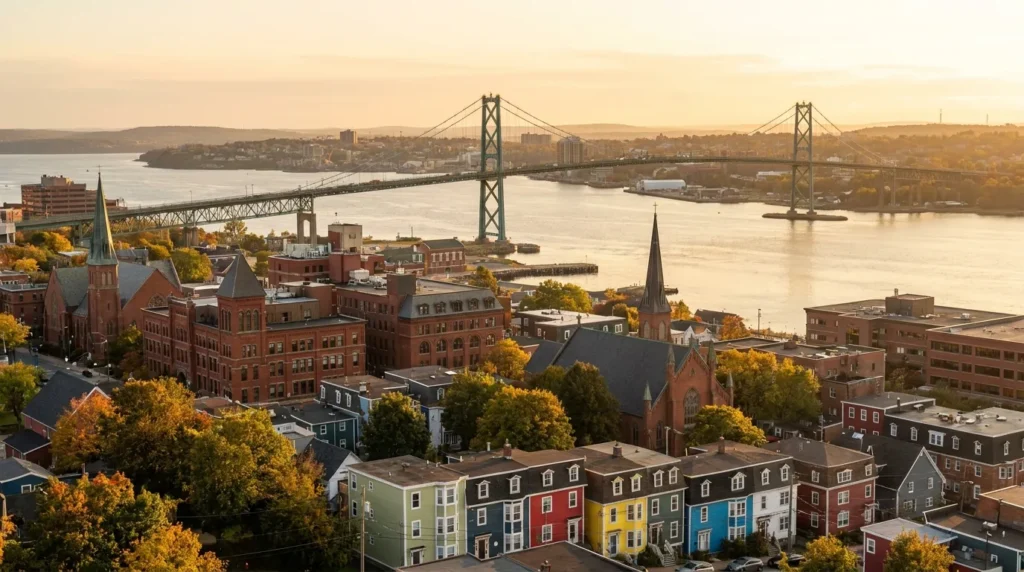
The landscape of the North End is dominated by two- and three-story wooden houses, many painted in bright colors, either survivors or reconstructions following the 1917 Explosion. There are also low-rise apartment blocks from the 1960s and 1970s, and more recently a wave of modern condominiums along Gottingen, Robie, and Almon Street.

For newly arrived immigrants, renting is the realistic option. Vacancy in Halifax is among the lowest in Canada, so securing an apartment requires speed, proof of income, and sometimes several months of deposit. Sites such as Kijiji, PadMapper, and PlacesForRent dominate the search. Subletting from Dalhousie students appears often in May and December.

Buying a home in the North End has become expensive. The same little wooden houses that were affordable in 2015 now exceed half a million Canadian dollars. Areas closer to Fairview and the Hydrostone Market have better prices, and those willing to live just past the MacKay Bridge roundabout find more options.

Recommended neighborhoods
  • Hydrostone Market
  • Gottingen Street
  • Agricola Street
  • Maynard Street
  • Young Street
  • +2 more

Work in the North End: services, healthcare, tech, and creative industries

The neighborhood is home to small businesses, restaurants, and creative studios, but most residents work in hospitals, universities, and downtown companies just minutes away.

People who live in the North End usually work somewhere else on the peninsula. The major employers are nearby: the QEII Health Sciences Centre complex, Dalhousie University, the IWK Health Centre for children, Nova Scotia government offices downtown, and the commercial port of Halifax. All of them are reachable by bike or bus within twenty minutes.

Within the neighborhood itself there is a strong local economy: restaurants along Gottingen and Agricola, breweries such as Propeller and Good Robot, bakeries, hair salons, tattoo studios, repair shops, and small design and tech offices. For those working in hospitality or services, the North End offers many positions within walking distance.

The tech sector in Halifax has grown in recent years, with companies such as REDspace, Verafin, and several startups tied to the ocean industry. Many professionals in that sector choose the North End for the combination of lower rents and proximity to the office.

Dominant sectors
  • Healthcare
  • Higher education
  • Technology and startups
  • Services and hospitality
  • Provincial government
  • +1 more
Major employers
  • QEII Health Sciences Centre
  • IWK Health Centre
  • Dalhousie University
  • Government of Nova Scotia
  • Port of Halifax
  • +3 more

Education in the North End: public schools and university proximity

Public schools under the Halifax Regional Centre for Education serve the neighborhood, with Halifax universities a short distance away.

The North End is covered by the Halifax Regional Centre for Education, with public schools such as Saint Joseph's-Alexander McKay, Joseph Howe Elementary, and Highland Park Junior High. The public high school of reference for the area is Citadel High, on the edge of downtown, which receives students from across the peninsula.

There are French school options through the Conseil scolaire acadien provincial, important for francophone families or those who want their children to grow up bilingual. Some private schools, such as the Halifax Independent School, are accessible from the neighborhood.

For higher education, the neighborhood is privileged: Dalhousie University and Saint Mary's University are just to the south, and NSCAD University, focused on art and design, has a campus downtown a few minutes away. Many students from these three campuses end up living in the North End precisely for the combination of price and proximity.

Notable universities
  • Dalhousie University
  • Saint Mary's University
  • NSCAD University
  • Mount Saint Vincent University
  • University of King's College

Healthcare in the North End: next to the largest hospitals in the province

The neighborhood sits beside the largest hospital complex in Atlantic Canada, with the Canadian public system and community clinics within walking distance.

Living in the North End means being minutes from the QEII Health Sciences Centre, the largest hospital complex in Atlantic Canada, and from the IWK Health Centre, the regional pediatric hospital of reference. For emergencies and complex treatments, the location is hard to beat anywhere else in the province.

Primary care, however, faces the same challenge as the rest of Nova Scotia: a shortage of family doctors. Many residents spend years on the Need a Family Practice Registry waitlist for a general practitioner. In the meantime, they rely on walk-in clinics, the North End Community Health Centre community clinic, which serves vulnerable populations, and the public mental health system.

For immigrants, the provincial Medical Services Insurance (MSI) covers essential services after a waiting period. Pharmacies from chains such as Shoppers Drug Mart and Lawtons are scattered along Gottingen, Young, and Robie. Mental health is partially covered by the public system, with expensive private supplementation.

Halifax North End

Safety in the North End: a neighborhood in transition, without alarmism

Historically seen as rougher than the South End, the North End is now considered safe by most residents, with a few specific stretches still busier at night.

For decades the North End had a reputation for being rougher than the South End, especially around Uniacke Square and the southern stretch of Gottingen. That perception weighed heavily on the neighborhood's Black community and did not always match actual crime data.

Today, with gentrification and investment in lighting, parks, and community policing, the North End is considered safe by most residents. The most common crimes are petty theft, car break-ins, and occasional vandalism. Violent crime exists but is localized and rare outside specific nights in a few spots on Gottingen.

For newly arrived immigrants, standard Canadian city precautions apply: lock your bike with a good lock, leave nothing visible in your car, and pay attention at night along Cogswell and around bars with late closing times. Women walk alone comfortably in most of the neighborhood.

Safer neighborhoods
  • Hydrostone Market
  • Young Avenue
  • Fairview
  • Almon Street near Robie
  • Commercial stretch of Agricola Street
Areas to avoid
  • Specific stretches of Gottingen late at night
  • Areas near isolated Cogswell parking lots
  • Uniacke Square at night

Transportation in the North End: walkable, with buses and bike lanes

One of the most walkable neighborhoods in Halifax, with several Halifax Transit bus routes, separated bike lanes, and proximity to the MacKay Bridge to Dartmouth.

The North End is perhaps the most walkable neighborhood in Halifax after downtown. Distances are short, streets have sidewalks, and grocery stores, cafes, schools, and libraries are all nearby. Cycling is also viable: the city has invested in separated bike lanes on Almon, Hollis, and Vernon, and the terrain is flatter than in other parts of the peninsula.

By bus, Halifax Transit covers the neighborhood with several routes, including the 1, 7, 9, and 10, which connect the North End to downtown, Dalhousie, and Bayers Lake. There is no subway, but the ferry across the harbor to Dartmouth leaves from downtown, a five-minute walk from some parts of the neighborhood.

To leave Halifax, the Stanfield International Airport is about forty minutes by car via Highway 102. There is no efficient direct public transportation to the airport. Those with cars use the MacKay Bridge to cross to Dartmouth and the eastern side of the metro area.

Airports
  • YHZ, Halifax Stanfield International (40 minutes by car)
  • Bike infrastructure

Climate

Halifax North End

Culture in the North End: music, art, and food from around the world

An intense artistic, musical, and culinary scene, with a deep African Nova Scotian heritage and recent additions from immigrant communities of the Middle East, Africa, and Asia.

Cultural life in the North End is one of the densest in Halifax. Gottingen Street and Agricola concentrate live music bars, independent galleries, record shops, and small theaters. The Marquee Ballroom hosts shows by local and Canadian indie bands. Festivals such as the Halifax Pop Explosion and the Halifax Jazz Festival use venues in the neighborhood.

African Nova Scotian heritage is a central part of the identity. The Cornwallis Street Baptist Church, the Africville Museum near Bedford Basin, and the African Heritage Month events in February reflect this history. Africville, a historic Black community demolished in the 1960s, sits just to the north and has been turned into a memorial park.

The food scene is eclectic. Old pubs serve seafood typical of Nova Scotia, Syrian restaurants have brought shawarma and Arab sweets, Ethiopians have opened injera spots, and there is Japanese ramen, Vietnamese pho, and Jamaican dishes. The Hydrostone Market brings together bakery, cheese shop, and cafes in a historic complex rebuilt after the Explosion.

Notable dishes
  • Halifax donair
  • Nova Scotia boiled lobster
  • Lobster roll
  • Fish and chips with local cod
  • Blueberry grunt
  • +2 more
Annual events
  • Halifax Pop Explosion
  • Halifax Jazz Festival
  • Nocturne: Art at Night
  • African Heritage Month
  • North End Open House
  • +1 more

What to see and do in the North End

The Africville memorial, Hydrostone Market, craft breweries, galleries, and the walk along Bedford Basin are the anchors of the neighborhood.

The Africville Museum, inside Africville Heritage Park, is a required stop to understand the history of the Black community demolished by the city in the 1960s. The park faces Bedford Basin and offers one of the most beautiful waterfront walks in Halifax, with a view of the MacKay Bridge.

The Hydrostone Market is the commercial heart rebuilt after the 1917 Explosion. It concentrates bakery, cheese shop, cafe, bookstore, and small restaurants in a block of low brick buildings. Around it, the streets feature semi-detached homes in the English cottage model, all built under the same post-disaster project.

For beer lovers, the North End is the brewing mecca of Halifax. Propeller, Good Robot, Unfiltered Brewing, and North Brewing operate open taprooms. Galleries such as the Khyber and Anchor Archive round out the cultural circuit. For running or cycling, the Halifax Common, just to the south, is the largest urban park on the peninsula.

  1. 1Africville Heritage Park and Museum
  2. 2Hydrostone Market
  3. 3Halifax Common
  4. 4Propeller Brewery
  5. 5Good Robot Brewery
  6. 6Fort Needham Memorial Park
Parks & green spaces
  • Halifax Common
  • Fort Needham Memorial Park
  • Africville Park
  • Isleville Park
  • Needham Park
  • +1 more

Immigrant communities in Halifax North End

A neighborhood with deep African Nova Scotian heritage has welcomed Syrian, Filipino, Indian, Chinese, and East African refugees in recent decades, with growing community infrastructure.

Halifax is the main gateway for immigrants in Atlantic Canada, and the North End is one of the neighborhoods that receives the most newcomers. The Syrian community grew significantly starting in 2015, with families brought through the federal refugee program. Today there are Arab bakeries, restaurants, and markets along Gottingen and Agricola.

The Filipino community is one of the largest and most organized, with a Catholic church, events, and community groups. Indians, Chinese, and Vietnamese are also well represented, many tied to Dalhousie. Eritreans, Ethiopians, Somalis, and Nigerians form the most recent African presence, with their own mosques and churches.

ISANS, the Immigrant Services Association of Nova Scotia, is the central settlement agency in the city, with offices accessible from the North End. They offer LINC English classes, help with recognition of professional credentials, and guidance on renting housing and finding work. It is the first address every new immigrant in Halifax should look up.

18,000
Foreign-born residents
estimated
Top countries of origin
  • Philippines
  • India
  • China
  • Syria
  • United Kingdom
  • Eritrea
  • Nigeria
  • United States
Foreign consulates
  • Honorary Consulate of Germany in Halifax
  • Honorary Consulate of France in Halifax
  • Honorary Consulate of Japan in Halifax
  • Honorary Consulate of Italy in Halifax
  • Honorary Consulate of the Netherlands in Halifax
  • +1 more
Community organizations
  • ISANS, Immigrant Services Association of Nova Scotia
  • YMCA Centre for Immigrant Programs
  • Halifax Refugee Clinic
  • Hope Blooms (diverse youth)
  • Mi'kmaw Native Friendship Centre
  • Multicultural Association of Nova Scotia

Latest posts

Straight from the blog

There are no posts specifically about Halifax North End yet. In the meantime, check out our latest posts.