Visto n' Visa
Blog
Notícias e artigos
Destinations
Careers
Immigrants

Want to live and work in Swan River?

Personalized immigration plan with eligible visas, costs, and next steps for your goal!

If you are not eligible, you will know exactly why and what to do to improve your approval chances.

Save up to 12 hours in meetings

No pointless assessments.

Save up to 90%

Save money on vague or unfocused consultations

Avoid Fraud and Mistakes

One mistake can cost you your visa

Total Impartiality

Zero commercial bias

Decide with peace of mind

No toxic urgency

Fast and Accurate

Answers in minutes, no guesswork

Who lives in Swan River

A mostly white population of Ukrainian, German, and British descent, with a significant Indigenous presence from neighboring First Nations communities and a recent inflow of Filipinos and Ukrainians through the PNP.

Swan River has about four thousand residents within the town and a few thousand more in the surrounding rural municipality. The historic profile is one of descendants of European settlers, mainly Ukrainians, Germans, English, and Scots, who established themselves in the valley in the early 20th century. Ukrainian Orthodox and Roman Catholic churches still function as community gathering points.

The Indigenous presence is strong: the Sapotaweyak Cree Nation, Wuskwi Sipihk, and Indian Birch First Nations are nearby, and a substantial share of the regional hospital's patients and the schools' students come from these communities. There is also a Métis population with deep roots in the region.

In recent years, the town has welcomed new Filipino residents brought through provincial programs to fill positions in healthcare, slaughter, and care services, along with Ukrainian families who arrived after 2022 under the federal welcome program. English is dominant; Ukrainian and Cree are still spoken at home in some families.

Languages spoken
  • English
  • Ukrainian
  • Cree
  • Tagalog
  • German
  • +1 more
Main religions
  • Roman Catholic Christianity
  • Ukrainian Orthodox Christianity
  • Protestant Christianity (United Church, Anglican, Mennonite)
  • Traditional Indigenous spirituality
  • No religion

Cost of living in Swan River: low by Canadian standards

Rent and housing well below the Winnipeg average, groceries and fuel slightly more expensive due to freight, high heating bills in winter.

Swan River is one of the most affordable places to live in Manitoba. Three-bedroom houses sell at prices that would be unthinkable in Winnipeg or Toronto, and those who arrive through the PNP often manage to buy property within a few years. Rent for a one-bedroom apartment falls into a modest range, and a duplex or older home rarely exceeds accessible levels.

Groceries cost a bit more than in the capital because everything arrives by truck, and fresh produce can be limited outside of season. Restaurants are few and simple, so most families cook at home. Fuel also tends to be pricier than in Winnipeg.

The big invisible expense is heating. Winter lasts more than six months, and the natural gas or propane bill climbs sharply between November and March. Thermal clothing, boots, and snow tires stop being optional and become part of the annual budget.

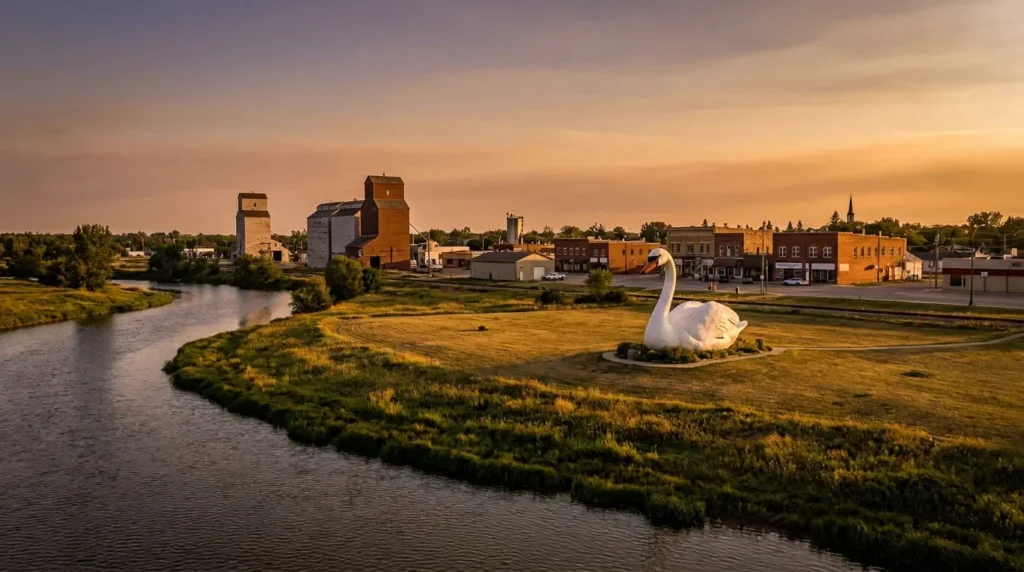
Swan River

Housing: cheap older homes and prairie-style bungalows

A market dominated by single-story single-family homes with large lots and a heated garage; apartment buildings are almost nonexistent.

Anyone arriving in Swan River should set aside the idea of an apartment. The overwhelming majority of housing consists of single-family homes with finished or semi-finished basements, in the bungalow style typical of the Canadian prairies. Lots are usually generous, with a yard for snow in winter and a garden in summer.

The town center has older wood-frame homes, some from the 1920s and 1930s, that need renovation but cost little. The newer neighborhoods are on the edges and offer 1980s and 1990s construction, with a heated garage, an essentially mandatory feature for surviving winter.

Rentals are scarce because few people invest in leasing. Those arriving through the PNP usually stay in a first rental for six to twelve months and then buy. Local real estate agencies, Royal LePage and Century 21, serve the region; it is common to close a deal directly with the owner.

Recommended neighborhoods
  • Downtown Swan River
  • Residential neighborhoods around Main Street
  • Kenville
  • Minitonas (a few minutes away)
  • Benito (to the west, even cheaper)

Job market: agriculture, slaughter, transport, and healthcare

Positions concentrated in agribusiness, poultry slaughter, grain cooperatives, regional hospital, and workshops; salaries lower than in Winnipeg, but with no competition.

The economic heart of the valley is agriculture: canola, wheat, barley, soy, and flax. Around it rotate grain cooperatives, John Deere and Case IH equipment dealers, heavy machinery workshops, and transport companies. Those who understand mechanical maintenance, welding, or agronomy find positions easily.

The second major employer is the HyLife slaughter and processing plant in nearby Neepawa and the smaller slaughterhouses in the valley, which actively recruit through provincial programs and hire immigrants for the production line. There is also strong demand in Class 1 highway transport and in healthcare services at the Swan Valley Regional Health Centre.

Salaries are lower than in Winnipeg or Calgary, but the cost of living offsets it. The bigger challenge is usually winter: many agricultural roles are seasonal, so it is common to combine two jobs, one in winter at a workshop or warehouse and another in summer in the field.

Dominant sectors
  • Agriculture and agribusiness
  • Meat slaughter and processing
  • Highway transport and grain logistics
  • Healthcare and long-term care
  • Retail trade and services
Major employers
  • Swan Valley Regional Health Centre (Prairie Mountain Health)
  • Swan Valley Co-op
  • Richardson Pioneer (grain elevator)
  • Cargill (grain handling)
  • Manitoba Institute of Trades and Technology (MITT) Swan Valley
  • +2 more

Education: strong basic schooling and local technical training

Public schools in the Mountain View School Division cover kindergarten through grade 12; higher education is in Winnipeg or Brandon, with short technical training at the local MITT campus.

Primary and secondary education is covered by the Mountain View School Division, with schools such as Swan River Junior Secondary School and Swan Valley Regional Secondary School. There is also École Communautaire Réal-Bérard for francophone families and First Nations schools on nearby reserves.

For higher education, the closest option is the Manitoba Institute of Trades and Technology MITT campus in Swan Valley, which offers short technical courses in healthcare, office work, and trades. Full university programs require moving to Brandon University, the University of Manitoba, or Université de Saint-Boniface, both in Winnipeg.

Those arriving with a foreign diploma usually use credential equivalency services from World Education Services WES and recertify through provincial bodies. English as an Additional Language EAL is offered in schools and by local agencies for newly arrived children.

Notable universities
  • Manitoba Institute of Trades and Technology (MITT) Swan Valley
  • Assiniboine Community College (regional)
  • Brandon University (3h by car)
  • University of Manitoba (Winnipeg)
  • Université de Saint-Boniface (Winnipeg)

Healthcare: a solid regional hospital for the town's size

Swan Valley Regional Health Centre covers emergency, inpatient care, maternity, and outpatient services; rarer specialists require travel to Brandon or Winnipeg.

Public health is managed by Prairie Mountain Health, the regional health authority of Manitoba. The reference hospital is the Swan Valley Regional Health Centre, which operates a 24-hour emergency room, clinical and surgical inpatient care, maternity, physical therapy, and outpatient services. For a town of this size, it is considered a good structure.

Primary care is handled at medical clinics and by family doctors who see patients in their own offices. There are also mental health services, dentists, optical shops, pharmacies, and home care for the elderly. Newcomers can register their Manitoba Health card shortly after receiving the social insurance number.

Rarer medical specialties, advanced cardiology, oncology, neurosurgery, require travel to the Brandon Regional Health Centre or hospitals in Winnipeg. In serious emergencies, the STARS medical air transport service is available when necessary.

Swan River

Safety: a quiet town, typical of small-town Canada

Low violence rates, crime more tied to opportunistic theft, alcohol, and social issues in neighboring reserves; policing is handled by the RCMP.

Swan River is considered safe by the standard of small Canadian towns. Violent crimes are rare, and most incidents involve opportunistic theft, vandalism, alcohol-related issues, and domestic violence. Policing is handled by the Royal Canadian Mounted Police RCMP, with a local detachment.

The historical relationship with the Indigenous communities of nearby First Nations carries deep scars, a legacy of the residential school system and economic marginalization, and this shows up in regional health and safety statistics. The town as public space is quiet, but ongoing reconciliation work and social services continue.

For immigrants, daily risks are more practical than criminal: snowstorms, icy roads, mosquito and tick attacks in summer, and encounters with wildlife, bears and moose, when driving rural roads at night.

Safer neighborhoods
  • Residential downtown Swan River
  • Newer neighborhoods north of Main Street
  • Area near the hospital and schools
Areas to avoid
  • Isolated areas along the river at night
  • Empty Main Street parking lots after bars close

Transportation: everything by car, small regional airport

No urban public transit, no passenger train; trips require a personal vehicle; commercial flights only in Winnipeg, four hours away by road.

In Swan River, a personal car is not a luxury, it is a prerequisite. There is no municipal bus, and the only regular regional service is a shared van service to Winnipeg a few times a week. Distances within the town are short, but the extreme cold makes walking unworkable for much of the year.

The main highway is PTH 10, which connects Winnipeg to the south and Flin Flon to the north, and PTH 83, which crosses the valley east to west. For commercial flights, the Swan River Municipal airport serves only general aviation and medical flights; those leaving the country drive to James Armstrong Richardson International Airport in Winnipeg.

In winter, driving requires preparation: snow tires, an emergency kit in the trunk, attention to snowstorms, and ice-covered roads. On the other hand, traffic essentially does not exist and parking is never a problem.

Airports
  • ZJN, Swan River Municipal Airport (general aviation)
  • YWG, Winnipeg James Armstrong Richardson International (about 4h30 by car)

Climate

Swan River

Culture: agricultural festivals, Ukrainian heritage, and outdoor life

A calendar marked by the annual agricultural fair, the Ukrainian festival, hockey tournaments, and seasonal events tied to hunting, fishing, and snow.

Swan River's culture is that of the Canadian prairies: community-oriented, practical, tied to the land and the cycle of the seasons. The Swan Valley Agricultural Fair, in July, is the biggest event of the year and brings together a rodeo, livestock exhibition, concerts, and the traditional parade along Main Street. Summer also hosts the Northwest Round-Up, one of the oldest rodeos in the region.

Ukrainian heritage shows up in the food, pierogi, holopchi, kovbasa, at church dinners and at smaller community festivals. Winter Fridays are for hockey at the Centennial Arena, and the local team mobilizes whole families. In summer, backyard barbecues and weekends at the lake are routine.

For newly arrived immigrants, integration usually involves joining a youth hockey team, attending the local church, or volunteering at the fair. It is a town where recognizing faces at the grocery store is part of daily life.

Notable dishes
  • Pierogi (stuffed dumplings)
  • Holopchi (cabbage rolls)
  • Kovbasa (Ukrainian sausage)
  • Indigenous bannock
  • Wild rice
  • +2 more
Annual events
  • Swan Valley Agricultural Fair (July)
  • Northwest Round-Up & Exhibition
  • Swan Valley Pro Rodeo
  • Canada Day at Centennial Park
  • Winterfest
  • +1 more

What to see and do: nature, small museums, and outdoor sports

A valley surrounded by provincial parks with trails, lakes, and fishing; local museums tell the region's agricultural and Ukrainian history.

Swan River's biggest draw is the landscape. Duck Mountain Provincial Park, an hour's drive away, is the highest point in the eastern part of the province, with trails, campgrounds, and fishing at lakes such as Wellman and Childs. Porcupine Provincial Forest, to the north, is a destination for hunting and snowmobiling in winter.

Within the town, the Swan Valley Museum, with reconstructed historic buildings, tells the story of the valley's settlers, and the North West Company Fur Post recalls the era of the fur trade. Centennial Park, by the river, concentrates community events in summer.

Outdoor sports dominate the agenda: fishing at Swan Lake, canoeing on the Swan River, snowmobiling on marked trails, cross-country skiing, and skating on frozen lakes. For immigrants used to a big city, it is a cultural adjustment; those who embrace outdoor life find plenty of room.

  1. 1Duck Mountain Provincial Park
  2. 2Porcupine Provincial Forest
  3. 3Swan Valley Museum
  4. 4Centennial Park
  5. 5Thunderhill Ski Area
  6. 6Swan Lake
Parks & green spaces
  • Centennial Park
  • Lions Park
  • Riverbank Walking Trail (Swan River)
  • Duck Mountain Provincial Park (regional)
  • Porcupine Provincial Forest (regional)

Immigrants in Swan River: Filipinos at the slaughterhouse, Ukrainians in the fields

A small and recent community concentrated in Manitoba PNP positions; Filipinos have led arrivals over the past decade, followed by post-2022 Ukrainians and Indians in transport.

Swan River is not a traditional destination for international immigration, but that has changed in the past fifteen years. The Manitoba Provincial Nominee Program PNP brought Filipino families for slaughterhouses, long-term care, and the healthcare sector, and today there is an active community that celebrates Christmas and the Philippine Independence Day in June.

After the Russian invasion in 2022, the federal Canada-Ukraine Authorization for Emergency Travel CUAET program brought Ukrainian families, who found in the town a community already rooted from descendants of the early 20th century. Indian and Nepalese workers arrive through transport programs and agricultural machinery operation.

Support is informal and community-based. There is no nearby consulate, so consular paperwork is handled in Winnipeg or by mail. Churches, schools, and Westman Immigrant Services in Brandon serve as a support network for newcomers.

350
Foreign-born residents
estimated
Top countries of origin
  • Philippines
  • Ukraine
  • India
  • United Kingdom
  • Germany
  • United States
  • Nepal
Foreign consulates
  • Consulate General of the Philippines in Winnipeg
  • Consulate General of Ukraine in Edmonton (jurisdiction)
  • Consulate General of India in Toronto (jurisdiction)
  • Consulate of the United States in Winnipeg
  • Honorary Consulate of Germany in Winnipeg
Community organizations
  • Westman Immigrant Services (Brandon)
  • Swan Valley Community Resource Centre
  • Filipino-Canadian Association of Swan Valley
  • Ukrainian Canadian Congress - Manitoba Provincial Council
  • Prairie Mountain Health - Newcomer Services

Latest posts

Straight from the blog

There are no posts specifically about Swan River yet. In the meantime, check out our latest posts.