Visto n' Visa
Blog
Notícias e artigos
Destinations
Careers
Immigrants

Want to live and work in Stonewall?

Personalized immigration plan with eligible visas, costs, and next steps for your goal!

If you are not eligible, you will know exactly why and what to do to improve your approval chances.

Save up to 12 hours in meetings

No pointless assessments.

Save up to 90%

Save money on vague or unfocused consultations

Avoid Fraud and Mistakes

One mistake can cost you your visa

Total Impartiality

Zero commercial bias

Decide with peace of mind

No toxic urgency

Fast and Accurate

Answers in minutes, no guesswork

Who lives in Stonewall: demographic profile

Largely Anglophone population descended from British, German, and Ukrainian settlers, with recent growth driven by families leaving Winnipeg.

Stonewall has roughly 5,000 residents, with a family-oriented profile and a median age close to the Manitoba average. English is the dominant language in daily life, but the heritage of the European settlers who populated the Interlake in the late 19th century still shows up in surnames, churches, and the region's home cooking.

Population growth comes mainly from urban flight: young families leaving Winnipeg in search of a bigger house and smaller schools. This has been gradually increasing diversity, with the arrival of immigrants from South Asia, the Philippines, and Sub-Saharan Africa who first settle in the capital and then migrate to satellite towns like Stonewall and Selkirk.

The predominant religion remains Christian, with a strong presence of United, Anglican, Catholic, and Lutheran churches, reflecting British and Central European colonization. Community life revolves heavily around these parishes, the local hockey club, and school sports leagues, which function as the social entry point for newcomers.

Languages spoken
  • English
  • French
  • Tagalog
  • Punjabi
  • Ukrainian
  • +1 more
Main religions
  • Protestant Christianity
  • Roman Catholicism
  • United Church of Canada
  • No religion
  • Ukrainian Orthodoxy

Cost of living in Stonewall: well below Winnipeg for housing

Housing, property tax, and utilities sit below the Winnipeg average and well below major Canadian cities, with retail and fuel slightly more expensive.

Stonewall is considered one of the most affordable options around Winnipeg when it comes to housing. The average price of a three-bedroom house typically runs at a fraction of what is charged in Toronto or Vancouver, and the municipal property tax is competitive compared to other Interlake towns. Rentals are scarce because most of the market is for sale.

Winter electricity bills weigh on the budget, since heating is mandatory from October through April. Most homes use natural gas from Manitoba Hydro, which is usually cheaper than pure electricity. Internet and mobile phone service follow the Canadian average, which is high by international standards, but there are local providers covering the Interlake.

Daily shopping at Sobeys, the pharmacy, and the local bakery runs a bit pricier than in Winnipeg due to lower volume, so many people do their big grocery run in the capital once a week. Fuel also tends to be a few cents per liter higher than in downtown Winnipeg. Overall, it pays off for those who prioritize space and a backyard.

Stonewall

Where to live in Stonewall: neighborhoods and home types

Most homes are single-story or two-story houses in planned subdivisions, with few apartment buildings and almost no rentals available.

Stonewall's housing stock is dominated by single-family homes with a garage and yard. Subdivisions such as Quarry Ridge, around the park, and the newer neighborhoods east of Main Street concentrate builds from the 2000s and 2010s, with lots larger than the Winnipeg average. The central area has older houses, some predating 1950, with character and higher maintenance costs.

Apartments are rare. There are a few low-rise condos aimed at seniors and a handful of townhouses, but those who want to rent usually wait a while or look in nearby towns like Stony Mountain and Balmoral. People coming from abroad typically buy instead of rent and finance through a Canadian bank after building local credit.

For recently arrived immigrants, the most common path is to spend a few months in Winnipeg, build up credit and income history, and then buy in Stonewall. Proximity to Highway 7 and the Perimeter Highway makes commuting to the capital easy, and many families keep their children in the local school after moving, which strengthens community life.

Recommended neighborhoods
  • Quarry Ridge
  • Downtown / Main Street
  • South Stonewall
  • East Stonewall
  • Ranch Road area

Working in Stonewall: small local market, Winnipeg next door

Local employment concentrates in health, education, retail, and agriculture; most residents work in Winnipeg or in the industrial parks of the northern capital.

Stonewall's local job market is modest and revolves around essential services. The Stonewall and District Health Centre, the Interlake-Eastern Regional Health Authority, the Interlake School Division schools, and the Main Street businesses employ a large share of those who live in town. The municipal government and construction firms and mechanic shops round out the picture.

For skilled professionals, the real opportunities are in Winnipeg, especially in the Inkster and Brookside industrial parks, at Richardson Airport, and at St. Boniface and Health Sciences Centre hospitals. The commute on Highway 7 takes 30 to 45 minutes under normal conditions. Many people also work at CentrePort Canada, a logistics hub in the northwest of the capital.

For immigrants, Manitoba's Provincial Nominee Program is the most common entry point. Job offers for positions such as health care aide, truck driver, construction technician, and information technology specialist appear regularly in the surrounding area. Remote work has also grown since 2020 and has made Stonewall more attractive for those who work from home.

Dominant sectors
  • Health and social assistance
  • Retail trade
  • Education
  • Construction
  • Agriculture
  • +2 more
Major employers
  • Stonewall and District Health Centre
  • Interlake School Division
  • Town of Stonewall
  • Sobeys Stonewall
  • Co-op Stonewall
  • +2 more

Education in Stonewall: schools and technical training

The Interlake School Division public network covers kindergarten through high school; universities are in Winnipeg, 30 minutes away.

The local school system belongs to the Interlake School Division. Stonewall Centennial School serves the early grades, Stonewall Collegiate covers high school, and Robert Smith School handles younger children. Class sizes tend to be small compared to Winnipeg, which makes individual attention and the integration of newly arrived students still learning English easier.

For post-secondary education, the reference is Winnipeg. The University of Manitoba in Fort Garry and the University of Winnipeg downtown offer broad undergraduate and graduate programs. Red River College Polytechnic concentrates the technical and technological courses most sought after by immigrants, in fields such as health, IT, construction, and administration. Booth University College and University College of the North round out the offering.

Immigrant families in Stonewall typically enroll their children early in the local school and use the route to Winnipeg as a path to college in late adolescence. English as an Additional Language classes are offered by the school division itself and by organizations such as the Immigrant Centre, located downtown in the capital.

Notable universities
  • University of Manitoba (Winnipeg)
  • University of Winnipeg
  • Red River College Polytechnic
  • Booth University College
  • Canadian Mennonite University

Healthcare in Stonewall: local hospital and Winnipeg referrals

Stonewall and District Health Centre provides emergency care, inpatient services, and appointments; complex cases go to tertiary hospitals in Winnipeg.

The Stonewall and District Health Centre is the local healthcare hub. It belongs to the Interlake-Eastern Regional Health Authority and offers emergency care, inpatient services for low and medium complexity cases, outpatient appointments, physiotherapy, and services for seniors. Newcomers commonly register there as soon as they receive their Manitoba Health card.

For primary care, the model is the Canadian family doctor. Demand outpaces supply in the Interlake, so there can be a waitlist to get a family physician. Walk-in clinics in town and in Stony Mountain help in the short term, and provincial telehealth services complement them.

Complex cases, oncology, advanced cardiology, neurosurgery, and high-risk childbirth, are referred to Winnipeg, mainly to Health Sciences Centre, St. Boniface Hospital, and Grace Hospital. Access is through Canadian Medicare, the provincial public system, free for permanent residents after the initial waiting period. Private insurance is optional and covers extras such as dental care, glasses, and psychology.

Stonewall

Safety in Stonewall: a quiet town by Canadian standards

Property crimes happen but serious violence is rare; policing is handled by the RCMP detachment in Stonewall.

Stonewall is a small town considered safe by Canadian standards. Policing is federal, carried out by the Royal Canadian Mounted Police, with its own detachment covering Stonewall and the surrounding area. Garage break-ins, occasional vandalism, and traffic infractions make up most of the calls.

The town has homogeneous, well-kept residential areas with no obvious risk zones. Neighborhoods near Main Street and Quarry Park are safe for walking day or night. Entry and exit via Highway 7 carry more traffic and a few traffic incidents, especially in winter with ice on the road.

Immigrants rarely report racially motivated crimes, but as in any small town, integration takes time and joining local clubs, schools, and churches speeds it up. In an emergency, the number is 911. The Stonewall RCMP also handles domestic violence calls and rural crimes, including theft of farm equipment, which is a real concern in the region.

Safer neighborhoods
  • Quarry Ridge
  • Around Quarry Park
  • South Stonewall
  • Downtown / Main Street
  • Ranch Road
Areas to avoid
  • Isolated rural roads after a blizzard
  • Industrial areas on the eastern outskirts at night

Getting around Stonewall and to Winnipeg

The town is car-dependent with no local public transit; Highway 7 connects directly to Winnipeg in 30 to 45 minutes.

Stonewall has no urban bus system. Daily life requires a car, especially in winter, when walking is limited by extreme cold. Most families have two vehicles, one for work in Winnipeg and another for local errands and school runs.

The connection to the capital is via Provincial Trunk Highway 7, which links Stonewall to the Perimeter Highway and continues into downtown Winnipeg. At rush hour the trip takes about 45 minutes; off-peak it drops to 30. There is no local passenger train. For long-distance travel, Winnipeg James Armstrong Richardson International Airport (YWG) sits 35 kilometers away and handles domestic flights and some international connections.

Within the town, distances are short and getting around on foot or by bicycle in summer is doable, but dedicated cycling infrastructure is limited. There are multi-use trails at Quarry Park and along part of the urban perimeter. In winter, accumulated snow and temperatures below -25°C limit cycling to well-equipped enthusiasts.

Airports
  • YWG, Winnipeg James Armstrong Richardson International (35 km)

Climate

Stonewall

Culture and daily life in Stonewall

Community culture with strong rural Manitoba heritage, seasonal events, hockey at local arenas, and prairie home cooking.

Local culture has the feel of a small Canadian prairie town. Hockey is almost a religion: the VMSC Arena packs in for local league games and youth practices. Curling also has an active club, a Scottish-Canadian heritage that survives intact in the Interlake. In summer, baseball and softball take over the fields around Quarry Park.

The calendar features consistent events that organize social life. Quarry Days, in August, is the biggest, with a parade, craft fair, fireworks, and concerts. There are seasonal festivals tied to the harvest, summer farmers markets, and winter activities such as ice skating at Quarry lake. Churches and the Royal Canadian Legion also organize frequent community dinners.

Daily cooking blends prairie classics with European heritage. Ukrainian perogies, kielbasa, tortière, and bannock appear in home menus and at some local businesses. Pork, beef, and grains from the region show up in barbecues and fairs. For more varied food, Asian or Latin, the destination is Winnipeg, which offers nearly anything imaginable just 30 minutes away by car.

Notable dishes
  • Perogies
  • Bannock
  • Tortière
  • Kielbasa
  • Ukrainian borscht
  • +1 more
Annual events
  • Quarry Days
  • Stonewall Farmers Market
  • Stonewall Santa Claus Parade
  • Quarry Park Winter Skate
  • Stonewall Agricultural Fair

Attractions in Stonewall: parks, museums, and industrial heritage

Quarry Park with restored limestone kilns, a local museum, artificial lakes, and easy access to Interlake provincial parks.

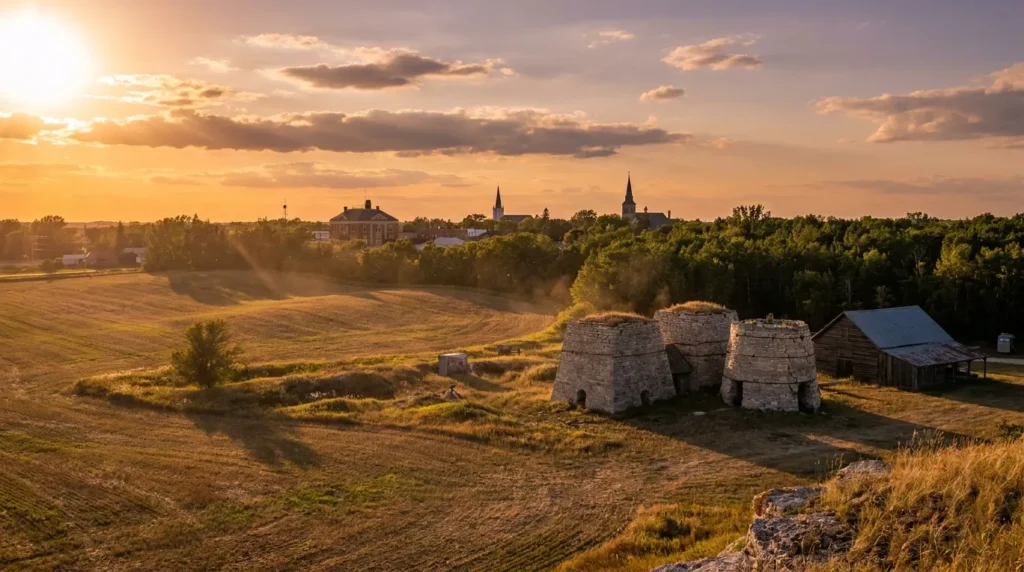
Quarry Park is Stonewall's landmark. Former limestone quarries were turned into a public park, with an artificial lake used for swimming in summer and skating in winter. The Lime Kilns, late 19th century limestone furnaces, are preserved and form the most recognizable industrial complex in town. There are trails, picnic areas, and a playground.

The Stonewall Quarry Park Heritage Arts Centre functions as a local museum, with exhibits on the history of limestone, the settlers, and the region's Indigenous peoples. For nature lovers, Oak Hammock Marsh, just a few kilometers away, is one of the largest migratory bird sanctuaries in Canada, with a visitor center and elevated trails over the marsh.

Nearby, Birds Hill Provincial Park offers beaches, trails, and camping half an hour away by car. Lower Fort Garry National Historic Site, further north, tells the story of the Hudson Bay Company and its relationship with the Métis. For urban life and larger museums, such as the Canadian Museum for Human Rights, just 30 minutes away in Winnipeg, it becomes part of many families' weekend routine.

  1. 1Quarry Park and Lime Kilns
  2. 2Stonewall Quarry Park Heritage Arts Centre
  3. 3Oak Hammock Marsh Interpretive Centre
  4. 4Stonewall Centennial Hall
  5. 5Veterans Memorial Sports Complex
Parks & green spaces
  • Quarry Park
  • Kinsmen Park
  • Rockwood Recreation Grounds
  • Oak Hammock Marsh (nearby)
  • Birds Hill Provincial Park (nearby)

Migrant communities in Stonewall and the Interlake

The immigrant presence is small and growing, with recent arrivals of families from South Asia and the Philippines coming from Winnipeg.

Stonewall was historically settled by British, German, Ukrainian, Scandinavian, and Icelandic colonists who populated the Interlake in the late 19th and early 20th centuries. That heritage still defines surnames, parishes, and home cooking. More recent immigration is modest in volume but has been increasing since the 2010s, driven by Manitoba's Provincial Nominee Program.

The current composition of immigrants in town reflects entry through Winnipeg. Filipinos form the most visible Asian community, with a strong presence in health and services. Indians arrived via the PNP in transportation, hospitality, and IT. Families from Ukraine, especially after 2022, were welcomed at various points across the Interlake. There is also a small presence of Chinese, Nigerian, and Latin American residents.

There are no consulates in Stonewall. All consular representation is in Winnipeg, where organizations supporting newcomers are also concentrated. For settlement services, language, credential recognition, and legal support, the path is the Immigrant Centre, NEEDS Centre, and Manitoba Start, all based in the capital, with services open to residents of satellite towns such as Stonewall.

350
Foreign-born residents
estimated
Top countries of origin
  • Philippines
  • India
  • Ukraine
  • United Kingdom
  • China
  • Germany
  • Nigeria
  • United States
Foreign consulates
  • Consulate General of the United States in Winnipeg
  • Consulate of Germany in Winnipeg
  • Consulate of Iceland in Winnipeg
  • Consulate of Ukraine in Winnipeg
  • Consulate of the Philippines in Winnipeg
Community organizations
  • Immigrant Centre Manitoba (Winnipeg)
  • NEEDS Centre (Winnipeg)
  • Manitoba Start
  • Westman Immigrant Services
  • Interlake Regional Library
  • Royal Canadian Legion Branch 52 Stonewall

Latest posts

Straight from the blog

There are no posts specifically about Stonewall yet. In the meantime, check out our latest posts.