Visto n' Visa
Blog
Notícias e artigos
Destinations
Careers
Immigrants

Want to live and work in Selkirk?

Personalized immigration plan with eligible visas, costs, and next steps for your goal!

If you are not eligible, you will know exactly why and what to do to improve your approval chances.

Save up to 12 hours in meetings

No pointless assessments.

Save up to 90%

Save money on vague or unfocused consultations

Avoid Fraud and Mistakes

One mistake can cost you your visa

Total Impartiality

Zero commercial bias

Decide with peace of mind

No toxic urgency

Fast and Accurate

Answers in minutes, no guesswork

Selkirk's Population: A Mix of Scottish Descendants, Métis, and New Immigrants

A city with deep Scottish and Métis heritage. Filipinos represent the most recent wave of immigration.

Selkirk was founded by Scottish settlers and takes its name from the Earl of Selkirk, who brought families from Scotland to the region in the early 19th century. The Scottish heritage remains visible in surnames, festivals, and the Manitoba Marine Museum. The Métis community (descendants of Europeans and Indigenous peoples) is a central part of the local identity, with a historical presence in the region.

There is also an Indigenous Cree, Anishinaabe, and Métis presence, with nearby communities at St. Peter's Reserve and around Lake Winnipeg. The recent wave of immigration has brought Filipinos to work at the steel mill, the hospital, and in retail. Descendants of early Ukrainian settlers are still present as well.

The languages most heard after English are Tagalog, Cree, and Ukrainian. As a small and traditional city, integration between communities is facilitated by daily interaction in schools, workplaces, and public life.

Languages spoken
  • English
  • Tagalog (Filipino)
  • Cree and Ojibwa
  • Ukrainian
  • French
Main religions
  • Christian (Anglican, Catholic, Presbyterian, Ukrainian Orthodox)
  • No religion
  • Indigenous spirituality

Cost of Living in Selkirk: Significantly Lower Than Winnipeg

Rent and home purchases cost a fraction of what is paid in the capital. Dining out and groceries are also more affordable.

Selkirk is one of the most affordable options for those looking to live near Winnipeg without paying capital-city prices. Three-bedroom homes with yards sell for values far below equivalent neighborhoods in the capital. Rent is also cheaper, though the supply of apartments is limited given the city's small size.

Sobeys, Co-op, and Walmart supermarkets cover the basics. There are also smaller markets and the traditional Selkirk Farmers' Market in summer. Dining out is inexpensive: local diners, Tim Hortons at multiple locations, and Filipino restaurants growing in the city. For greater variety, many residents head to Winnipeg.

Electricity is affordable through Manitoba Hydro. Winter heating and car insurance through Manitoba Public Insurance are the major expenses. As a small city, internal distances are short. The commute to Winnipeg is the significant cost for those who work there: 30 to 45 minutes each way, with fuel and vehicle wear adding up.

Selkirk

Housing in Selkirk: Large, Affordable Homes with River Views

Purchasing a family home is achievable on an average salary. Areas near the Red River are the most sought after.

The most sought-after neighborhoods are near the Red River, with traditional homes and quiet streets. West Selkirk has newer family homes. East Selkirk, on the other side of the river, is more rural and features larger properties. The downtown area has older homes from the first settlers, some over a hundred years old.

The rental market is smaller than in Winnipeg, so searching in advance is advisable. Properties are listed on Kijiji, Facebook Marketplace, and local newspapers. Homes for purchase come up regularly, and the market pace is not frantic as in larger cities.

Banks such as RBC, TD, Scotiabank, and the Sunova Credit Union cooperative offer mortgages to newcomers with 5% down. Local real estate agencies such as Royal LePage Dynamic serve the market. Purchasing a home on an average Canadian salary is attainable. For those who prefer waterfront living, properties along the Red River with private docks are available.

Recommended neighborhoods
  • West Selkirk (newer family homes)
  • Near the Red River (views, docks)
  • East Selkirk (rural, larger properties)
  • Downtown (traditional homes)

Job Market in Selkirk: Steel Industry, Healthcare, and Commuting to Winnipeg

Gerdau is the largest local employer. Healthcare, retail, and smaller industries also provide employment. Many residents commute to Winnipeg.

Gerdau operates a large steel mill in Selkirk, producing steel for construction, infrastructure, and the automotive industry. It employs hundreds of people, with steady demand for welders, electricians, mechanics, and operators. Wages are competitive by small-city standards.

The Selkirk Regional Health Centre is the second-largest employer, with openings in nursing, medicine, laboratory technicians, and support staff. There is also the Selkirk Mental Health Centre, one of the largest psychiatric institutions in western Canada. Local retail, schools, and construction round out the picture.

Many residents commute daily to Winnipeg, working in offices, hospitals, or industries in the capital. Through the MPNP, occupations in demand in Selkirk include welders, mechanics, nurses, truck drivers, and technicians. The unemployment rate tends to be low due to the combination of local employment and proximity to the capital.

Dominant sectors
  • Steel and steel manufacturing
  • Mental health and general healthcare
  • Sport fishing and tourism
  • Agriculture
  • Retail trade
  • +1 more
Major employers
  • Gerdau (steel mill)
  • Selkirk Regional Health Centre
  • Selkirk Mental Health Centre
  • Lord Selkirk School Division
  • Manitoba Hydro (regional offices)

Education in Selkirk: Free Public Schooling and Proximity to Winnipeg Universities

Lord Selkirk School Division operates the public schools. Universities are located in Winnipeg, 30-40 minutes away.

Resident children have access to free public schooling. The Lord Selkirk School Division serves the region with several schools, including Lord Selkirk Regional Comprehensive Secondary School as the main high school. Programs are available in English and French immersion. The schools reflect the city's demographic mix.

There is no university in Selkirk, but proximity to Winnipeg makes it straightforward to study there while residing in Selkirk. The University of Manitoba, the University of Winnipeg, and Red River College Polytechnic are 30-40 minutes away by car. Many students commute daily, particularly those living with family.

For adult immigrants, free English classes (LINC) are offered through local community organizations and in Winnipeg. Manitoba Start operates in the city, guiding newcomers on the job market and foreign credential recognition.

Literacy99.0%
Tertiary education32.9%
516
PISA score (avg)
$9,000
Private school
per year
Notable universities
  • University of Manitoba
  • University of Winnipeg
  • Red River College Polytechnic
  • Canadian Mennonite University
  • Université de Saint-Boniface

Healthcare in Selkirk: Regional Hospital and a Leading Psychiatric Centre

Selkirk Regional Health Centre serves the region. The psychiatric centre is one of the largest in western Canada.

Manitoba Health covers legal residents after a waiting period of approximately 3 months. Medical care, hospitalization, and surgery are provided at no cost with the provincial health card. Newcomers typically obtain temporary private insurance for the first few months.

The Selkirk Regional Health Centre is the local hospital, offering 24-hour emergency service, maternity care, general surgery, and clinics. More complex cases (advanced oncology, neurosurgery, cardiology) are referred to Winnipeg, primarily the Health Sciences Centre and St. Boniface Hospital, just 40 minutes away. The Selkirk Mental Health Centre is one of the largest psychiatric institutions in western Canada.

Walk-in clinics and family physicians are available, though finding a regular family doctor may take time, which is common throughout Canada. Medications are not fully covered: the provincial Pharmacare program assists those with high drug costs. Dental, optometry, and physiotherapy services require private insurance.

Healthcare index66.0 / 100
  • Life expectancyyears at birth
    81.6yrs
  • Doctors per 1kpracticing physicians
    2.8
  • Health spendper capita, per year
    $6,187
  • Public systemoverall quality rating
    Good

Safety in Selkirk: A Quiet City, with Basic Precautions Downtown at Night

Serious crimes are rare. Typical small-city life, with occasional attention warranted near bars at night.

Selkirk is considered a quiet city by Canadian standards. Violent crimes are rare, and most incidents involve minor offenses such as theft, property damage, and traffic violations. Families with children live normally throughout most neighborhoods.

As in many Canadian cities, certain downtown areas at night, particularly near bars and on weekends, can see situations related to alcohol. These rarely affect families going about their routines. Vehicle theft and general theft are the most common crimes; basic precautions address most situations.

The greater real risk is the climate. Manitoba winters with temperatures reaching minus 30 degrees Celsius require appropriate clothing. Snowstorms can close Highway 9 between Selkirk and Winnipeg for hours. Winter tires, a proper parka, and insulated boots are part of basic safety here, particularly for daily commuters.

2.0
Homicides per 100k
per year
Safety index
58.0
Crime index
42.0
Safer neighborhoods
  • Selkirk Park area
  • West side residential
  • Eveline Street area
  • Mercy Street
  • Manitoba Avenue East
Areas to avoid
  • Downtown Main Street at night
  • Industrial areas along the Red River outside business hours

Transportation in Selkirk: A Car Is Essential, with Easy Access to Winnipeg

No regular public transit to Winnipeg. A personal vehicle is the primary mode of transportation. Highway 9 connects Selkirk to the capital in 30-40 minutes.

Selkirk is a car-dependent city. There is no regular municipal bus system or direct bus service to Winnipeg, making it difficult to live without a vehicle. Internal distances are short, which simplifies daily routines. Parking is abundant and free in virtually every location.

Highway 9 (Henderson Highway) connects Selkirk to Winnipeg in 30 to 40 minutes. The Trans-Canada Highway (Highway 1) is about 20 minutes away. For Lake Winnipeg and beach communities such as Gimli and Winnipeg Beach, Highway 9 continues north. In winter, snow and ice can complicate travel, so flexibility is necessary.

There is no commercial airport in Selkirk. Winnipeg James Armstrong Richardson International Airport (YWG) is the nearest, about 40 minutes away, and the only practical option for international flights. Local taxi services are available; Uber and Lyft from Winnipeg serve Selkirk at higher fares due to the distance.

18 min
Avg commute
38
Walkability
Airports
  • JSL — Selkirk Airport
  • Bike infrastructure

What the Climate Is Like in Selkirk

A city on the banks of the Red River, north of Winnipeg. A dry continental climate with short, warm summers and long, severe winters typical of Manitoba.

Summer is an active season. From June through August, high temperatures average around 25 to 28 degrees Celsius, with long daylight hours. The city is known for sport fishing on the Red River, particularly for sturgeon and catfish. Mosquitoes can be a nuisance on humid evenings near the water.

Winter is the most defining season. From November through March, lows can reach 25 to 30 degrees below zero Celsius. The river freezes and becomes a site for ice fishing, a traditional activity in the region. Homes rely on central gas heating, and heavy winter gear including a parka, wool hat, and thermal boots is essential for daily life.

Total rainfall averages around 520 mm per year, peaking in summer. Snowfall accumulates roughly one meter between November and March. Spring brings the risk of Red River flooding; the city maintains well-built dikes and an emergency plan that has been tested across several recent years.

Sunny days / year235 days
Avg high (°F)
  • 31°J
  • 32°F
  • 54°M
  • 66°A
  • 82°M
  • 94°J
  • 93°J
  • 92°A
  • 87°S
  • 75°O
  • 52°N
  • 35°D
Avg low (°F)
  • -35°J
  • -34°F
  • -18°M
  • 15°A
  • 28°M
  • 44°J
  • 52°J
  • 48°A
  • 37°S
  • 18°O
  • -2°N
  • -25°D
Rainfall (")
  • 1"J
  • 1"F
  • 1"M
  • 2"A
  • 2"M
  • 2"J
  • 2"J
  • 2"A
  • 2"S
  • 2"O
  • 1"N
  • 1"D

Culture in Selkirk: The Red River, Sport Fishing, and Maritime Tradition

Catfish fishing on the Red River and the Manitoba Marine Museum are highlights. Summer festivals bring the city to life.

Selkirk takes pride in the title of Catfish Capital of Canada: the Red River is a renowned destination for sport fishing of giant catfish, some exceeding 20 kilograms. The Chuck the Channel Cat statue at the entrance to the city symbolizes this identity. Annual tournaments draw anglers from across Canada and the United States.

The Manitoba Marine Museum, in the downtown area, features historic steamboats from the Red River and Lake Winnipeg, some of which can be boarded. The Lower Fort Garry National Historic Site, nearby, is a restored Hudson's Bay Company fort with costumed interpreters during the summer months. Selkirk Park, on the riverbank, is a popular spot for picnics and festivals.

The Manitoba Highland Gathering (Celtic festival) in July showcases the Scottish heritage, with bagpipes, dancing, and caber toss. Local pubs such as Sal's and restaurants along Main Street complete the social scene. For greater variety, Winnipeg is 30 minutes away.

2
Major museums
Notable dishes
  • Lake Winnipeg Pickerel (Catfish Capital)
  • Smoked Goldeye
  • Perogies
  • Bannock
  • Smoked lake whitefish
  • +1 more
Annual events
  • Manitoba Highland Gathering
  • Triple S Fair and Rodeo
  • Selkirk Friendship Festival
  • Catfish Derby
  • Canada Day Selkirk Park
  • +1 more

Riverside Life and Attractions in Selkirk on the Red River

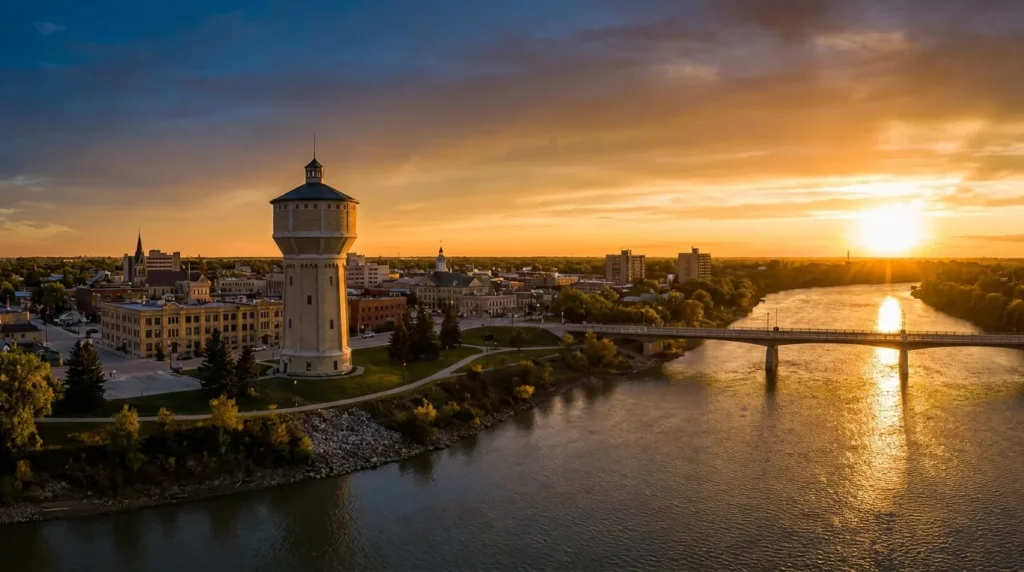
A small city on the banks of the Red River, 30 km north of Winnipeg, with an identity rooted in catfish fishing, Scottish heritage, and access to Lake Winnipeg.

The Marine Museum of Manitoba, featuring six historic vessels on dry land including the SS Keenora, is the most visited landmark. On the waterfront, the famous Chuck the Channel Cat statue in Selkirk Park announces the city's reputation as the Catfish Capital of the World, with fishing tournaments held throughout the summer.

Lower Fort Garry National Historic Site, a Hudson's Bay Company post, is just a few minutes away and offers reenactments of 19th-century life. The Selkirk Mental Health Centre Museum and the Gaynor Family Regional Library round out the local cultural circuit.

For outdoor recreation, Selkirk Park has riverside trails, a public pool, and camping. About 20 minutes away, Beaudry Provincial Park and the beaches of Grand Beach on Lake Winnipeg are classic weekend destinations for local residents.

  1. 1["Marine Museum of Manitoba"
  2. 2"Lower Fort Garry National Historic Site (nearby)"
  3. 3"Chuck the Channel Cat (statue)"
  4. 4"Selkirk Park"
  5. 5"Red River Heritage Trail"
  6. 6"Lockport Locks and Dam (nearby)"]
Nightlife3.0 / 10
Parks & green spaces
  • ["Selkirk Park"
  • "Red River Trail"
  • "Selkirk Waterfront"
  • "Memorial Park"
  • "Patsy's Park"]

Latest posts

Straight from the blog

There are no posts specifically about Selkirk yet. In the meantime, check out our latest posts.