Visto n' Visa
Blog
Notícias e artigos
Destinations
Careers
Immigrants

Want to live and work in Portage la Prairie?

Personalized immigration plan with eligible visas, costs, and next steps for your goal!

If you are not eligible, you will know exactly why and what to do to improve your approval chances.

Save up to 12 hours in meetings

No pointless assessments.

Save up to 90%

Save money on vague or unfocused consultations

Avoid Fraud and Mistakes

One mistake can cost you your visa

Total Impartiality

Zero commercial bias

Decide with peace of mind

No toxic urgency

Fast and Accurate

Answers in minutes, no guesswork

Population of Portage la Prairie: Indigenous peoples, Filipinos, and recent immigrants

A strong historical Indigenous presence. Filipinos make up the largest recent wave of immigration. The Ukrainian community has deep roots.

The region has a significant Indigenous population, primarily Ojibwe (Anishinaabe), Cree, and Métis. The Long Plain First Nation and Dakota Tipi reserves are located nearby, and there is a steady flow between those communities and the city. Long Plain First Nation in particular maintains a visible economic presence through ventures such as Yellowquill College and various commercial activities.

The Filipino community has grown rapidly over the past decade, driven largely by employment at Simplot and McCain. Filipino restaurants, grocery stores, and Catholic churches now serve this population. More recent arrivals have come from Ukraine, Eritrea, and Sudan. The original Ukrainian and German prairie settler communities are still present, their surnames and traditions still visible.

After English, the most widely heard languages are Tagalog, Ukrainian, Ojibwe, Spanish, and, more recently, Tigrinya. Integration is aided by the city's small size: schools and factories naturally bring communities together.

Languages spoken
  • English
  • Tagalog (Filipino)
  • Ojibwe and Cree
  • Ukrainian
  • Spanish
  • +1 more
Main religions
  • Christian (Catholic, Anglican, Ukrainian Orthodox, Evangelical)
  • Indigenous Spirituality
  • No religion
  • Hindu
  • Muslim

Cost of living in Portage la Prairie: among the lowest in Canada

Rent, groceries, and home purchases cost far less than in large cities. Electricity is affordable through Manitoba Hydro.

Portage la Prairie is one of the most affordable places to live in Canada. Three-bedroom houses with yards can be purchased at prices that would not cover a studio apartment in Toronto or Vancouver. Rent is proportionally low, and large employers often help new employees find initial housing.

Walmart, Sobeys, and Real Canadian Superstore cover everyday grocery needs. There are also small ethnic markets carrying Filipino and Asian products. Dining out is inexpensive: chains such as Tim Hortons, A&W, and Boston Pizza coexist with local and Filipino restaurants scattered through the downtown.

Electricity is affordable through Manitoba Hydro. The larger expenses are winter heating and car insurance through Manitoba Public Insurance. Because the city is small and flat, internal distances are minimal, so fuel costs are a minor budget item.

Portage la Prairie

Housing in Portage la Prairie: affordable homes and a reasonable supply

Buying a home on an average salary is realistic. Rentals are available, especially for those entering through the MPNP.

The main neighborhoods are well defined. The Tupper Centre area and streets near Crescent Lake are established, with older homes on generous lots. Newer subdivisions have grown to the south, around Tupper Street. The area near the Regional Hospital is convenient for those working in health care.

The rental market is smaller than Winnipeg's, so it pays to search early. Properties are listed on Kijiji, Facebook Marketplace, and local newspapers. Large employers such as McCain, Simplot, and Roquette commonly assist new employees in finding initial housing for the first few months.

For purchases, banks including RBC and TD, along with the Sunrise Credit Union, offer mortgages to newcomers with 5% down. The market is stable: home prices generally do not spike as they do in major cities, but they also do not depreciate.

Recommended neighborhoods
  • Crescent Lake area (established, lake views)
  • Tupper Street south (new homes)
  • Near the hospital (convenient)
  • North End (affordable, close to the factories)

Job market in Portage la Prairie: strong agri-food industry and recent expansion

McCain, Simplot, and Roquette dominate the industrial market. Health care, education, and construction also hire consistently.

McCain Foods operates one of Canada's largest frozen french fry plants in Portage la Prairie, exporting across the continent. Simplot processes potatoes in direct competition within the same sector. Roquette recently opened the world's largest pea protein processing plant, generating hundreds of new jobs. These three companies form the backbone of the local economy.

Other major employers include CN Rail, which operates an important rail yard in the city, and Southport Aerospace Centre, a former military air base now functioning as a pilot training facility. Portage District General Hospital is the leading employer in the health care sector. The construction industry is expanding in response to industrial growth.

Through the MPNP, Portage la Prairie is a priority destination for positions in manufacturing, transportation, agriculture, health care, and construction. In-demand occupations include machine operators, mechanics, welders, truck drivers, nurses, and food processing technicians.

Dominant sectors
  • Food processing (potatoes, plant protein)
  • Agriculture
  • Rail and road transportation
  • Aviation training
  • Health care and social services
  • +2 more
Major employers
  • McCain Foods
  • Simplot Canada
  • Roquette Canada (pea protein)
  • CN Rail
  • Portage District General Hospital
  • +2 more

Education in Portage la Prairie: free public schooling and a regional college campus

The Portage la Prairie School Division operates the public schools. Assiniboine Community College maintains a campus in the city offering technical programs.

The Portage la Prairie School Division serves the public schools at no cost. Portage Collegiate Institute is the main secondary school. French-language schooling is available through the Division Scolaire Franco-Manitobaine, and small private schools affiliated with local churches also operate in the area.

Assiniboine Community College, headquartered in Brandon, maintains a campus in Portage la Prairie offering practical technical programs in nursing, agriculture, mechanics, and business administration. These programs are popular among adults returning to education and immigrants who need to validate existing skills or develop new ones.

For university-level studies, most students travel to Winnipeg or Brandon. Free English-language classes (LINC) are offered through local community organizations in partnership with Eastman Immigrant Services and Manitoba Start, supporting newcomers during settlement.

Notable universities
  • Assiniboine Community College (Portage campus)

Health care in Portage la Prairie: local regional hospital and a free public system

Portage District General Hospital handles emergencies and general surgery. Specialized cases are referred to Winnipeg.

Manitoba Health covers legal residents after a waiting period of approximately three months. Medical visits, hospital stays, and surgery are covered at no cost with a provincial health card. Newcomers typically obtain short-term private insurance for the first few months, especially families with young children.

Portage District General Hospital serves as the local facility, with 24-hour emergency care, maternity services, general surgery, and specialist clinics. More complex cases involving advanced oncology, neurosurgery, or cardiology are referred to Winnipeg, generally to Health Sciences Centre or St. Boniface Hospital.

Walk-in clinics and family physicians operate in the city, though finding a regular family doctor may take time, as is the case throughout Canada. Prescription medications are not fully covered: the provincial Pharmacare program assists those with high drug costs. Dental, optometry, and physiotherapy services generally require private insurance.

Healthcare index66.0 / 100
  • Life expectancyyears at birth
    81.6yrs
  • Doctors per 1kpracticing physicians
    2.8
  • Health spendper capita, per year
    $6,187
  • Public systemoverall quality rating
    Good

Safety in Portage la Prairie: a quiet city with basic precautions needed

Serious crime is rare. Small-city life offers a degree of protection, with neighbors who know one another and a calm daily pace.

Portage la Prairie is considered quiet by Canadian standards. Violent crime is uncommon, and most police calls involve minor incidents such as theft, property damage, and traffic violations. Families with children live without major concerns in most neighborhoods.

As in any city, certain areas and times call for more awareness: parts of the downtown at night and streets near bars after closing time. Such situations rarely involve newcomers or families going about their routines. Vehicle theft and petty theft are the most common offenses; basic precautions are sufficient.

The most significant real-world risk is the climate. Manitoba winters with temperatures around minus 30 degrees Celsius require proper clothing and preparation. Snowstorms can close the Trans-Canada for hours and increase the frequency of road accidents. Winter tires, an appropriate coat, and insulated boots are part of basic safety here.

2.0
Homicides per 100k
per year
Safety index
50.0
Crime index
50.0
Safer neighborhoods
  • Lorne Avenue area
  • Crescent Lake
  • Royal Road area
  • Tupper Street North
  • Island Park surroundings
Areas to avoid
  • Central stretch of Saskatchewan Avenue at night
  • Isolated industrial areas south of the CN railway

Transportation in Portage la Prairie: a car is essential, with easy access to Winnipeg via the Trans-Canada

No regular public transit operates in the city. The Trans-Canada Highway runs through town and connects to Winnipeg in about an hour.

Portage la Prairie is a car-dependent city. There is no regular municipal bus service, making life without a vehicle difficult. Internal distances are short, which simplifies daily logistics. Parking is abundant and free in virtually every location.

The Trans-Canada Highway (Highway 1) runs along the north side of the city, connecting Portage la Prairie to Winnipeg in just over an hour and to Brandon in roughly two hours. Highway 16 (the Yellowhead) also branches off toward Saskatchewan. In winter, snowstorms can close roads for hours, so schedule flexibility is important.

Southport Aerospace Centre has an airfield used primarily for military pilot training and private flights. Commercial air travel requires a trip to Winnipeg's James Armstrong Richardson International Airport (YWG), about an hour away. Rideshare services such as Uber and Lyft have no significant presence; local taxis and personal vehicles are the standard options.

10 min
Avg commute
42
Walkability
Airports
  • YPG — Southport Airport (Portage la Prairie)
  • Bike infrastructure

What the climate is like in Portage la Prairie

Located in south-central Manitoba amid agricultural prairie, Portage la Prairie has a dry continental climate with short, warm summers, long and severe winters, and distinct seasons with a wide temperature range.

Summer is short and sunny. From June to August, highs typically range between 25 and 28 degrees Celsius, with low humidity and long days. The area is surrounded by wheat and canola fields, and the golden landscape is striking. Nights drop to around 12 degrees Celsius even at the height of summer.

Winter is cold and dry. From November to March, lows of minus 25 to minus 30 degrees Celsius are common, with frigid winds from the plains. Homes have central gas heating and double-pane windows. A heavy parka, hat, gloves, and thermal boots are wardrobe staples.

Annual rainfall totals around 510 millimeters, peaking in June and July. Total snowfall is around one meter. The sky is frequently blue even in winter, with more than 2,300 hours of sunshine per year. Roads are well-maintained and school buses operate normally almost year-round.

Sunny days / year238 days
Avg high (°F)
  • 33°J
  • 33°F
  • 55°M
  • 68°A
  • 82°M
  • 93°J
  • 92°J
  • 93°A
  • 87°S
  • 74°O
  • 51°N
  • 37°D
Avg low (°F)
  • -32°J
  • -33°F
  • -14°M
  • 17°A
  • 29°M
  • 45°J
  • 52°J
  • 49°A
  • 38°S
  • 18°O
  • N
  • -21°D
Rainfall (")
  • 1"J
  • 1"F
  • 1"M
  • 2"A
  • 3"M
  • 3"J
  • 2"J
  • 2"A
  • 2"S
  • 2"O
  • 1"N
  • 1"D

Culture in Portage la Prairie: a small community, a historic downtown, and Crescent Lake as the central landmark

Crescent Lake, a horseshoe-shaped lake within city limits, is the defining landmark. Events such as the Strawberry Festival animate the summer.

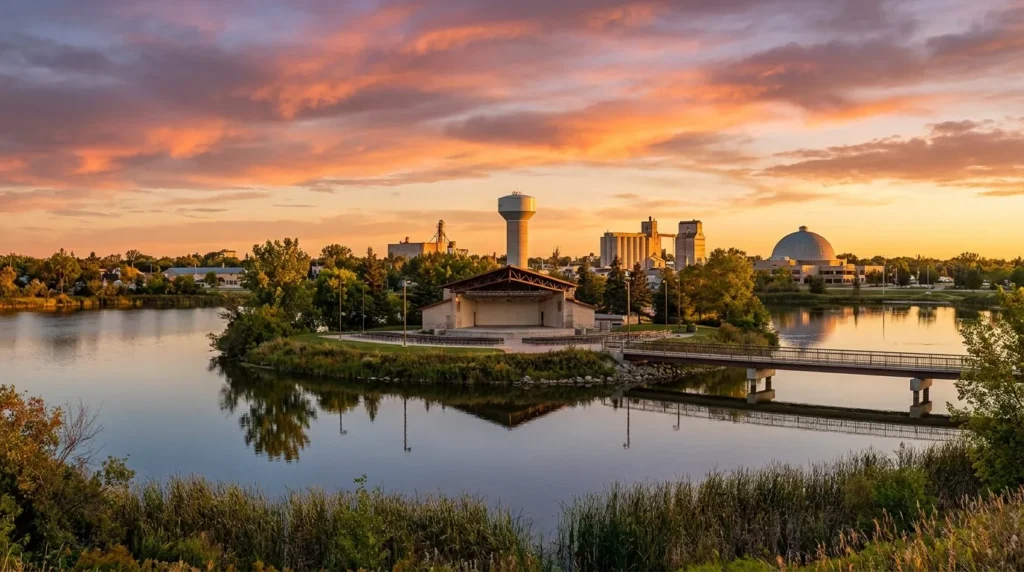
Crescent Lake, located in the city's core, is the most cherished spot for residents. It is an abandoned oxbow of the Assiniboine River, forming a horseshoe-shaped lake surrounded by a park with walking trails, a bridge, and Island Park, a small island at its center featuring a pool, a small zoo, and sports courts.

Portage Plaza and Saskatchewan Avenue concentrate local retail. Events such as the Manitoba Strawberry Festival in July and a Country Music Festival draw visitors from the surrounding region. The Fort la Reine Museum, built in the style of a heritage village, chronicles the history of pioneer settlement and the fur trade through restored historic buildings.

Nightlife is modest. Everyday needs are covered by spots such as Sammy's Pizza, local diners, and neighborhood pubs. The Filipino community has added its own restaurants, grocery stores, and community celebrations. For a wider range of entertainment and dining options, many residents make the trip to Winnipeg.

2
Major museums
Notable dishes
  • Fried pickerel
  • Perogies
  • Bannock
  • Cabbage rolls
  • Prairie beef on a bun
  • +1 more
Annual events
  • Portage Strawberry Festival
  • Manitoba Pickerel Cup
  • Island Park Drive Christmas Lights
  • Portage Industrial Exhibition
  • Portage Terriers hockey season
  • +1 more

Attractions in Portage la Prairie, Manitoba's prairie city on the banks of the Assiniboine

The city combines railway heritage, Crescent Lake at its center, and parks along the Assiniboine River. Recreation is peaceful, with small museums, fishing, cycling trails, and community festivals.

The center of outdoor life is Crescent Lake and Island Park, an urban island with a free zoo, a large playground, and Splash Island in the summer. The trail surrounding the lake is about six kilometers long and used for running year-round. The Fort la Reine Museum, at the city's entrance, recreates a Hudson's Bay fort and displays locomotives, pioneer homes, and props used in Canadian film productions.

The William Glesby Centre, downtown, is the main theater and hosts plays, country shows, and the annual Strawberry Festival. The Portage Plains United Way Heritage Centre and the Centennial Library complement the cultural offerings. In summer, the Manitoba Liquor Mart Stampede & Exhibition takes place, featuring professional rodeo, a fairground, and live shows.

For those seeking more expansive nature, Delta Marsh to the south is one of the most important migratory bird observation sites on the continent. Spruce Woods Provincial Park, with its Spirit Sands dunes, is about an hour and a half away. Winnipeg, with museums, international flights, and larger shopping, is about eighty minutes away via the Trans-Canada Highway.

  1. 1["Island Park"
  2. 2"Fort la Reine Museum"
  3. 3"Crescent Lake"
  4. 4"Portage and District Arts Centre"
  5. 5"Stride Place"
  6. 6"Delta Marsh (nearby)"]
Nightlife3.0 / 10
Parks & green spaces
  • ["Island Park"
  • "Crescent Lake Trail"
  • "Lions Park"
  • "Splash Island"
  • "Delta Marsh Wildlife Management Area"]

Latest posts

Straight from the blog

There are no posts specifically about Portage la Prairie yet. In the meantime, check out our latest posts.