Visto n' Visa
Blog
Notícias e artigos
Destinations
Careers
Immigrants

Want to live and work in Norway House?

Personalized immigration plan with eligible visas, costs, and next steps for your goal!

If you are not eligible, you will know exactly why and what to do to improve your approval chances.

Save up to 12 hours in meetings

No pointless assessments.

Save up to 90%

Save money on vague or unfocused consultations

Avoid Fraud and Mistakes

One mistake can cost you your visa

Total Impartiality

Zero commercial bias

Decide with peace of mind

No toxic urgency

Fast and Accurate

Answers in minutes, no guesswork

Predominantly Cree population with a small non-Indigenous presence

The vast majority of residents are Indigenous Cree, with a small contingent of non-Indigenous professionals linked to health, education and public administration, coming from other parts of Canada and abroad.

Norway House is predominantly Indigenous. The Norway House Cree Nation has thousands of registered members, and the community coexists with the Northern Affairs Community, totaling several thousand residents in the area. The non-Indigenous presence is small and almost always tied to professional contracts in health, education, RCMP and government.

The everyday language is Cree (Swampy/Woodlands dialect) alongside English, which appears in schools, the hospital and services. Families tend to be large, and the social structure revolves around the Cree Nation, the elders and the church, with historic weight from Anglican and Catholic traditions brought by 19th-century missions.

For those moving in for work, it is important to understand that one is entering a community with its own governance, specific cultural rules and a strong bond with the land. The community receives relatively few international immigrants, but there are foreign professionals, especially doctors, nurses and teachers, hired through recruitment programs in northern Manitoba.

Languages spoken
  • Cree (Swampy/Woodlands)
  • English
  • English as a second language
Main religions
  • Anglicanism
  • Catholicism
  • Pentecostal churches
  • Traditional Cree spirituality
High cost driven by northern logistics, offset by housing subsidies

Food, fuel and durable goods cost much more than in Winnipeg because of freight; private rentals are scarce and functional housing often comes through an employment contract or through the band.

Living in Norway House is expensive at the supermarket and cheap on rent, when rent is available. Almost everything consumed arrives by truck via PR 373 or the winter road, and that shows in the price of meats, fruits, fresh vegetables and imported items, which can cost twice as much as in Winnipeg. The Northern Store handles a large share of daily shopping.

Fuel, propane gas for heating and electricity weigh heavily on the budget, especially during the long winter. On the other hand, restaurants and paid leisure are few, so residents spend less on going out. Programs such as Nutrition North Canada subsidize part of perishable food at the Northern Store.

Professionals recruited from outside usually receive a northern allowance, housing assistance or institutional accommodation, which substantially changes the final bill. For those arriving without a contract, the real challenge is not only the price, but the limited supply of private rentals, which practically does not exist outside the band and the government.

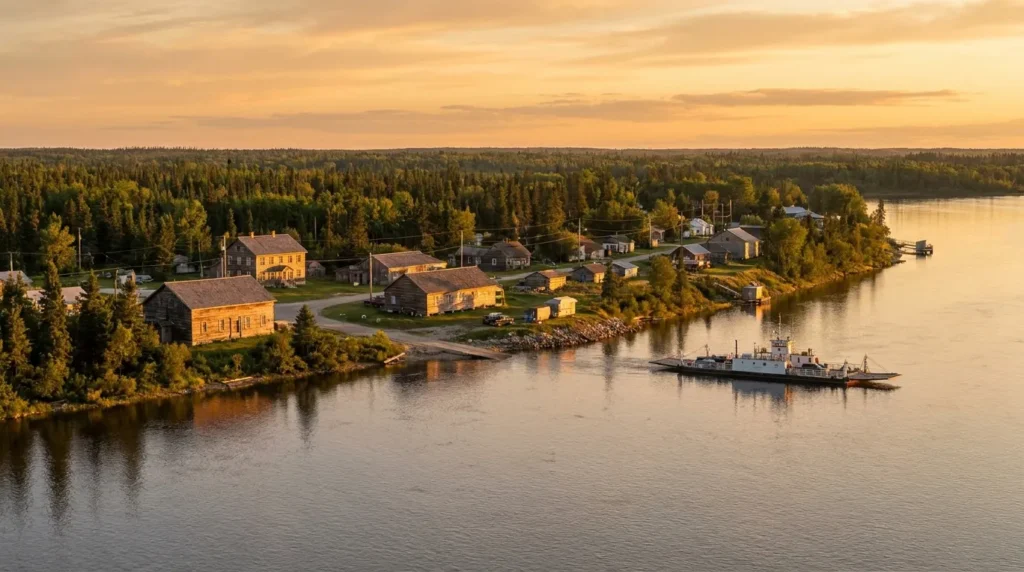
Norway House

Limited stock between band houses, staff housing and few private options

Most homes belong to the Norway House Cree Nation; health, education and RCMP professionals usually come with staff housing, and the open rental market is practically nonexistent.

Housing supply in Norway House is mainly controlled by the Cree Nation, which manages homes for its members, and by institutions such as the hospital, the Frontier School Division and the RCMP, which keep staff housing for employees recruited from outside. Without ties to one of these structures, it is very difficult to find a place to live.

Residential areas are spread across Rossville, Fort Island, Jack River and zones near the services hub. Houses are predominantly low, made of wood, designed to withstand a long winter, with propane or electric heating systems. Larger lots and proximity to the water are valued.

Those arriving on contract should confirm before moving whether the employer provides housing, what the cost is and whether it comes furnished. The practical rule is simple: arriving without prearranged housing rarely works in northern communities like Norway House, so housing logistics are an essential part of the decision to migrate.

Recommended neighborhoods
  • Rossville
  • Fort Island
  • Jack River
  • Downtown near the hospital
  • Mission Island

Jobs concentrated in health, education, band government and essential services

The main employers are the regional hospital, the school division, the Norway House Cree Nation, the Northern Store and federal and provincial agencies; there is turnover in qualified professional positions.

The local job market is small and quite institutional. Health is the sector that hires the most qualified professionals, around the Norway House Hospital and care centers, with openings for doctors, nurses, dentists, therapists and caregivers. The Frontier School Division employs teachers and support staff in several schools in the community.

The Norway House Cree Nation is the main employer in the Indigenous community, with positions in administration, social services, maintenance, community safety and cultural programs. Essential commerce and services include the Northern Store, gas stations, workshops and small construction and transportation companies tied to northern Manitoba.

For immigrants recruited from abroad, the typical entry points are contracts in health and education via provincial programs such as the Manitoba Provincial Nominee Program, alongside federal programs aimed at remote communities. It is not a destination for those seeking a broad range of careers, but rather for specific niches with chronic labor shortages.

Dominant sectors
  • Public health
  • Basic education
  • Band government
  • Social services
  • Northern retail
Major employers
  • Norway House Hospital
  • Norway House Cree Nation
  • Frontier School Division
  • Northern Store
  • RCMP, local detachment

Cree Nation and Frontier School Division schools, with distance higher education

Basic education is served by band schools and the Frontier School Division; post-secondary courses arrive via the University College of the North and distance partnerships with universities in Manitoba.

Basic education in Norway House is divided between schools operated by the Norway House Cree Nation and units of the Frontier School Division, which serves several communities in northern Manitoba. Local schools cover from elementary to high school and offer programs focused on the Cree language and culture, alongside the provincial curriculum.

For post-secondary, the most visible presence is that of the University College of the North, which maintains regional centers and offers technical courses and degrees, partly in person and partly through distance learning. There are also partnerships with the University of Manitoba and Brandon University in education, nursing and social work programs designed for the north.

For immigrants coming for work, it is worth understanding that children will have a bilingual educational experience culturally situated in Cree life. Those arriving as professionals can find mentoring opportunities, continuing education and course funding via Indigenous Services Canada and provincial programs aimed at remote communities.

Notable universities
  • University College of the North, regional center
  • University of Manitoba (distance learning/partnerships)
  • Brandon University (education partnerships)

Norway House Hospital as the regional health hub for neighboring communities

Norway House Hospital serves the town and several surrounding First Nations, with emergency care, basic inpatient care, selected deliveries and a rotating team of doctors, nurses and itinerant specialists.

Norway House Hospital is the main health service in the region and functions as a hub for several nearby Indigenous communities. It has an emergency room, inpatient beds, laboratory, X-ray, low-risk maternal and child care and clinics for diabetes, mental health and chronic diseases, prevalent in the north.

A large part of the clinical staff is made up of doctors hired on rotation, advanced practice nurses and itinerant professionals in specialties such as ophthalmology, orthopedics and cardiology, who visit periodically. Complex cases, high-risk deliveries and major surgeries are transferred to Winnipeg via medical flights.

Dental health, physiotherapy, occupational therapy and social services operate in a combined structure with the Cree Nation and the provincial system. For those arriving from outside, it is important to know that public coverage comes from Manitoba Health, and that recruited foreign professionals need to be licensed by the CPSM or the corresponding professional colleges.

Norway House

Small community with social challenges typical of the north and RCMP presence

Like remote communities in northern Canada, Norway House deals with problems linked to alcohol, drugs and domestic violence at times, but it is generally a safe community for those who follow local routines.

Norway House is a small and quite cohesive community, where people know each other and public life revolves around the school, the hospital, the church and community events. The RCMP maintains a local detachment that serves the community and responds to calls together with Cree Nation Safety Officers in some situations.

Like other remote communities in northern Canada, there are social challenges related to alcohol, drugs and domestic violence that appear in cycles, especially after benefit payments or during holiday periods. There have been different times when the community adopted restrictions on the sale and consumption of alcohol to reduce these incidents.

For residents and recruited professionals, the practical recommendations are simple: keep a predictable routine, respect cultural norms, avoid walking alone at night on remote trails in winter and be careful with lake and river ice during seasonal travel. Daytime life in service areas is calm.

Safer neighborhoods
  • Downtown near the hospital
  • Residential Rossville
  • Areas near the schools
  • Mission Island
Areas to avoid
  • Isolated trails at night
  • Riverbanks without signage in winter
  • Remote areas without cell coverage

Access via PR 373, winter road and regional flights to Winnipeg and Thompson

PR 373 links Norway House to the provincial network for much of the year, complemented by a winter road; YNE Airport connects daily to Winnipeg via Calm Air and Perimeter.

The main land access is Provincial Road 373, which connects to PTH 6 and leads to Winnipeg in a long, multi-hour drive. In the winter, the winter road extends reach to neighboring communities such as Cross Lake and other isolated First Nations, but the route depends on firm ice and closes when it warms up.

By air, the Norway House Airport (YNE) receives regular flights from Calm Air and Perimeter Aviation connecting to Winnipeg and Thompson, used heavily by residents, health professionals and patients referred for treatment. In urgent situations, medical flights via Lifeflight take people to Winnipeg.

Within the community, transportation is almost entirely by personal vehicle, pickup or truck, with some walkable distances in the services hub. There is no formal public transit network, and in winter snowmobiles are part of the routine; boats and canoes are common in the summer for those who live near the water.

Airports
  • YNE, Norway House Airport

Climate

Norway House

Strong Cree identity, with fur trade history and a calendar of community events

Cultural life revolves around Cree heritage, the history of the Hudson's Bay Company post and events such as York Boat Days, which combine traditional races, music and local cuisine.

Norway House has a striking cultural identity. The Cree language is widely spoken, traditional spirituality coexists with the historic churches and elements such as the tipi, the drum, smudge ceremonies and respect for the elders are part of daily community life. The Norway House National Historic Site preserves buildings from the old Hudson's Bay Company post.

The best-known event is York Boat Days, an annual festival that celebrates the trading post past with traditional york boat races, music, dances, typical foods and family activities. Powwows, jamborees, hockey tournaments and Christian festivals are also milestones on the calendar, bringing together neighboring communities.

The local cuisine highlights bannock, dishes with fish from Lake Winnipeg, moose and venison, as well as traditional dried meat. Those who move to the community quickly realize that respecting protocols with elders, asking for guidance before entering traditional lands and taking part in community events is an essential part of living well there.

Notable dishes
  • Bannock
  • Smoked fish from Lake Winnipeg
  • Roasted walleye
  • Moose stews
  • Traditional Cree dried meat
Annual events
  • York Boat Days
  • Treaty 5 Days
  • Community powwows
  • Norway House Christmas Jamboree
  • Annual hockey and broomball tournaments

Fur trade heritage, historic churches and the nature of Lake Winnipeg

Attractions combine the Norway House National Historic Site, 19th-century churches, trails and fishing spots on the Nelson River and Lake Winnipeg, with a strong Cree cultural character.

The best-known landmark is the Norway House National Historic Site, with remaining buildings from the old Hudson's Bay Company post, telling the story of the fur trade and the community's role as a crossroads between Lake Winnipeg and Hudson Bay. The stone Powder Magazine is one of the most photographed symbols.

The historic churches, especially the Anglican church in Rossville and the broader Cross Lake Heritage Church in the region, show the interweaving of Christian missions and Cree culture. Areas such as Rocky Point and Treaty Point have symbolic value and are used for community gatherings and outdoor cultural events.

The surrounding nature is an attraction in itself: the Nelson River, Lake Winnipeg, bays for fishing walleye, pike and whitefish, short trails and areas for observing migratory birds. In winter, snowmobiles cross long trails and ice fishing has become a typical activity for residents and visitors.

  1. 1Norway House National Historic Site
  2. 2Powder Magazine (HBC Stone Building)
  3. 3Anglican Church of Rossville
  4. 4Rocky Point
  5. 5Treaty Point
  6. 6Mouth of the Nelson River at Lake Winnipeg
Parks & green spaces
  • Lake Winnipeg shore at Mission Island
  • Natural area around Rocky Point
  • Community trails along the Nelson River
  • Fishing and camping areas nearby
  • Boreal woods east of the community

Small core of foreign professionals in health, education and administration

International immigration in Norway House is small and selective, concentrated in doctors, nurses, teachers and technicians recruited via federal and provincial programs for remote communities.

Norway House is not a traditional destination for mass international immigration. The foreign-born population is small and tends to be linked to professional contracts, especially in health and education. It is common to find doctors and nurses trained in India, the Philippines, Nigeria, the United Kingdom and other countries, recruited via the Manitoba Provincial Nominee Program and by northern agencies.

There are no foreign consulates based in the community. Consular jurisdiction for all nationalities is exercised from Winnipeg, where consulates-general and honorary consulates of various countries are located. The most visible immigrant communities in the province tend to be concentrated in Winnipeg, Brandon and Steinbach, not in the north.

Concrete support for those arriving comes from local programs linked to the Cree Nation, the hospital and the school division, rather than from dedicated ethnic organizations. For immigrant-specific services, it is common to turn to entities based in Winnipeg, such as IRCOM, NEEDS Inc. and Manitoba Start, which guide newcomers throughout the province.

150
Foreign-born residents
estimated
Top countries of origin
  • Philippines
  • India
  • Nigeria
  • United Kingdom
  • United States
  • Ukraine
  • China
Foreign consulates
  • Consulate of the Philippines, Winnipeg
  • Consulate of India, Winnipeg (coverage)
  • Consulate-General of the United States, Winnipeg (coverage)
  • Honorary Consulate of the United Kingdom, Winnipeg
  • Consulate of Ukraine, Winnipeg
  • +1 more
Community organizations
  • Immigrant and Refugee Community Organization of Manitoba (IRCOM)
  • NEEDS Inc., Newcomer Employment and Education Development Services
  • Manitoba Start
  • Norway House Cree Nation, Employment & Training
  • Frontier School Division, Newcomer Support
  • Catholic Charities Manitoba

Latest posts

Straight from the blog

There are no posts specifically about Norway House yet. In the meantime, check out our latest posts.