Visto n' Visa
Blog
Notícias e artigos
Destinations
Careers
Immigrants

Want to live and work in Prince George?

Personalized immigration plan with eligible visas, costs, and next steps for your goal!

If you are not eligible, you will know exactly why and what to do to improve your approval chances.

Save up to 12 hours in meetings

No pointless assessments.

Save up to 90%

Save money on vague or unfocused consultations

Avoid Fraud and Mistakes

One mistake can cost you your visa

Total Impartiality

Zero commercial bias

Decide with peace of mind

No toxic urgency

Fast and Accurate

Answers in minutes, no guesswork

Who lives in Prince George

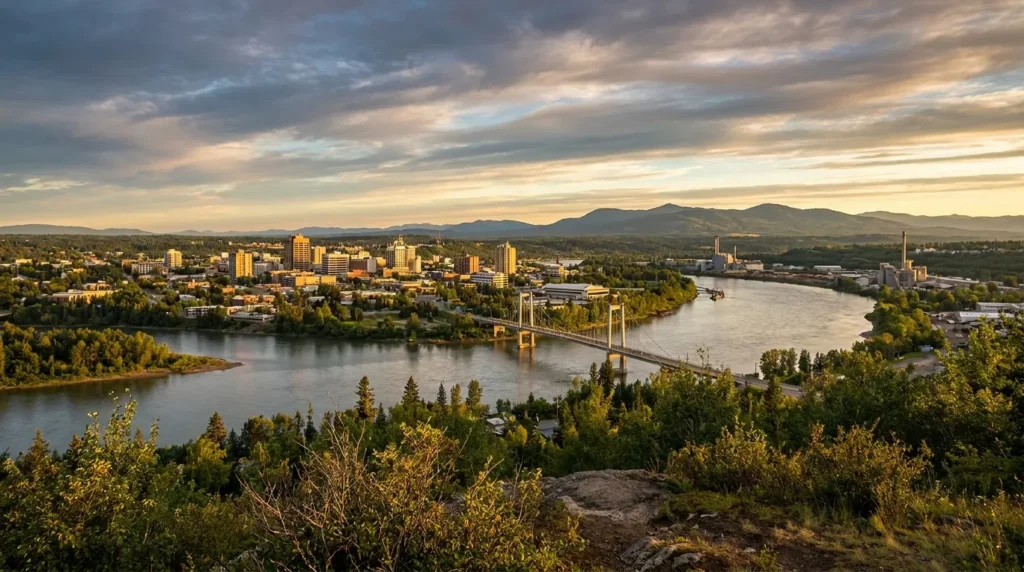
A mid-sized city with a strong Indigenous presence, established South Asian and Filipino communities, and a recent influx of immigrants tied to healthcare and construction.

The population is predominantly of European origin, a legacy of the British and Central European settlement waves that accompanied the railway and the lumber industry. Alongside this, there is a significant presence of First Nations peoples, particularly the Lheidli T'enneh, whose traditional territory includes the city, and broader Carrier communities in the surrounding region.

Among the most visible immigrant groups are South Asians, particularly Punjabi Indians tied to the transportation and sawmill sectors, and Filipinos, present in healthcare, hospitality, and care work. The number of Chinese, Vietnamese, Ukrainian, and Middle Eastern residents is also growing, many arriving through provincial immigration programs targeting regions outside major centers.

English is the dominant language. Punjabi, Tagalog, Mandarin, and Ukrainian are spoken at home by growing shares of the population. Sikh temples, Filipino Catholic churches, and Indigenous cultural centers coexist with traditional Protestant churches and serve as support points for newcomers.

Languages spoken
  • English
  • Punjabi
  • Tagalog
  • Mandarin
  • French
  • +1 more
Main religions
  • Christianity (Catholic)
  • Christianity (Protestant)
  • Sikhism
  • Indigenous Spiritualities
  • No religion
  • +1 more

Cost of living well below the southern part of the province

Prince George is one of the most affordable cities in British Columbia for renting and buying property, but fuel, food, and flights are more expensive than in Vancouver.

The budget of those who move to Prince George tends to stretch further than in any large BC city. One-bedroom apartment rents are far below those in Vancouver or Victoria, and three-bedroom homes in established neighborhoods cost a fraction of coastal prices. This allows families to enter the housing market earlier.

On the other hand, geographic isolation raises the cost of other goods. Fuel tends to run above the provincial average, neighborhood grocery stores charge more than large southern chains, and flying out requires a connection. Heavy winter clothing, snow tires, and home heating are mandatory expenses that do not exist in coastal cities.

Utilities, internet, and phone services follow standard Canadian rates, with little local competition. Healthcare is covered by the provincial plan after the waiting period, eliminating an expense that would weigh heavily in other countries. Overall, the value is strong for those earning in local currency, particularly in healthcare, education, and skilled trades.

Prince George

Neighborhoods: from downtown to College Heights

Affordable homes in the old downtown core, families prefer College Heights and Hart, and new subdivisions are growing in the south near the university.

Downtown and nearby neighborhoods such as Crescents and VLA have the oldest housing stock, with homes from the 1950s and 1960s and lower rents. This area is preferred by those who work downtown or at the hospitals, but some streets show visible social challenges, which is part of the urban landscape and calls for care when choosing a specific block.

College Heights, in the south, is the most sought-after neighborhood for families and professionals. It is close to UNBC and the College of New Caledonia, with well-rated schools, local shops, and quiet streets. Hart Highlands, in the north, is a more spacious alternative, with larger lots and a suburban feel, requiring more driving day to day.

For newcomers, the practical approach is to rent first, near the downtown core or in College Heights, learn the winter commute routes, and buy later. The rental market tightens during university peak periods, so searching in advance is advisable.

Recommended neighborhoods
  • College Heights
  • Hart Highlands
  • St. Lawrence Heights
  • Westgate
  • Lakewood
  • +1 more

Work tied to resources, healthcare, and education

Timber, rail transportation, the regional hospital, the university, and construction sustain the economy; wages are competitive for skilled trades and nursing.

The forestry sector remains the backbone of the economy, with sawmills and pulp and paper mills operating in and around the city. Despite industry cycles, it still employs thousands directly and indirectly, including truck drivers, mechanics, and operators. CN Rail maintains a major yard, sustaining stable logistics jobs.

Healthcare is the other major driver. The University Hospital of Northern British Columbia serves the entire northern region and continuously hires nurses, technicians, physicians, and care professionals. The Northern Health Authority is headquartered in the city. UNBC and the College of New Caledonia generate jobs in education, research, and administration, and attract qualified international staff.

Construction, retail, regional mining, and public services round out the picture. For immigrants, certified trades (electricians, plumbers, welders, heavy equipment mechanics) and healthcare professions find real demand, and provincial programs such as the BC PNP Northeast route tend to prioritize the region.

Dominant sectors
  • Forestry Industry
  • Healthcare
  • Rail Transportation
  • Higher Education
  • Construction
  • +1 more
Major employers
  • Northern Health Authority
  • University of Northern British Columbia
  • Canfor
  • CN Rail
  • College of New Caledonia
  • +3 more

Public university and technical college in the same hub

UNBC offers undergraduate and graduate programs with a focus on the north and Indigenous studies; CNC is the gateway for trades and short technical courses.

The University of Northern British Columbia, founded in 1990, is the only research university based in the northern interior of BC. It enrolls approximately four thousand students and offers programs in health sciences, engineering, natural resources, education, business, and a strong First Nations Studies department. The campus, set on a wooded hill in the south of the city, is compact and well equipped.

The College of New Caledonia, located downtown, is the most direct path to certified trades, practical nursing courses, heavy equipment mechanics, welding, information technology, and English as a Second Language for newcomers. Programs typically have direct ties to local employers and eligibility for immigration programs.

School District 57 administers the K-12 public schools, including Francophone and French immersion schools for families wishing to maintain or learn the second official language. IRCC recognizes both UNBC and CNC as designated learning institutions, and transition programs are available for children who do not speak English.

Notable universities
  • University of Northern British Columbia (UNBC)
  • College of New Caledonia (CNC)

Referral hospital for all of northern BC

The University Hospital of Northern British Columbia serves a vast region; access to a family doctor requires patience, as in most of Canada.

The healthcare system is public, managed by the Northern Health Authority, with coverage through British Columbia's MSP after the three-month waiting period for new residents. Immigrants must obtain private insurance during that interval. After that, consultations, hospital stays, and essential surgeries are covered.

The University Hospital of Northern British Columbia, located downtown, is the tertiary referral hospital for the entire northern half of the province, with emergency, oncology, pediatrics, obstetrics, and surgical services. Patients from smaller communities are transferred there. Walk-in clinics are available, but securing a regular family doctor typically requires a wait of months to years.

Chain pharmacies such as Shoppers Drug Mart, London Drugs, and Save-On are spread throughout the city. Mental health, dental, and vision care are not covered by MSP and require private insurance, typically provided by employers. UNBC and CNC have student health clinics, and specific services for Indigenous communities are available through the First Nations Health Authority.

Prince George

Safety: quiet residential neighborhoods and social challenges in the core

The city is safe throughout most residential neighborhoods; downtown has a concentration of social issues and opportunistic crime, particularly at night.

Prince George has a safety profile common to mid-sized Canadian resource economy cities: quiet residential neighborhoods and a downtown with visible issues tied to substance dependency, housing insecurity, and mental health. Historical property crime rates are above the national average, but violent crimes against strangers are rare.

In practice, families living in College Heights, Hart, Westgate, or Lakewood report a quiet routine. Basic precautions with unlocked cars and unattended bicycles prevent most incidents. At night, downtown, parts of George Street, and some streets near First Avenue call for greater awareness, particularly on foot.

The RCMP is the local police force. Community policing patrols also operate in parks and central areas. Indigenous women face historically higher risks, and several local organizations work specifically on prevention and support. For newcomers, the standard guidelines for a mid-sized Canadian city apply: common sense, avoiding isolated areas at night, and extra caution in winter due to ice.

Safer neighborhoods
  • College Heights
  • Hart Highlands
  • St. Lawrence Heights
  • Westgate
  • Lakewood
  • University Heights
Areas to avoid
  • George Street at night
  • Area around First Avenue downtown
  • Millar Addition in late hours
  • Isolated Industrial Townsite

A car-dependent city with a regional airport

A car is practically necessary in winter; the municipal bus system covers main routes, and YXS Airport connects to Vancouver, Calgary, and seasonal flights.

Prince George was built around the car. Distances between neighborhoods, snow for up to eight months in harsh winters, and low density make driving the norm. Winter tires are required by law in the region between October and April, and four-wheel-drive vehicles make navigating steep streets considerably easier.

BC Transit operates urban buses on routes connecting College Heights, Hart, downtown, and the university. The system works but runs less frequently than in larger cities, requiring planning. HandyDart service is available for reduced mobility. Taxis and ride-hailing apps cover the rest, with sparser coverage outside business hours.

Prince George Airport (YXS) is a key asset. It has a long runway, daily flights to Vancouver via Air Canada and WestJet, connections to Calgary and Fort St. John, and seasonal routes. VIA Rail runs the Jasper-Prince Rupert service through the city twice a week, more scenic than practical.

Airports
  • YXS — Prince George Airport
  • Bike infrastructure

Climate

Prince George

Northern, Indigenous, and working-class culture

Annual winter festival, a strong Indigenous arts scene, and simple gastronomy based on game, fish, and cuisines brought by immigrant communities.

Local culture is shaped by the heritage of First Nations peoples, particularly the Lheidli T'enneh and Carrier, with a strong presence in art, music, and public ceremonies. Lheidli T'enneh Memorial Park, in the city center, hosts community events and carries the name of the territory's original people. Galleries and cultural centers display contemporary Indigenous works.

Social life revolves around hockey, seasonal events, and neighborhood pubs. The Prince George Cougars, the WHL team, play at CN Centre and fill the city on game nights. Craft breweries such as CrossRoads and Trench Brewing have become gathering spots. The food scene is understated, with highlights including local salmon, moose, ramen, and curries brought by Asian and South Asian communities.

The Caledonia Highland Games celebrate Scottish heritage in July, the Coldsnap Music Festival brings live music to multiple venues in January, and Studio Fair gathers artisans at year's end. It is a city where cultural programming is built by the community, not imported ready-made.

Notable dishes
  • Grilled Pacific salmon
  • Moose and venison
  • Bannock
  • Tourtière
  • Pierogi
  • +2 more
Annual events
  • Coldsnap Music Festival
  • Caledonia Highland Games
  • Prince George Exhibition (BCNE)
  • Studio Fair
  • National Indigenous Peoples Day at Lheidli T'enneh Memorial Park
  • +1 more

Immediate nature and compact urban landmarks

Trails in Forests for the World, a railway museum, Lheidli T'enneh Memorial Park, and easy access to lakes, skiing, and provincial parks a short distance away.

The great draw of Prince George is direct access to nature. Forests for the World, a municipal park with trails and an artificial lake, is just minutes from the city center and is usable in every season. Cottonwood Island Nature Park, at the river confluence, has flat trails, tree sculptures, and is a favorite spot for photographers in autumn.

In the urban core, Lheidli T'enneh Memorial Park hosts public events, monuments, and a scenic bridge over the Fraser. Two Rivers Gallery covers contemporary art, and The Exploration Place combines science museum with regional history, making it ideal for families. The Central BC Railway and Forestry Museum draws those with an interest in industrial and rail history.

A short drive away are Purden Lake Provincial Park for camping, Powder King Mountain Resort for skiing at a smaller resort, and Crooked River Provincial Park for summer swimming. It is a city where genuine leisure takes place outside shopping malls.

  1. 1Lheidli T'enneh Memorial Park
  2. 2Forests for the World
  3. 3Cottonwood Island Nature Park
  4. 4Two Rivers Gallery
  5. 5The Exploration Place Museum + Science Centre
  6. 6Central BC Railway and Forestry Museum
Parks & green spaces
  • Forests for the World
  • Cottonwood Island Nature Park
  • Lheidli T'enneh Memorial Park
  • Connaught Hill Park
  • Fort George Park
  • +1 more

Immigrant communities in continuous growth

Punjabi Indians and Filipinos form the most visible groups; Chinese, Vietnamese, and Ukrainian communities have an established presence, with a recent influx from the Middle East and Africa.

Prince George has seen concentrated immigration over the past two decades, driven by the BC Provincial Nominee Program and chronic labor demand in healthcare, transportation, and construction. Punjabi Indians arrived first through the trucking and sawmill sectors, then retail, and are now one of the most established groups, with an active Sikh temple and extensive family networks.

Filipinos arrived mainly through care and healthcare programs, with a strong presence in hospitals, clinics, and the hospitality sector. There is an active cultural association, Tagalog-language masses, and community-run businesses. Chinese and Vietnamese residents work in restaurants, retail, and technology. Ukrainians have historical roots, now reinforced by new refugees since 2022. Smaller communities from Syria, Eritrea, Ethiopia, and South Korea are growing through humanitarian programs and community sponsorship.

Institutional support is centered at the Immigrant and Multicultural Services Society of Prince George, the main entry point for LINC English classes, labor market orientation, credential recognition, and refugee settlement. Churches, temples, and cultural centers function as a second layer of real-world support.

7,500
Foreign-born residents
estimated
Top countries of origin
  • India
  • Philippines
  • China
  • United Kingdom
  • Vietnam
  • Ukraine
  • South Korea
  • United States
Foreign consulates
  • Consulate General of India in Vancouver (jurisdiction)
  • Consulate General of the Philippines in Vancouver (jurisdiction)
  • Consulate General of China in Vancouver (jurisdiction)
  • Consulate General of the United States in Vancouver (jurisdiction)
  • Consulate General of Japan in Vancouver (jurisdiction)
  • +1 more
Community organizations
  • Immigrant and Multicultural Services Society of Prince George (IMSS)
  • Prince George Local Immigration Partnership
  • Northern John Howard Society
  • Prince George Native Friendship Centre
  • Punjabi Cultural Association of Prince George
  • Filipino-Canadian Association of Prince George

Latest posts

Straight from the blog

There are no posts specifically about Prince George yet. In the meantime, check out our latest posts.