Visto n' Visa
Blog
Notícias e artigos
Destinations
Careers
Immigrants

Want to live and work in East Hastings?

Personalized immigration plan with eligible visas, costs, and next steps for your goal!

If you are not eligible, you will know exactly why and what to do to improve your approval chances.

Save up to 12 hours in meetings

No pointless assessments.

Save up to 90%

Save money on vague or unfocused consultations

Avoid Fraud and Mistakes

One mistake can cost you your visa

Total Impartiality

Zero commercial bias

Decide with peace of mind

No toxic urgency

Fast and Accurate

Answers in minutes, no guesswork

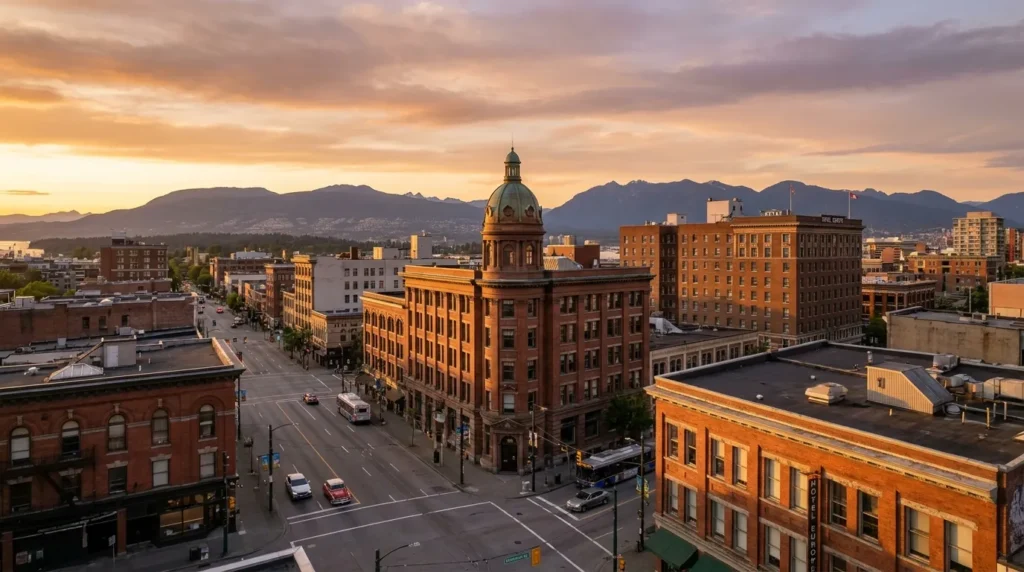
One of Vancouver's most diverse areas

Strong presence of Chinese, Vietnamese, Filipino, Indigenous, Italian, and Latin American communities, with a varied age profile and very unequal income levels across sub-areas.

The East Hastings corridor brings together some of Vancouver's oldest immigrant communities. Chinatown, just to the west, still concentrates residents of Chinese origin, many of them elderly people who have lived in the area for decades. Hastings-Sunrise, farther east, has a strong Italian, Vietnamese, and Filipino presence, a legacy of postwar migration waves.

The age profile shifts from block to block. Strathcona and Hastings-Sunrise attract young families and creative professionals, while the Downtown Eastside has an older population with a high proportion of First Nations Indigenous people and greater social vulnerability. Average income varies drastically within just a few blocks.

English is dominant, but Cantonese, Mandarin, Tagalog, Vietnamese, Punjabi, and Spanish are commonly heard in local businesses. The city officially recognizes the multicultural character of the area and maintains bilingual programs in local public schools.

Languages spoken
  • English
  • Cantonese
  • Mandarin
  • Tagalog
  • Vietnamese
  • +2 more
Main religions
  • Christianity (Catholic and Protestant)
  • Buddhism
  • No religion
  • Sikhism
  • Hinduism
  • +1 more

Cheaper than downtown Vancouver, but far from affordable

Rents below the city average, especially in Hastings-Sunrise and Strathcona, but the market remains under pressure, and groceries and transportation cost the same as elsewhere in Vancouver.

Vancouver is one of Canada's most expensive cities, and East Hastings offers some relief compared to neighborhoods like Kitsilano, Yaletown, or the West End. Studios and one-bedroom apartments in older buildings still appear at lower price points, particularly in the stretch between Commercial Drive and Nanaimo Street.

Grocery costs are in line with city standards, but the area has a clear advantage: Asian markets in Chinatown, Italian butcher shops in Hastings-Sunrise, and producers at the Trout Lake Farmers Market can significantly lower food expenses for those who cook at home. Affordable and quality restaurants are plentiful.

Basic utilities such as electricity (BC Hydro), heating, and internet follow provincial averages. Public transit via a monthly TransLink pass (Compass Card) is practically a necessity, as street parking in the area is expensive and competitive.

106Cost index (US = 100)6% above US average
CategorySingleCoupleFamily (2 + 2)
iHousing$1,382$1,707$2,195
iFood$325$650$1,179
iTransport$309$569$732
iHealthcare$65$130$228
iChildcare$1,423
iOther$439$732$975
Monthly total$2,520$3,788$6,732

Source: Statistics Canada (SHS 2022 + CPI 2024) · Estimates in USD, monthly.

From century-old restored homes to new towers and social housing

A rare Vancouver mix: Victorian houses, 1960s walk-ups, new towers in Strathcona, and a large stock of social housing in the Downtown Eastside.

Hastings-Sunrise is the most sought-after area for families and offers semi-detached homes, duplexes, and low-rise buildings with rent controls. Many properties still have laneway houses at the back, a Vancouver specialty that creates additional housing on the same lot.

Strathcona is experiencing a real estate boom with new towers and warehouse conversions into lofts. The neighborhood is Vancouver's oldest and maintains protected heritage designation, which limits demolitions and preserves the character of its streets.

The Downtown Eastside has the largest network of social housing, shelters, and SROs (single room occupancy) in Canada. It is not a typical destination for newcomers, but it is a fundamental part of the area's landscape and housing policy. Prospective renters in this zone should visit the property during both day and night before making a decision.

Recommended neighborhoods
  • Hastings-Sunrise
  • Strathcona
  • Commercial Drive (The Drive)
  • Grandview-Woodland
  • Renfrew-Collingwood

Port, creative industries, and social services

The local economy blends port logistics, small manufacturers, creative studios, hospitality, and Vancouver's largest hub for social and health services.

Proximity to the Port of Vancouver, Canada's largest, sustains jobs in logistics, transportation, and light industry throughout the corridor. Strathcona is home to small factories, craft breweries, workshops, and design studios that employ thousands of skilled professionals.

The creative scene is strong: advertising agencies, game studios, film and TV production companies (Vancouver is nicknamed Hollywood North), and coworking spaces concentrated near Powell Street. For tech professionals, the path typically runs through companies headquartered downtown, just a few SkyTrain stops away.

The health and social services sector is massive in this area, with St. Paul's, Vancouver Coastal Health, nonprofits, and community clinics employing nurses, social workers, peer support workers, and administrators. Hospitality and independent retail round out the picture.

Dominant sectors
  • Logistics and port operations
  • Creative and audiovisual industries
  • Health and social services
  • Hospitality and food service
  • Independent retail
  • +1 more
Major employers
  • Port of Vancouver
  • Vancouver Coastal Health
  • PHS Community Services Society
  • City of Vancouver
  • Translink
  • +1 more

Public schools with bilingual programs and easy access to universities

The Vancouver School Board serves the area with Mandarin and French programs, and universities such as UBC, SFU, and Emily Carr are a short SkyTrain ride away.

Local public schools are part of the Vancouver School Board and serve neighborhood families with French immersion, Mandarin programs, and support for newly arrived students (ELL). Strathcona Elementary and Britannia Secondary are historic landmarks of the area.

Post-secondary options are strong and accessible. Emily Carr University of Art and Design is located on Great Northern Way, minutes from the corridor, and holds an international reputation in design and digital media. Vancouver Community College (VCC) offers short technical programs that are popular among immigrants transitioning careers.

The University of British Columbia (UBC) and Simon Fraser University (SFU) are reachable from the area via direct bus routes and SkyTrain. Both have international student support offices and offer graduate pathways connected to permanent residency programs.

Notable universities
  • University of British Columbia (UBC)
  • Simon Fraser University (SFU)
  • Emily Carr University of Art and Design
  • Vancouver Community College (VCC)
  • British Columbia Institute of Technology (BCIT)

The city's highest concentration of public health services

Served by Vancouver Coastal Health, with nearby St. Paul's Hospital, community clinics, and an extensive network of mental health and harm reduction services.

British Columbia's health system is public and administered through the MSP (Medical Services Plan). Eligible immigrants must wait out a waiting period (generally up to three months after arrival) before coverage begins and should maintain private insurance during that interval.

The area is served by Vancouver Coastal Health, with St. Paul's Hospital to the west and Vancouver General Hospital a short distance to the south. Community clinics such as REACH, Mid-Main, and Three Bridges provide family care, sexual health services, and support for immigrant and LGBTQ+ populations.

The Downtown Eastside hosts one of the world's most advanced networks for mental health, harm reduction, and addiction treatment, including Insite, the first supervised consumption site in North America. It represents a technical distinction, even as it reflects a complex social crisis.

East Hastings

Unequal reality across sub-areas, with extra caution needed in the Downtown Eastside

Hastings-Sunrise and Strathcona are considered safe and family-friendly; the Downtown Eastside stretch concentrates social challenges and opportunistic crime, requiring awareness.

An honest assessment of East Hastings requires separating its sub-areas. Hastings-Sunrise, Grandview-Woodland, and Commercial Drive are considered safe, with crime rates close to the Vancouver average and a strong community presence. Families move around comfortably during the day and at night.

Strathcona is safe but busier, with noticeable differences between blocks. The Downtown Eastside stretch, between Main and Gore, concentrates housing instability, substance dependency, and mental health challenges. Violent crime against individuals is less common than it might appear, but theft, harassment, and distressing scenes are frequent. It is not an area for walking distracted with a phone out or leaving valuables in a car.

Throughout the corridor, standard big-city common sense applies: lock bikes in visible spots, leave nothing in the car, and pay attention to street lighting at night. Vancouver Police maintain enhanced foot patrols in the most sensitive stretch.

Safer neighborhoods
  • Hastings-Sunrise
  • Grandview-Woodland
  • Commercial Drive (The Drive)
  • Renfrew-Collingwood
  • Strathcona (residential section)
Areas to avoid
  • Downtown Eastside (Main and Hastings, at night)
  • Oppenheimer Park and surroundings after dark
  • Industrial area near Powell Street in the early morning hours

Frequent buses, nearby SkyTrain, and a cycling culture

Route 14 and the R5 RapidBus serve all of Hastings Street, with SkyTrain stations at Main Street-Science World and Commercial-Broadway serving the area.

The Hastings Street corridor is served by Route 14 (to UBC) and the R5 RapidBus, an express bus connecting downtown to SFU in Burnaby. Frequency is high during the day, with 24-hour service on weekends along part of the route. Night Bus N20 covers the overnight hours.

The SkyTrain station closest to most of the corridor is Commercial-Broadway, a hub connecting the Expo and Millennium lines and the B-Line to UBC. Main Street-Science World serves the western end. From there, downtown is about 5 minutes away and YVR airport roughly 35 minutes with one transfer.

The city has protected bike lanes on Union Street, Adanac, and Powell, connecting East Hastings to Stanley Park and downtown. Cars are useful for leaving the city, but street parking requires a residential permit and is competitive on nearly every block.

Airports
  • YVR — Vancouver International Airport (approximately 12 km away, outside the neighborhood)
  • Bike infrastructure

Climate

East Hastings

Arts scene, Asian cuisine, and street festivals

Independent galleries, food trucks, Chinatown restaurants, Italian bakeries, and multicultural festivals define the cultural calendar of the corridor.

East Hastings is essential territory for those who enjoy independent art in Vancouver. Strathcona is home to galleries, open studios, and the Eastside Culture Crawl, an annual festival that opens hundreds of studios to the public. There are also live music venues, small theaters, and alternative cinemas.

The food scene blends traditions. Chinatown offers century-old dim sum, Peking duck restaurants, egg tart bakeries, and Asian grocery markets. Commercial Drive is the heart of the Italian heritage, with historic cafes, gelaterias, and trattorias. Hastings-Sunrise has one of the best Vietnamese food offerings in the city.

The calendar includes the Vancouver Mural Festival, Italian Day on The Drive, Lunar New Year in Chinatown, the Powell Street Festival (Japanese-Canadian culture), and the Pacific National Exhibition (PNE), an annual fair at the eastern end of the corridor.

Notable dishes
  • Chinatown dim sum
  • Peking duck
  • Vietnamese pho
  • Wood-fired Italian pizza
  • Pacific Coast-style grilled salmon
  • +2 more
Annual events
  • Eastside Culture Crawl
  • Pacific National Exhibition (PNE)
  • Vancouver Mural Festival
  • Italian Day on The Drive
  • Powell Street Festival
  • +2 more

From historic Chinatown to parks with mountain views

Includes Canada's oldest Chinese neighborhood, the PNE, established urban parks, and one of Vancouver's most photographed waterfront spots at Crab Park.

Chinatown is a must-visit, with the Dr. Sun Yat-Sen Classical Chinese Garden, the Millennium Gate, and century-old markets. Strathcona Park and Trout Lake (John Hendry Park) offer generous green spaces, with a swimming lake in summer and a farmers market on Saturdays.

The Pacific National Exhibition (PNE) and Playland amusement park operate at the eastern end of the corridor and host the city's largest summer fair. Crab Park, on the waterfront, offers a striking view of the North Shore Mountains and the downtown skyline, particularly at sunset.

For art, the Polygon gallery (in nearby North Vancouver, accessible by a short ferry), the Vancouver Art Gallery a few SkyTrain stops away, and the mural and independent gallery circuit of the Vancouver Mural Festival covering much of Strathcona and Mount Pleasant are all worth exploring.

  1. 1Chinatown and Millennium Gate
  2. 2Dr. Sun Yat-Sen Classical Chinese Garden
  3. 3Pacific National Exhibition (PNE) and Playland
  4. 4Crab Park
  5. 5Trout Lake (John Hendry Park)
  6. 6Strathcona Park
Parks & green spaces
  • Strathcona Park
  • John Hendry Park (Trout Lake)
  • Crab Park
  • Hastings Park
  • Oppenheimer Park
  • +1 more

A mosaic of multi-generational immigrant communities

Chinese, Vietnamese, Filipino, Italian, South Asian, Latin American, and African communities form a visible multicultural fabric across businesses, schools, and community centers.

Vancouver is one of the world's most multicultural cities, and East Hastings holds an important share of that mosaic. The Chinese community, with a documented presence since the 19th century, remains strong in Chinatown. Italians and Portuguese arrived in large numbers after World War II and continue to shape Commercial Drive to this day.

More recently, Vietnamese, Filipino, Indian, Punjabi, and Latin American communities have grown in Hastings-Sunrise and Renfrew-Collingwood. Markets, bakeries, churches, and temples reflect this diversity in the streets.

Organizations such as MOSAIC, ISSofBC, and S.U.C.C.E.S.S. serve newly arrived immigrants from any background with English classes, professional credential recognition, job search support, and legal guidance. The city maintains municipal programs focused on integration and racial equity.

280,000
Foreign-born residents
estimated
Top countries of origin
  • China
  • Philippines
  • India
  • Vietnam
  • South Korea
  • Iran
  • United Kingdom
  • Mexico
Foreign consulates
  • Consulate General of China in Vancouver
  • Consulate General of Japan in Vancouver
  • Consulate General of South Korea in Vancouver
  • Consulate General of Mexico in Vancouver
  • Consulate General of the Philippines in Vancouver
  • +3 more
Community organizations
  • MOSAIC BC
  • ISSofBC (Immigrant Services Society of BC)
  • S.U.C.C.E.S.S.
  • DIVERSEcity Community Resources Society
  • Vancouver Association of Chinese Canadians
  • Strathcona Community Centre

Latest posts

Straight from the blog

There are no posts specifically about East Hastings yet. In the meantime, check out our latest posts.