Visto n' Visa
Blog
Notícias e artigos
Destinations
Careers
Immigrants

Want to live and work in Hilton Head Island?

Personalized immigration plan with eligible visas, costs, and next steps for your goal!

If you are not eligible, you will know exactly why and what to do to improve your approval chances.

Save up to 12 hours in meetings

No pointless assessments.

Save up to 90%

Save money on vague or unfocused consultations

Avoid Fraud and Mistakes

One mistake can cost you your visa

Total Impartiality

Zero commercial bias

Decide with peace of mind

No toxic urgency

Fast and Accurate

Answers in minutes, no guesswork

Mixed Population of Retirees, Tourism Workers, and Families

Hilton Head has about 38,000 permanent residents, with a strong presence of Anglo-American retirees and a significant Hispanic community that sustains the hospitality sector. The population quadruples in summer with tourists.

The resident population of Hilton Head Island hovers around 38,000, but visitor numbers during high season push the island to receive more than 2.5 million people per year. The median age is high, above 55, reflecting the retirement destination profile the city has built over recent decades.

The majority demographic is white Anglo-American, but the Hispanic and Latino community accounts for about 17 percent of residents, concentrated mainly in neighborhoods such as Northridge and areas near US-278. Workers from Mexico, Guatemala, Honduras, and El Salvador sustain restaurants, landscaping, construction, and resort cleaning services.

The island also has a historically significant Gullah Geechee community, descended from enslaved Africans who preserved their own traditions, Creole language, and cuisine. Neighborhoods like Mitchelville, Squire Pope, and Spanish Wells preserve this heritage through churches, markets, and festivals celebrating Gullah culture throughout the year.

Languages spoken
  • English
  • Spanish
  • Gullah
  • Portuguese
Main religions
  • Protestantism
  • Catholicism
  • Judaism
  • No religion

Cost Above the State Average, Driven by Housing and Services

Living in Hilton Head costs about 20 to 30 percent more than the South Carolina average. Rent, food, and services reflect the island's tourist profile, but the absence of state tax on retirement income offsets some of that.

Hilton Head Island ranks among the most expensive cities in South Carolina. A one-bedroom apartment in a condominium inside one of the plantations runs between $1,800 and $2,500 per month, while a three-bedroom house in more modest neighborhoods like Bluffton, across the bridge, can be found for $2,200 to $3,000 per month. Buying a decent home rarely comes in under $500,000.

Grocery chains such as Publix, Harris Teeter, and Fresh Market dominate the island, with prices above the national average. Restaurants in tourist areas like Coligny Plaza and Shelter Cove charge coastal destination prices. To save money, residents often cross the bridge to shop in Bluffton or Beaufort, where Walmart, Aldi, and more affordable options are available.

Electricity runs about $130 to $180 per month for an average apartment, with peak costs in summer due to air conditioning. Fiber internet through Hargray or Spectrum costs $60 to $90 per month. Individual private health insurance rarely comes in under $450 per month for an adult without a federal subsidy.

Hilton Head Island

Market Divided Between Gated Plantations and Workforce Neighborhoods

Those who can afford it live inside one of the private plantations, with access to beach, golf, and security. Those who work in hospitality typically live in Bluffton or the northern end of the island, where rents are more accessible.

The real estate market in Hilton Head is heavily segmented. The most sought-after plantations, including Sea Pines, Palmetto Dunes, Port Royal, and Hilton Head Plantation, offer waterfront condominiums, golf course homes, and full amenities, with prices ranging from $600,000 to several million dollars. Association dues and plantation fees can add up to $1,500 to $4,000 per year.

For renters, condominiums in Folly Field, Forest Beach, and Shipyard are common options, many with short-term rental restrictions. Neighborhoods like Northridge, Indigo Run, and Spanish Wells offer more affordable housing within the island, but with fewer amenities. Long-term rental inventory is limited because owners prefer to rent to tourists on a seasonal basis.

The practical solution for most workers is to live in Bluffton, Hardeeville, or Beaufort, across the bridge, and commute to the island each day. Bluffton in particular has grown significantly in recent years, with newer neighborhoods like Palmetto Bluff and Old Town offering alternatives with more space for less money.

Recommended neighborhoods
  • Sea Pines
  • Palmetto Dunes
  • Hilton Head Plantation
  • Port Royal
  • Shipyard Plantation
  • +3 more

Economy Dominated by Tourism, Golf, and Luxury Services

The job market revolves around hospitality, dining, golf, real estate, and construction. Average wages in hospitality are modest, but demand for workers is consistent across all seasons.

Hilton Head is, above all, a hospitality economy. Hotels, resorts, golf courses, restaurants, and vacation rental companies employ the largest share of the island's workforce. Roles such as front desk agents, housekeepers, cooks, servers, caddies, and landscapers have year-round openings, with strong demand from March through October.

Real estate and construction form the second pillar. As the island sees constant property renovation and high-end home construction in Bluffton, opportunities exist in brokerage, property management, renovation, landscaping, and architecture. Licensed professionals in South Carolina can enter this market with relative ease.

For skilled professionals in healthcare, education, and technology, the market is more limited and requires commuting to Savannah, Georgia, about 50 minutes away. Many residents work remotely for companies in Charleston, Atlanta, or other states, taking advantage of the island's reliable internet and quality of life.

Dominant sectors
  • Hospitality and tourism
  • Golf and recreation
  • Real estate and construction
  • Dining and food service
  • Healthcare and elder care
  • +1 more
Major employers
  • Sea Pines Resort
  • Palmetto Dunes Oceanfront Resort
  • The Sea Pines Country Club
  • Hilton Head Hospital
  • Town of Hilton Head Island
  • +2 more

Strong Public Schools and Proximity to Universities in Beaufort and Savannah

The island's public schools belong to the Beaufort County School District and have a good reputation. For higher education, students travel to Bluffton, Beaufort, or Savannah, where the region's main universities are located.

The island has three main public schools administered by the Beaufort County School District: Hilton Head Island Elementary, Hilton Head Island Middle School, and Hilton Head Island High School. Academic performance is above the state average, particularly at the high school level, with well-developed International Baccalaureate (IB) programs. Private options include Hilton Head Preparatory School and Heritage Academy.

For higher education, the closest option is the University of South Carolina Beaufort, with a campus in Bluffton, 15 minutes from the island, offering programs in business, marine biology, hospitality, and nursing. The Technical College of the Lowcountry, also in Bluffton, offers technical and vocational programs.

For those seeking a larger university, the Savannah College of Art and Design (SCAD), Georgia Southern (Armstrong), and Savannah State University are less than an hour's drive away in Savannah. Charleston, with the College of Charleston and the Medical University of South Carolina, is two hours away via Interstate 95.

Notable universities
  • University of South Carolina Beaufort
  • Technical College of the Lowcountry
  • Savannah College of Art and Design (nearby)
  • Savannah State University (nearby)
  • College of Charleston (2 hrs away)

Good Hospital Network for the Island's Size, with Regional Referral to Savannah

The island has its own hospital covering emergencies and mid-level care. For specialized cases, patients are referred to Savannah or Charleston, both established regional medical centers.

Hilton Head Hospital, part of the Tenet Healthcare network, is the island's main hospital, with a 24-hour emergency room, maternity ward, general surgery, and cardiology. For the size of the city, the facility is considered good, with reasonable wait times outside peak seasons. Private clinics and urgent care centers like Doctors Care and MedExpress are spread across the island and in Bluffton.

For specialized treatments such as oncology, neurosurgery, or complex cardiology, patients are referred to Memorial Health University Medical Center or St. Joseph's/Candler in Savannah, 50 minutes away. Charleston, with the Medical University of South Carolina and Roper St. Francis, is the referral center for rarer cases, but requires a two-hour trip.

The system is private, and island residents generally carry employer-sponsored or individual marketplace health insurance. For retirees 65 and older, Medicare covers a significant portion of costs. South Carolina has not expanded Medicaid, so low-income adults have limited coverage and rely on community clinics and Volunteers in Medicine Hilton Head Island.

Hilton Head Island

One of the Safest Cities in South Carolina

Hilton Head Island has very low crime rates compared to state and national averages. Violent crimes are rare, and most incidents involve property theft and opportunistic crimes in summer.

The island is consistently listed among the safest cities in South Carolina. The Beaufort County Sheriff's Office, combined with private plantation patrols, maintains a constant presence, especially in tourist areas and near the beaches. Violent crimes are rare and make headlines when they occur.

The most practical concern is theft from cars parked at beach access points, mainly in summer, when many visitors leave valuables in plain sight. Domestic incidents and alcohol-related crimes increase on weekends during events such as the RBC Heritage and during spring break weeks, when college students flood the island.

Beyond that, it is a city where seniors ride bikes at night, children play on plantation interior streets, and residents frequently leave doors unlocked. Mosquitoes, alligators, and summer storms are the threats most often mentioned in porch conversations.

Safer neighborhoods
  • Sea Pines
  • Palmetto Dunes
  • Hilton Head Plantation
  • Port Royal Plantation
  • Shipyard Plantation
  • Indigo Run
Areas to avoid
  • Isolated stretches of US-278 at night
  • Beach parking lots with valuables visible in the car

Car-Dependent City with Minimal Bus Service and Good Nearby Airports

Hilton Head requires a car for nearly everything. Public transit is minimal, but the island has excellent bike paths and two airports within short distance, with Savannah serving as the main international gateway.

US-278 is the only road connecting the island to the mainland, and traffic can back up on summer weekends and during peak hours. Inside the island, internal plantation roads are narrow and well-shaded, with low speed limits. Beach parking is free at several public access points, including Coligny Beach Park and Driessen Beach, but fills up early.

Public transportation is essentially nonexistent. A seasonal tourist trolley service operates, and the Lowcountry Regional Transportation Authority runs some bus routes, but frequency is low and service is oriented toward workers. Rideshare apps like Uber and Lyft work well, and water taxi and charter services are available for outings on Calibogue Sound.

The island is a regional benchmark for bike infrastructure. More than 60 miles of paved pathways connect virtually all neighborhoods, grocery stores, restaurants, and beaches. Many residents and tourists use bicycles as their primary mode of transportation, and rentals are available almost everywhere.

Airports
  • HHH — Hilton Head Island Airport
  • SAV — Savannah/Hilton Head International Airport
  • Bike infrastructure

Climate

Hilton Head Island

Blend of Lowcountry Tradition, Gullah Geechee Heritage, and Resort Culture

The island's culture balances the Lowcountry coastal tradition, the African Gullah Geechee heritage, and the resort lifestyle of newer residents. Seafood, live music, and golf festivals mark the calendar.

Local cuisine is pure Lowcountry. Fresh seafood such as shrimp, oysters, blue crab, and swordfish appear on nearly every menu, typically accompanied by grits, hush puppies, and collard greens. Historic restaurants like Hudson's on the Docks and The Old Oyster Factory have served this food for decades and are essential stops.

The Gullah Geechee heritage is alive and visible. Festivals such as the Gullah Celebration in February and the Native Island Business and Community Affairs Association preserve traditions of song, dance, craft, and cuisine. Sites like Mitchelville Freedom Park tell the story of the first self-governed town of freed people in the United States, founded in 1862.

The sports and cultural calendar is anchored by the RBC Heritage Golf Tournament in April, which draws the world's best players to Harbour Town Golf Links and moves the entire island. Other popular events include the Concours d'Elegance and Motoring Festival, the Hilton Head Wine and Food Festival, and live performances at Shelter Cove during summer.

Notable dishes
  • Shrimp and grits
  • Lowcountry boil
  • She-crab soup
  • Frogmore stew
  • Lowcountry roasted oysters
  • +1 more
Annual events
  • RBC Heritage Golf Tournament
  • Gullah Celebration
  • Hilton Head Wine and Food Festival
  • Concours d'Elegance and Motoring Festival
  • Harbour Town Lighthouse 4th of July
  • +1 more

Wide Beaches, World-Class Golf, and Preserved Natural Areas

The main attractions center on beaches, golf, and natural areas. Harbour Town Lighthouse, Coligny Beach, and nearby state parks are essential stops for first-time visitors.

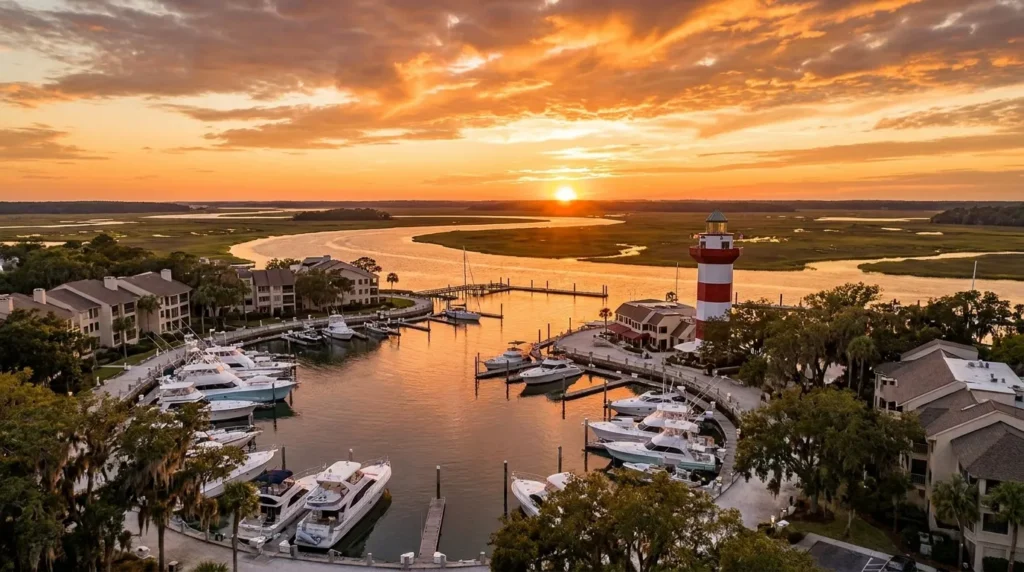
Harbour Town Lighthouse, inside Sea Pines, is the island's iconic landmark. Below it sits the Harbour Town Yacht Basin, with restaurants, shops, and sunset performances during peak season. The surrounding golf courses, especially Harbour Town Golf Links, are bucket-list destinations for any serious player.

The beaches are the heart of the island. Coligny Beach Park is the busiest access point, with showers, restrooms, and parking. Driessen Beach Park, Burkes Beach, and Folly Field are quieter options. Hilton Head's hard-packed sand is popular with cyclists and runners, who take advantage of low tide to ride and run along the shoreline.

For nature, Sea Pines Forest Preserve offers trails through centuries-old live oaks and marshes with alligators. Pinckney Island National Wildlife Refuge, at the island's entrance, shelters migratory birds. To explore Gullah history, Mitchelville Freedom Park tells the story of the community founded by freed people during the Civil War.

  1. 1Harbour Town Lighthouse
  2. 2Coligny Beach Park
  3. 3Sea Pines Forest Preserve
  4. 4Mitchelville Freedom Park
  5. 5Pinckney Island National Wildlife Refuge
  6. 6Harbour Town Golf Links
Parks & green spaces
  • Sea Pines Forest Preserve
  • Pinckney Island National Wildlife Refuge
  • Jarvis Creek Park
  • Chaplin Community Park
  • Crossings Park
  • +1 more

Strong Hispanic Community Sustains the Island's Economy

The largest immigrant community in Hilton Head is Hispanic, with a strong Mexican, Guatemalan, and Honduran presence. There are also seasonal European workers and small Brazilian and Filipino communities.

The Hispanic community is by far the largest immigrant group in Hilton Head. Coming mainly from Mexico, Guatemala, Honduras, and El Salvador, these workers sustain restaurants, hotels, landscaping, cleaning, and construction across the island. They are concentrated in neighborhoods like Northridge and Spanish Wells, and in Bluffton across the bridge, where more affordable rental options are available.

There is also a significant presence of seasonal European workers, primarily Irish, British, and Eastern European, who come on J-1 and H-2B visas to work at resorts during the summer. Small Brazilian, Colombian, Filipino, and Indian communities live on the island, generally connected to work in hospitality, healthcare, and construction.

There are no consulates on the island, but Charleston and Atlanta host regional diplomatic representations. Organizations such as the Lowcountry Immigration Coalition, Family Promise of Beaufort County, and Holy Family Catholic Church serve as support points, offering English classes, basic legal assistance, and support for newly arrived families.

5,500
Foreign-born residents
estimated
Top countries of origin
  • Mexico
  • Guatemala
  • Honduras
  • El Salvador
  • Ireland
  • Colombia
  • Brazil
  • Philippines
Foreign consulates
  • Consulate General of Mexico in Atlanta (jurisdiction)
  • Consulate General of Brazil in Atlanta (jurisdiction)
  • Honorary Consulate of Ireland in Charleston
  • Consulate General of the United Kingdom in Atlanta (jurisdiction)
Community organizations
  • Lowcountry Immigration Coalition
  • Family Promise of Beaufort County
  • Holy Family Catholic Church Hispanic Ministry
  • Volunteers in Medicine Hilton Head Island
  • The Literacy Center of the Lowcountry

Latest posts

Posts about South Carolina

Coverage and updates related to this destination.

Showing content from South Carolina, as there is no specific data for Hilton Head Island yet.