Visto n' Visa
Blog
Notícias e artigos
Destinations
Careers
Immigrants

Want to live and work in Dubuque?

Personalized immigration plan with eligible visas, costs, and next steps for your goal!

If you are not eligible, you will know exactly why and what to do to improve your approval chances.

Save up to 12 hours in meetings

No pointless assessments.

Save up to 90%

Save money on vague or unfocused consultations

Avoid Fraud and Mistakes

One mistake can cost you your visa

Total Impartiality

Zero commercial bias

Decide with peace of mind

No toxic urgency

Fast and Accurate

Answers in minutes, no guesswork

Who lives in Dubuque today

A predominantly white city of German and Irish descent, with smaller Hispanic and Marshallese communities growing in recent years around manufacturing jobs.

Dubuque is historically one of the most Catholic cities in the American Midwest, a legacy of German, Irish, and Luxembourgish immigration in the 19th century. That heritage still shows in active parishes, St. Patrick's Day celebrations, and the surnames that dominate the local phone directory.

The population is predominantly white, with a smaller African American community concentrated in neighborhoods near downtown and a slowly growing Hispanic community driven mainly by Mexican and Central American workers at regional meat processing plants. There is also a small but visible Marshallese community, connected to larger networks in Arkansas and other Iowa cities through migration chains.

English is the dominant language in all settings, with Spanish present in some public services and at the Hispanic parish. The city lacks the linguistic diversity of Des Moines or Cedar Rapids, but public schools offer English as a Second Language support for newly arrived families.

Languages spoken
  • English
  • Spanish
  • Marshallese
  • German (heritage)
Main religions
  • Catholic
  • Lutheran
  • Methodist
  • No religion
  • Evangelical

Cost of living in Dubuque: one of the lowest in the Midwest

Rent, food, and services are well below the national average, with housing being the primary financial draw for families relocating from larger cities.

Dubuque consistently ranks among the most affordable cities in the United States. A two-bedroom apartment downtown rarely exceeds $1,100 per month, and rents fall considerably lower outside downtown. Buying a home is also accessible by American standards, with many properties available below $250,000 in established neighborhoods.

Groceries, restaurants, and everyday services follow the same trend. National chains such as Hy-Vee, Aldi, and Walmart dominate grocery shopping, and meals at local diners typically run between $12 and $18. Utility bills rise in winter due to natural gas heating, common in older homes.

Iowa's state income tax ranges from 4.4% to 5.7% depending on the bracket, and property taxes run around 1.5% of assessed value per year, with a reduction for primary residences. A car is essentially required, but fuel and insurance are inexpensive compared to coastal markets.

86Cost index (US = 100)14% below US average
CategorySingleCoupleFamily (2 + 2)
iHousing$1,118$1,290$1,634
iFood$326$654$1,187
iTransport$430$732$947
iHealthcare$241$482$903
iChildcare$1,566
iOther$732$1,316$1,849
Monthly total$2,847$4,474$8,086

Source: U.S. BLS Consumer Expenditure Survey 2023 + BEA Regional Price Parities 2023 · Estimates in USD, monthly.

Where to live in Dubuque: from downtown Victorians to the western suburbs

Victorian homes and historic duplexes define the central neighborhoods; recent growth has concentrated in the western zone, with new construction and condominiums near the US-20 corridor.

The appeal of Dubuque lies in the Victorian homes on the hills near downtown. Neighborhoods such as Cathedral, Langworthy, and Jackson Park feature restored 1880s and 1890s mansions with wide porches and wooden details. These are options for those who want historic character and proximity to downtown, though they require attention to older heating and plumbing systems.

Families preferring new construction and larger yards look to the western zone along John F. Kennedy Road and Pennsylvania Avenue, where the most recent developments are located. Asbury, a neighboring city bordering Dubuque, functions essentially as a residential suburb and has seen growth with new three- and four-bedroom homes.

For more affordable rentals, North End and neighborhoods near Central Avenue offer options, though quality varies block by block. University of Dubuque students concentrate around McCormick Street, and Loras College maintains its own stock of apartments near campus.

Recommended neighborhoods
  • Cathedral Historic District
  • Langworthy
  • Jackson Park
  • West End
  • Asbury
  • +2 more

Work in Dubuque: manufacturing, healthcare, and financial services

A diversified economy anchored in heavy manufacturing, financial services through John Deere and IBM, regional hospitals, and higher education; unemployment has historically remained below the national average.

Dubuque has a stronger economy than its size suggests. John Deere operates a large factory in the city, the Dubuque Works, which produces construction tractors and employs several thousand people directly and indirectly. It is the region's largest private employer and generates continuous demand for engineers, technicians, and operators.

The healthcare sector is also strong, with MercyOne Dubuque Medical Center and UnityPoint Health-Finley Hospital serving the entire Tri-State Area, which includes parts of Illinois and Wisconsin. Qualified workers find consistent openings in nursing, medical technology, and hospital administration.

The financial sector has grown through Cottingham and Butler, one of the country's largest independent insurance brokerages, along with Prudential and Heartland Financial operations. The Port of Dubuque and Diamond Jo Casino drive hospitality employment, while the University of Dubuque and Loras College generate academic and administrative positions.

Dominant sectors
  • Manufacturing
  • Healthcare
  • Financial services and insurance
  • Higher education
  • Hospitality and tourism
  • +1 more
Major employers
  • John Deere Dubuque Works
  • MercyOne Dubuque Medical Center
  • UnityPoint Health-Finley Hospital
  • Cottingham and Butler
  • Heartland Financial USA
  • +3 more

Education in Dubuque: higher learning well above average for a small city

Four higher education institutions in the city, public schools with a strong regional reputation, and a prominent Catholic private education tradition inherited from the immigrant legacy.

Dubuque has an uncommon concentration of higher education for a city of 59,000 residents. The University of Dubuque, Loras College, and Clarke University are small private institutions with religious traditions, offering undergraduate programs in areas such as business, nursing, education, and theology. Northeast Iowa Community College complements these with technical programs.

The public K-12 system is administered by the Dubuque Community School District, with schools generally well rated by Iowa standards. Hempstead High School and Senior High School are the two main public options. Families seeking Catholic education can choose from Holy Family Catholic Schools, which operates several K-12 schools throughout the city.

For immigrant families with children, public schools offer reasonable English Language Learner (ELL) programs, though the city lacks the multilingual infrastructure of larger urban centers. Meetings and materials are often available in Spanish at schools with higher concentrations of Hispanic families.

Notable universities
  • University of Dubuque
  • Loras College
  • Clarke University
  • Northeast Iowa Community College
  • Emmaus Bible College

Healthcare in Dubuque: two regional hospitals and a solid outpatient network

The city serves as a healthcare hub for the entire Tri-State Area, with two general hospitals, specialized clinics, and shorter wait times compared to urban centers.

Dubuque is the medical center of northeastern Iowa and draws patients from Illinois and Wisconsin. MercyOne Dubuque Medical Center and UnityPoint Health-Finley Hospital are the two general hospitals, both with 24-hour emergency departments, maternity wards, surgery, and multiple covered specialties.

For highly specialized procedures such as transplants or complex oncology, patients are often referred to Iowa City (University of Iowa Hospitals), Madison, or Chicago. The city has dental, ophthalmology, and mental health clinics proportionate to its size, and the Crescent Community Health Center serves low-income populations on a sliding-fee scale.

As in any American city, health insurance is essential. John Deere, hospital, and academic institution employees generally receive robust employer-sponsored plans. Newly arrived immigrants without coverage can access the Crescent Community Health Center, which provides care on an income-based scale, and Iowa Medicaid for those who qualify.

Dubuque

Safety in Dubuque

A city considered safe by national American standards, with crime rates below the national average; minor issues are concentrated in specific areas of North End and Central Avenue.

Dubuque is generally a safe city by American standards. Violent crime rates fall below the national average, and most residents go about daily life without safety concerns. Residential neighborhoods in the west and the historic districts have the feel of a traditional small town, with neighbors who know each other.

Some areas near Central Avenue and North End have somewhat higher rates of petty theft and drug incidents, particularly at night. These are not areas to avoid entirely, but standard precautions for a mid-sized American city apply: lock the car, avoid leaving valuables visible, and stay aware in empty parking lots.

The Dubuque Police Department maintains an active presence and runs community prevention programs. For immigrants, residential burglaries and vehicle thefts are more common than violent crimes, and carrying valid American identification is important in any police interaction.

Safer neighborhoods
  • West End
  • Asbury
  • Cathedral Historic District
  • Pennsylvania Avenue Corridor
  • Sageville
  • Langworthy
Areas to avoid
  • Sections of Central Avenue at night
  • Industrial areas of North End after business hours
  • Isolated parking lots at the Port of Dubuque late at night

Getting around Dubuque

A car-dependent city with a small regional airport, a modest urban bus system, and road connections to Chicago, Madison, and Cedar Rapids via US-20 and US-61.

A car is essentially required in Dubuque. The hilly topography and spread-out layout make walking impractical outside of downtown, and public transit is limited. The Jule system offers bus routes covering the main corridors at low fares, but service frequency is reduced on weekends and evenings.

Dubuque Regional Airport (DBQ) offers daily flights to Chicago O'Hare via American Eagle, connecting the city to virtually any destination with one layover. For cheaper fares, many residents drive to Madison, Cedar Rapids, or even Chicago Midway, all two to three hours away.

Federal highways US-20 and US-61 pass through the city and link it to the regional network. There is no passenger rail, although a Canadian Pacific line runs through the city hauling freight. The city has invested in some bike paths along the Heritage Trail and the riverfront, useful for recreation more than commuting.

Airports
  • DBQ — Dubuque Regional Airport
  • Bike infrastructure

Climate

Dubuque

Local culture: the river, Catholic heritage, and seasonal celebrations

Cultural life centered on the Mississippi River, with seasonal festivals, a small but active arts scene at the Dubuque Museum of Art, and a strong tradition of Catholic and ethnic celebrations.

Dubuque's culture is shaped by the Mississippi and the 19th-century European immigrant heritage. Summer festivals concentrate at the Port of Dubuque and Town Clock Plaza, featuring live music, food trucks, and celebrations tied to harvest and river navigation. The Dubuque County Fair in July remains an important social event.

The Mississippi Moon Bar and Five Flags Center host shows and performances throughout the year, and the Dubuque Museum of Art holds a respected collection of Midwest regional art, including works by Grant Wood. For immigrants accustomed to a more active cultural scene, Madison and Chicago are a few hours away by car.

The local food scene carries German and Irish influences, with craft breweries such as Dimensional Brewing and Backpocket Dubuque gaining popularity. Signature dishes include the traditional Friday fish fry, a Catholic heritage still alive in bars and parishes, and German rye bread from old-established bakeries.

Notable dishes
  • Friday fish fry
  • German rye bread
  • Homemade bratwurst
  • Fresh sweet corn in summer
  • Local craft beer
  • +1 more
Annual events
  • Dubuque County Fair
  • America's River Festival
  • Dubuque...and All That Jazz
  • Catfish Festival
  • Voices from the Warehouse District
  • +1 more

What to see and do in Dubuque

Attractions centered on the Mississippi River, including the river museum, the historic funicular, rural parks on the bluffs, and preserved Victorian architecture in the central districts.

The National Mississippi River Museum and Aquarium is Dubuque's main attraction, located at the Port of Dubuque. It combines an aquarium, historical exhibits about the river, and family activities in a large waterfront space. A full afternoon is well spent for those discovering the region.

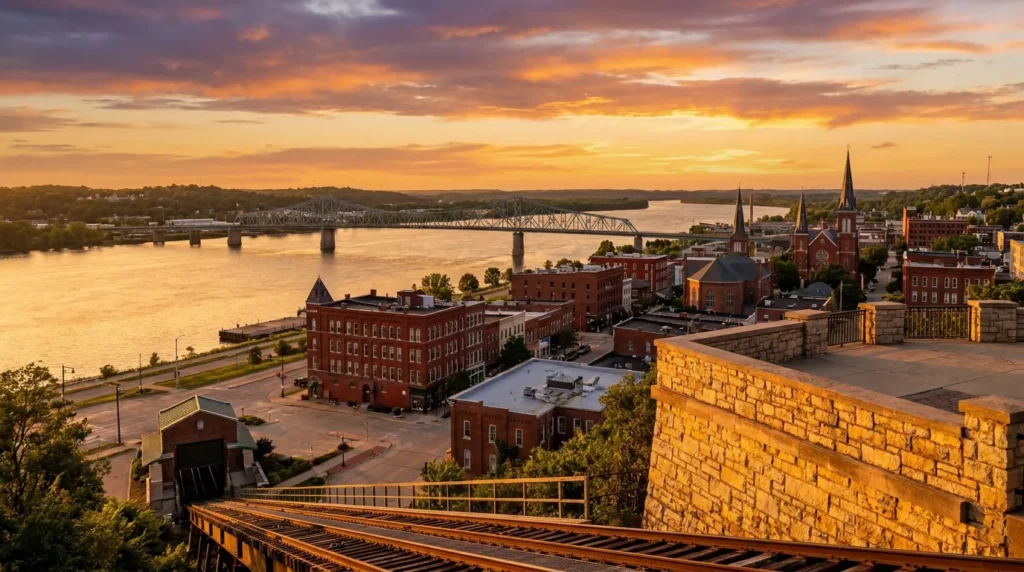
The Fenelon Place Elevator, a funicular built in 1882 that climbs the river bluff, is the city's iconic landmark. In three minutes it carries passengers to an overlook with views of Iowa, Illinois, and Wisconsin simultaneously. It costs a few dollars and operates almost year-round.

For nature, the Mines of Spain State Recreation Area offers trails, historic ruins from the old lead mines, and views of the Mississippi. Eagle Point Park at the top of the city is another classic for picnics. The Heritage Trail is a popular option for cycling and running.

  1. 1National Mississippi River Museum and Aquarium
  2. 2Fenelon Place Elevator
  3. 3Mines of Spain State Recreation Area
  4. 4Dubuque Museum of Art
  5. 5Diamond Jo Casino
  6. 6Mathias Ham House Historic Site
Parks & green spaces
  • Eagle Point Park
  • Mines of Spain State Recreation Area
  • Murphy Park
  • Flora Park
  • Heritage Trail
  • +1 more

Immigrant communities in Dubuque

A city with a smaller immigrant population than the national average, but with visible Mexican, Central American, and Marshallese groups, alongside historically German and Irish communities that have fully assimilated.

Dubuque is not an intensive immigration city like Des Moines or coastal cities, but contemporary immigrant communities are slowly growing. The largest is the Mexican community, tied mainly to manufacturing, construction, restaurant, and regional meat processing jobs. Modest Hispanic commerce exists along Central Avenue.

The Marshallese form a small but present community, connected to larger networks in Arkansas and other Iowa cities. There are also more recent immigrants from Central America, particularly Guatemala and Honduras, and a growing number of families from Bosnia who arrived in the 1990s as refugees.

For support, local Catholic organizations affiliated with the Archdiocese of Dubuque have a long tradition of welcoming immigrants going back to the 19th century. Catholic Charities provides counseling and assistance with legalization processes. Crescent Community Health Center offers sliding-fee medical care for uninsured families.

2,400
Foreign-born residents
estimated
Top countries of origin
  • Mexico
  • Marshall Islands
  • Guatemala
  • Bosnia and Herzegovina
  • Honduras
  • India
  • China
Foreign consulates
  • Honorary Consulate of Mexico in Davenport
  • Consulate General of Mexico in Chicago (jurisdiction)
  • Consulate General of Germany in Chicago
  • Consulate General of Guatemala in Chicago
  • Consulate General of Brazil in Chicago
Community organizations
  • Catholic Charities of the Archdiocese of Dubuque
  • Crescent Community Health Center
  • Multicultural Family Center
  • Dubuque Dream Center
  • Project Concern
  • Northeast Iowa Community Action Corporation

Latest posts

Posts about Iowa

Coverage and updates related to this destination.

Showing content from Iowa, as there is no specific data for Dubuque yet.