Visto n' Visa
Blog
Notícias e artigos
Destinations
Careers
Immigrants

Want to live and work in Boise City?

Personalized immigration plan with eligible visas, costs, and next steps for your goal!

If you are not eligible, you will know exactly why and what to do to improve your approval chances.

Save up to 12 hours in meetings

No pointless assessments.

Save up to 90%

Save money on vague or unfocused consultations

Avoid Fraud and Mistakes

One mistake can cost you your visa

Total Impartiality

Zero commercial bias

Decide with peace of mind

No toxic urgency

Fast and Accurate

Answers in minutes, no guesswork

Boise demographics: a white majority, an active refugee community, and accelerated growth

A predominantly white city with a significant Hispanic community and one of the highest per-capita resettled refugee populations in the United States.

The ethnic composition reflects the American West: a white majority of European descent, with a notable presence of Basque families who arrived in the late 19th century and maintain an active cultural center in the downtown area known as the Basque Block. English is the general language of daily life, and Spanish is the second most widely spoken language.

Boise has a unique history of welcoming refugees. Since the 1970s, organizations such as the International Rescue Committee and the Agency for New Americans have resettled people from Sudan, Eritrea, Bosnia, Syria, Iraq, Afghanistan, and the Democratic Republic of Congo. This has created neighborhoods and markets with an international character that is remarkable for a city of this size.

Protestant Christianity is the dominant religion, with a strong Catholic presence among Hispanic residents and a Latter-day Saint population spread throughout the region. There are also mosques, synagogues, and Buddhist temples, reflecting the diversity brought by refugee resettlement programs. The median age is relatively young, driven by university students and technology professionals.

Languages spoken
  • English
  • Spanish
  • Arabic
  • Swahili

Cost of living in Boise: rose quickly, but still below major metropolitan areas

Once one of the most affordable cities in the West, Boise now carries a medium-to-high cost by regional standards. It remains more accessible than Seattle, Portland, or cities along the California coast.

The cost of living in Boise changed significantly over the past decade. Rents and home prices surged as new residents arrived, and neighborhoods that were once affordable now command prices closer to those of mid-size coastal cities. Even so, the city remains less expensive than Seattle, Portland, Denver, or any point along the California coast.

Supermarkets such as Albertsons, founded in Boise, Fred Meyer, and WinCo offer a good variety of products. Ethnic grocers along Vista Avenue and State Street carry products from the Middle East, Africa, and Latin America. Local restaurants range from national chains to independent establishments, and dining-out prices are moderate.

Idaho levies a state income tax and a sales tax, but the combined rates fall within the national average. Utility bills are moderate, with natural gas heating in winter and air conditioning a necessity in summer. For immigrants coming from expensive cities, the overall impression is one of more space, more access to the outdoors, and less financial pressure.

96Cost index (US = 100)4% below US average
CategorySingleCoupleFamily (2 + 2)
iHousing$1,248$1,440$1,824
iFood$365$729$1,325
iTransport$480$816$1,056
iHealthcare$269$538$1,008
iChildcare$1,747
iOther$816$1,469$2,064
Monthly total$3,178$4,992$9,024

Source: U.S. BLS Consumer Expenditure Survey 2023 + BEA Regional Price Parities 2023 · Estimates in USD, monthly.

Housing in Boise: a competitive market with historic homes and new developments

A contested market after the migration boom. Good inventory of homes in established neighborhoods, modern apartments downtown, and new construction on the western outskirts.

Boise has a diverse housing inventory. The North End offers older wood-frame homes on tree-lined streets, priced at a premium for location and charm. The East End, toward the Foothills, mixes historic and newer properties with strong demand. For families, neighborhoods such as Collister, West Bench, and Southwest Boise tend to offer houses with yards at more moderate prices.

New apartment buildings have proliferated in Downtown and the BoDo district, particularly over the past five years. More affordable rental complexes are also available in Garden City, a municipality adjacent to Boise. Those seeking more space and a yard often look to suburban Meridian, Eagle, and Star, where commute times remain manageable.

The rental process requires a good credit score, proof of income equal to roughly three times the monthly rent, and references. Recently arrived immigrants may find it easier to rent through resettlement organizations or more flexible complexes that accept larger security deposits. Purchasing property requires an established US credit history.

Recommended neighborhoods
  • North End
  • East End
  • Boise Bench
  • Collister
  • Downtown Boise
  • +3 more

Job market in Boise: technology, healthcare, state government, and manufacturing

A diversified economy anchored by technology, food processing, and public administration. Home to Micron Technology and Albertsons, with a growing startup ecosystem.

Boise is the headquarters of Micron Technology, a major memory and semiconductor manufacturer, and Albertsons, one of the largest supermarket chains in the country. Both are among the largest employers in the Treasure Valley. Micron's presence supports an entire supply chain of vendors and tech startups, and the company has announced a significant expansion of chip manufacturing facilities in the coming years.

The healthcare sector is robust, with St. Luke's Health System and Saint Alphonsus Health System operating large hospitals and clinics throughout the city. State government employs thousands, and Boise State University is a significant employer in its own right. HP Inc. maintains a longstanding operation in Boise tied to its printing division.

Demand also exists in construction, retail, hospitality, and professional services. For skilled immigrants, openings in engineering, information technology, healthcare, and higher education tend to have more flexibility for sponsored visa candidates. In operational roles, food processing and logistics absorb a steady supply of workers.

Dominant sectors
  • Technology and semiconductors
  • Healthcare
  • State public administration
  • Food processing
  • Higher education
Major employers
  • Micron Technology
  • St. Luke's Health System
  • Saint Alphonsus Health System
  • Albertsons
  • HP Inc.
  • +2 more

Education in Boise: a large public school district and solid regional universities

A large school district with bilingual programs, a variety of private school options, and Boise State University as the state of Idaho's main academic center.

The Boise School District operates dozens of public schools, with Mandarin, Spanish, and French immersion programs available at select campuses. Schools such as Boise High School, Timberline, and Borah have academic traditions and strong extracurricular programs. Charter schools and private schools affiliated with various religious traditions are also available.

Boise State University, with approximately 26,000 students, is the state's leading institution of higher education. It offers strong programs in engineering, health sciences, business, and communications, along with a nationally recognized college football team known for its blue turf field. The College of Western Idaho provides accessible technical training and associate degree programs.

For immigrants, the community college system is an important entry point for starting or completing a credential at low cost. Public schools serve families at no charge and provide support for newly arrived students through English as a Second Language programs. Idaho State University maintains an auxiliary campus in the city for select programs.

Notable universities
  • Boise State University
  • College of Western Idaho
  • Idaho State University - Boise
  • Northwest Nazarene University

Healthcare in Boise: two large hospital systems and a broad network of specialists

The city is served by two major regional hospital systems and clinics throughout every neighborhood. Idaho did not expand Medicaid at the same pace as other states, but a community health network exists.

St. Luke's Boise Medical Center and Saint Alphonsus Regional Medical Center are the two large hospitals in the city, both offering emergency care, maternity services, oncology, and trauma centers. There is also a VA Medical Center serving American veterans, along with specialized pediatric, cardiology, and orthopedic clinics distributed across Boise.

For primary care, networks such as Primary Health Medical Group and private clinics cover the city. Community health centers such as Terry Reilly Health Services serve low-income families and refugee populations, with multilingual services and income-based sliding-scale fees.

The US healthcare system operates through private insurance, typically provided through an employer. Idaho expanded Medicaid following a referendum approved in 2018, and subsidized plan options are available through the federal marketplace. Immigrants without documentation have limited access to the system but can receive emergency care and services at community health clinics.

Healthcare index67.0 / 100
  • Life expectancyyears at birth
    78.4yrs
  • Doctors per 1kpracticing physicians
    3.7
  • Health spendper capita, per year
    $13,473
  • Public systemoverall quality rating
    Good

Safety in Boise: one of the safest state capitals in the United States

Boise consistently ranks among the safest cities in the country. Violent crime is low, residential areas are calm, and property crime rates fall within the national average.

Boise appears repeatedly in national rankings as one of the safest state capitals in the United States. Violent crime is low compared to cities of similar size, and the sense of safety in downtown and residential neighborhoods is high, including at night. Families routinely allow children to ride bicycles independently.

The most common crimes are bicycle theft along the Greenbelt, break-ins to parked cars at tourist spots, and petty theft in commercial areas. Neighborhoods such as the North End, East End, Hyde Park, and Southeast Boise are considered very safe. Some areas of the Boise Bench and parts of Vista Avenue warrant more attention, but nothing approaching the crime patterns of larger troubled cities.

The municipal police department maintains stable relationships with the community, including programs directed at refugees and immigrants. For emergencies, 911 operates in English with translators available. Immigrants consistently report a smooth adjustment from a safety standpoint, with quality of life that compares favorably to larger coastal cities.

5.8
Homicides per 100k
per year
Safety index
70.0
Crime index
30.0
Safer neighborhoods
  • North End
  • East End
  • Harris Ranch
  • Boise Bench (residential portions)
  • Downtown during the day
Areas to avoid
  • Industrial stretches south of Fairview at night
  • Some portions of West Bench after dark

Transportation in Boise: a drivable city with strong cycling infrastructure and limited bus service

The car is the default mode of transport, but the cycling network ranks among the best in the American West. Local buses operate but with low frequency outside peak hours.

The city was designed around the automobile, and the road network flows smoothly through most of the day, with predictable congestion toward Meridian during peak hours. Parking downtown carries a cost but is generally easy to find. Interstate 84 connects Boise to Salt Lake City and Portland, the two main regional destinations.

The standout feature is the Greenbelt, a paved pathway along the Boise River that links parks, universities, and neighborhoods. Many residents commute by bicycle, and electric scooters are common downtown. Boise is consistently cited as one of the most bicycle-friendly cities in the United States.

The Valley Regional Transit bus system covers main routes but with reduced frequency and limited reach in outlying neighborhoods. Those who arrive without a vehicle are advised to plan for purchasing or financing a car within the first few months. Boise Airport offers direct flights to the major hubs of the American West.

21 min
Avg commute
40
Walkability
Airports
  • BOI — Boise Airport
  • International airport
  • Bike infrastructure

What the Climate Is Like Living in Boise City

Idaho's capital has a cold semi-arid climate with dry summers near 91 F, moderate winter snowfall, and four well-defined seasons.

Summer in Boise City is hot and very dry. From June through August, highs range between 86 and 93 F, with low humidity and cool nights around 61 F. Because of the dry climate, the heat is more tolerable than in the American South, though smoke from regional wildfires can affect air quality in July and August.

Winter is cold but not extreme by American standards. From December through February, lows range between 25 and 27 F, and the city accumulates around 20 inches of snow per season. Central heating, a waterproof coat, and sturdy boots are sufficient for most households.

Spring and fall are long and particularly scenic, with the foothills of the Rocky Mountains changing color. Compared to Midwest cities, Boise offers a gentler seasonal adjustment, and proximity to skiing, hiking, and rivers makes it very attractive for those who enjoy outdoor activities.

Sunny days / year206 days
Avg high (°F)
  • 41°J
  • 44°F
  • 54°M
  • 63°A
  • 73°M
  • 83°J
  • 96°J
  • 93°A
  • 83°S
  • 65°O
  • 49°N
  • 40°D
Avg low (°F)
  • 27°J
  • 26°F
  • 33°M
  • 39°A
  • 48°M
  • 56°J
  • 66°J
  • 64°A
  • 55°S
  • 43°O
  • 32°N
  • 27°D
Rainfall (")
  • 2"J
  • 2"F
  • 1"M
  • 1"A
  • 2"M
  • 1"J
  • 0"J
  • 0"A
  • 1"S
  • 1"O
  • 1"N
  • 2"D

Culture in Boise: Basque heritage, outdoor life, and an expanding arts scene

A city with a strong identity shaped by its Basque community, outdoor activities along the Greenbelt and the Foothills, and a cultural scene that is surprisingly diverse for its size.

Few American cities have a Basque community as visible as Boise's. The Basque Block, in the downtown core, is home to restaurants such as Bar Gernika, the Basque Museum, and the Cultural Center, with annual festivals that fill the street. It is a distinctive and rare cultural marker in the American West.

Outdoor life defines the local lifestyle. Foothills trails begin within city limits, and the Boise River is used for floating in summer. In winter, Bogus Basin ski area is less than an hour from downtown. Parks such as Julia Davis and Ann Morrison host festivals, free concerts, and the Boise Art Museum.

The food scene has grown alongside the influx of new residents. Hispanic, Vietnamese, Ethiopian, Syrian, and Mexican restaurants are scattered across the city, many of them opened by refugees. Craft breweries such as Payette and Boise Brewing are part of the local identity. The Egyptian Theatre and the Idaho Shakespeare Festival sustain a consistent performing arts scene.

Boise City

Boise Attractions: Greenbelt, Basque Block, and the Sawtooth Within Reach

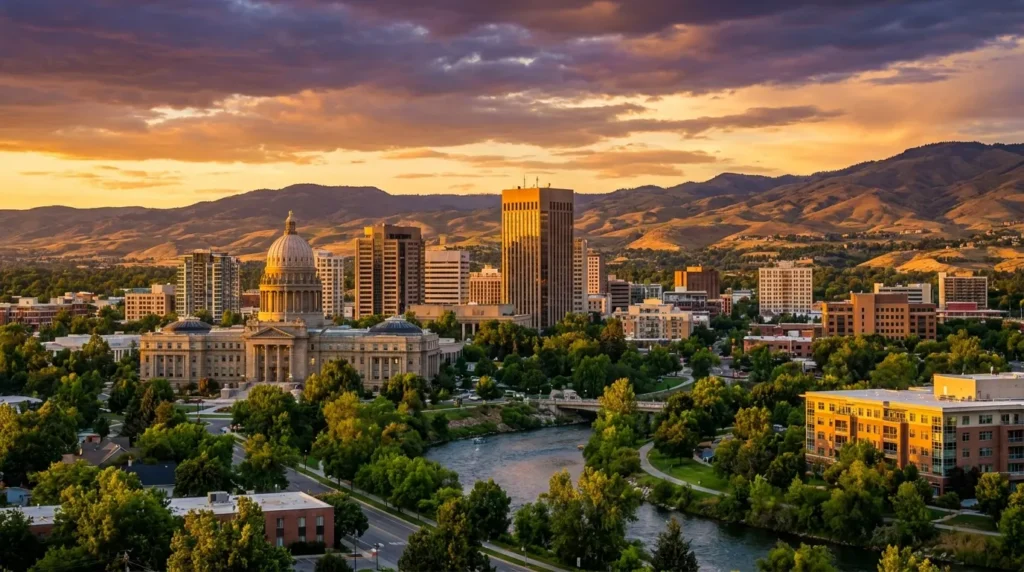
Boise features the Boise River Greenbelt running through the city, the historic Basque Block, the Idaho State Capitol, and easy access to Bogus Basin and the Sawtooth Mountains for active weekends.

The Boise River Greenbelt, with roughly 25 miles of riverside bike path and walking trail, serves as the city's backbone, connecting Lucky Peak State Park to the west and passing through downtown via Julia Davis Park and Ann Morrison Park. The marble Idaho State Capitol is open to visitors, and the Idaho Anne Frank Human Rights Memorial sits adjacent to the Greenbelt.

The Basque Block on Grove Street preserves one of the most distinctive Basque heritage districts in the United States, with the Basque Museum and Cultural Center, restaurants such as Bar Gernika, and the Jaialdi festival held every five years. The Boise Art Museum and Zoo Boise are located in Julia Davis Park, alongside the Idaho State Museum and the Discovery Center of Idaho. Hyde Park in the North End neighborhood offers a charming neighborhood commercial strip.

Bogus Basin Mountain Recreation Area, 30 minutes from downtown, opens for skiing in winter and zip lines and hiking in summer. Table Rock rises on the city's eastern edge with its iconic illuminated cross, and Lucky Peak State Park at Sandy Point Beach provides a summer retreat from the heat. Boise State University brings student life to the city, and the Broncos play on the Blue Turf at Albertsons Stadium.

  1. 1["Idaho State Capitol"
  2. 2"Basque Block and Basque Museum"
  3. 3"Boise Art Museum"
  4. 4"Old Idaho Penitentiary"
  5. 5"World Center for Birds of Prey"
  6. 6"Zoo Boise"
Nightlife5.0 / 10
Parks & green spaces
  • ["Boise River Greenbelt"
  • "Julia Davis Park"
  • "Ann Morrison Park"
  • "Camel's Back Park"
  • "Kathryn Albertson Park"
  • +1 more

Latest posts

Straight from the blog

There are no posts specifically about Boise City yet. In the meantime, check out our latest posts.