Visto n' Visa
Blog
Notícias e artigos
Destinations
Careers
Immigrants

Want to live and work in Loveland?

Personalized immigration plan with eligible visas, costs, and next steps for your goal!

If you are not eligible, you will know exactly why and what to do to improve your approval chances.

Save up to 12 hours in meetings

No pointless assessments.

Save up to 90%

Save money on vague or unfocused consultations

Avoid Fraud and Mistakes

One mistake can cost you your visa

Total Impartiality

Zero commercial bias

Decide with peace of mind

No toxic urgency

Fast and Accurate

Answers in minutes, no guesswork

Who Lives in Loveland

A predominantly white population with a growing Hispanic community, a balanced age distribution, and a middle-class suburban profile.

Loveland has a demographic profile typical of Colorado's Front Range: a majority of non-Hispanic white residents, a growing Hispanic community that now exceeds 12% of residents, and smaller populations of Asian and African American residents. The median age is around 40, with a good balance between young families and retirees drawn by the dry climate.

English is the dominant language in everyday life, but Spanish appears in schools, businesses, and public services. The public school system offers bilingual programs in some schools, and signage and services in Spanish are available at municipal agencies.

Religiously, the city is predominantly Christian, with a strong presence of evangelical, Catholic, and Mormon (LDS) denominations. There is also a notable non-religious community, common in Colorado, one of the least religious states in the country.

Languages spoken
  • English
  • Spanish
Main religions
  • Evangelical Christianity
  • Catholicism
  • Mormonism (LDS)
  • No religion

Cost of Living in Loveland

More affordable than Boulder and Denver, but above the U.S. national average, particularly for housing.

Loveland is considered one of the most affordable cities on the Front Range, but costs have risen considerably over the past decade due to an exodus of residents leaving Denver and Boulder. Housing, energy, and groceries are slightly above the national average, while healthcare and transportation costs are reasonable.

Groceries are accessible: chains such as King Soopers, Safeway, and Sprouts dominate the market, and the Loveland Farmers Market operates from June through September with local producers. Dining out costs between 15 and 25 dollars per person at casual restaurants, and the craft brewery scene is strong and relatively affordable.

Taxes: Colorado has a flat state income tax of around 4.4%, and Loveland charges a combined sales tax of approximately 6.7%. There is no tax on unprepared food, which helps with monthly household budgets.

98Cost index (US = 100)2% below US average
CategorySingleCoupleFamily (2 + 2)
iHousing$1,278$1,475$1,868
iFood$373$747$1,356
iTransport$492$835$1,081
iHealthcare$276$550$1,032
iChildcare$1,789
iOther$835$1,504$2,114
Monthly total$3,254$5,111$9,240

Source: U.S. BLS Consumer Expenditure Survey 2023 + BEA Regional Price Parities 2023 · Estimates in USD, monthly.

Housing: Renting and Buying in Loveland

A balanced market of suburban homes and new condominiums, more affordable than Fort Collins but under pressure from recent demand.

Loveland's housing stock is dominated by single-family homes with yards, typical of American suburbs, along with newer condominiums around Centerra. The median home price ranges from around 470,000 to 520,000 dollars, below Fort Collins and well below Boulder, but above the national average.

Two-bedroom apartment rentals range from 1,700 to 2,200 dollars per month. Studios and shared rooms in houses are around 900 to 1,300 dollars. There is a good supply of new buildings around Lake Loveland and U.S. 34, with amenities such as fitness centers, pools, and guaranteed parking.

For those seeking more affordable options, areas west of U.S. 287 and neighborhoods near Garfield Avenue are worth exploring. For new construction and modern infrastructure, Centerra and the eastern area near I-25 concentrate recent developments.

Recommended neighborhoods
  • Centerra
  • Mariana Butte
  • Old Downtown Loveland
  • Boyd Lake
  • West Loveland

Job Market in Loveland

A diversified economy anchored by healthcare, tech manufacturing, regional retail, and mountain tourism, with many residents commuting to Fort Collins or Denver.

Loveland has a solid local economy in healthcare, high-tech manufacturing, retail, and tourism. UCHealth Medical Center of the Rockies is the region's largest employer, serving all of northern Colorado. Aerospace and medical manufacturing also supports a significant workforce, with companies such as Lightning eMotors and Numerica.

Many residents commute to Fort Collins (15 minutes), home of Colorado State University, or to Denver (50 minutes) and Boulder (45 minutes). I-25 is the backbone of this daily commute, with heavy traffic during peak hours.

For immigrants, Colorado's minimum wage in 2026 is above the federal level and the state has strong labor protections. Construction, hospitality, commercial cleaning, and home care are common entry points for those still regularizing documentation or learning English.

Dominant sectors
  • Healthcare
  • Aerospace and Medical Manufacturing
  • Regional Retail
  • Mountain Tourism
  • Construction
Major employers
  • UCHealth Medical Center of the Rockies
  • Thompson School District R2-J
  • City of Loveland
  • Walmart
  • McKee Medical Center (Banner Health)
  • +1 more

Education in Loveland

A well-regarded Thompson R2-J public school system, a local community college, and proximity to research universities in Fort Collins and Boulder.

Loveland's public school system is Thompson School District R2-J, serving approximately 16,000 students across elementary, middle, and high schools. The main high schools are Thompson Valley, Loveland High, Mountain View, and Resort Charter. The district is considered above average by Colorado standards.

For local higher education, Front Range Community College maintains a campus in Loveland, offering associate degrees, technical programs, and transfer pathways to four-year universities. It is an affordable and popular option for recently arrived immigrants seeking professional requalification.

For full degree programs, residents commute to Colorado State University in Fort Collins, about 20 minutes away, or to the University of Colorado Boulder, about 45 minutes away. Both rank among the best public universities in the western United States and offer English as a Second Language programs.

Notable universities
  • Front Range Community College — Larimer Campus
  • Colorado State University (in Fort Collins)
  • University of Northern Colorado (in Greeley)
  • Aims Community College

Healthcare in Loveland

Two major hospital networks serve the city and surrounding region, with infrastructure above average for a mid-sized city in the American West.

Loveland has above-average hospital infrastructure for a city of its size. UCHealth Medical Center of the Rockies is a Level II trauma center and the regional reference for cardiology, neurology, and oncology. McKee Medical Center, part of the Banner Health network, handles emergencies, maternity care, and general surgery.

As throughout the United States, healthcare is expensive and heavily dependent on insurance. Those with formal employment typically receive coverage through their employer. Freelancers or those without steady work can purchase plans through Connect for Health Colorado, the state marketplace, with federal subsidies based on income.

For undocumented immigrants, options include community clinics such as Salud Family Health Centers, which operates on a sliding-fee scale and has a bilingual staff. Emergency care at hospitals cannot be refused under federal law (EMTALA), though bills are issued afterward.

Loveland

Safety in Loveland

Considered safe by Colorado standards, with violent crime below the state average for major urban centers and solid safety indicators overall.

Loveland is considered a safe city by Front Range standards. Violent crime rates are below the state average and well below Denver. The main issues are property theft, car break-ins, and crimes related to methamphetamine and fentanyl, a trend affecting all of Colorado.

The Loveland Police Department is responsible for the city, with active community programs and limited bilingual services. For emergencies, the standard number is 911. In surrounding rural areas, the Larimer County Sheriff operates.

Residentially, the western and northern areas (Mariana Butte, Boyd Lake, Centerra) are calm and safe. Some areas near older commercial corridors on U.S. 287 and North Lincoln Avenue see more incidents, though none qualify as genuinely dangerous zones. Walking downtown at night is generally safe.

Safer neighborhoods
  • Mariana Butte
  • Centerra
  • Boyd Lake
  • Old Downtown Loveland
  • West Loveland
Areas to avoid
  • North Lincoln Avenue industrial corridor at night
  • Older commercial stretches of south U.S. 287

Getting Around Loveland

A car-dependent city with limited public transit and good road access; a small regional airport and Denver International about one hour away.

Loveland is a car-dependent city. The main arteries are U.S. 34 (Eisenhower Boulevard), running east-west, and U.S. 287 along the north-south axis, plus I-25 connecting to Denver and Wyoming. Owning a car is practically essential for living there.

Public transportation is operated by COLT (City of Loveland Transit), with several fixed routes covering downtown and the main commercial corridors. Bustang, a regional bus service, connects Fort Collins, Loveland, and Denver, useful for commuters without a car.

The main airport is Denver International (DEN), about 100 kilometers away via I-25. Northern Colorado Regional Airport (FNL), between Loveland and Fort Collins, serves limited commercial flights and general aviation. The city has a growing network of bike paths, primarily around Boyd Lake and the Loveland Recreation Trail.

Airports
  • FNL — Northern Colorado Regional Airport
  • DEN — Denver International (100 km away)
  • Bike infrastructure

Climate

Loveland

Culture and Daily Life in Loveland

The bronze sculpture capital of the United States, with a strong arts scene, seasonal festivals, and the distinctive Valentine's Day remailing tradition.

Loveland calls itself the bronze sculpture capital of the United States. The city is home to three major art foundries, more than 500 sculptures displayed in public spaces, and Benson Sculpture Garden, an outdoor park dedicated exclusively to contemporary sculpture. Loveland Museum downtown brings together art, history, and traveling exhibitions.

The most famous tradition is the Valentine's Day remailing program. Since 1947, volunteers have manually processed around 160,000 cards per year from around the world, each receiving a poetic verse and the official Loveland postmark before being forwarded. For the city, it is a tourist event, a civic ritual, and a registered trademark.

The dining scene blends Texas-style barbecue, authentic Mexican tacos, third-wave coffee shops, and the inevitable Colorado craft brewery. Verdes Coffee Roasters, Big Beaver Brewing, and Door 222 are essential stops. In summer, the city comes alive with farmers markets, concerts at Foote Lagoon, and parades.

Notable dishes
  • Rocky Mountain trout
  • Green chili colorado
  • Bison burger
  • Seasonal Palisade peaches
Annual events
  • Loveland Valentine Re-mailing Program (February)
  • Sculpture in the Park (August)
  • Corn Roast Festival (August)
  • Old Fashioned Corn Roast Parade
  • Fire & Ice Festival (February)

What to See and Do in Loveland

Outdoor sculptures, lakes for water sports, Rocky Mountain trails, and seasonal festivals define the cultural and leisure calendar.

The main cultural draw is Benson Sculpture Garden, a park with more than 170 permanent bronze sculptures, free and open year-round. In August, it hosts Sculpture in the Park, the largest outdoor sculpture fair in the United States. Loveland Museum downtown complements this with rotating exhibitions.

For nature, Boyd Lake State Park offers sailing, jet skiing, fishing, and camping. Lake Loveland, within the city, has a walking trail around its perimeter. For mountain access, the drive along U.S. 34 to Estes Park and the east entrance of Rocky Mountain National Park takes about an hour, reaching one of the most visited parks in the country.

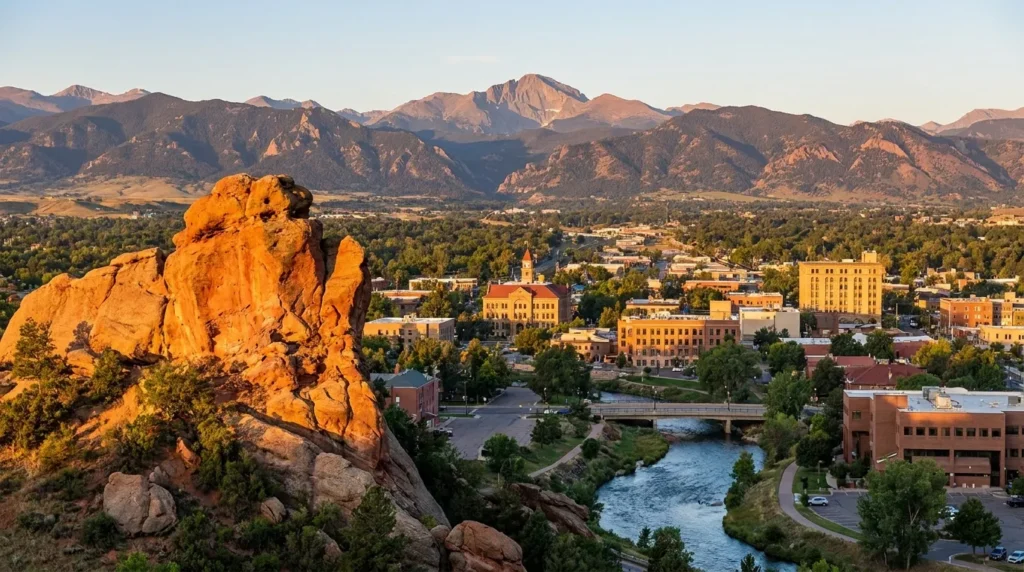
Devil's Backbone Open Space, on the city's west side, is an iconic trail featuring distinctive rock formations. In winter, skiing at Eldora or Winter Park is about two hours away. Shopping is concentrated at Promenade Shops at Centerra, an open-air mall with stores, restaurants, and a cinema.

  1. 1Benson Sculpture Garden
  2. 2Loveland Museum
  3. 3Boyd Lake State Park
  4. 4Devil's Backbone Open Space
  5. 5Chapungu Sculpture Park
  6. 6Promenade Shops at Centerra
Parks & green spaces
  • Benson Sculpture Garden
  • Boyd Lake State Park
  • Lake Loveland
  • Devil's Backbone Open Space
  • North Lake Park
  • +1 more

Immigrant Communities in Loveland

A historic Hispanic community is the largest group, with a growing presence of Mexican, Salvadoran, Asian, and European immigrants at a small-city pace.

Loveland has a smaller immigrant community than cities such as Denver or Aurora, but it is diverse for its size. The largest community is Hispanic, with Mexican roots dating to the early twentieth century, when workers came to labor on sugar beet farms. Salvadorans and Guatemalans arrived in recent decades, primarily for construction and service work.

There is a growing presence of Asian immigrants, particularly Filipinos connected to healthcare at UCHealth, and Vietnamese and Chinese residents in commerce. Europeans, mostly German, British, and Eastern European, typically arrive through skilled work in aerospace manufacturing or retire to Loveland for the cost of living and climate.

For services and support, regional organizations such as Alianza NORCO in Fort Collins serve all of northern Colorado with English classes, legal guidance, and help with forms. Salud Family Health Centers offers bilingual healthcare. Catholic and evangelical churches often serve as initial gathering points for newcomers.

6,500
Foreign-born residents
estimated
Top countries of origin
  • Mexico
  • El Salvador
  • Philippines
  • Guatemala
  • Germany
  • Vietnam
  • China
  • United Kingdom
Foreign consulates
  • Mexican Consulate General in Denver
  • Honorary German Consulate in Denver
  • Japanese Consulate General in Denver
  • Honorary British Consulate in Denver
  • Honorary French Consulate in Denver
Community organizations
  • Alianza NORCO
  • Salud Family Health Centers
  • Catholic Charities of Larimer County
  • Immigrant & Refugee Center of Northern Colorado
  • House of Neighborly Service

Latest posts

Posts about Colorado

Coverage and updates related to this destination.

Showing content from Colorado, as there is no specific data for Loveland yet.