Visto n' Visa
Blog
Notícias e artigos
Destinations
Careers
Immigrants

Want to live and work in Slovenia?

Personalized immigration plan with eligible visas, costs, and next steps for your goal!

If you are not eligible, you will know exactly why and what to do to improve your approval chances.

Save up to 12 hours in meetings

No pointless assessments.

Save up to 90%

Save money on vague or unfocused consultations

Avoid Fraud and Mistakes

One mistake can cost you your visa

Total Impartiality

Zero commercial bias

Decide with peace of mind

No toxic urgency

Fast and Accurate

Answers in minutes, no guesswork

Discover Slovenia

Alps, Adriatic Sea, and a small capital with a high quality of life.

Slovenia is located in southern Central Europe, bordered by Austria, Italy, Hungary, and Croatia. The best-known cities are Ljubljana (the capital, in the center of the country), Maribor (the second largest, in the northeast), and Koper (a port on the Adriatic). The country has only about 46 km of coastline, but combines the Alps, vineyards, forests, and the sea within a small territory. The official language is Slovenian.

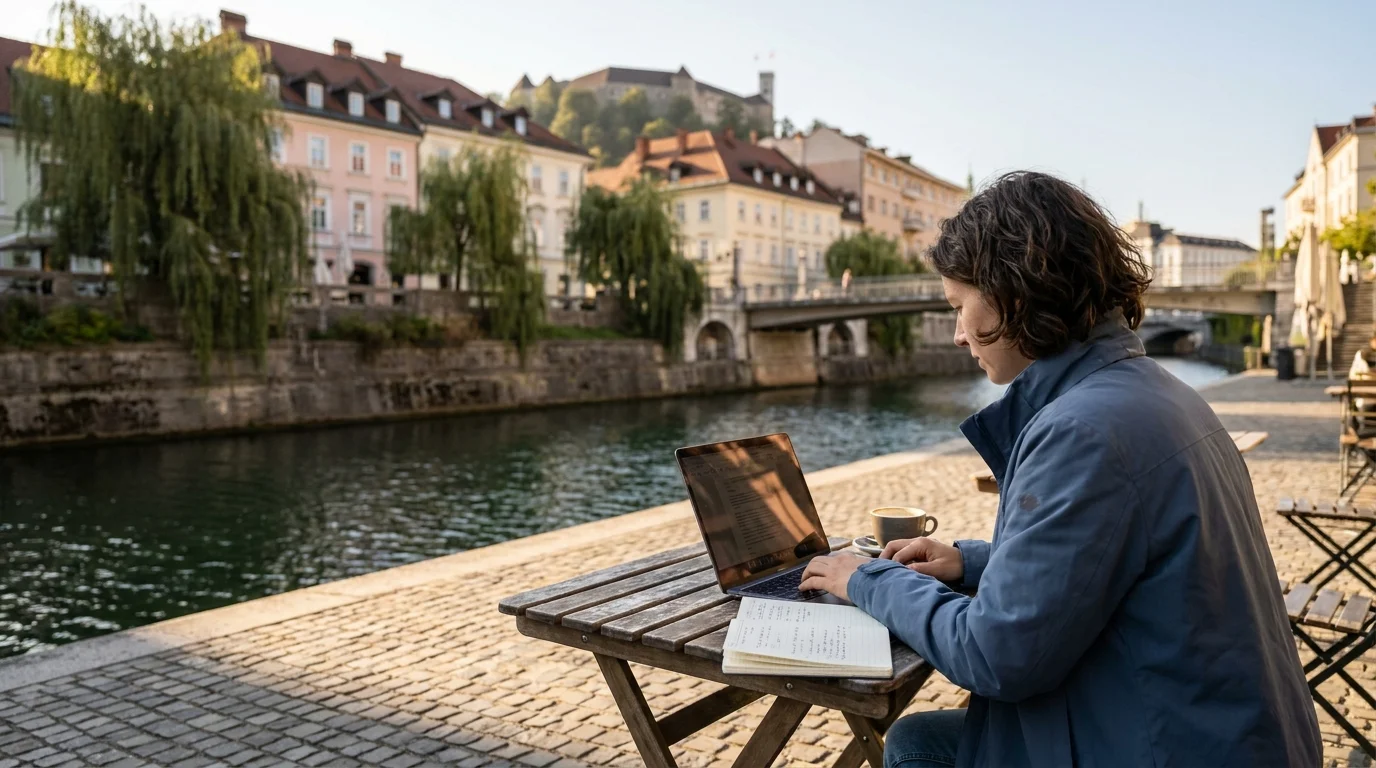
Daily life is calm and of high quality. Ljubljana is a small city (about 290,000 inhabitants), with a car-free historic center, rivers running through the center, and a university-town atmosphere. Lake Bled, with a cliff-top castle and a tiny island in the middle, is the country's most recognized postcard. More than half the territory is covered by forests.

For those thinking of moving, the country has defined paths: skilled work, student, investor, family reunification, and citizenship by descent. EU citizens can settle freely. The Dovoljenje za prebivanje (residence card) is the main document for non-EU foreigners, issued by the regional administrative office.

46.1167°, 14.8167°

Slovenia's demographics: about 2.1 million people, mostly ethnically Slovenian

About 55% of the population lives in urban areas. Ljubljana and Maribor concentrate most of the skilled employment.

Slovenia has one of the smallest populations in the European Union. Most people live in small and medium-sized cities: Ljubljana, Maribor, Celje, Kranj, Velenje, and Koper. Population aging is a trend, with a low birth rate. The Slovenian diaspora is historical, especially in the US (Cleveland, Ohio), Argentina, Australia, and Canada.

The population is largely ethnically Slovenian (about 83%). There are Italian and Hungarian minorities that are constitutionally recognized (with legal protection and parliamentary representation), as well as communities of Serbs, Croats, Bosnians, Macedonians, and Albanians (a legacy of former Yugoslavia). Recent immigration has brought Ukrainians, Romanians, Asians, and Western professionals.

Slovenian is the official language. English is spoken by young people, professionals, and in tourist areas, at a moderate level compared to Nordic countries. Italian is co-official in some coastal cities (Koper, Izola, Piran). German and Croatian are also widely understood. Learning Slovenian is challenging, but getting by with English in Ljubljana is quite manageable in the first months.

Languages spoken
  • Slovenian
  • English (among young people and professionals)
  • Italian (co-official on the coast)
  • German
  • Croatian and Serbian (mutually intelligible)
Main religions
  • Catholic (about 70%)
  • No religion (about 18%)
  • Muslim (about 2%)
  • Orthodox (about 2%)

Cost of living in Slovenia: among the most affordable in Western Europe

Ljubljana is a small and manageable capital, with rents below Vienna or Trieste. Smaller cities offer high quality at low cost.

Slovenia is one of the most affordable economies in Western Europe and the Schengen area. In Ljubljana, a one-bedroom apartment in the centre runs between EUR 600 and EUR 900 monthly. Neighbourhoods such as Center, Siska, and Bezigrad concentrate demand. Maribor, Celje, Koper, and smaller cities offer considerably lower rents, between EUR 350 and EUR 550. Supply has grown in recent years with new buildings in suburban areas.

Supermarket shopping is reasonable, with Mercator, Spar, Hofer (Aldi), and Lidl covering the basics. Mid-range restaurants in Ljubljana charge between EUR 12 and EUR 25 per meal. Cafes and bakeries are a strong part of local culture. Public transport in Ljubljana is efficient, with electric buses and wide cycle lanes. The monthly LPP pass costs around EUR 37.

Energy costs rose with European price increases, but heating is manageable in the mild climate. Public healthcare via ZZZS (compulsory insurance) covers virtually everything, with small co-payments. In general terms, it is a country that combines a Western European standard of living with costs closer to Central Europe, making it one of the best value propositions in the European Union.

62Cost index (NYC = 100)38% below NYC
CategorySingleCoupleFamily (2 + 2)
iHousing$944$1,220$1,616
iFood$292$585$1,072
iTransport$195$358$422
iHealthcare$80$152$256
iChildcare$400
iOther$217$372$496
Monthly total$1,728$2,687$4,262

Job market in Slovenia: industry, automotive, pharmaceuticals, and tech

Krka and Lek (pharmaceuticals), Gorenje (appliances), and Revoz (Renault) lead. A small but dynamic market with low unemployment.

The Slovenian market has a small but diversified economy by Central European standards. The pharmaceutical industry is a central pillar, with Krka (headquartered in Novo Mesto) and Lek (part of Sandoz/Novartis, in Ljubljana) among the largest in Central Europe. The automotive industry has Revoz (a Renault plant in Novo Mesto), plus suppliers such as Hidria and Cimos. Home appliances with Gorenje (part of Hisense), in Velenje.

Other strong sectors include metallurgy, paper, chemicals, and brewing (Lasko and Union). Technology grew over the past two decades, with Outfit7 (creator of Talking Tom, acquired by Zhejiang Jinke), Bitstamp (cryptocurrency), and Iskratel. Ljubljana hosts headquarters of banks such as NLB, SKB, and NKBM. Tourism is a growing sector, with Bled, Ljubljana, and the coast attracting visitors.

The gross minimum wage is EUR 1,253 monthly, with qualified professionals earning well above that. Labour laws follow European standards, with 30 days of vacation and generous parental leave. Qualified foreigners access the market via work permit, European Blue Card, or the Highly Qualified Worker scheme. Slovenian facilitates corporate integration, but English covers much of the environment in multinationals.

$1,350
Minimum wage
per month
Top national employers
  • Krka
  • Lek (Sandoz)
  • Gorenje
  • Revoz
  • Petrol
  • +3 more

Education in Slovenia: public, free, and well-rated in international tests

Free basic and university education for EU/EEA citizens. Programmes in English are increasingly common.

Education in Slovenia is free from primary through doctorate level for EU/EEA citizens at public universities. The school system is well rated in international tests (PISA), with results above the European average in mathematics and sciences. There are international schools in Ljubljana for foreign families, including the British International School and the French International School.

The most recognised public universities are the University of Ljubljana (the largest and oldest, founded in 1919) and the University of Maribor. Tuition in Slovenian-language programmes is free for EU/EEA citizens. For students from outside the EU, tuition exists but is generally much lower than in the US, UK, or Australia, with medicine and engineering among the most sought-after courses.

For foreign students, several universities offer programmes in English, especially at postgraduate, MBA, medicine, and engineering level. Medicine in Ljubljana and Maribor is popular among European and South American students, with a degree recognised throughout the European Union. Scholarships are available through Erasmus+ and CMEPIUS (the Slovenian mobility centre), with significant exchange flows.

Notable universities
  • Univerza v Ljubljani (University of Ljubljana)
  • Univerza v Mariboru (University of Maribor)
  • Univerza na Primorskem (University of Primorska, Koper)
  • Univerza v Novi Gorici
  • International School for Social and Business Studies

Healthcare in Slovenia: a well-rated public system with complementary insurance common

The ZZZS (national health fund) covers all residents. Most people also have private supplementary insurance to avoid copayments.

The Slovenian healthcare system is funded by compulsory contributions (about 13% of salary, shared with the employer). Everyone who is formally employed, retired, or resident must be affiliated with the ZZZS (Zavod za zdravstveno zavarovanje Slovenije). It covers consultations, tests, hospitalizations, births, vaccinations, and most medications.

The system is considered one of the best in Central and Southern Europe. Public hospitals like UKC Ljubljana are regionally recognized. Doctors often have European training and many speak English or Italian. Most Slovenians also have private supplementary insurance (zavarovalnica) to cover copayments on consultations and elective procedures.

Foreigners with residency need to join the ZZZS. For employees, payment is deducted from payroll. Retirees and the self-employed pay monthly. EU/EEA citizens can use the European Health Insurance Card (EHIC) in emergencies. Pharmacies are easy to find, and medications tend to be cheaper than in the US and UK.

  • Public systemoverall quality rating
    Excellent

Safety in Slovenia: one of the safest countries in Europe

Violent crime is rare. Petty theft in tourist areas and bicycle theft are the main concerns.

Slovenia is consistently listed as one of the safest countries in Europe, with statistics comparable to Austria and Germany. Violent crime is rare, and women walk at night alone in Ljubljana and smaller cities without concern. Villages and small towns have very low crime rates. Security cameras are not as pervasive as in other countries simply because they are not needed.

The most common crimes affecting foreigners are wallet theft in tourist areas (central Ljubljana, Bled, Piran) in summer and bicycle theft. Basic precautions solve most problems (a good lock, do not leave things visible in the car). Uber does not operate in the country, but there are local ride-hailing services (Avantcar) and traditional taxis.

For those arriving from abroad, settling in is smooth. There are expat communities in Ljubljana (especially in Bezigad, Siska, and Center), with active online groups. The proximity of Venice, Trieste (Italy), Graz (Austria), and Zagreb (Croatia) makes the country attractive for those wanting a Central European base with easy access to other capitals.

Safer neighborhoods
  • Center, Bezigad, and Siska (Ljubljana)
  • Maribor center
  • Piran, Izola, and Koper (coast)
  • Bled and Bohinj (Alps)
  • Kranj and Skofja Loka

Climate in Slovenia: Three Zones in a Small Country — Alpine, Continental, and Mediterranean

Cold winters in the Alps, warm summers inland, and a Mediterranean climate along the short coastline.

Despite its small size, Slovenia has three distinct climate zones. The alpine zone (north and northwest, including Bled, Bohinj, and Kranjska Gora) features cold winters with heavy snowfall and cool summers. It is a popular ski destination in winter and a hiking and cycling destination in summer.

The continental zone (interior, including Ljubljana and Maribor) has a Central European climate, with cold winters (-3 to 4°C) and warm summers (20 to 30°C). Ljubljana sits in a basin, which can cause fog and stagnant air to accumulate in winter. Autumn is widely considered beautiful, with foliage across the forests that cover most of the country's territory.

The coastal zone (Adriatic coast: Koper, Izola, Piran) has a Mediterranean climate, with mild winters (5 to 12°C) and hot, dry summers (22 to 30°C). This is the sunniest part of the country. Those arriving from tropical countries often find the inland winters surprisingly cold. Homes have central heating, and air conditioning is beginning to appear in newer apartments and offices.

Slovenian culture: hearty food, historic cities, wine, and folk festivals

Ljubljana, Bled, Piran, vineyards of the Goriska Brda region. Food blends Austrian, Italian, Hungarian, and Balkan influences.

Slovenian culture blends Central European influences (Austrian, German) with Mediterranean ones (Italian) and Balkan ones (Croatian, Serbian). The architecture reflects this mix: cities like Ljubljana have baroque and Art Nouveau buildings, with bridges designed by architect Joze Plecnik. Lake Bled and Predjama Castle are classic tourist landmarks.

Food varies by region. In the Alpine north, stews, potatoes, cold cuts, and sweets like potica (filled rolled cake) predominate. In the east influenced by Hungary, paprika-based dishes and goulash are common. On the coast, grilled fish, seafood, and Karst prosciutto (called prsut). Slovenian wine has a long history, with regions like Goriska Brda, Vipava, and Stajerska producing internationally awarded whites and reds.

Festivities include the Ptuj carnival (Kurentovanje, with furry characters called Kurenti, a UNESCO Intangible Heritage), Easter, wine festivals, and Christmas markets. Ljubljana has a Christmas market renowned throughout Central Europe. Winter sports (skiing, ski jumping, biathlon) are a national passion, and Slovenia has produced Olympic champions like Tina Maze.

Notable dishes
  • Potica (rolled cake with walnut filling)
  • Kranjska klobasa (sausage)
  • Struklji (rolled dough)
  • Jota (sauerkraut and bean soup)
  • Idrijski zlikrofi (local ravioli)
  • +5 more
Annual events
  • Kurentovanje in Ptuj (carnival, February)
  • Ljubljana Summer Festival (July-August)
  • Ljubljana Christmas Market (December)
  • Wine festival in Goriska Brda (various dates)
  • Ski jumping at Planica (March)
  • +1 more
UNESCO sites
  • Skocjan Caves
  • Prehistoric pile dwellings around the Alps (shared)
  • Mercury of Idrija
  • Carpathian beech forests (shared)
  • Works of Joze Plecnik in Ljubljana

Slovenia's economy: industry, pharmaceuticals, automotive, and tourism

Krka and Lek are global pharmaceutical companies. Renault Revoz and the automotive industry are strong. Tourism is growing, with a focus on nature and gastronomy.

Slovenia has a diversified and modern economy. The pharmaceutical industry is an important export, with Krka (Novo Mesto) among the largest pharmaceutical companies in Central Europe, and Lek (part of Sandoz/Novartis). They produce generic and original medications for the world market.

The automotive industry is also relevant. Renault has a factory in Novo Mesto (Revoz) that produced models like the Renault Clio for Europe. There is also a home appliances industry (Gorenje, now owned by China's Hisense), chemicals, metallurgy, machinery, and shipbuilding on the Adriatic. The Adriatic shipyard in Izola is one of the few shipbuilding activities in the country.

Tourism has become a strategic sector, with a focus on nature, gastronomy, wine, and wellness. Ljubljana, Bled, Piran, the Postojna caves, and the Julian Alps attract millions of visitors per year. The technology sector is growing in Ljubljana, with startups and companies like Outfit7 (creator of Talking Tom) and Bitstamp (crypto exchange). Financial services, energy (including nuclear power at Krsko), and agriculture round out the economy.

Top sectors
  • Pharmaceuticals (Krka, Lek)
  • Automotive industry (Renault Revoz)
  • Home appliances (Gorenje)
  • Chemicals and metallurgy
  • Tourism (nature, gastronomy, wellness)
  • +3 more

Geography of Slovenia: Alps, Adriatic, and karst in just over 20,000 km2

A small country between the Alps, the Adriatic, and the Pannonian plains. Forests cover 60% of the territory.

Slovenia covers around 20,273 square kilometres between four major European geographic regions. The Julian Alps and Karavanke dominate the northwest, with Mount Triglav (2,864 m, the national symbol) as the highest peak. The karst plateau (Kras) in the southwest gave its name to the worldwide geological term, with spectacular caves such as Postojna and Skocjan (a UNESCO World Heritage site). The Pannonian plain extends to the east, with fertile agricultural land.

The Adriatic coast is short (only 47 kilometres) but has historic towns such as Koper, Izola, and Piran, a Venetian heritage. The main rivers (Sava, Drava, Mura) drain to the Black Sea via the Danube, and the Soca/Isonzo flows to the Adriatic. Lake Bled and Lake Bohinj in the Julian Alps are iconic postcards and tourist destinations. The hydrographic and geological diversity is impressive for such a small country.

The climate varies by region: alpine in the northwest, Mediterranean on the coast, and continental in the east. Forests cover around 60% of the territory, and brown bears, wolves, and lynxes still roam. Biomes include alpine forest, temperate mixed forest, Mediterranean vegetation, and wetlands. Population density is moderate, around 104 inhabitants per km2, concentrated in Ljubljana and the central belt.

104/km²
Population density
Main biomes
  • Alpine forest
  • Temperate mixed forest
  • Mediterranean vegetation
  • Wetland

Terrain

Alps to the northwest, karst plateau to the southwest, plains to the east, short Adriatic coastline

Immigrant communities in Slovenia: Balkan neighbours and Europeans

Bosnians, Serbians, Croatians, Kosovars, and Macedonians form the largest communities. Ljubljana, Maribor, and industrial cities concentrate the presence.

Slovenia is the westernmost country in the Balkans and has a migration profile strongly linked to the former Yugoslavia. Bosnians are the largest foreign community, with around 100,000 people, tied to civil construction, manufacturing, and services. Serbians, Croatians, Kosovars, and Macedonians form the second block, all with deep family and cultural ties to Slovenia from the Yugoslav era.

Italians and Hungarians form autochthonous minorities with constitutional status, with officially bilingual regions on the coast (Koper, Izola, Piran) and in the east (Lendava). More recently, Ukrainians arrived in large numbers after 2022 with temporary protection status. Indians, Filipinos, and Nepalese are growing in manufacturing and care sectors, with a presence in cities such as Maribor, Celje, and Velenje. Qualified Russians also migrated after 2022.

Integration is facilitated by the Slovenian language (South Slavic), which is close to Croatian and Serbian, and by the good command of English in urban areas. EU citizens have an automatic right to residence. For non-EU nationals, there are routes via qualified work, the European Blue Card, student status, and investor. Naturalisation requires ten years of legal residence, a language test, and stable income. Permanent residence comes after five years.

Top countries of origin
  • Bosnia and Herzegovina
  • Serbia
  • Croatia
  • Kosovo
  • North Macedonia
Main immigrant hubs
  • Ljubljana
  • Maribor
  • Celje
  • Koper (with Italian minority)
  • Velenje

Integration & naturalization

Slovenian is required for naturalisation. EU citizens have freedom of movement. Permanent residence after 5 years, naturalisation after 10. Italian and Hungarian minorities have constitutional protection. Temporary protection programme active for Ukrainians.

Pathways to live in the US from Slovenia: E-1 treaty, ESTA, H-1B, and EB-5

Slovenians have access to the E-1 (trader) treaty with the US, ESTA available for short visits, and various qualified work routes.

Slovenian citizens have access to the E-1 treaty with the United States, which allows treaty traders to live in the US conducting substantial bilateral trade between the two countries. For investment without a commercial focus, Slovenia does not have an active E-2 treaty, so the common pathways for investors are EB-5 (with USD 800,000 to USD 1,050,000 available) or L-1 (intra-company transfer for branches of Slovenian companies in the US).

Slovenia participates in the Visa Waiver Program, with ESTA allowing trips of up to 90 days for tourism or business without a formal visa. For long-term work, the common pathways are H-1B (technical speciality, subject to the annual lottery), O-1 (extraordinary talent, common in scientific research, sports, and arts), and EB-2 NIW (national interest, for professionals with a master's degree in strategic areas).

Slovenian students use the F-1 for undergraduate and graduate study at American universities, with Optional Practical Training (OPT) and STEM Extension to work after graduation. Research professionals enter via J-1 in university programmes. Professionals with international awards or exceptional records access EB-1 (extraordinary ability) with a world-class profile.

From Slovenia, the main routes to the US are F-1 for academic study, H-1B for qualified professionals, L-1 for intracompany transfer, EB-1, EB-2, EB-2 NIW for researchers and strategic professionals, and O-1 for exceptional talent. The US-Slovenia E-2 treaty is on the active list; ESTA covers short visits up to 90 days.

Latest posts

Straight from the blog

There are no posts specifically about Slovenia yet. In the meantime, check out our latest posts.