English
 Português
 Español


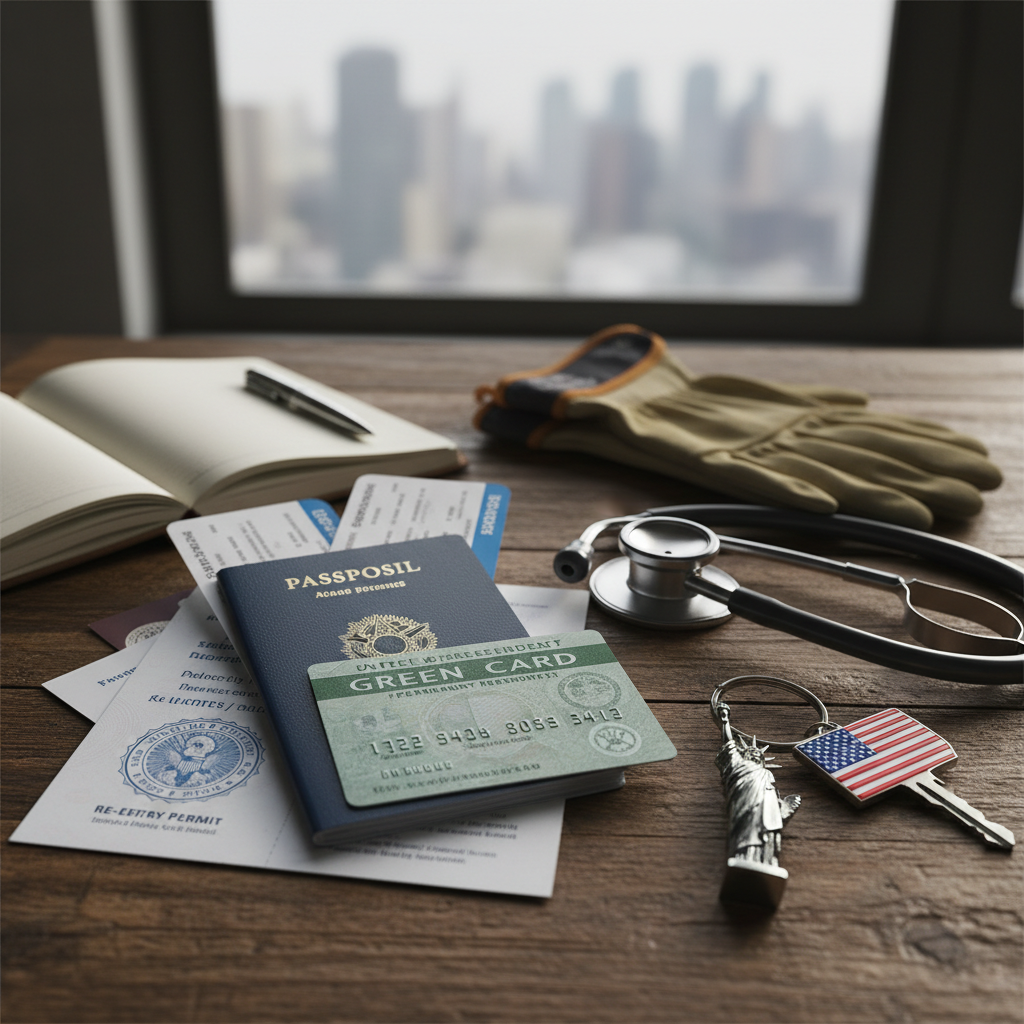
Obtaining a Green Card is a significant achievement for anyone planning to build their life in the United States. However, permanent residency comes with a fundamental obligation that many holders underestimate: maintaining the US as your primary domicile. International travel is permitted and is part of the routine for any permanent resident, but prolonged absences can jeopardize your Lawful Permanent Resident (LPR) status. Knowing the rules, critical deadlines, and available tools to protect your status is essential before planning any extended trip abroad.
Intention to reside in the US
The central principle underlying the Green Card is the continuous intention to reside permanently in the United States. Upon returning from an international trip, the CBP (U.S. Customs and Border Protection) officer at the port of entry has the authority to question this intention if there are signs of abandonment of residence. The main factor analyzed is the duration and frequency of absences from the country, but other elements are also considered, such as maintaining a home, active employment, filing taxes, and family ties in the US.
There is no single rule that automatically defines abandonment of residence. Each case is individually assessed by the CBP officer based on the totality of circumstances. However, there are well-established thresholds that determine the level of scrutiny applied upon the resident’s return.
Short trips: up to 6 months
Absences of up to six consecutive months generally do not cause problems when reentering the United States. For CBP, this period is usually interpreted as a temporary trip, whether for tourism, occasional professional commitments, or family visits, without breaking ties with the country. Still, it is advisable to keep documentation proving maintenance of residence in the US, such as income tax returns, bank statements, and proof of an active residence.
Even within this considered safe period, very frequent trips that result in more time outside the US than inside may eventually raise questions. The travel pattern matters as much as the individual duration of each absence.
Trips from 6 to 12 months
Absences longer than six months but less than a year already raise a significant red flag. In these cases, a rebuttable presumption of abandonment of residence may arise. This means that CBP may presume that the resident has abandoned their status, and it is up to the resident to prove otherwise at the time of reentry.
Upon returning to the US after an absence in this range, the permanent resident may be referred for secondary inspection at the port of entry, subjected to detailed questions about the reasons for the absence, and asked to present concrete evidence that they maintain ties with the United States.
Effective evidence to rebut the presumption of abandonment includes: federal income tax return with resident status (Form 1040), active address with recent mail, US bank accounts with activity, active employment or formally documented leave from the employer, valid driver’s license from a US state, and presence of immediate family members residing in the US. The more robust the documentation, the easier it will be to dispel any doubts.
Absences longer than 1 year
Staying outside the United States for one year or more can be interpreted as automatic abandonment of permanent resident status. When attempting to return, the Green Card may be invalidated at the port of entry and admission may be denied. In this situation, the resident may be placed in removal proceedings and have to defend their case before an immigration judge, an extremely unfavorable and costly scenario.
For planned absences longer than one year, there is a specific instrument designed to protect the resident’s status: the Re-entry Permit.
Re-entry Permit (I-131)
The Re-entry Permit is the essential document for permanent residents who need to be outside the US for a period longer than one year and less than two years. Obtained through Form I-131 (Application for Travel Documents), it serves as a formal notice to USCIS that the resident does not intend to abandon their residence, even with a prolonged absence.
The Re-entry Permit is valid for up to two years from the date of issuance. The filing fee for Form I-131 is $630 for paper submission. It is important to note that the I-131 for Re-entry Permit cannot be filed online; submission must be done by mail.
There are critical requirements for obtaining the document. The form must be filed while the resident is still physically in the United States, before the trip begins. After filing, the applicant must attend a biometrics appointment, also in the US, before being able to travel. Processing time can vary from a few months to over a year, so advance planning is absolutely essential.
Each family member who needs a Re-entry Permit must file their own individual Form I-131, with the respective $630 fee. It is not possible to include spouses or children in the same application.
The Re-entry Permit prevents the long absence from being used as the sole reason to revoke resident status. However, the final decision on admission at the port of entry remains with the CBP officer, who may check other admissibility factors beyond the length of absence.
Frequently Asked Questions
Proof of ties
The strongest evidence of maintaining ties with the US includes federal income tax return as a resident (Form 1040), active address with mail, active US bank accounts, valid driver’s license from a US state, close family members residing in the US, and proof of employment or enrollment in a US educational institution. Combining multiple categories of evidence is significantly more effective than any single document.
Guarantee of the Re-entry Permit
The Re-entry Permit does not automatically guarantee entry into the US. It protects the resident against Green Card revocation based solely on an absence of up to two years. However, final admission depends on the CBP officer, who may consider other admissibility factors, such as criminal background or customs issues. The document significantly reduces the risk, but does not completely eliminate the discretion of the border officer.
Emergencies without a Re-entry Permit
If an emergency forces you to stay outside the US for more than a year without a Re-entry Permit, the situation becomes complex. The resident will need to apply for a Returning Resident Visa (SB-1) at the nearest US consulate. This process requires proof that the long absence was due to reasons completely beyond the applicant’s control, such as a serious medical emergency, armed conflict, or natural disasters. Approval of the SB-1 is not guaranteed and the process can be lengthy, so preventive planning with the I-131 is always the safest strategy.
About the author

Victoria Harper
Editor-in-Chief
As a journalist and lead editor at Visto n’ Visa, Victoria helps ensure that immigration topics are covered in a clear, trustworthy, and easy-to-understand way. Her focus is on delivering useful, human, and relevant content for people exploring new paths abroad.