English
 Português
 Español


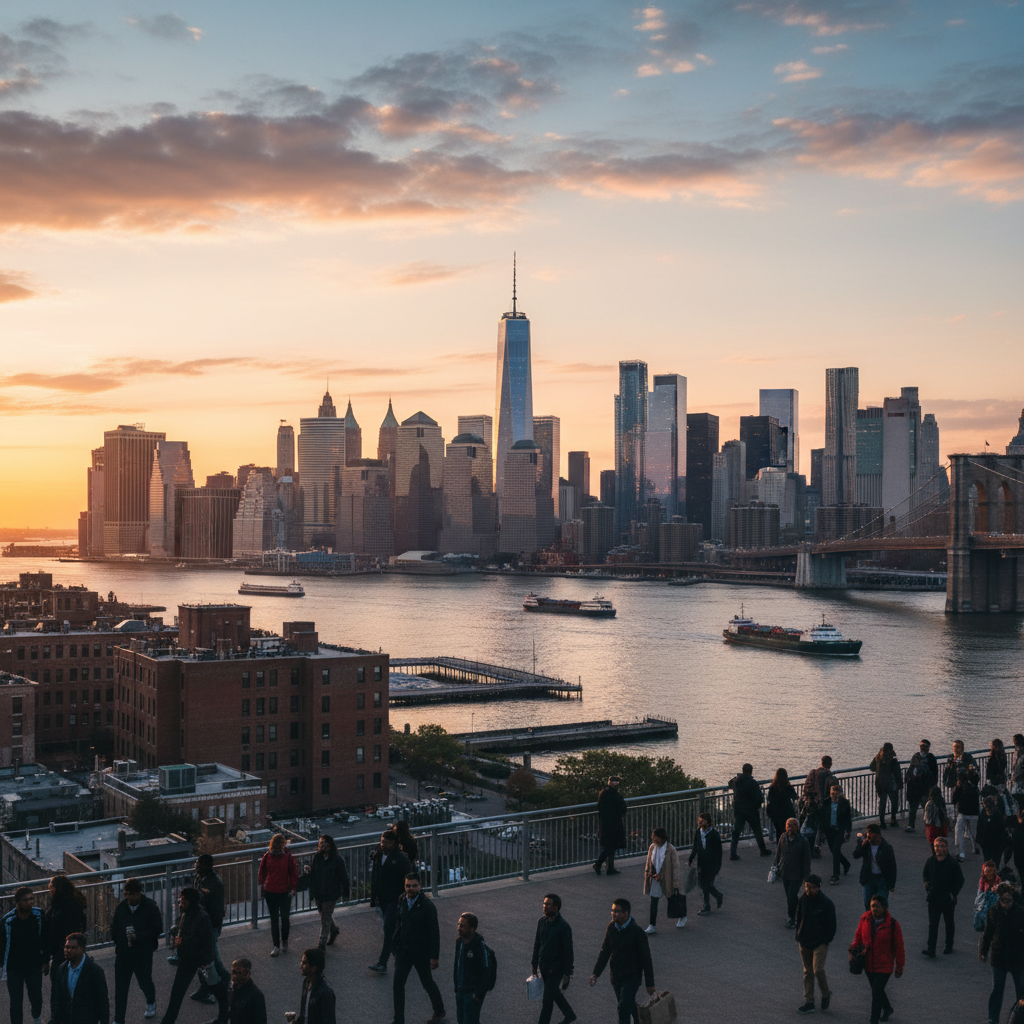
The United States is home to the largest immigrant population on the planet in absolute terms — 47.8 million foreign-born individuals living within its borders, according to Migration Policy Institute data consolidated in 2023. That figure represents roughly 14% of the American population, a share approaching the historical record of 14.8% reached in 1890, and underscores how the country remains a destination for structural migration flows, not merely episodic ones.
More than a statistic, the immigrant presence in the U.S. shapes the economy, demographics, education system, and political debate. Each wave brings distinct origins, profiles, and contributions, and understanding the current composition helps those planning international mobility situate their own journey within a broad and evolving global community.
The Weight of Immigration in American Demographics
Immigrants and their U.S.-born children totaled approximately 90.9 million people in 2023, or 27% of the total population. This group grows at a faster pace than the native-born population of the second generation or beyond, and accounts for a significant share of the country’s net population growth. Without immigration, Census Bureau projections indicate that the American population would enter stagnation or contraction in the coming decades, partly due to the aging of the baby boomer generation and declining fertility rates among the native-born.
Geographic distribution is uneven. States such as California, Texas, Florida, New York, and New Jersey concentrate the largest share of immigrants in absolute numbers, while Southern and Southeastern states — especially Georgia, North Carolina, and Tennessee — have recorded the fastest percentage growth over the past two decades.
Origins of Contemporary Immigration
Latin America remains the leading region of origin, accounting for just over half of the immigrant population. Mexico remains the single most-represented country, with roughly 23% of the total. Next come India, China, the Philippines, El Salvador, the Dominican Republic, Cuba, Vietnam, South Korea, and Guatemala. Brazil ranks among the top fifteen source countries, with a growing presence in recent years.
The profile has been shifting. Immigration from Asia — particularly India and China — is growing rapidly and tends to concentrate in high-skill occupations such as technology, engineering, science, and medicine. Meanwhile, flows from Central America are driven largely by humanitarian factors, with parole programs for Venezuelans, Cubans, Haitians, and Nicaraguans adding significant numbers starting in 2022.
Immigration Status: Legal, Undocumented, and In-Between
In 2022, data compiled by the Pew Research Center indicated that 77% of immigrants held permanent legal status — as naturalized citizens, lawful permanent residents (green card holders), refugees, or asylees — or long-term nonimmigrant status, such as international students and temporary workers. The remaining group, estimated at 11.3 million people, lived in an irregular situation.
The number of undocumented immigrants remained relatively stable over the past decade, with new arrivals offset by deportations, voluntary departures, and regularizations through marriage, asylum, adjustment of status, and other pathways. The majority of this group has lived in the United States for more than a decade, with established roots in communities, family ties, and active participation in the labor market.
The Brazilian Presence by the Numbers
The Brazilian community in the U.S. has grown consistently over the past twenty years. Official estimates and data from the Itamaraty point to more than 1.9 million Brazilians living legally in the United States, with a strong presence in Massachusetts, Florida, New Jersey, Connecticut, and California. In terms of green cards, the Department of Homeland Security’s ranking showed 28,050 Brazilians receiving permanent residence in 2023 — a historic record and a 16% increase over 2022 — placing Brazil tenth among all source countries.
Brazil’s immigration profile spans multiple eligibility categories. EB-2 NIW and EB-3 stand out among employment-based routes, while marriage-based green cards (CR-1, IR-1) and immediate relative petitions remain substantial. Long-term nonimmigrant visas — especially F-1 for students and H-1B for skilled workers — feed the pipeline of future adjustment of status cases.
Economic and Educational Impact
Immigrants represent a significant share of the American workforce, with especially high participation in agriculture, construction, hospitality, healthcare, and information technology. Bureau of Labor Statistics data indicate that foreign-born workers make up roughly 19% of the U.S. civilian labor force — a share that exceeds 30% in states such as California and New York.
In higher education, students from immigrant families accounted for more than 90% of college enrollment growth between 2000 and 2022. Research universities — particularly Ivy League schools and large public institutions — depend on foreign-born researchers to sustain scientific output, especially in STEM fields. In doctoral programs, foreign national participation reaches 40% in computer science, electrical engineering, and physics.
The Recent Political Landscape
Immigration was one of the central issues of the 2024 U.S. elections, and Donald Trump’s second term brought significant changes to the southern border, the humanitarian parole program, the asylum system, and the treatment of applicants in irregular status. Executive orders signed in January 2025 reinforced removal operations, temporarily suspended portions of the refugee program, and increased requirements for consular visas.
For those seeking legal, lasting pathways to mobility, the current landscape underscores the importance of careful planning, strategic visa selection based on professional or family profile, and heightened attention to opportunity windows such as annual H-1B quotas, Visa Bulletin priority dates, and category-specific regulatory changes. The demographic and economic force of immigration in the U.S. remains structural — but the regulatory terrain demands constant monitoring.
About the author

Victoria Harper
Editor-in-Chief
As a journalist and lead editor at Visto n’ Visa, Victoria helps ensure that immigration topics are covered in a clear, trustworthy, and easy-to-understand way. Her focus is on delivering useful, human, and relevant content for people exploring new paths abroad.