English
 Português
 Español


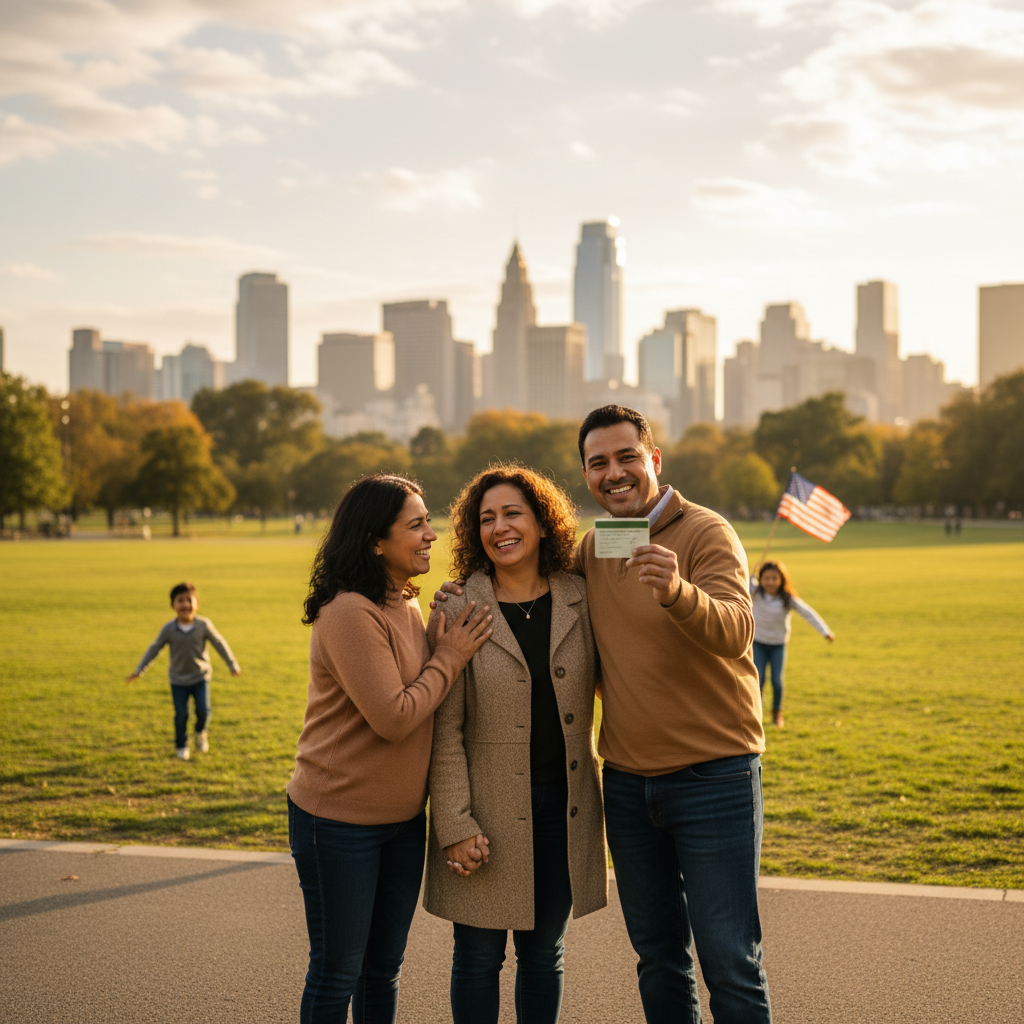
Bringing parents to live permanently in the United States is one of the most straightforward pathways within the family-based immigration system. As an immediate relative category, the green card petition for the mother or father of a U.S. citizen is not subject to annual quotas or the Visa Bulletin, making the process significantly faster than other family preference categories. This guide walks through every step — from petitioner eligibility to the consular interview — with current USCIS fees and updated average timelines.
Who Can Sponsor Parents
Only U.S. citizens who are at least 21 years old may petition for a parent’s green card. Lawful permanent residents (green card holders) cannot sponsor parents under any circumstances, even if they have lived together their entire lives. This restriction is written into the Immigration and Nationality Act (INA § 201) and reflects Congress’s deliberate choice to classify parents of citizens as immediate relatives.
The petitioner must demonstrate three objective conditions: U.S. citizenship proven by a U.S. birth certificate, certificate of naturalization, or valid U.S. passport; a parental relationship proven by the petitioner’s own birth certificate listing both parents’ names; and financial capacity to support the parent under the terms of the Affidavit of Support (Form I-864), meeting at least 125% of the federal poverty guidelines issued by HHS for the applicable household size.
The IR-5 Category: What It Means
The Department of State’s IR-5 classification groups parents of U.S. citizens as immediate relatives. Unlike preference categories F1, F2A, F2B, F3, and F4, immediate relatives do not compete for a limited number of visa numbers. This means that once the I-130 is approved, there is no waiting line for an available visa number: the case moves immediately to adjustment of status (if the parent is in the U.S.) or consular processing (if abroad).
Documentation for the I-130
The Form I-130, Petition for Alien Relative, is the mandatory starting point. The petitioning citizen fills out and signs the form; the parent does not complete anything at this stage. The purpose of the I-130 is to establish the parental relationship and confirm category eligibility.
- Copy of the petitioner’s proof of U.S. citizenship (U.S. birth certificate, certificate of naturalization, certificate of citizenship, or U.S. passport photo page)
- Copy of the petitioner’s birth certificate with both parents’ names clearly legible
- Copy of the parents’ marriage certificate when the petitioner is the father’s child (paternity), except in cases of out-of-wedlock birth with subsequent legitimation or proven ties
- Legal name change documentation when applicable (marriage certificates or court orders)
- Two passport-style photos of the petitioner and two of the beneficiary
Special Cases of Parentage
For adoptive parents, the adoption must have taken place before the petitioner’s 16th birthday, and legal custody and physical cohabitation must have lasted at least two years. Note: petitioners who acquired U.S. citizenship through adoption may not petition for biological parents, unless the adoption was formally terminated and the biological relationship reestablished without any immigration benefit derived from the adoption.
For stepparents, a marriage certificate between the biological parent and the stepparent is required, with proof that the marriage occurred before the petitioner turned 18. Documentation of the termination of prior marriages (divorce decree, death certificate, or annulment) is also required.
For a biological father of a child born out of wedlock, there are two paths: if legitimation occurred before the petitioner’s 18th birthday (through the parents’ subsequent marriage or a formal legal act), proof of legitimation is sufficient; if there was no legitimation, continuous financial and emotional ties initiated before age 18 must be demonstrated through cohabitation records, beneficiary designations in insurance policies, documented financial transfers, correspondence, and witness affidavits.
Affidavit of Support (Form I-864)
The I-864 is the legally enforceable financial commitment by which the petitioner guarantees to the U.S. government that the parent will not become a public charge. The petitioner must demonstrate annual income of at least 125% of the federal poverty guidelines for their household size, counting the parent as an additional household member, plus any other immigrants the petitioner previously sponsored whose I-864 is still legally in force.
When current income is insufficient, it is possible to combine liquid assets (savings, investments, unencumbered real estate excluding the primary residence) valued at at least five times the difference between the petitioner’s income and the 125% threshold. Alternatively, a joint sponsor (also a U.S. citizen or lawful permanent resident with their own qualifying income) may be used, or the income of a household member living with the petitioner who signs Form I-864A may be combined.
I-864 Supporting Documents
- Copy of the most recent federal income tax return (Form 1040) with W-2s and schedules
- Pay stubs from the past six months or an employer letter confirming salary and employment stability
- For self-employed individuals: Schedules C, D, E, or F from the tax return, business financial statements, and bank statements
- Asset documentation when used to supplement income
- Proof of the petitioner’s U.S. citizenship
Parents in the U.S.: Adjustment of Status
If the parent is in the United States with a valid nonimmigrant status (B-1/B-2, F-1, H-1B, among others) and entered through an airport with formal inspection by CBP, it is possible to file Form I-485, Application to Register Permanent Residence or Adjust Status, concurrently with the I-130 (concurrent filing). This strategy significantly accelerates the outcome, as the adjustment is processed within the U.S. by USCIS without the need to return to the home country for a consular interview.
The I-485 covers the beneficiary’s background in detail: address history, employment, marriages, travel, criminal convictions, immigration violations, security-related activities, and organizational memberships. Filed along with the I-485 are two passport-style photos, copies of the beneficiary’s birth certificate, entry records (passport stamps and Form I-94), approval notice or receipt for any prior petition, and Form I-693 with the medical examination in a sealed envelope from a USCIS-designated civil surgeon.
When Entry Was Without Inspection
Parents who entered the U.S. without inspection (without being formally admitted at a port of entry) generally cannot adjust status through the I-485 and may need waivers such as the I-601A for forgiveness of unlawful presence before consular processing. These cases are complex and require individualized legal planning before any petition is filed, due to the risk of a three- or ten-year bar upon leaving the U.S.
Parents Abroad: Consular Processing
When the parent is outside the U.S., the I-130 is approved by USCIS and forwarded to the National Visa Center (NVC) of the Department of State. The NVC coordinates three steps through the CEAC portal:
- Form DS-261 indicating a contact address and case agent
- Payment of consular fees (Immigrant Visa Application Processing Fee and Affidavit of Support Review Fee)
- Form DS-260, the electronic immigrant visa application
In parallel, the beneficiary assembles a civil documents package: birth certificate, marriage certificate if applicable, divorce and death certificates from prior spouses, police certificates from each country where the beneficiary resided for more than six months after age 16, and court records for any convictions. Once all documents are considered complete, the NVC declares the case documentarily qualified and schedules the interview at the appropriate U.S. consulate.
Medical Examination (Form I-693 or DS-3025)
A medical examination is mandatory in both processing routes. In the U.S., the parent visits a civil surgeon designated by USCIS through the Find a Doctor tool, and the results are delivered in a sealed envelope that cannot be opened until received by USCIS. Abroad, the exam is performed by a panel physician accredited by the U.S. embassy, and Form DS-3025 is transmitted electronically to the consulate.
The exam includes a physical and mental health evaluation, tuberculosis screening by chest X-ray (for applicants age 2 and older), syphilis and gonorrhea testing, vaccination history review, and administration of CDC-required vaccines. Active communicable diseases, disorders associated with harmful behavior, active substance dependence, and missing required immunizations create inadmissibility under INA § 212(a)(1) and require a specific waiver or prior treatment.
USCIS and Consular Fees
The fees listed below reflect the USCIS and DOS fee schedule effective mid-2025 and still applicable in 2026; they should be confirmed on the USCIS G-1055 portal before filing.
When the Parent Is Already in the U.S.
- I-130: US$675 by paper or US$625 online
- I-485 (adult): US$1,440, which already includes biometrics
- I-131 Advance Parole (optional): US$630
- I-765 EAD (optional): free when filed concurrently with a family-based I-485
- Private medical exam: typically US$200–US$500
When the Parent Is Abroad
- I-130: US$675 by paper or US$625 online
- DS-260 Immigrant Visa Application Processing Fee: US$325
- I-864 Affidavit of Support Review Fee: US$120
- USCIS Immigrant Fee (post-approval): US$235
- Medical exam with panel physician: varies by country
Average Processing Timelines
For adjustment of status, USCIS reports an average timeline of approximately 9 to 13 months between I-485 filing and approval, varying by field office. A standalone I-130 is typically approved in 8 to 14 months, but in a concurrent filing the I-130 and I-485 move through the process together.
For consular processing, the total timeline typically falls between 14 and 24 months: I-130 adjudication at USCIS, transfer to the NVC, civil document collection, interview scheduling, and visa issuance. The final duration depends heavily on the jurisdiction’s consulate and its local backlog.
The Green Card Interview
For adjustment of status, the interview takes place at the USCIS field office nearest the beneficiary’s residence. For consular processing, it occurs at the U.S. consulate in the country of residence. The officer confirms the parental relationship, verifies identity, and reviews the original documents. Common questions include: where the parent intends to live in the U.S., how many children they have, what the sponsoring child’s occupation is, how the child obtained U.S. citizenship, and the parent’s prior U.S. travel history.
After Approval
Once adjustment of status is approved, USCIS mails the permanent resident card within approximately 60 days. Through consular processing, the parent receives a visa stamped in their passport and enters the U.S. before the indicated validity date; the physical green card is issued after payment of the USCIS Immigrant Fee and mailed to the address provided on the DS-260.
The immediate relative green card is issued with a ten-year validity and is renewed via Form I-90. There is no two-year conditional period as applies in recent-marriage cases. The permanent resident may apply for naturalization after five years, with the count beginning on the date of admission as a permanent resident.
Learn more about Family Based
- Type
- Family-sponsored Green Card
- Sponsor
- U.S. citizen or LPR
- Petition
- Form I-130
- Processing
- 12 months to several years
About the author

Victoria Harper
Editor-in-Chief
As a journalist and lead editor at Visto n’ Visa, Victoria helps ensure that immigration topics are covered in a clear, trustworthy, and easy-to-understand way. Her focus is on delivering useful, human, and relevant content for people exploring new paths abroad.