English
 Português
 Español


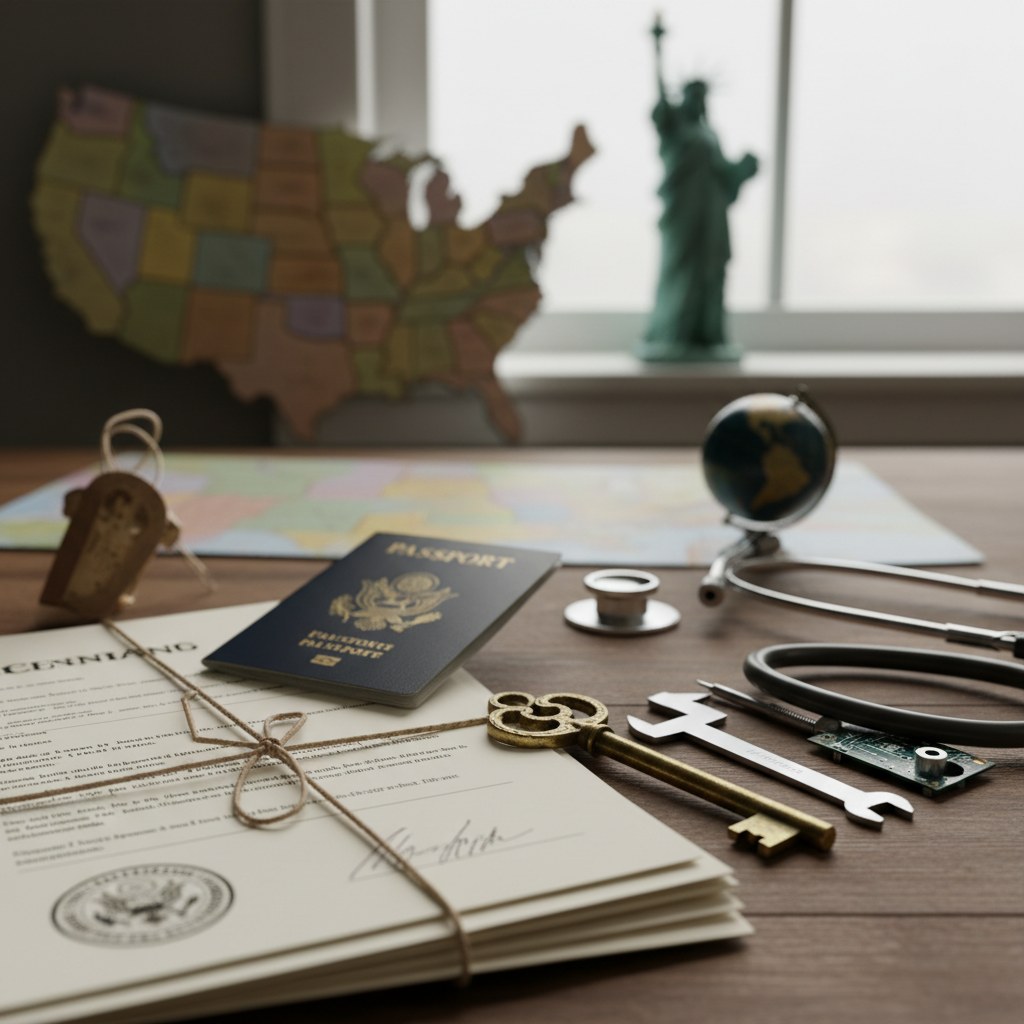
When an EB-2 NIW (National Interest Waiver) petition is approved by USCIS and the beneficiary is outside the United States, the path to a green card must go through the consular process. This step requires interaction with the American diplomatic structure abroad — embassies and consulates — institutions that many applicants confuse or treat as if they were the same thing. Understanding the specific functions of each, when to turn to one or the other, and how consular processing unfolds is essential to avoid delays and surprises in the final stretch of the immigration process.
What is an American embassy
The embassy is the highest-level diplomatic representation of the United States in a foreign country. Located in the capital city, it is headed by an ambassador appointed by the American president and confirmed by the Senate. Its primary mission is to manage bilateral relations (foreign policy, trade, defense, academic and scientific cooperation) and to serve as the central point of communication between the American government and the host government.
In addition to diplomatic functions, embassies provide services to American citizens abroad (passport renewal, birth registrations, emergency assistance) and, in countries without a dedicated consulate, also process visa applications. In Brazil, the embassy is in Brasília, with consulates in São Paulo, Rio de Janeiro, Recife, and Porto Alegre.
What is an American consulate
The consulate is an extension of the embassy located in cities beyond the capital, typically in major economic and population centers. It is headed by a consul general and has an operational, not diplomatic, focus. Its main activity is serving the public with consular services: issuance of immigrant and non-immigrant visas, assistance to American citizens abroad, document certifications, and emergency support.
For most visa applicants, the consulate is the primary point of contact. It is where interviews take place, documents are submitted, and the physical visa is stamped in the passport. In countries with multiple consulates, each one serves a specific geographic jurisdiction determined by the applicant’s place of residence.
Practical differences between the two institutions
Although both serve American interests abroad, their operational functions are distinct. The embassy concentrates high-level diplomatic activities, with various departments specialized in foreign policy, defense, agriculture, trade, and economic cooperation. Visa services, when offered, are just one of many.
The consulate, in contrast, is almost exclusively focused on public services. Its structure is optimized to handle high volumes of applicants (scheduling, document intake, applicant communication). For the EB-2 NIW visa applicant, the consulate tends to be the processing location, with the embassy coming into play only in small countries without dedicated consulates.
When the EB-2 NIW reaches consular processing
After USCIS approves the I-140 petition with a National Interest Waiver request, the process follows a specific path if the applicant is outside the United States. The case is sent to the National Visa Center (NVC), located in Portsmouth, New Hampshire, which functions as the screening point between petition approval and the consular interview scheduling.
The NVC notifies the applicant and their dependents to collect and submit the following documents:
- Completed DS-260 form for each family member who will immigrate
- Proof of payment of immigrant visa fees and processing fee
- Civil documents: birth certificates, marriage and divorce certificates (if applicable), criminal and military background records
- Proof of financial capacity or relevant affidavit depending on the petition subtype
- Passports valid for at least six months beyond the expected entry date
- Photographs meeting U.S. visa standards
After the documentation is accepted, the NVC forwards the case to the designated consulate or embassy based on the applicant’s residence and schedules the consular interview. Waiting times between I-140 approval and the interview vary significantly: in countries with high demand, it can take many months; in countries with few applicants, it may be a matter of weeks.
Medical examination and interview
Before the consular interview, the applicant must undergo a medical examination by a designated physician (panel physician) listed by the consulate itself. The examination includes medical history, physical examination, vaccines required by U.S. law, and laboratory tests such as tuberculosis and sexually transmitted diseases. The results are sent in a sealed envelope directly to the consulate or delivered by the applicant on the day of the interview, depending on local procedure.
On the day of the interview, the applicant appears with all original documentation. The consular officer conducts a relatively short interview focused on confirming the beneficiary’s identity, validating the content of the approved I-140 petition, and verifying that there are no grounds of inadmissibility not previously detected. For EB-2 NIW, the focus falls on the professional area of expertise, the consistency between the presented résumé and the declared work, and the concrete plan to carry out the activity in the United States.
After consular approval
Once the interview is approved, the consulate retains the passport for a few days to print the immigrant visa and issue a sealed package containing all petition documents. This package must not be opened by the applicant; it is delivered to the CBP (Customs and Border Protection) officer at the time of entry into the United States.
The applicant has six months from the date of visa issuance to make their first entry into U.S. territory. After admission by CBP, permanent resident status is formally granted. The physical green card is mailed to the American address provided, typically within 30 to 90 days. The USCIS Immigrant Fee must be paid online after entry in order for the card to be issued.
When the applicant is inside the U.S.
If the EB-2 NIW beneficiary is already in the United States in valid status (H-1B, F-1 with OPT, L-1, O-1, among others) and the priority date is current per the month’s Visa Bulletin, they may opt for Adjustment of Status via Form I-485, without needing to go through a consulate. This path keeps the applicant in U.S. territory throughout the entire processing period and is generally faster for those already in the country.
Adjustment of Status, however, requires continuous presence in the United States during the process, with Advance Parole requests for international travel and an EAD for independent work authorization. Each path — consular processing or Adjustment of Status — has distinct advantages, risks, and costs, and the choice should be made based on the applicant’s current immigration situation and professional plans.
Common challenges in consular processing
Waiting time is one of the biggest obstacles. In high-demand countries, the interval between I-140 approval and the interview can exceed one year. Administrative delays at the NVC, missing civil documents, medical examinations with additional requirements, and the need for inadmissibility waivers are frequent causes of process prolongation.
Applicants in countries without an American consulate face the additional burden of international travel. Citizens of Yemen, Venezuela, and other countries with reduced diplomatic presence often need to travel to a third country for the interview, with significant logistical costs.
Consular denials, though less common for cases with an approved I-140, can occur in situations of inadmissibility detected only at the time of the interview: undisclosed criminal records, unreported health conditions, or inconsistencies between the DS-260 and the submitted documentation.
Preparation and attention to detail
For EB-2 NIW applicants processing the visa through the consulate, the work of document organization does not end with the I-140 approval. Each certificate must be current and in a format accepted by the specific consulate. Every required vaccine must be recorded in the applicant’s vaccination record. Every item in the DS-260 must accurately reflect the résumé, family ties, and travel history.
Understanding that embassies and consulates have different roles — and that for EB-2 NIW the consulate is almost always the gateway — helps in planning timelines, choosing the correct jurisdiction, and organizing the interview logistics. The green card journey via NIW holds great professional value for those who demonstrate substantial national interest; taking good care of the final step, at the consulate, is what transforms an approved petition into effective permanent residency.
Learn more about EB-2 NIW
- Category
- EB-2 NIW Green Card
- Self-petition
- Allowed (no sponsor needed)
- PERM
- Waived
- Processing
- 12-36 months
About the author

Victoria Harper
Editor-in-Chief
As a journalist and lead editor at Visto n’ Visa, Victoria helps ensure that immigration topics are covered in a clear, trustworthy, and easy-to-understand way. Her focus is on delivering useful, human, and relevant content for people exploring new paths abroad.