English
 Português
 Español


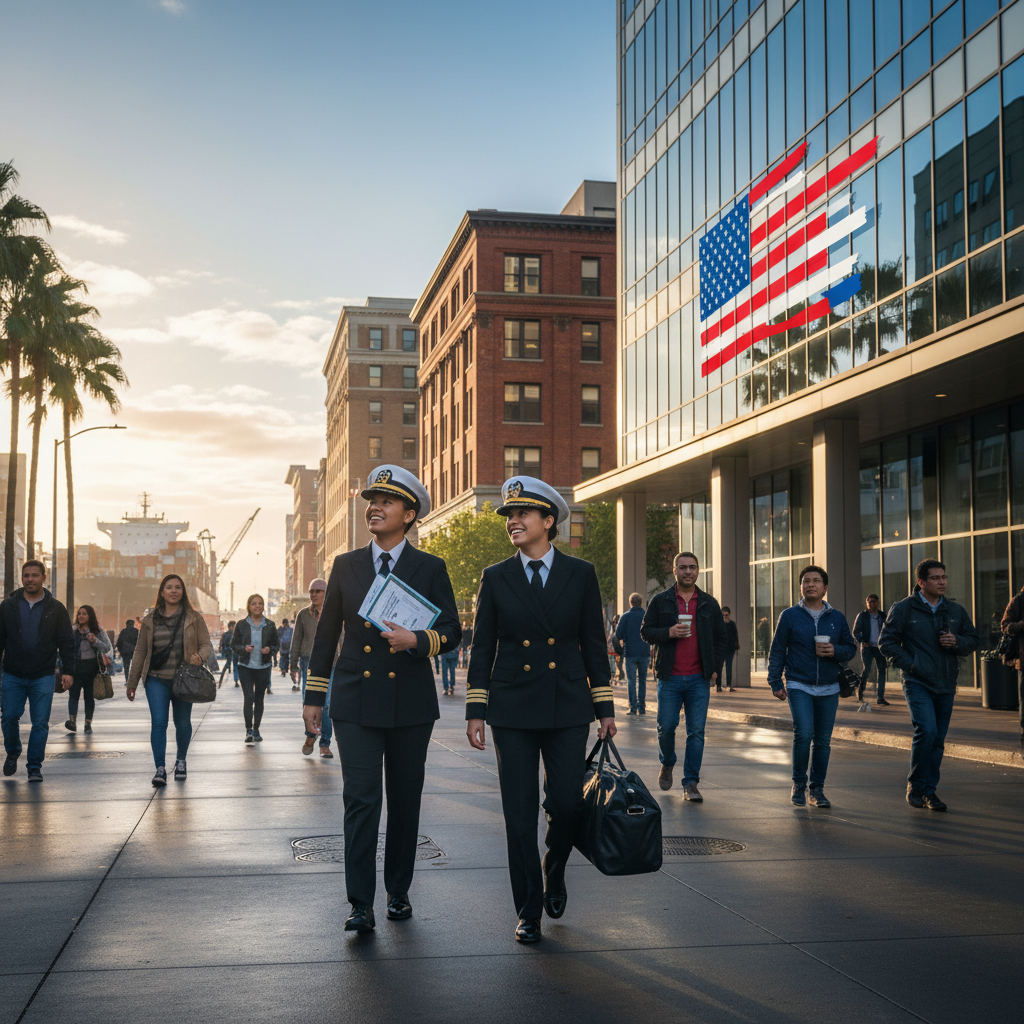
The U.S. maritime sector is facing a qualified personnel crisis that has been worsening for more than a decade and that, in 2026, has reached proportions classified by the Department of Defense itself as a national security threat. Offshore wind farms along the East Coast, Gulf of Mexico exploration projects, and the strategic merchant fleet face a structural deficit of licensed officers, both deck and engine. For Brazilian professionals with STCW credentials and offshore experience, this scenario opens a concrete window for permanent immigration through the EB-2 NIW and EB-1A categories, both allowing self-petition without requiring a prior U.S. job offer.
The Deficit That Worries the Pentagon
The Maritime Workforce Working Group, established by Congress within the Department of Transportation (MARAD), identified a shortage of approximately 1,800 to 2,000 qualified officers needed to keep the Ready Reserve Force — the strategic reserve fleet used in military mobilization operations — fully operational. The number is not theoretical: it corresponds to crews that would need to be ready to sail within 96 hours in the event of a conflict or humanitarian crisis.
On the civilian side, the sector faces similar pressure. The U.S.-flag merchant fleet operates with ever-thinner redundancy margins, and the expansion of offshore wind farms requires a new contingent of officers qualified for specialized vessels such as Service Operation Vessels and Wind Turbine Installation Vessels. The result is an aggregate demand that the domestic education system cannot meet.
Why the Shortage Cannot Be Solved Internally
The six U.S. maritime academies — including the U.S. Merchant Marine Academy and state academies — collectively graduate approximately 800 officers per year. The problem is retention: MARAD’s own studies show that a significant portion of these graduates migrate to shore-based careers within the first five years, drawn by family predictability and comparable salaries in port logistics, regulation, or consulting.
The Bureau of Labor Statistics projects that thousands of new officers will be needed by 2032, largely to replace retiring professionals. The average age of the U.S. merchant officer corps exceeds fifty years, creating a scenario where retirements outpace academic recruitment.
Why the Brazilian Offshore Profile Fits
Over the past three decades, Brazil has built one of the world’s largest offshore hubs, with professionals experienced in FPSO operations, ultra-deepwater drilling, supply vessels, and ROVs. Naval engineers, deck officers, and engine officers trained at CIAGA, CIABA, or the Brazilian Merchant Marine typically hold, simultaneously:
- Internationally recognized STCW certifications;
- Operational experience in adverse conditions equivalent to or exceeding those of the Gulf of Mexico;
- Proficiency in maritime technical English;
- A track record with global contractors such as Modec, SBM Offshore, Subsea 7, and Saipem.
In immigration terms, this combination is precisely what U.S. authorities describe as an advanced degree professional or individual of extraordinary ability, depending on the level of evidence assembled.
EB-2 NIW: The More Accessible Route
The EB-2 category with National Interest Waiver allows the professional to waive the job offer and labor certification (PERM) requirements, provided they demonstrate that their work serves a national interest of the United States. The landmark case is Matter of Dhanasar, a 2016 Administrative Appeals Office decision that established three cumulative criteria:
- The proposed endeavor has substantial merit and national importance;
- The petitioner is well-positioned to advance it;
- On balance, it would be beneficial to the United States to waive the job offer and labor certification requirements.
For an offshore officer, the national interest thesis finds direct support in public MARAD and Department of Defense reports classifying the officer shortage as a national security issue. The petitioner must establish an advanced degree — typically a senior officer diploma combined with STCW management-level certifications — or demonstrate exceptional ability through the applicable regulatory criteria.
Typical Documentation for a Maritime EB-2 NIW Case
- Bachelor’s degree and, ideally, a graduate degree or Master Mariner license;
- STCW license booklet with relevant endorsements (Master Unlimited, Chief Engineer Unlimited, Dynamic Positioning Operator);
- Certified sea service record from the shipowner or ship management company;
- Letters of recommendation from captains, superintendents, and operations managers;
- Evidence of technical publications, presentations at industry conferences, or participation in IMO committees;
- References to MARAD reports framing the shortage as a national priority.
EB-1A: The Extraordinary Ability Route
The EB-1A is designed for professionals with extraordinary ability recognized at the top of their field. The evidentiary bar is higher, but the benefit is one of the fastest Green Card queues available. The petitioner must satisfy at least three of the ten regulatory criteria listed in 8 CFR 204.5(h)(3), including industry awards, participation on judging panels, original contributions of major significance, authorship of technical articles, salary substantially above average, and performance in a critical role at prominent organizations.
In the maritime segment, strong evidence includes participation on technical committees of the International Maritime Organization, authorship of industry-adopted standards, leading pioneering projects in DP3 or ultra-deepwater production fields, and compensation comparable to top performers in the sector.
Practical Comparison Between the Two Routes
| Aspect | EB-2 NIW | EB-1A |
|---|---|---|
| Job offer | Waived | Waived |
| Labor certification | Waived | Waived |
| Self-petition | Allowed | Allowed |
| Average queue time | Longer, depends on the Visa Bulletin | Shorter, frequently current |
| Evidentiary standard | National interest under Dhanasar | Extraordinary ability at the top of the field |
Premium Processing and Realistic Timeline
Premium Processing, with a 45-calendar-day decision for EB-1A and EB-2 NIW, is available for an additional fee. After the I-140 is approved, the petitioner waits for the priority date to become current in the Department of State’s Visa Bulletin to then adjust status via I-485, if already lawfully in the U.S., or process the immigrant visa through DS-260, if abroad.
For Brazilian nationals, EB-1A tends to be current or with very modest retrogression, while EB-2 NIW may accumulate waits of several years depending on the fiscal cycle and aggregate category demand. Monthly monitoring of the Visa Bulletin is an inseparable part of the planning process.
Strategic Mistakes That Invalidate Strong Cases
Even with a strong technical profile, cases are denied due to avoidable errors. The most common in the maritime segment are: submitting STCW documentation without certified translation, failing to tie the national interest thesis to official MARAD reports, presenting generic recommendation letters drafted by the petitioner themselves, and overlooking comparative salary documentation — especially important when the recent work history involved vessels under foreign flags.
Another sensitive issue is maintaining lawful status in the U.S. during the adjudication process. Professionals who enter on B-1/B-2 while petitions are pending must observe the rules on unauthorized presence and potential inadmissibility. The safest alternative for those who need to be on U.S. soil during the process is to transition through a compatible work category, such as O-1 or H-1B, before consolidating permanent residence.
What to Consider Before Filing
The window opened by the officer shortage is not permanent. Domestic incentive programs for recruiting young Americans, expansion of state academies, and regulatory changes may, over the coming years, compress the national interest argument for foreign maritime profiles. Professionals who currently meet EB-2 NIW or EB-1A requirements tend to benefit from a favorable evidentiary environment that may not be available with the same intensity in the future.
Building the dossier takes, on average, four to eight months between gathering evidence, drafting the petition letter, and reviewing recommendation letters. Preparation time is, in practice, part of the immigration project and deserves the same rigor that the professional applies to an international deployment plan.
Learn more about EB-2 NIW
- Category
- EB-2 NIW Green Card
- Self-petition
- Allowed (no sponsor needed)
- PERM
- Waived
- Processing
- 12-36 months
About the author

Victoria Harper
Editor-in-Chief
As a journalist and lead editor at Visto n’ Visa, Victoria helps ensure that immigration topics are covered in a clear, trustworthy, and easy-to-understand way. Her focus is on delivering useful, human, and relevant content for people exploring new paths abroad.