English
 Português
 Español


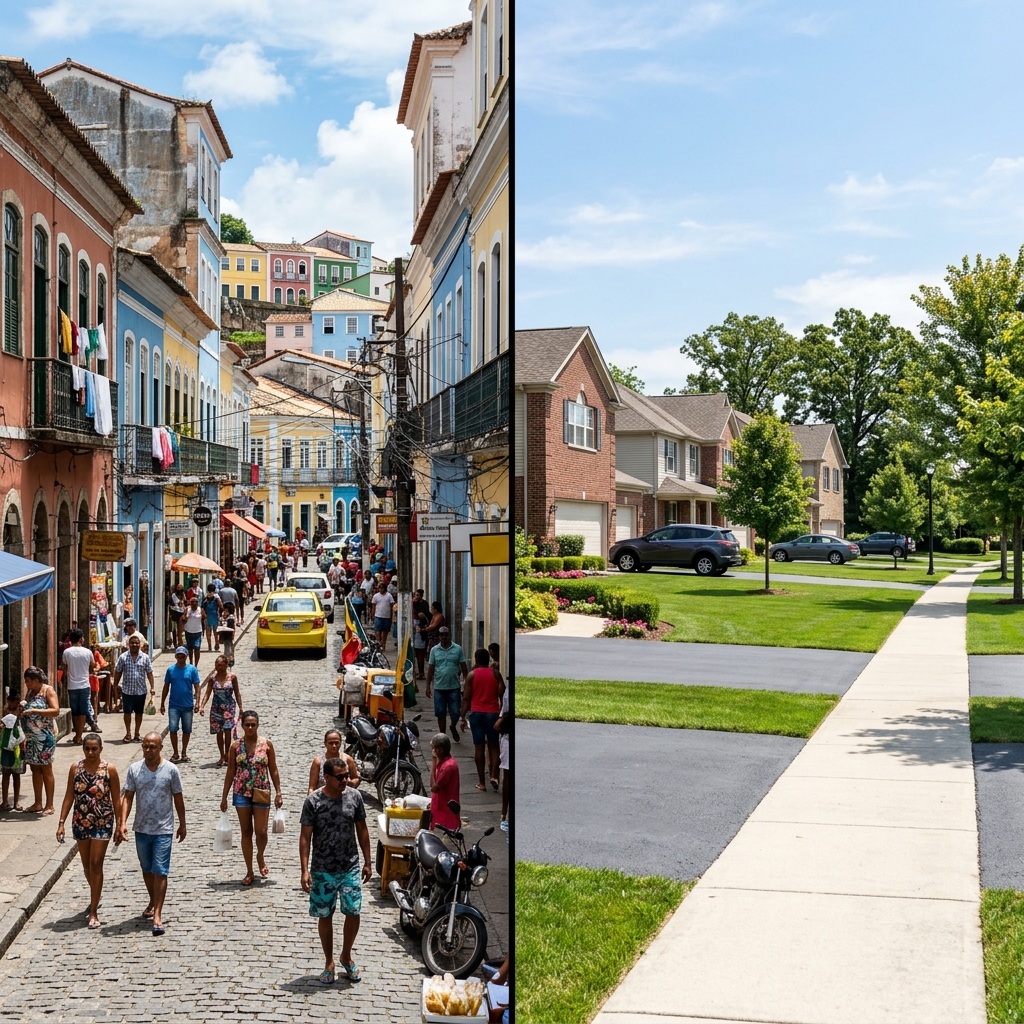
The decision to emigrate involves a rational analysis of concrete factors that affect daily life: personal safety, professional opportunities, and the weight of income taxes. For Brazilians considering the United States as a destination, these three pillars are usually decisive. With updated data from 2025, it is possible to make an objective comparison and understand where each country stands out.
This article brings together official statistics and recent analyses on crime, the job market, and taxation in Brazil and the US, helping the reader form their own assessment of quality of life and stability. It is worth noting that no comparison replaces individual analysis: the impact of each factor varies according to professional profile, destination city, and each person’s financial planning.
Crime in numbers
The most commonly used indicator to compare safety between countries is the homicide rate per 100,000 inhabitants. In 2025, Brazil recorded a rate of approximately 19.2 homicides per 100,000 inhabitants, a significant drop from 21 per 100,000 in 2024 and the lowest rate in more than a decade in the country. Even with this improvement, the absolute number of violent deaths in Brazil still exceeded 40,000 for the year.
In the United States, the homicide rate in 2025 fell to 4.29 per 100,000 inhabitants, a 21% reduction compared to the previous year and the lowest level since 2014. Cities like Baltimore saw drops of up to 60%, and carjacking rates fell 61% since 2023.
| Indicator (2025) | Brazil | United States |
|---|---|---|
| Homicide rate/100,000 | ~19.2 | ~4.29 |
| Trend | Decline (lowest in 10+ years) | Record drop of 21% |
| Sense of safety | Low in major capitals | High in suburbs and mid-sized cities |
Both countries show significant regional inequality. In Brazil, capitals in the Northeast have rates well above the national average, while in the US, cities like Milwaukee saw localized increases in 2025. The choice of destination city is as important as the choice of country.
Job market and career
The United States maintains one of the most dynamic job markets in the world, with an unemployment rate consistently below 4% in recent years. Sectors such as technology, healthcare, engineering, and renewable energy continue to have high demand for qualified professionals, offering salaries significantly higher than those in Brazil for equivalent positions.
A software engineer in the US earns on average between $120,000 and $180,000 per year, depending on region and experience. In healthcare, specialized nurses (Nurse Practitioners) make over $120,000 per year, and resident doctors start with salaries above $60,000. In Brazil, professionals with equivalent qualifications often earn a third or less of these amounts, even in major cities.
The American market also offers greater career predictability: structured professional development plans, benefits such as corporate health insurance, and retirement contributions (401k) are standard in medium and large companies. In Brazil, informality still affects about 40% of the workforce, and regulatory instability makes long-term planning difficult.
| Sector | Demand in the US | Salary advantage |
|---|---|---|
| Technology | High (AI, cloud, cybersecurity) | 3x to 5x vs. Brazil |
| Healthcare | Critical (nursing, pharmacy) | 4x to 6x vs. Brazil |
| Engineering | Strong (civil, mechanical, electrical) | 3x to 4x vs. Brazil |
| Finance | Stable (compliance, analysis) | 2x to 4x vs. Brazil |
Taxation and tax burden
The Brazilian tax burden reached 32.3% of GDP in 2024, according to data from the National Treasury, above the Latin American average (21.3%) and close to the OECD average (33.9%). The Brazilian tax system is notoriously complex: there are five federal taxes (PIS, COFINS, IPI, IOF, and IRPF), plus state ICMS and municipal ISS, each with its own rules, variable rates, and accessory obligations that consume hundreds of hours annually from companies.
The 2026 tax reform, which introduces the dual VAT model (federal CBS and state/municipal IBS), promises simplification in the long term, but the seven-year transition adds uncertainty to short- and medium-term tax planning.
In the United States, the tax system is organized into three clear levels: federal, state, and municipal. In 2026, federal rates range from 10% to 37%, with the top rate applying to incomes above $640,600 (individual). The standard deduction was raised to $16,100 (individual) or $32,200 (couple), which effectively exempts lower incomes. The One Big Beautiful Bill Act, enacted in July 2025, made the Tax Cuts and Jobs Act brackets permanent, eliminating the uncertainty that hovered over a possible reversal.
An important differentiator is transparency: in the US, taxpayers know exactly how much they owe before the end of the fiscal year. Structures such as LLCs, trusts, and retirement accounts with tax advantages (IRA, 401k) allow for legitimate and accessible tax planning, something that in Brazil requires specialized consulting and proportionally higher costs.
Beyond the three pillars
Safety, work, and taxes are the most cited factors by Brazilians who emigrate, but they are not the only ones. The American infrastructure (highways, airports, telecommunications) offers a standard of operation that reduces daily stress. The educational system, especially in universities and technical education, opens doors to globally recognized professional qualifications.
On the other hand, the cost of healthcare in the US is significantly higher: without insurance, an emergency visit can cost thousands of dollars. The cost of housing in cities like New York, San Francisco, and Miami is also a major factor. The decision to immigrate requires detailed financial planning that goes beyond comparing gross salaries.
For those considering this change, the most productive exercise is to compare the specific destination city with the city of origin in Brazil, considering cost of living, local safety, opportunities in your field, and support network. National numbers offer an overview, but the real experience is built at the local level.
About the author

Victoria Harper
Editor-in-Chief
As a journalist and lead editor at Visto n’ Visa, Victoria helps ensure that immigration topics are covered in a clear, trustworthy, and easy-to-understand way. Her focus is on delivering useful, human, and relevant content for people exploring new paths abroad.