Visto n' Visa
Blog
Notícias e artigos
Destinations
Careers
Immigrants

Want to live and work in Downtown Halifax?

Personalized immigration plan with eligible visas, costs, and next steps for your goal!

If you are not eligible, you will know exactly why and what to do to improve your approval chances.

Save up to 12 hours in meetings

No pointless assessments.

Save up to 90%

Save money on vague or unfocused consultations

Avoid Fraud and Mistakes

One mistake can cost you your visa

Total Impartiality

Zero commercial bias

Decide with peace of mind

No toxic urgency

Fast and Accurate

Answers in minutes, no guesswork

Downtown Halifax Population: young adults, students, and professionals

Predominantly young adults, university students, and office professionals. More diverse than the city average.

Downtown Halifax has around 25,000 residents, but the profile is quite specific: adults between 20 and 40, university students, office professionals, and newcomers to Canada. Families with children are a minority; those with kids tend to move to South End, Bedford, or Dartmouth.

It is the most multicultural area of Halifax. International students from India, China, the Philippines, and Brazil share the streets with Syrian, Nigerian, Iranian, and European professionals. English is dominant, but many languages can be heard throughout the neighbourhood. The Brazilian community is small and dispersed, with no specific neighbourhood, but with Facebook groups and Portuguese-language evangelical churches nearby.

The population is young and in high rotation, with many annual rental contracts due to students and professionals in transition. Neighbouring areas (South End, North End, West End) also absorb downtown activity. Spring Garden Road, Argyle Street, and Barrington Street concentrate most of the foot traffic.

Languages spoken
  • English
  • Mandarin
  • Arabic
  • Hindi and Punjabi
  • Tagalog (Filipino)
  • +3 more
Main religions
  • No religion (large majority)
  • Protestant Christian (Anglican, United)
  • Catholic
  • Muslim
  • Hindu
  • +1 more

Cost of Living in Downtown Halifax: the highest in the city, but everything is within walking distance

Rent is the most expensive in Halifax, but savings on transportation and time offset the cost. Dining out and nightlife add up.

Living in Downtown Halifax is the most expensive option in the city. A one-bedroom apartment in a new building (Maple, Vuze, Spring Garden Place) runs between CAD 2,000 and CAD 2,500 per month. Studios go for CAD 1,700 to CAD 2,000. Older apartments on Brunswick Street or South Park Street may cost CAD 1,700 to CAD 2,100. Buying is expensive: new condominiums exceed CAD 600,000.

Grocery options include Pete's Fine Foods (gourmet), Sobeys Spring Garden, and Pete's at Bayers Lake for larger shops. A meal at a pub on Argyle (Bicycle Thief, Henry House) or Spring Garden Road costs CAD 25 to CAD 40 per person. A coffee and a bite at spots like Two If By Sea or Pavia: CAD 5 to CAD 8.

A Halifax Transit monthly pass costs CAD 82.50, but many Downtown residents never use it, as everything is walkable. Not owning a car is the norm, and those who do pay high parking fees. A cell phone plan runs CAD 50 to CAD 70. The sales tax (HST) is 15%, which is high, and income is subject to both federal and provincial deductions.

Downtown Halifax

Housing in Downtown Halifax: new waterfront towers and historic buildings

A mix of modern towers near the harbour, mid-rise buildings on residential streets, and some renovated Victorian homes.

The housing stock in Downtown Halifax has changed significantly over the past decade. New towers have been built near the waterfront (Cunard, King's Wharf in neighbouring Dartmouth, Maple on Argyle), with harbour views, gyms, and amenities. These are the most expensive options, but with everything nearby: the ferry, restaurants, offices, and parks.

On residential streets such as South Park Street, Brunswick Street, and around the Public Gardens, there are mid-rise buildings from the 1970s, 80s, and 90s at more affordable rents. Renovated Victorian houses exist on quieter streets, but they tend to be owned by established families. Students live in low-rise buildings near Dalhousie and Saint Mary's.

To rent, landlords typically ask for proof of income, references, and usually a half-month to one-month deposit. Those arriving without a Canadian credit history often need a guarantor or must pay in advance. Popular listing sites include Kijiji, PadMapper, Liv.rent, and Facebook Marketplace. The market is tight due to population growth.

Recommended neighborhoods
  • Waterfront (near the harbour and ferry)
  • Spring Garden Road (shops and restaurants)
  • South Park Street (near the Public Gardens)
  • Brunswick Street (more residential)
  • Argyle and Grafton (pub and bar district)
  • +2 more

Job Market in Downtown Halifax: offices, government, and hospitality

Home to bank offices, law firms, the provincial government, and federal agencies. Hospitality and restaurants are major employers.

Downtown Halifax concentrates the city's offices. Banks such as RBC, Scotiabank, BMO, and CIBC have regional headquarters here. Law firms (Stewart McKelvey, Cox & Palmer), consultancies, and insurers (Manulife, IA Financial) employ thousands. Halifax Regional Municipality and the Nova Scotia government also have downtown offices.

Hospitality and restaurants are major employers, with hotels such as the Marriott, Westin Nova Scotian, Lord Nelson, and the Halifax Marriott Harbourfront. Restaurants on Argyle Street and the waterfront hire cooks, servers, bartenders, and managers. Cruise ships arriving from May to October drive demand for tour guides, retail, and transportation workers.

The Port of Halifax, with its container and cruise terminals, and the Navy (CFB Halifax/Stadacona) are located near the centre. Universities such as Dalhousie and King's College are a short walk away, employing faculty, researchers, and staff. The provincial minimum wage is around CAD 15.20 per hour (2024).

Dominant sectors
  • Financial services and banking
  • Government (municipal and provincial)
  • Law and consulting
  • Hospitality and tourism
  • Higher education
  • +2 more
Major employers
  • RBC, Scotiabank, BMO, CIBC (regional offices)
  • Halifax Regional Municipality
  • Government of Nova Scotia
  • Stewart McKelvey
  • Manulife
  • +3 more

Education in Downtown Halifax: close to universities and urban schools

No university is located within Downtown itself, but Dalhousie, King's College, and SMU are within walking distance. Urban public schools serve families.

There are no major universities within Downtown Halifax proper, but several are 10 to 20 minutes on foot: Dalhousie University in South End, University of King's College, and Saint Mary's University. NSCAD University (art and design) has a campus on Granville Street, in the centre itself. University libraries are open to the public during extended hours.

For children, urban public schools are served by the Halifax Regional Centre for Education (HRCE). Tower Road School (elementary) and St. Mary's Elementary serve the centre and nearby neighbourhoods. Citadel High School, near Halifax Common, is the regional high school. Some schools offer French Immersion programmes.

Downtown is full of English-language schools (ILSC, EC Halifax, ILS), which welcome international students for programmes ranging from a few months to a year. Groups of young international visitors are a common sight around Spring Garden Road. Tuition for English programmes varies widely, starting at CAD 350 per week.

Notable universities
  • NSCAD University (Granville Street campus, downtown)
  • Dalhousie University (short walk away, South End)
  • University of King's College (adjacent to Dalhousie)
  • Saint Mary's University (15-minute walk)
  • Nova Scotia Community College - Waterfront Campus (in Dartmouth, via ferry)

Healthcare in Downtown Halifax: close to QEII and IWK

MSI covers residents. The region's main hospitals are within minutes. Walk-in clinics are available downtown.

Healthcare in Downtown Halifax is covered by Nova Scotia's Medical Services Insurance (MSI), free for permanent residents and work permit holders with more than one year of validity. There is a waiting period of up to three months upon arrival, so private insurance is important for the first few months. International students are enrolled in their university's health plan.

Being in Downtown means being close to the largest hospitals in Atlantic Canada. The QEII Health Sciences Centre is in South End, 10 minutes on foot from Spring Garden Road. It is the regional reference for transplant, cardiology, oncology, and surgery. The neighbouring IWK Health Centre specialises in women's and children's care. Walk-in clinics and 24-hour pharmacies are also available.

As elsewhere in Nova Scotia, finding a family doctor is a challenge. The provincial waiting list is long. For non-urgent matters, walk-in clinics and telemedicine services (Maple, Virtual Care NS) are available. Medications are not covered by default, but extended benefits plans (typically employer-provided) cover dental, physiotherapy, and prescriptions.

Healthcare index72.0 / 100
  • Life expectancyyears at birth
    81.6yrs
  • Doctors per 1kpracticing physicians
    2.8
  • Health spendper capita, per year
    $6,187
  • Public systemoverall quality rating
    Good

Safety in Downtown Halifax: calm during the day, with caution needed on weekend nights

The centre is safe day-to-day. Minor altercations occur at night near bar areas. Vehicle break-ins are the most common crimes.

Downtown Halifax is considered safe. Walking at night along Spring Garden Road, the waterfront, or residential streets such as South Park Street is generally calm. Halifax Regional Police patrol the centre, with a stronger presence on weekend nights. Violent crimes are rare and almost always involve specific groups.

The busiest area is around Argyle Street and Grafton Street on Friday and Saturday nights, when bars and clubs close around 2 a.m. Minor altercations among patrons occur, but rarely affect bystanders. Police presence is generally maintained throughout.

The most common crimes are break-ins to parked vehicles (nothing should be left visible), minor theft of bags in cafés and bars, and bicycle theft even when locked. Downtown also has a homeless population, and the opioid crisis has reached the centre, but on a much smaller scale than Vancouver or Toronto. The general sense of safety in daily life is high.

2.0
Homicides per 100k
per year
Safety index
60.0
Crime index
40.0
Safer neighborhoods
  • Waterfront Boardwalk
  • Spring Garden Road
  • Argyle Street (with caution on weekend nights)
  • Barrington Street (commercial area)
  • South Park area
Areas to avoid
  • Argyle and Grafton Streets during late weekend nights (concentrated nightlife)
  • Isolated stretches near port parking areas at night
  • Some parts adjacent to the North End after late hours

Transportation in Downtown Halifax: entirely walkable, with ferry and buses as complements

Fully walkable centre. Ferry to Dartmouth in 12 minutes, buses crossing the bridges, no car required.

Downtown Halifax is the most walkable area in Nova Scotia. From the waterfront to the Halifax Citadel is a 10-minute walk uphill. Spring Garden Road, Argyle Street, and Barrington Street intersect across short blocks. Residents rarely need a car: bakery, grocery store, office, cinema, and park are all within minutes.

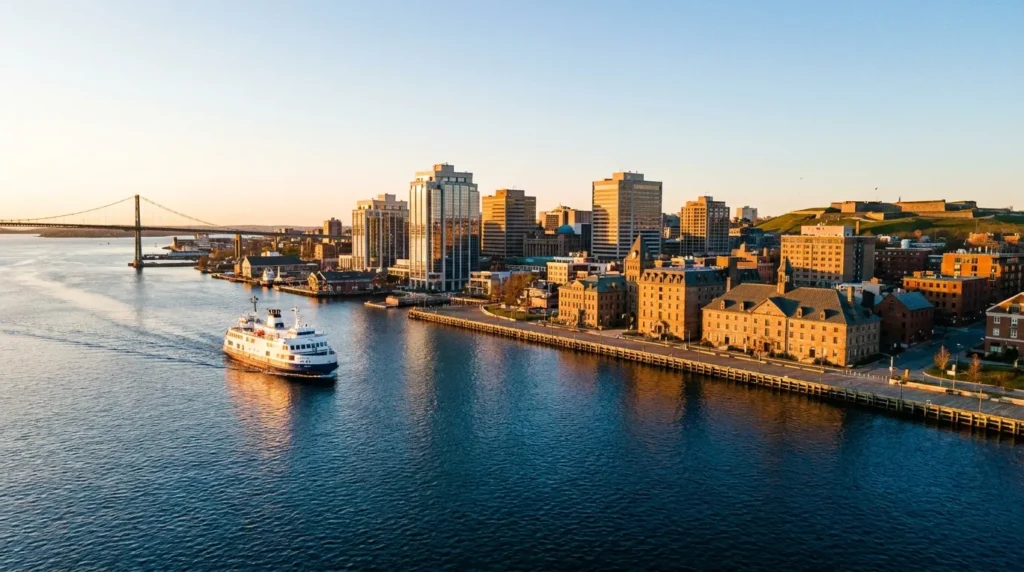
The Halifax Ferry, departing from Cable Wharf, crosses the harbour in 12 minutes to Alderney Landing in Dartmouth. It is part of the regular transit system and operates like a water bus. Halifax Transit buses cover the entire city, with terminals at Scotia Square and near the waterfront, and cross the Macdonald and MacKay bridges to Dartmouth.

Halifax Stanfield International Airport (YHZ) is about 35 minutes away via Highway 102. The MetroX 320 bus departs from downtown directly to the airport. Via Rail (Halifax station) also serves the city, with the Ocean train connecting to Montreal once daily. For travel to Cape Breton or New Brunswick, Highway 102 is the main route.

15 min
Avg commute
92
Walkability
Airports
  • YHZ — Halifax Stanfield International Airport (approximately 19 miles away)
  • Bike infrastructure

What the climate is like living in Downtown Halifax

Downtown Halifax sits on the peninsula and shares the same Atlantic oceanic climate: cool summers with fog, and rainy, snowy winters.

Summer downtown is cool and busy with visitors. From June to September, highs range between 21°C and 24°C, with frequent coastal fog and steady breezes. The waterfront boardwalk energizes summer evenings. Air conditioning is rarely needed.

Winter is variable and windy. From December to March, highs stay between -1°C and 3°C, with the maritime influence softening extremes. The city receives about 150 cm of snow annually, though rain and ice are equally common. Nor'easters can bring the city to a standstill.

Apartments downtown are mostly newer condominiums or converted historic houses, heated by electric baseboard, heat pump, or oil. The winds demand good weatherproofing. A quality waterproof outer layer matters more than an extreme-cold parka. Walking through the downtown core is pleasant throughout the year.

Sunny days / year285 days
Avg high (°F)
  • 47°J
  • 46°F
  • 47°M
  • 53°A
  • 65°M
  • 72°J
  • 77°J
  • 77°A
  • 73°S
  • 67°O
  • 60°N
  • 55°D
Avg low (°F)
  • 12°J
  • F
  • 13°M
  • 28°A
  • 34°M
  • 44°J
  • 54°J
  • 55°A
  • 47°S
  • 39°O
  • 27°N
  • 19°D
Rainfall (")
  • 6"J
  • 5"F
  • 5"M
  • 6"A
  • 4"M
  • 5"J
  • 5"J
  • 5"A
  • 5"S
  • 4"O
  • 5"N
  • 6"D

Culture in Downtown Halifax: pubs, museums, and a festival calendar

The centre thrives with pubs, jazz festivals, theatre at the Neptune, and maritime museums. Live music plays every day in at least one bar.

Halifax's cultural life is centred in Downtown. Pubs such as the Lower Deck, the Old Triangle, Henry House, and the Split Crow feature live Celtic music nearly every day. Argyle Street and Grafton Street form the heart of the nightlife, with bars, restaurants, and clubs. The International Jazz Festival in July, the Atlantic Film Festival, and Halifax Pop Explosion animate the calendar.

Maritime history dominates the museums. The Maritime Museum of the Atlantic, on the waterfront, holds Titanic artefacts and exhibits related to the 1917 Halifax Explosion. The Halifax Citadel, at the top of the hill, is a national historic site with guards in Scottish uniform and a cannon fired every day at noon. Pier 21, the former immigration gateway, is now the Canadian Museum of Immigration.

Neptune Theatre presents productions throughout the year. The Halifax Public Library, a modern glass building near Spring Garden Road, has become a community gathering point. Restaurants such as The Bicycle Thief, Salty's, Stories at the Halliburton, and Café Chianti define the dining scene, with a strong presence of seafood and contemporary cuisine.

10
Major museums
Notable dishes
  • Donair (official sandwich)
  • Lobster roll
  • Halifax-style fish and chips
  • Fried Digby scallops
  • Solomon Gundy
  • +3 more
Annual events
  • Royal Nova Scotia International Tattoo
  • Halifax International Busker Festival
  • Halifax Jazz Festival
  • Nocturne: Art at Night
  • Atlantic Film Festival (FIN)
  • +3 more

Downtown Halifax offers a boardwalk, a citadel, and waterfront university life

Halifax Waterfront, Citadel Hill, and Spring Garden Road anchor daily life in the downtown core. Seafood restaurants, museums, and Dalhousie University keep the area active year-round.

The Halifax Waterfront Boardwalk stretches more than three kilometers between Casino Nova Scotia and Pier 21, passing the Halifax Seaport Farmers' Market, lobster roll food trucks, and the museum ship CSS Acadia. On summer Sundays, virtually the entire city gathers there to walk along the water.

Up the hill, Halifax Citadel National Historic Site offers panoramic views and the daily noon cannon firing. Spring Garden Road, home to Halifax Central Library at 5440, concentrates cafes, bookshops, and the entrance to Halifax Public Gardens, a Victorian garden with a lake and bandstand.

Cultural life centers on the Art Gallery of Nova Scotia, Neptune Theatre on Argyle Street, and the Discovery Centre, an interactive science museum. The Canadian Museum of Immigration at Pier 21, the entry point for more than one million immigrants between 1928 and 1971, is a meaningful stop for anyone arriving today.

  1. 1["Halifax Waterfront Boardwalk"
  2. 2"Halifax Citadel National Historic Site"
  3. 3"Maritime Museum of the Atlantic"
  4. 4"Art Gallery of Nova Scotia"
  5. 5"Old Burying Ground"
  6. 6"Halifax Public Gardens"
Nightlife7.0 / 10
Parks & green spaces
  • ["Halifax Public Gardens"
  • "Citadel Hill grounds"
  • "Cornwallis Park"
  • "Victoria Park"
  • "Grand Parade"]

Latest posts

Straight from the blog

There are no posts specifically about Downtown Halifax yet. In the meantime, check out our latest posts.