Visto n' Visa
Blog
Notícias e artigos
Destinations
Careers
Immigrants

Want to live and work in St. Albert?

Personalized immigration plan with eligible visas, costs, and next steps for your goal!

If you are not eligible, you will know exactly why and what to do to improve your approval chances.

Save up to 12 hours in meetings

No pointless assessments.

Save up to 90%

Save money on vague or unfocused consultations

Avoid Fraud and Mistakes

One mistake can cost you your visa

Total Impartiality

Zero commercial bias

Decide with peace of mind

No toxic urgency

Fast and Accurate

Answers in minutes, no guesswork

St. Albert Demographics: upper-middle class, family-oriented, historic Francophone presence

Predominantly white population with high income. Historic Francophone community, Métis presence, and a growing Filipino and Indian immigrant community.

St. Albert has the sociodemographic profile of a prosperous suburb. The median income is among the highest for Canadian cities of similar size, with a strong presence of professionals who work in Edmonton. The majority of the population is white, with roots in earlier waves of immigration (British, French, German, Ukrainian, and Dutch).

The historic Francophone community left its mark: there is Académie Saint-Marguerite-Bourgeoys and other French-language schools, and institutions such as the Cité Francophone d'Edmonton have ties to St. Albert. The Métis presence is also historic and visible, with families rooted in the region for generations, and Michif Cultural Connections promotes Métis culture locally.

In recent years, the presence of Filipino, Indian, Chinese, and Nigerian immigrants has grown, though on a smaller scale than in Edmonton. Families with children predominate, and the age distribution is concentrated between 30 and 60. The Brazilian community is minimal, generally linked to professionals working in Edmonton.

Languages spoken
  • English
  • French
  • Tagalog
  • Punjabi
  • Mandarin
  • +1 more
Main religions
  • Christian (Catholic, Protestant, Evangelical)
  • No religion (approximately 30%)
  • Sikh
  • Hindu
  • Muslim

Cost of living in St. Albert: more expensive than Edmonton, with higher income to offset

Real estate and rent above Edmonton's average. No PST. Family-oriented neighborhoods drive costs up.

Buying a home in St. Albert costs more than the Edmonton average, reflecting higher incomes and demand for neighborhoods with top-ranked schools and safety ratings. A family home with four to five bedrooms and a double garage ranges between 600,000 and 900,000 Canadian dollars. Custom homes in neighborhoods like Erin Ridge North or Riverside can reach 1 to 1.5 million.

Rent for a family home ranges between 2,500 and 3,800 dollars. Apartments and townhouses are less common; when available, rent falls between 1,500 and 2,500. Alberta charges no PST, only the federal 5% GST. Grocery chains such as Save-On-Foods, Sobeys, Real Canadian Superstore, and Costco are comparable to Edmonton, with some more upscale options reflecting the affluent clientele.

The overall cost of living resembles that of a desirable Edmonton neighborhood, with home purchase and rental prices slightly above. In return, the average income is higher, and those who work in Edmonton may save on commuting if their workplace is in the west or north of the capital. Heating bills in winter add up in large homes.

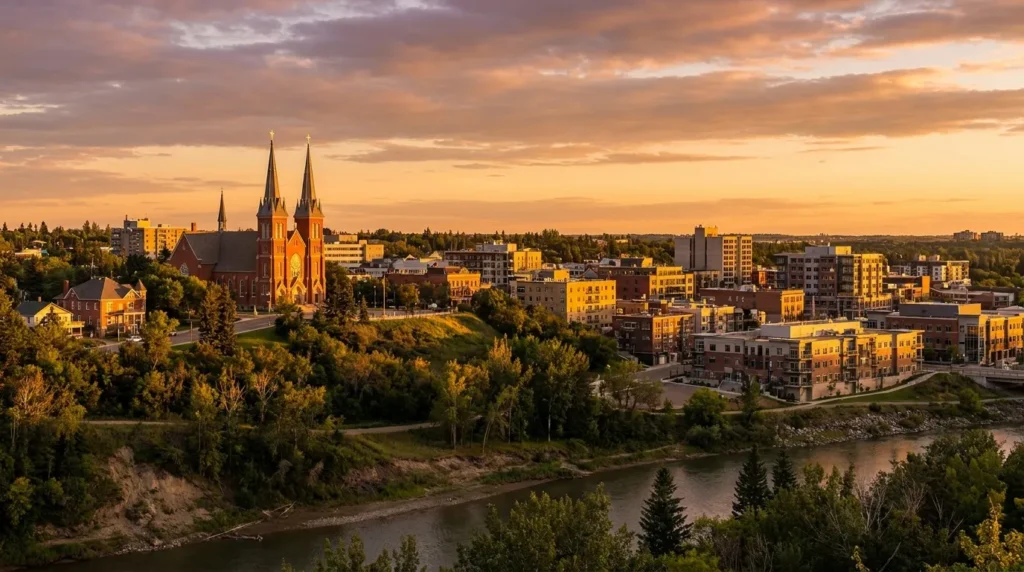
St. Albert

Housing in St. Albert: large family homes in planned neighborhoods along the Sturgeon River

Neighborhoods like Erin Ridge, Kingswood, Deer Ridge, Riverside, and North Ridge are the most sought after. Large homes with yards predominate.

St. Albert is dominated by single-family homes with three to five bedrooms, double garages, finished upper floors, and yards. Newer neighborhoods such as Erin Ridge North, Riverside, and Jensen Lakes are located in the north of the city, with modern homes priced between 600,000 and 900,000 dollars. Jensen Lakes features development around an artificial lake, attracting families.

Established neighborhoods such as Kingswood, Deer Ridge, Akinsdale, Forest Lawn, Mission, and Pineview have homes built from the 1970s to 2000s, typically on tree-lined streets with a settled community feel. Prices range from 450,000 to 750,000. Townhouses and condominiums are concentrated around downtown St. Albert (Grandin) and in newer developments, priced between 300,000 and 500,000.

The rental market is tighter than Edmonton's, with fewer options, particularly for houses. Finding a property can take several weeks. Landlords request proof of income, references, and a credit check. Recent arrivals may need a co-signer or may be asked to pay in advance. Unfurnished rentals are the norm, and leases are typically one year.

Recommended neighborhoods
  • Erin Ridge North (north, new)
  • Riverside (north, near Sturgeon River)
  • Jensen Lakes (north, artificial lake)
  • Kingswood (established, upscale)
  • Deer Ridge (south, established)
  • +2 more

Job market in St. Albert: most residents commute to Edmonton, local jobs in retail, healthcare, and schools

The majority of working-age residents commute to Edmonton. Locally, retail, schools, and professional services employ the most workers.

As an affluent suburb, St. Albert has a relatively small local economy. The majority of working-age residents commute to Edmonton via St. Albert Trail or Anthony Henday. Engineers, healthcare professionals, finance workers, lawyers, provincial public sector executives, and corporate managers make up a large portion of the workforce.

Locally, retail is the largest employment sector, with St. Albert Trail concentrating stores and supermarkets, and developments like Riel Park driving new commercial activity. Walmart, Costco, Save-On-Foods, Sobeys, Canadian Tire, Home Depot, and dozens of independent stores operate in the city. Schools (St. Albert Public Schools, Greater St. Albert Catholic Schools) and the City of St. Albert are also major employers.

Local healthcare is anchored by Sturgeon Community Hospital, part of Alberta Health Services. For recently arrived immigrants, positions in retail, hospitality, and personal services in St. Albert often serve as accessible entry points while seeking better opportunities in Edmonton. Professional services (offices, law, accounting) cater to the affluent local population.

Dominant sectors
  • Edmonton commuters
  • Retail
  • Healthcare
  • Education
  • Professional services
  • +2 more
Major employers
  • City of St. Albert
  • Sturgeon Community Hospital (AHS)
  • St. Albert Public Schools
  • Greater St. Albert Catholic Schools
  • Walmart and Costco
  • +2 more

Education in St. Albert: schools with excellent reputations, French and Catholic options

The public school system is one of the best in the Edmonton metropolitan area. French immersion programs and Francophone schools available. Post-secondary education in Edmonton.

Resident children are entitled to free public education from kindergarten through high school. The school system is among the best-ranked in the Edmonton metropolitan area, divided between St. Albert Public Schools (secular) and Greater St. Albert Catholic Schools (Catholic, also publicly funded). The Conseil scolaire Centre-Nord also operates fully Francophone schools, including École Father Jan and Académie Saint-Marguerite-Bourgeoys.

French immersion programs are offered at several schools (Sir Alexander Mackenzie, Albert Lacombe, and others), reflecting the city's Francophone heritage. Schools such as Bellerose Composite High School, St. Albert Catholic High School, and Paul Kane High School have solid reputations and historically strong scores in the Fraser Institute rankings.

For post-secondary education, there is no university or college in St. Albert. Students attend the University of Alberta, MacEwan University, NAIT, Concordia University of Edmonton, or King's University, all in Edmonton, typically commuting daily or moving closer to campus during their studies.

Literacy99.0%
Tertiary education32.9%
520
PISA score (avg)
$13,500
Private school
per year
Notable universities
  • University of Alberta
  • MacEwan University
  • Concordia University of Edmonton
  • NAIT (Northern Alberta Institute of Technology)
  • King's University

Healthcare in St. Albert: Sturgeon Community Hospital locally and easy access to Edmonton

Alberta Health Care covers residents. Sturgeon Community Hospital handles urgent cases and surgeries. Complex cases are referred to Edmonton.

As in all of Alberta, the system is public and funded through the Alberta Health Care Insurance Plan. Permanent residents and citizens register to receive a health card, which covers consultations, tests, hospitalizations, and surgeries at no direct cost. New residents from other provinces face a waiting period of up to three months.

Sturgeon Community Hospital, in St. Albert, provides 24-hour emergency services, maternity care, some surgical services, and outpatient care. For highly specialized cases (transplants, advanced oncology, complex cardiac surgery, neurosurgery), patients are transferred to larger Edmonton hospitals, primarily the University of Alberta Hospital, the Royal Alexandra, and the Stollery Children's Hospital.

Finding a family doctor can take months, as throughout Canada. Walk-in clinics handle non-urgent cases. Dentistry, physiotherapy, and medications are not covered by the public plan; those with formal employment typically receive supplemental insurance through their employer. Immigrants during the waiting period may purchase transitional insurance.

Healthcare index72.0 / 100
  • Life expectancyyears at birth
    81.6yrs
  • Doctors per 1kpracticing physicians
    2.8
  • Health spendper capita, per year
    $6,187
  • Public systemoverall quality rating
    Good

Safety in St. Albert: one of the safest cities in Canada

Violent crime is rare, residential neighborhoods are peaceful. The city consistently appears among the safest in national rankings.

St. Albert regularly appears among the safest cities in Canada in national rankings. The combination of high income, family-oriented profile, quality schools, and low population density results in low crime rates. Violent crimes involving weapons are rare compared to any American city of similar size.

The most common issues are vehicle theft (Alberta has elevated rates overall), break-ins to vehicles in commercial parking lots, and theft. Drug-related crime exists, but on a much smaller scale than in Edmonton. The city is policed by the RCMP (St. Albert RCMP Detachment), with units dedicated to community engagement and prevention.

Virtually every neighborhood is considered safe. Erin Ridge North, Riverside, Jensen Lakes, Kingswood, Deer Ridge, and Mission are among the most peaceful. Basic recommendations are the same as for any Canadian city: avoid leaving visible items in the car, keep the garage closed at night, and consider a security system. Children walk to school and ride bikes through the parks without significant concerns.

2.0
Homicides per 100k
per year
Safety index
70.0
Crime index
30.0
Safer neighborhoods
  • Erin Ridge North
  • North Ridge
  • Lacombe Park
  • Akinsdale
  • Heritage Lakes
  • Kingswood
Areas to avoid
  • commercial parking lots along St. Albert Trail at night
  • industrial areas of Riel Business Park outside business hours

Transportation in St. Albert: bus service to Edmonton, car essential locally

StAT (St. Albert Transit) operates local buses and express routes to downtown Edmonton. A car is necessary for most of the city. YEG airport is 45 minutes away.

St. Albert operates St. Albert Transit (StAT), with several local routes and express lines running directly to downtown Edmonton and the University of Alberta campus during peak hours. It is one of the better public transit options among Edmonton suburbs, widely used by those who work downtown. A monthly pass costs around 110 dollars.

For anything beyond the St. Albert-Edmonton corridor, a car is practically essential. The city is designed for automobiles, with wide streets and ample parking. St. Albert Trail is the main artery running through the city, and Anthony Henday (Highway 216) provides access to the rest of the metropolitan area without entering Edmonton's traffic.

Edmonton International Airport (YEG) is approximately 45 minutes by car to the south. It offers direct flights to several Canadian cities, the United States, and some international destinations. Jasper National Park is approximately 4 hours to the west via the Yellowhead Highway (Highway 16). In winter, appropriate tires and extra travel time are essential for all trips.

28 min
Avg commute
35
Walkability
Airports
  • YEG — Edmonton International Airport (approximately 45 km southeast)
  • Bike infrastructure

What the climate is like living in St. Albert

St. Albert follows Edmonton's climate pattern: long, frigid winters and short, bright summers, with abundant sunshine throughout the year.

Summer in St. Albert is short and luminous. From June to August, highs range between 72 and 77 degrees Fahrenheit, with low humidity and very long days. Parks along the Sturgeon River fill up and daily life moves almost entirely outdoors. Air conditioning is optional.

Winter is the annual challenge. From November to March, highs hover around 18 degrees Fahrenheit, and lows below -13 degrees Fahrenheit occur regularly. Snow covers the ground for five months. The dry cold is manageable with layered clothing, but requires genuine preparation.

Homes in St. Albert are modern suburban builds with gas heating, heated double garages, and solid insulation. The city consistently ranks among the best places to raise children in Canada, with quiet neighborhoods and excellent schools. A full winter is simply part of the routine.

Sunny days / year322 days
Avg high (°F)
  • 37°J
  • 37°F
  • 58°M
  • 68°A
  • 76°M
  • 82°J
  • 85°J
  • 86°A
  • 78°S
  • 67°O
  • 44°N
  • 37°D
Avg low (°F)
  • -22°J
  • -26°F
  • -6°M
  • 15°A
  • 29°M
  • 41°J
  • 45°J
  • 42°A
  • 33°S
  • 15°O
  • N
  • -11°D
Rainfall (")
  • 1"J
  • 1"F
  • 1"M
  • 1"A
  • 3"M
  • 5"J
  • 4"J
  • 2"A
  • 2"S
  • 1"O
  • 1"N
  • 1"D

Culture in St. Albert: city of the arts, festivals, and strong community identity

Arden Theatre, Servus Place, Jubilee Park, and dozens of seasonal festivals. The International Children's Festival of the Arts is the largest annual event.

St. Albert has a reputation as an arts city in Alberta. The Arden Theatre, in the downtown area, hosts plays, classical music, jazz, dance, and children's shows. Servus Place is the city's sports and recreation center, with a pool, courts, gymnasium, skating rinks, and fitness facilities. Jubilee Park, along the Sturgeon River, is where many community events take place.

The International Children's Festival of the Arts, held in June, is the most recognized cultural event, with programming for children and families that draws visitors from across the Edmonton region. Other events include the Rainmaker Rodeo (May), the Kinsmen RibFest, the St. Albert Botanic Park Open Garden Days, and Saturday farmers markets during summer (the St. Albert Farmers' Market is one of the largest in western Canada).

Outdoor life is a large part of the local identity. The Red Willow Trail system follows the Sturgeon River and connects virtually every neighborhood, ideal for running, cycling, or walking dogs. St. Albert has active leagues for minor hockey, soccer, ringette, and curling. For more active nightlife, residents head to Edmonton.

3
Major museums
Notable dishes
  • Alberta beef
  • Ukrainian perogies
  • bison burger
  • bannock and Métis cuisine (strong local Métis heritage)
  • Saskatoon berry pie
  • +3 more
Annual events
  • Rainmaker Rodeo
  • International Children's Festival of the Arts
  • St. Albert Farmers' Market (one of the largest outdoor markets in western Canada)
  • Kinsmen Triple Crown of Heritage events
  • Canada Day Celebrations at Lions Park
  • +2 more

What to do in St. Albert on weekdays and weekends

St. Albert blends Francophone missionary history with outdoor life along the Sturgeon River. The city is compact and works well for families seeking a quiet routine close to Edmonton.

The historic and cultural heart of the city is Mission Hill, home to Father Lacombe Chapel (the oldest standing structure in Alberta) and the St. Albert Heritage Museum. Newcomers typically start there to understand the Métis and Francophone origins of the place before exploring the rest.

For everyday life, St. Albert Place brings together a library, gallery, and the Arden Theatre, which hosts music and theater seasons throughout the year. Servus Credit Union Place offers an indoor pool, gym, and skating rink used year-round given the long winters. In summer, the St. Albert Farmers Market draws more than 250 vendors and is considered one of the largest in western Canada.

On weekends, social life shifts to the Red Willow Trail, a trail network following the Sturgeon River that connects neighborhoods such as Akinsdale, Grandin, and Erin Ridge. Families mix hiking, cycling, and cross-country skiing depending on the season, and the parks feature well-maintained public barbecue areas and playgrounds.

  1. 1["Father Lacombe Chapel (Provincial Historic Site
  2. 2oldest standing structure in Alberta)"
  3. 3"Musée Héritage Museum"
  4. 4"Arden Theatre"
  5. 5"St. Albert Place (architecture by Douglas Cardinal)"
  6. 6"St. Albert Farmers Market"
Nightlife2.0 / 10
Parks & green spaces
  • ["Red Willow Park (trail system along the Sturgeon River)"
  • "Lions Park"
  • "Lacombe Lake Park"
  • "Big Lake (Lois Hole Centennial Provincial Park)"
  • "Kingswood Park"
  • +1 more

Latest posts

Straight from the blog

There are no posts specifically about St. Albert yet. In the meantime, check out our latest posts.