Visto n' Visa
Blog
Notícias e artigos
Destinations
Careers
Immigrants

Want to live and work in Medicine Hat?

Personalized immigration plan with eligible visas, costs, and next steps for your goal!

If you are not eligible, you will know exactly why and what to do to improve your approval chances.

Save up to 12 hours in meetings

No pointless assessments.

Save up to 90%

Save money on vague or unfocused consultations

Avoid Fraud and Mistakes

One mistake can cost you your visa

Total Impartiality

Zero commercial bias

Decide with peace of mind

No toxic urgency

Fast and Accurate

Answers in minutes, no guesswork

Demographics of Medicine Hat: traditional city, with Filipino and Ukrainian presence

More homogeneous population than larger Alberta cities. Filipinos, Ukrainians, and Indians form the main immigrant communities. The Hutterite community has a historical presence.

Medicine Hat has a more traditional sociodemographic profile than Calgary or Edmonton. The population is largely white, with roots in older immigration waves (British, German, Ukrainian, and Dutch). Recent immigration has grown, though on a smaller scale: Filipinos form the largest immigrant community, present in healthcare, retail, and personal care services.

Indians, Chinese, Nigerians, and Syrian and Ukrainian refugees round out the recent immigration picture. The Hutterite communities (an Anabaptist Christian group living in communal agricultural colonies) have a historical presence in the region and visit the city for commerce. The Brazilian community is minimal, with a few scattered families.

English is completely dominant. Other languages (Tagalog, Punjabi, Ukrainian, Hutterite German) appear in specific communities. The population has a slightly higher average age than Calgary, reflecting the small-city profile where many older residents retire due to the lower cost of living.

Languages spoken
  • English
  • Tagalog
  • Ukrainian
  • Punjabi
  • German (Hutterites)
Main religions
  • Christian (Catholic, Protestant, Mormon/LDS, Anabaptist)
  • No religion (approximately 35%)
  • Sikh
  • Hindu
  • Muslim

Cost of living in Medicine Hat: among the lowest of Canadian cities

Rent and housing among the most affordable in western Canada. No PST. Energy rates historically subsidized by the city.

Medicine Hat is one of the least expensive cities to live in across Canada. A one-bedroom apartment costs between 900 and 1,200 Canadian dollars. A two-bedroom runs between 1,100 and 1,400. A family home with three or four bedrooms rents for between 1,500 and 2,500. Purchasing a family home for under 400,000 dollars is entirely realistic. Well-maintained four-bedroom homes can be found in the 400,000 to 500,000 range.

Alberta has no PST, only the federal GST of 5%. Grocery stores such as Real Canadian Superstore, Save-On-Foods, Costco, and Walmart are comparable to other mid-size Alberta cities. A meal at a popular chain costs 12 to 16 dollars; a full meal at a neighborhood restaurant runs between 25 and 40 dollars.

A historic advantage of Medicine Hat is its own municipal electricity and natural gas service (Medicine Hat Utility), which typically offers competitive rates. Winter heating bills are significant but generally lower than in other Alberta cities. On the other hand, salaries tend to be lower: administrative positions pay less than in Calgary, and skilled professionals find fewer openings.

Medicine Hat

Housing in Medicine Hat: established and new neighborhoods at realistic prices

A quiet market, without the pressure of Calgary or Edmonton. A family home with a yard is fully accessible to the middle class.

The city is divided into several well-defined neighborhoods. To the west, newer neighborhoods such as Hamptons, Cimarron, Saamis Heights, and Southlands Estates feature modern family homes with three to five bedrooms, double garages, and yards. Prices range from 350,000 to 550,000 to purchase. Family home rentals run between 2,000 and 2,800.

Older neighborhoods such as Crescent Heights, Ross Glen, Norwood, and Riverside feature homes from the 1970s to 1990s, at lower prices (between 250,000 and 400,000), with mature trees and quiet streets. The downtown (Hill area) has some historic homes as well as modest apartments. Townhouses and condominiums are a minority but do exist, priced between 200,000 and 350,000.

The rental market is straightforward, with ample supply. Finding a home in two to three weeks is normal. Landlords ask for proof of income, references, and a credit check. Recent arrivals typically find more flexibility than in large cities, but may need a co-signer or advance payment.

Recommended neighborhoods
  • Hamptons (west, new)
  • Cimarron (west, families)
  • Saamis Heights (west, new)
  • Southlands Estates (south, upscale)
  • Crescent Heights (established, south)
  • +2 more

Job market in Medicine Hat: natural gas, agriculture, health, and government

Historic gas sector, strong agriculture, Medicine Hat Regional Hospital, Medicine Hat College, and municipal government employ the majority. Small and traditional market.

Medicine Hat has one of the most diversified economies for cities of its size in Alberta, though on a small scale. The natural gas sector was historically the main driver (the city had gas so cheap it earned the nickname Gas City in the 19th century), and it remains present with Methanex (methanol plant), CF Industries (fertilizers), and some exploration operations.

Agriculture is strong: wheat, barley, corn, cattle, potatoes, and dairy drive the surrounding area. Processing plants linked to meat, dairy, and grain employ local residents. Medicine Hat Brick & Tile (one of the largest brick factories in Canada) and ceramic producers round out the light industry sector.

The public sector carries weight: Medicine Hat Regional Hospital, Medicine Hat College, the City of Medicine Hat (one of the largest local employers because of its own utilities), Cypress Hills RCMP, and schools. Retail covers the rest, with the city serving as a regional hub for southeastern Alberta and western Saskatchewan. The labor market is small and requires patience for skilled professionals.

Dominant sectors
  • Natural gas and energy
  • Agriculture and food processing
  • Chemical industry (methanol, fertilizers)
  • Healthcare
  • Municipal government
  • +2 more
Major employers
  • City of Medicine Hat
  • Medicine Hat Regional Hospital (AHS)
  • Medicine Hat College
  • Methanex Canada
  • CF Industries Canada
  • +2 more

Education in Medicine Hat: public school system and Medicine Hat College

Public and Catholic schools serve residents. Medicine Hat College offers short programs and degrees in partnership with larger universities.

Resident children have the right to free public schooling from kindergarten through high school. The system is divided between Medicine Hat Public Schools (secular) and Medicine Hat Catholic Board of Education (Catholic, also public). French-language programs are available in some schools. Neighborhoods such as Hamptons, Cimarron, and Southlands Estates tend to have relatively new and well-regarded schools.

Medicine Hat College is the main local post-secondary institution. It offers technical diplomas and short programs in areas such as nursing, paramedicine, business administration, welding, mechanics, hospitality, and technology. It also offers degree programs in partnership with larger universities (University of Lethbridge, University of Calgary), allowing students to complete part of their studies locally and finish at larger centers.

For advanced programs (medicine, advanced engineering, research), residents travel to Calgary (3 hours) or Edmonton (5 to 6 hours), usually relocating for the duration of the program. Athabasca University, with online degrees, is a popular option among professionals working in the city who want to expand their credentials.

Notable universities
  • Medicine Hat College

Healthcare in Medicine Hat: regional hospital serves southeastern Alberta

Alberta Health Care covers residents. Medicine Hat Regional Hospital serves the city and region. Complex cases are referred to Calgary.

As in all of Alberta, the system is public and funded by the Alberta Health Care Insurance Plan. Permanent residents and Canadian citizens register to receive the health card, which covers consultations, tests, hospitalizations, and surgeries at no direct cost. There is a waiting period of up to three months for new residents arriving from other provinces.

Medicine Hat Regional Hospital serves the city and the southeastern Alberta region, with 24-hour emergency, maternity, ICU, and surgical services. For highly specialized cases (transplants, complex cardiac surgery, pediatric oncology), patients are transferred to Calgary, primarily Foothills Medical Centre.

Finding a family doctor can take months, as throughout Canada, but the situation is generally less critical than in Grande Prairie or Fort McMurray. Walk-in clinics handle non-urgent cases. Dentistry, physiotherapy, and medications are not covered publicly; those with formal employment typically have supplemental insurance through their employer. Immigrants in a waiting period can purchase bridge insurance.

Healthcare index69.0 / 100
  • Life expectancyyears at birth
    81.6yrs
  • Doctors per 1kpracticing physicians
    2.8
  • Health spendper capita, per year
    $6,187
  • Public systemoverall quality rating
    Good

Safety in Medicine Hat: one of the safest cities in Alberta

Violent crime is rare, residential neighborhoods are quiet. Vehicle theft and break-ins are the most common incidents.

Medicine Hat frequently appears among the safest cities in Alberta in annual statistics. Residential neighborhoods are quiet, with children riding bikes through parks and a well-defined family atmosphere. The combination of a small city, traditional profile, and solid municipal management results in low crime rates.

Violent crimes involving weapons are rare compared to American cities of similar size. The most common issues are vehicle theft (Alberta has generally high rates), vehicle break-ins in parking lots, and some drug-related crimes, particularly in areas near the downtown at night. The city has its own police force (Medicine Hat Police Service).

Neighborhoods such as Hamptons, Cimarron, Saamis Heights, Southlands Estates, Crescent Heights, and Ross Glen are considered especially safe. General advice for new residents is the same as for any Canadian city: do not leave valuables visible in the car, keep the garage closed at night, install a home alarm. In general, the sense of safety is so high that many residents leave their doors unlocked during the day.

2.0
Homicides per 100k
per year
Safety index
50.0
Crime index
50.0
Safer neighborhoods
  • Ranchlands
  • Southridge
  • Saamis Heights
  • Hamptons
  • Cimarron
  • Crescent Heights
Areas to avoid
  • parts of downtown and North Flats at night
  • industrial areas along Highway 1 outside business hours
  • Riverside (some streets) late at night

Transportation in Medicine Hat: small city, car essential, small local airport

Basic bus system covers the main neighborhoods. A car is practically mandatory. For flights, most residents drive to Calgary, three hours away.

Medicine Hat operates Medicine Hat Transit, a modest bus system that covers the main neighborhoods. It is sufficient for Medicine Hat College students and downtown residents, but frequency is low, especially on weekends. A monthly pass costs around 75 dollars.

For the rest of the city and any destination outside it, a car is essential. The main roads are the Trans-Canada Highway (Highway 1, linking Calgary to Winnipeg) and Highway 3, which leads to Lethbridge and southern Alberta. Parking is free in almost all areas of the city.

Medicine Hat Regional Airport has direct flights only to Calgary. For any other destination, most residents drive to Calgary International Airport, three hours away along the Trans-Canada. Under normal conditions it is an easy drive, but in winter, snowstorms and ice can close the road for hours.

15 min
Avg commute
35
Walkability
Airports
  • YXH — Medicine Hat Regional Airport
  • Bike infrastructure

What the Climate Is Like Living in Medicine Hat

Medicine Hat is one of the sunniest cities in Canada. The semi-arid climate brings hot, dry summers and winters moderated by chinook winds.

Summers in Medicine Hat are the warmest on the prairies. From June through August, highs range between 27°C and 32°C, with very low humidity and over 340 hours of sunshine in July alone. Hailstorms can develop in the afternoons. Air conditioning is essential in the home.

Winters are cold but not extreme compared to northern regions. Highs hover around -4°C and lows frequently reach -20°C, though chinook winds bring unexpectedly warm days several times a year. Snow falls but rarely accumulates for long. It is one of the sunniest winters in Canada.

Homes in Medicine Hat rely on natural gas — the city is nicknamed Gas City for its local reserves — and come equipped with robust heating. Residents benefit from a low cost of living, nearby vineyards, and an outdoor lifestyle year-round. Clothing should account for hot summers and dry winters.

Sunny days / year330 days
Avg high (°F)
  • 46°J
  • 48°F
  • 63°M
  • 75°A
  • 84°M
  • 92°J
  • 97°J
  • 96°A
  • 89°S
  • 78°O
  • 56°N
  • 47°D
Avg low (°F)
  • -7°J
  • -13°F
  • M
  • 17°A
  • 30°M
  • 43°J
  • 50°J
  • 45°A
  • 34°S
  • 14°O
  • N
  • -3°D
Rainfall (")
  • 1"J
  • 1"F
  • 0"M
  • 1"A
  • 1"M
  • 2"J
  • 1"J
  • 1"A
  • 1"S
  • 1"O
  • 1"N
  • 1"D

Culture in Medicine Hat: traditional small city, outdoor life, regional festivals

Esplanade Arts & Heritage Centre, Medalta Pottery District, Cypress Hills nearby, and seasonal festivals mark the local cultural calendar.

Cultural life in Medicine Hat has the feel of a traditional small Canadian city. The Esplanade Arts & Heritage Centre, in the downtown area, houses a theater, local history museum, and art galleries. The Medalta Pottery District, in the former brick and ceramic industrial district (Historic Clay District), has become a cultural center with a museum, art studios, and events.

Seasonal festivals mark the year: Medicine Hat Exhibition and Stampede (July), JazzFest, Medicine Hat Folk Music Festival, Hat Days, and summer farmers' markets. Co-op Place (hockey arena) hosts the Medicine Hat Tigers (WHL, junior league) and concerts. In January, events such as the Spectrum Festival animate the arts scene.

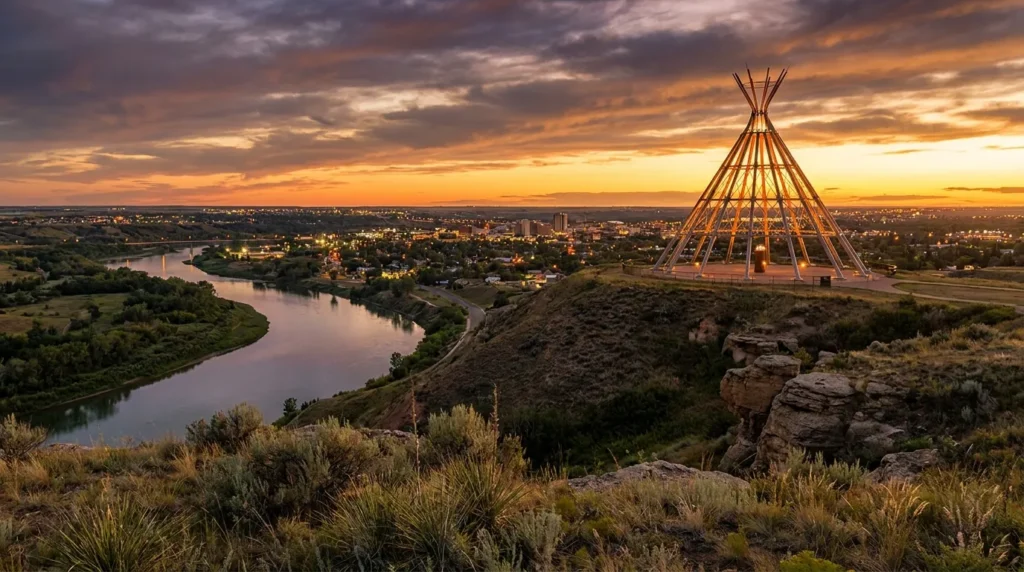
Outdoor life is part of the local identity. The South Saskatchewan River runs through the city, with trails, parks, and the famous Tepee (a giant metal structure visible from the highway, a city landmark). Cypress Hills Interprovincial Park, an hour to the south, is a frequent destination for camping, hiking, and fishing. Police Point Park, within the city, is a natural area with a good trail network.

3
Major museums
Notable dishes
  • Alberta beef
  • bison burger
  • Saskatoon berry pie
  • perogies
  • bannock
  • +3 more
Annual events
  • Medicine Hat Exhibition and Stampede
  • JazzFest Medicine Hat
  • Spectrum Festival (arts)
  • Canada Day Celebration
  • Medicine Hat Folk Music Club concerts
  • +2 more

Medicine Hat Attractions: Prairie, Natural Gas, and Frontier Art

Medicine Hat combines Alberta prairie landscapes, local museums, and the ceramic tradition of Medalta Potteries. Cultural life operates on a small scale, with seasonal events and trails along the South Saskatchewan River.

The tourism hub is the Historic Clay District, where Medalta Potteries has been transformed into a living museum of industrial ceramics. The Esplanade Arts and Heritage Centre anchors the city's theater programming, exhibitions, and local archives. The Saamis Tepee tower, the largest tipi structure in the world, marks the city's entrance along the Trans-Canada Highway.

Residents use the South Saskatchewan River as the backbone of leisure. Trails at Echo Dale Regional Park and Strathcona Island Park provide access to freshwater beaches, picnic areas, and summer canoeing. In winter, the Family Leisure Centre skating complex becomes a gathering point for families.

The dining scene is small but consistent, with cafes in the historic downtown around 2nd Street SE and craft breweries such as Travois Ale Works. Anchor events include the Medicine Hat Exhibition and Stampede in July and the JazzFest at the end of winter, both offering family programming and affordable admission.

  1. 1["Esplanade Arts and Heritage Centre"
  2. 2"Medalta Potteries (Historic Clay District)"
  3. 3"Saamis Tepee (world's largest tipi)"
  4. 4"Police Point Park"
  5. 5"Echo Dale Regional Park"
  6. 6"Medicine Hat Public Library and Cultural Centre"
Nightlife2.0 / 10
Parks & green spaces
  • ["Police Point Park"
  • "Echo Dale Regional Park"
  • "Strathcona Island Park"
  • "Kin Coulee Park"
  • "Riverside Veterans Memorial Park"
  • +1 more

Latest posts

Straight from the blog

There are no posts specifically about Medicine Hat yet. In the meantime, check out our latest posts.