Visto n' Visa
Blog
Notícias e artigos
Destinations
Careers
Immigrants

Want to live and work in Grande Prairie?

Personalized immigration plan with eligible visas, costs, and next steps for your goal!

If you are not eligible, you will know exactly why and what to do to improve your approval chances.

Save up to 12 hours in meetings

No pointless assessments.

Save up to 90%

Save money on vague or unfocused consultations

Avoid Fraud and Mistakes

One mistake can cost you your visa

Total Impartiality

Zero commercial bias

Decide with peace of mind

No toxic urgency

Fast and Accurate

Answers in minutes, no guesswork

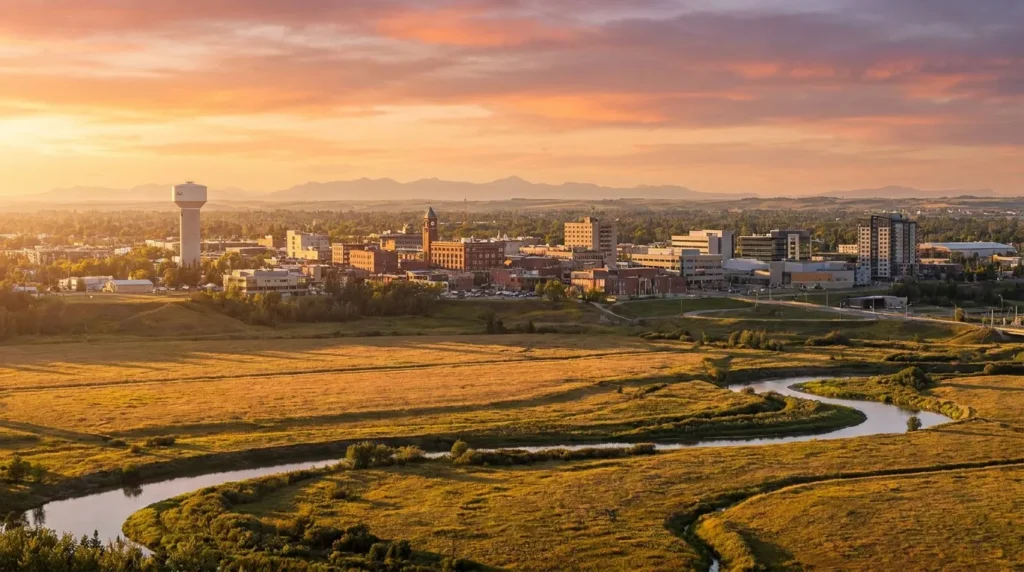
Grande Prairie demographics: young city with a strong Filipino, Indigenous, and eastern Canadian presence

Low median age, drawn by jobs in the energy sector. Filipinos form the largest immigrant community, and there is a significant presence of people from Newfoundland and the Maritimes.

Grande Prairie has one of the youngest populations among Canadian cities, with a median age close to 32 years. Most residents are young families attracted by well-paying jobs in the oil and gas sector. There is a significant historical migration of people from Newfoundland and Labrador and the Maritime provinces (New Brunswick, Nova Scotia), who go to work in camps and refineries.

The Indigenous population is significant, with the presence of Cree, Métis, and Dene Tha' nations. The Métis Settlements surrounding the city (East Prairie, Peavine, Gift Lake) bring Indigenous residents frequently into town. Filipinos form the largest immigrant community, present in healthcare, retail, and processing. There is also a growing Indian, Ukrainian, and Nigerian presence.

English is dominant. Tagalog, Cree, Spanish, and Punjabi appear in specific communities. The Brazilian community is minimal, with a few scattered families linked to the oil and gas sector. Newfoundlanders are so prevalent that the Atlantic accent can be heard regularly in bars and work sites.

Languages spoken
  • English
  • Tagalog
  • Cree
  • Punjabi
  • Spanish
  • +1 more
Main religions
  • Christian (Catholic, Protestant, Evangelical)
  • No religion (approximately 35%)
  • Sikh
  • Hindu
  • Muslim
  • +1 more

Cost of living in Grande Prairie: high wages offset reasonable prices

Affordable rentals and homes. Energy sector wages among the highest in Alberta. No PST. Costs rise in remote field regions.

Grande Prairie has a moderate cost of living, similar to other mid-sized Alberta cities. A one-bedroom apartment costs between 1,000 and 1,400 Canadian dollars. Two bedrooms range from 1,300 to 1,700. A family home with three to four bedrooms sells for 350,000 to 600,000 and rents for 1,800 to 2,800. Buying a family home is realistic for the working middle class.

Alberta does not charge PST, only the federal GST of 5%. Monthly groceries at chains such as Real Canadian Superstore, Save-On-Foods, Costco, and Walmart run 700 to 900 dollars for a couple. Because the city is farther north, some products may cost slightly more than in Edmonton due to transportation. Heating bills in winter are significant (natural gas costs can nearly double in January and February).

What sets Grande Prairie apart is the salary. Welders, machine operators, truck drivers, rig technicians, and engineers can earn between 100,000 and 200,000 dollars per year, especially with field overtime. This draws workers from across Canada and abroad. Costs become manageable when the salary justifies them.

Grande Prairie

Housing in Grande Prairie: large homes in new neighborhoods, accessible options for families

New neighborhoods such as Royal Oaks, Mountview, Country Side, and O'Brien Lake offer three- to five-bedroom homes with double garages at realistic prices.

Grande Prairie has housing options for every budget. New neighborhoods such as Royal Oaks, Mountview, Country Side, and O'Brien Lake South are located in the south and southwest of the city, with three- to five-bedroom homes, double garages, and yards, priced between 400,000 and 600,000. Custom homes in Crystal Lake and Crystal Heights reach 700,000 to 900,000.

Older neighborhoods such as Patterson Place, Cobblestone, Highland Park, and Mission Heights have homes from the 1970s to 2000s, more affordable, between 280,000 and 450,000. Apartments and townhouses are concentrated near the downtown core and in new developments, with rents between 1,200 and 1,700.

The rental market fluctuates considerably with oil sector cycles. During boom periods, demand surges and prices rise; during downturns, supply increases and values fall. Landlords ask for proof of income, references, and credit checks. Recent arrivals may need a co-signer or be asked to pay rent in advance.

Recommended neighborhoods
  • Royal Oaks (south, new, families)
  • Mountview (southwest, schools)
  • Country Side (south, new)
  • O'Brien Lake South (southwest, new)
  • Crystal Lake (north, upscale)
  • +2 more

Job market in Grande Prairie: oil, natural gas, agriculture, and forestry

Oilfield services companies dominate. Wages for welders, operators, and technicians are among the highest in Canada. Healthcare, education, and retail complete the picture.

Grande Prairie is one of Canada's natural gas capitals. The Montney formation, which extends through northwestern Alberta and northeastern British Columbia, is one of the country's most productive. Companies such as Tourmaline Oil, ARC Resources, Ovintiv, Encana, and Canadian Natural Resources operate in the region, alongside dozens of service companies (drilling, fracking, transportation, pressure services).

For immigrants with certifications in welding, industrial mechanics, heavy equipment operation, instrumentation, or engineering, there is real demand and high wages. Those willing to work in remote camps (rotations of 2 weeks on, 1 or 2 weeks off) can earn significantly more. Companies frequently sponsor work visas.

Agriculture employs workers in the surrounding area (canola, wheat, barley, cattle), and forestry carries weight (Weyerhaeuser and Canfor have operations in the region, with a pulp mill in Grande Prairie). Healthcare (QEII Hospital), education (Northwestern Polytechnic), retail (Prairie Mall, Costco), and regional government round out local employment.

Dominant sectors
  • Oil and natural gas
  • Oilfield services (drilling, fracking, transportation)
  • Agriculture (grains, cattle)
  • Forestry and pulp
  • Healthcare
  • +2 more
Major employers
  • Tourmaline Oil
  • ARC Resources
  • Canadian Natural Resources (CNRL)
  • Weyerhaeuser
  • Canfor
  • +3 more

Education in Grande Prairie: public schools and Northwestern Polytechnic

Public network serves residents. Northwestern Polytechnic (formerly Grande Prairie Regional College) offers degrees and technical programs focused on the local market.

Children who are residents have the right to free public schooling from kindergarten through high school. The system is divided between the Grande Prairie Public School Division (secular) and the Grande Prairie Catholic School District (Catholic, also public). French immersion programs are available in some schools. Neighborhoods such as Royal Oaks, Country Side, and O'Brien Lake South have relatively new schools.

Northwestern Polytechnic (renamed in 2022, formerly Grande Prairie Regional College) is the main local post-secondary institution. It offers diplomas and degrees in partnership with larger universities, focused on what the local market demands: nursing, computer science, business administration, welding, heavy mechanics, oil and gas, and agriculture.

For advanced programs not offered at the polytechnic (medicine, advanced engineering, research), residents travel to Edmonton (University of Alberta) or Calgary (University of Calgary), typically relocating for the duration of their studies. Athabasca University offers online degrees, an increasingly popular option for professionals working in the industry.

Notable universities
  • Northwestern Polytechnic

Healthcare in Grande Prairie: QEII Regional Hospital serves northwestern Alberta

Alberta Health Care covers residents. QEII Hospital is a referral centre for a vast region. Shortage of family doctors is a chronic problem.

As throughout Alberta, the system is public and funded by the Alberta Health Care Insurance Plan. Permanent residents and citizens register to receive a health card, which covers consultations, tests, hospital stays, and surgeries without direct charges. There is a waiting period of up to three months for new residents coming from other provinces.

The Queen Elizabeth II Regional Hospital serves not only Grande Prairie but all of northwestern Alberta and part of northeastern British Columbia, making it one of the busiest regional hospitals in western Canada. It has a 24-hour emergency department, maternity, oncology (recently opened), ICU, and surgical services. For highly specialized cases, patients are transferred to Edmonton.

Finding a family doctor is a serious challenge in the region, with a chronic shortage that leaves many residents relying on walk-in clinics. Dental care, physiotherapy, and prescription medications are not covered by the public system; those in formal employment generally have supplemental insurance through their employer. Immigrants in their waiting period can purchase transitional insurance.

Healthcare index68.0 / 100
  • Life expectancyyears at birth
    81.6yrs
  • Doctors per 1kpracticing physicians
    2.8
  • Health spendper capita, per year
    $6,187
  • Public systemoverall quality rating
    Fair

Safety in Grande Prairie: quiet residential neighborhoods, occasional issues downtown

Violent crime is low in residential neighborhoods. Downtown and some northern areas have more incidents, partly linked to the boom-and-bust cycle of the energy sector.

Grande Prairie has a profile typical of a Canadian oilfield city: new residential neighborhoods are quiet and safe, but the downtown core and some areas have seen an increase in crime in recent years, with fluctuations that track economic cycles in the oil and gas sector. Drug-related crime and homelessness are visible in parts of downtown.

Neighborhoods such as Royal Oaks, Country Side, O'Brien Lake South, Crystal Lake, Mountview, and Mission Heights are considered safe, with children cycling around and a family-oriented atmosphere. The most common issues are vehicle theft, break-ins in parking lots, and drug-related incidents. Violent crimes involving weapons are rare by North American standards.

The region is policed by the RCMP. Before finalizing a rental or purchase, checking the Grande Prairie RCMP Crime Map is advisable. In general, neighborhoods in the south and southwest are considered the most peaceful. The city's young demographic profile with many transient workers also shapes the local social dynamic, with a livelier nightlife than similarly sized cities.

2.0
Homicides per 100k
per year
Safety index
35.0
Crime index
65.0
Safer neighborhoods
  • Country Club West
  • Westpointe
  • O'Brien Lake
  • Pinnacle Ridge
  • Mission Heights
Areas to avoid
  • sections of downtown (100 Avenue) late at night
  • Richmond Industrial Park outside business hours
  • isolated parking lots along Highway 43 at night

Transportation in Grande Prairie: car essential, regional airport with flights to Calgary and Edmonton

Basic bus system. A car is practically mandatory. YQU airport has daily flights to major Alberta cities.

Grande Prairie has a modest bus system operated by Grande Prairie Transit, with a few routes through the main neighborhoods. It is sufficient for students at Northwestern Polytechnic and residents near the downtown core, but frequency is low, especially on weekends. A monthly pass costs around 75 dollars.

For the rest of the city and any travel outside it, a car is practically essential. The main routes (Highway 43, Highway 40, Highway 2) connect Grande Prairie to Edmonton (4-5 hours), Dawson Creek (BC, 90 minutes), Fairview, High Level, and the rest of Peace Country.

The Grande Prairie Airport (YQU) has daily flights to Calgary and Edmonton (via WestJet and Air Canada), with high frequency due to business traffic for the energy sector. For any other destination, a connection through Calgary or Edmonton is required. In winter, snowstorms and ice frequently close roads, so travelers need to allow considerable extra time.

15 min
Avg commute
30
Walkability
Airports
  • YQU — Grande Prairie Airport
  • International airport
  • Bike infrastructure

What the Climate Is Like Living in Grande Prairie

Grande Prairie has a continental subarctic climate: long, very cold winters and short summers with almost endlessly long days.

Summer in Grande Prairie is short but intense. From June to August, highs range between 21 and 24 degrees Celsius, and the days are extremely long: in June, sunrise comes around 4 a.m. and darkness falls after 10 p.m. Outdoor activities can fill nearly 18 hours of the day.

Winter is severe. From November to March, highs hover around -10 C and lows of -30 C are common. Snow covers the ground for more than five months, and December days are very short, with only around seven hours of daylight. This is Canada's subarctic belt.

Homes in Grande Prairie are built with powerful natural gas heating, enclosed garages, and heavy insulation. Extreme winter clothing, daylight-spectrum lamps to counter the dark season, and block heaters for vehicles in garages are standard. The local economy runs on oil, gas, and agriculture.

Sunny days / year310 days
Avg high (°F)
  • 36°J
  • 36°F
  • 50°M
  • 66°A
  • 74°M
  • 83°J
  • 86°J
  • 84°A
  • 78°S
  • 68°O
  • 45°N
  • 37°D
Avg low (°F)
  • -22°J
  • -26°F
  • -10°M
  • 13°A
  • 28°M
  • 38°J
  • 45°J
  • 41°A
  • 32°S
  • 15°O
  • N
  • -12°D
Rainfall (")
  • 2"J
  • 2"F
  • 1"M
  • 1"A
  • 3"M
  • 4"J
  • 4"J
  • 3"A
  • 2"S
  • 1"O
  • 2"N
  • 1"D

Culture in Grande Prairie: northern city life, outdoor activities, hockey, and seasonal festivals

Bonnetts Energy Centre for hockey and shows, Centre for Creative Arts for theatre and music. Outdoor life is a large part of the local identity.

Cultural life in Grande Prairie reflects a northern Canadian city. The Bonnetts Energy Centre is home to the Grande Prairie Storm (junior hockey) and hosts country, rock, and comedy shows. The Centre for Creative Arts and the Douglas J. Cardinal Performing Arts Centre (on the Northwestern Polytechnic campus) welcome plays, classical music, and dance.

Events such as the Bear Creek Folk Festival (in August), the Grande Prairie Stompede (rodeo in May), the Reel Shorts Film Festival, and the Big Country Fair define the calendar. Muskoseepi Park, in the center of the city, has trails, playgrounds, and Bear Creek running through it. In summer, it is the heart of local outdoor life.

Fishing, hunting, snowmobiling, and quad riding are part of the routine for many residents. Lakes such as Saskatoon Island, Williamson Provincial Park, and Kakwa Falls (more remote) are popular weekend destinations. For nightlife, there are some bars and restaurants, but the selection is limited compared to Edmonton or Calgary.

2
Major museums
Notable dishes
  • Alberta beef
  • bison burger
  • perogies
  • Saskatoon berry pie
  • bannock
  • +3 more
Annual events
  • Grande Prairie Stompede (annual rodeo and fair)
  • Bear Creek Folk Music Festival
  • Reel Shorts Film Festival
  • Street Performers Festival
  • Canada Day Festival at Muskoseepi Park
  • +1 more

What to See and Do in Grande Prairie Day to Day

A mid-sized city in northwest Alberta with cultural life centered on a few modern facilities and plenty of nature accessible within minutes by car.

The cultural anchor is the Montrose Cultural Centre, downtown, which houses the Grande Prairie Public Library and The Centre for Creative Arts. A few blocks away sits Bonnetts Energy Centre, the arena where the junior hockey team Grande Prairie Storm plays.

To understand the region, the Heritage Discovery Centre and the Philip J. Currie Dinosaur Museum in Wembley, 20 minutes out, are worth the trip, displaying fossils excavated at Pipestone Creek. Families make frequent use of the Eastlink Centre, a public complex with a pool and gymnasium.

On weekends, life moves to Muskoseepi Park, which runs through the city along Bear Creek. Saskatoon Island Provincial Park and Kleskun Hill Natural Area, with its dry prairie formations, round out the nearby natural attractions.

  1. 1["Philip J. Currie Dinosaur Museum (in Wembley
  2. 2nearby)"
  3. 3"Grande Prairie Museum"
  4. 4"Muskoseepi Park"
  5. 5"Centre for Creative Arts"
  6. 6"Bonnetts Energy Centre"
Nightlife2.0 / 10
Parks & green spaces
  • ["Muskoseepi Park"
  • "Bear Creek Reservoir"
  • "Crystal Lake"
  • "Saskatoon Island Provincial Park (nearby)"
  • "South Bear Creek Park"
  • +1 more

Latest posts

Straight from the blog

There are no posts specifically about Grande Prairie yet. In the meantime, check out our latest posts.