Visto n' Visa
Blog
Notícias e artigos
Destinations
Careers
Immigrants

Want to live and work in Fort McMurray?

Personalized immigration plan with eligible visas, costs, and next steps for your goal!

If you are not eligible, you will know exactly why and what to do to improve your approval chances.

Save up to 12 hours in meetings

No pointless assessments.

Save up to 90%

Save money on vague or unfocused consultations

Avoid Fraud and Mistakes

One mistake can cost you your visa

Total Impartiality

Zero commercial bias

Decide with peace of mind

No toxic urgency

Fast and Accurate

Answers in minutes, no guesswork

Fort McMurray Demographics: young, diverse, and transient city

Low median age, with a strong presence of workers from Newfoundland and Labrador, the Maritime provinces, and Filipino, Indian, and Nigerian immigrants. Significant local Indigenous community.

Fort McMurray has one of the youngest populations in Canada, with a median age close to 32 years. The combination of well-paying jobs and transient migration creates a unique profile: young families, many single workers, and few elderly residents. Internal Canadian migration is strong, especially from Newfoundland and Labrador, Nova Scotia, New Brunswick, and Cape Breton, where local employment disappeared decades ago.

The Indigenous population is significant, with the historical presence of the Athabasca Chipewyan, Mikisew Cree, Fort McKay, and Fort McMurray First Nations, as well as Metis settlements. Fort McKay First Nation, to the north, has formed economic partnerships with the petroleum industry and is an economically active Indigenous community.

Among immigrants, Filipinos form the largest community, present in healthcare, retail, and services. Indians, Nigerians, Pakistanis, South Africans, and Brazilians (in small numbers, generally engineers) also have a presence. The city has a reputation for being surprisingly diverse given its size and geographic isolation.

Languages spoken
  • English
  • Tagalog
  • Cree
  • Dene
  • Punjabi
  • +2 more
Main religions
  • Christian (Catholic, Protestant, Evangelical)
  • No religion (approximately 30%)
  • Muslim
  • Sikh
  • Hindu
  • +1 more

Cost of Living in Fort McMurray: expensive by Canadian standards, but wages compensate

Rent and groceries higher than average Alberta cities. Oil sands wages compensate. No PST. Costs rise for goods transported from afar.

Fort McMurray historically had one of the highest costs of living in Canada due to demand pressure during boom years. Prices have since stabilized but remain above average. A one-bedroom apartment costs between 1,300 and 1,700 Canadian dollars; two-bedroom units range from 1,500 to 2,000. A family home for rent runs between 2,200 and 3,500 dollars.

Purchasing a three- to four-bedroom family home costs between 350,000 and 550,000 dollars, values that dropped sharply after the 2016 fire and low oil price cycles. For those confident in sector stability, this presents an interesting window, though volatility must be considered. Alberta does not charge PST, only the federal GST of 5%.

Groceries are more expensive than in Edmonton because everything is transported by road. Costco, Walmart, Real Canadian Superstore, Save-On-Foods, and Sobeys operate in the city. A meal at a popular chain costs 15 to 20 dollars; a full-service restaurant, 30 to 50. Wages compensate: technicians and operators can earn 100,000 to 180,000 per year with field overtime, and qualified professionals (engineers, supervisors) frequently exceed 200,000.

Fort McMurray

Housing in Fort McMurray: accessible family homes, varied supply after post-2016 reconstruction

Neighborhoods such as Timberlea, Eagle Ridge, Stone Creek, and Parsons Creek concentrate most family homes. Market fluctuates with oil cycles.

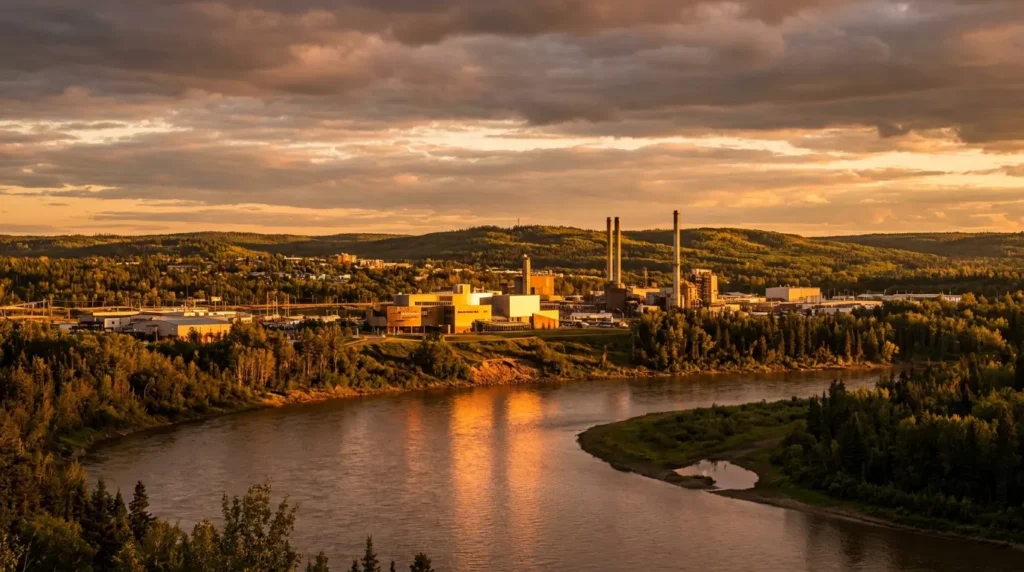
The city is divided by the Athabasca River. The east side (Lower Townsite) has the downtown and older neighborhoods such as Waterways and Abasand, the latter partially rebuilt after the 2016 fire. The west side, on the plateau, concentrates the larger neighborhoods: Timberlea (the largest and newest, with Eagle Ridge, Stone Creek, and Parsons Creek as sub-neighborhoods), Thickwood (older, established), and Wood Buffalo Estates.

Homes in Timberlea cost between 350,000 and 600,000 dollars to purchase, with new four- to five-bedroom homes with double garages in the 500,000 range. In Thickwood, values are similar but homes are older. Townhouses and condominiums are concentrated around the downtown and new neighborhoods, with prices between 250,000 and 400,000.

The rental market fluctuates with the oil sector: during boom periods, finding a home is difficult and prices spike; during downturns, supply is plentiful and values fall. Landlords require proof of income, references, and credit checks. Recent arrivals may need a guarantor or upfront payment.

Recommended neighborhoods
  • Eagle Ridge (Timberlea, new, families)
  • Stone Creek (Timberlea, new)
  • Parsons Creek (Timberlea, new)
  • Thickwood (established)
  • Wood Buffalo Estates (upscale)
  • +2 more

Job Market in Fort McMurray: oil sands dominate everything

Nearly all economic activity orbits around the oil sands. Wages among the highest in Canada for welders, operators, technicians, and engineers.

Fort McMurray's economy centers on the oil sands. The mining and in situ operations (extraction via steam injection) north and west of the city are enormous. Syncrude and Suncor operate historic mines; Imperial Oil has the Kearl Mine (the largest operating oil sands mine); CNRL (Horizon and Albian), Cenovus (Christina Lake, Foster Creek), and MEG Energy complete the picture.

For immigrants with certifications in welding, industrial mechanics, electricity, instrumentation, heavy equipment operation, chemical or petroleum engineering, or supervision, there is real demand. Many companies operate remote camps (workers stay in company lodging on rotations, generally 14 days on and 7 or 14 days off, flying home to any Canadian city).

Locally, retail, healthcare (Northern Lights Regional Health Centre), education (Keyano College, schools), and government (Regional Municipality of Wood Buffalo) employ the rest. The hospitality sector fluctuates significantly with oil cycles. For newly arrived immigrants without specific certification, retail and fast food positions are accessible entry points, with wages still higher than the provincial average.

Dominant sectors
  • Oil sands mining
  • Oilfield services and heavy construction
  • Petroleum processing (upgrading)
  • Transportation and logistics
  • Healthcare
  • +2 more
Major employers
  • Suncor Energy
  • Syncrude (joint venture)
  • Imperial Oil (Kearl)
  • Canadian Natural Resources (CNRL)
  • Cenovus Energy
  • +3 more

Education in Fort McMurray: solid public school system, Keyano College for higher education

Public and Catholic schools serve residents. Keyano College offers degree programs and technical courses geared toward the local industry.

Resident children have access to free public schooling from kindergarten through high school. The system is divided between Fort McMurray Public Schools (secular) and Fort McMurray Catholic Schools (Catholic, also public), with francophone programs as well. Newer neighborhoods in Timberlea have relatively recent schools. Father Mercredi High School (Catholic), Holy Trinity High School, and Westwood Community High School are among the best known.

Keyano College is the main local institution of higher education. It offers diplomas and degree programs in partnership with larger universities, with a focus on local industry needs: oil sands engineering, welding, heavy mechanics, instrumentation, nursing, business administration, and technology. For immigrants seeking fast retraining, it is a direct route to the job market.

For advanced programs not offered at Keyano (medicine, advanced engineering, research), residents travel to Edmonton (University of Alberta) or Calgary (University of Calgary), generally relocating for the duration of their studies. Athabasca University, headquartered in Athabasca (three hours to the south), offers online degree programs and is a popular option for those working in the petroleum sector.

Notable universities
  • Keyano College

Healthcare in Fort McMurray: Northern Lights Regional Health Centre serves the entire northeastern region

Alberta Health Care covers residents. A large regional hospital for a city of this size. Complex cases are transferred to Edmonton by air or ambulance.

As throughout Alberta, the system is public and funded by the Alberta Health Care Insurance Plan. Permanent residents and citizens register to receive a health card, which covers consultations, tests, hospital stays, and surgeries at no direct cost. There is a waiting period of up to three months for new residents arriving from other provinces.

Northern Lights Regional Health Centre is the reference hospital for all of northeastern Alberta, serving Fort McMurray, nearby Indigenous communities, and remote oil sands operations. It has a 24-hour emergency department, maternity ward, ICU, some oncology services, and surgery. For highly specialized cases, patients are transferred to Edmonton via STARS (air rescue) or ambulance.

Finding a family doctor is difficult, with a chronic shortage of physicians in the region. Walk-in clinics handle non-urgent cases. Dental, physiotherapy, and medication costs are not covered by the public system; those with formal employment in the petroleum sector generally have generous supplemental insurance through their employer (many companies offer packages above the Canadian average). Immigrants in a waiting period can purchase transitional insurance.

Healthcare index66.0 / 100
  • Life expectancyyears at birth
    81.6yrs
  • Doctors per 1kpracticing physicians
    2.8
  • Health spendper capita, per year
    $6,187
  • Public systemoverall quality rating
    Fair

Safety in Fort McMurray: quiet in residential neighborhoods, natural risks greater than urban ones

Crime rates typical for North American standards. The greatest risks are natural: wildfires and extreme winters. The city bears the trauma of the 2016 fire.

In terms of crime, Fort McMurray has the profile of an average Canadian city. Residential neighborhoods in Timberlea, Eagle Ridge, Stone Creek, Parsons Creek, and Thickwood are quiet, with children riding bicycles and a family atmosphere. The most common issues are vehicle theft, break-ins to vehicles in commercial parking lots, and some drug-related incidents.

Violent crimes involving weapons are rare compared to American cities of similar size. The city is policed by the RCMP (Wood Buffalo RCMP). Some areas of downtown and the Lower Townsite have a more visible presence of homeless individuals and drug users, but on a much smaller scale than Edmonton or Calgary.

The greatest risks in Fort McMurray are natural. The May 2016 wildfire (nicknamed The Beast) destroyed more than 2,400 properties and forced the evacuation of the entire city. There was renewed risk in 2024 with new fires. Residents need to understand the evacuation protocol, have an emergency plan, and maintain adequate insurance. Winters are also severe, with temperatures that can cause frostbite within minutes without adequate protection.

2.0
Homicides per 100k
per year
Safety index
40.0
Crime index
60.0
Safer neighborhoods
  • Thickwood
  • Timberlea
  • Eagle Ridge
  • Stone Creek
  • Parsons Creek
Areas to avoid
  • parts of the Lower Townsite (downtown) at night
  • industrial areas along Highway 63 outside business hours
  • isolated parking lots at worker camps away from urban centers

Transportation in Fort McMurray: car essential, airport important for fly-in-fly-out

Local bus service exists. A car is necessary. Fort McMurray Airport (YMM) has flights to Calgary, Edmonton, Toronto, and Newfoundland to accommodate worker rotation.

Fort McMurray has a bus system operated by Wood Buffalo Transit, covering the main neighborhoods and transporting workers to embarkation points for oil sands camps. Frequency is reasonable on weekdays and drops on weekends. A monthly pass costs around 110 dollars. Specific routes take workers to departure points for Syncrude, Suncor, and other operations.

For the rest of the city and any journey beyond it, a car is virtually mandatory. Highway 63 is the only road connecting Fort McMurray to the south (Edmonton, four and a half hours away). The route along Highway 63 is known for accidents in winter conditions, and drivers must be prepared for ice, snow, and wildlife on the road.

Fort McMurray International Airport (YMM) is central to city life. It has direct flights to Calgary, Edmonton, and Toronto, as well as charter flights to Newfoundland, Halifax, and other cities where workers reside during their time off. This fly-in-fly-out (FIFO) model is a structural part of the local industry. Flights fill up on Friday evenings and Sunday afternoons.

25 min
Avg commute
25
Walkability
Airports
  • YMM, Fort McMurray International Airport
  • International airport
  • Bike infrastructure

What the Climate Is Like Living in Fort McMurray

Fort McMurray has an extreme subarctic climate: long, very cold winters, short hot summers, and a real risk of wildfires.

Summer in Fort McMurray is brief but warm. From June to August highs can reach 27°C, with extremely long days (sun until 11 pm in June). Mosquitoes and black flies are intense near the rivers. Wildfire risk is high and smoke can dominate the air in July and August.

Winter is severe and prolonged. From November to March highs hover around -12°C, and lows of -35°C are common. Snow covers the ground for six months, and December days are very short, with only about seven hours of daylight. This is Canada's boreal belt.

Homes in Fort McMurray have powerful natural gas heating, enclosed garages, and high-performance insulation. Engine block heaters prevent vehicles from freezing overnight. High salaries offset the isolation and the climate. Those working in the oil sands follow a schedule of long shifts and time off spent in other cities.

Sunny days / year285 days
Avg high (°F)
  • 32°J
  • 29°F
  • 35°M
  • 61°A
  • 74°M
  • 79°J
  • 85°J
  • 84°A
  • 71°S
  • 60°O
  • 37°N
  • 29°D
Avg low (°F)
  • -34°J
  • -43°F
  • -19°M
  • A
  • 23°M
  • 36°J
  • 45°J
  • 40°A
  • 29°S
  • 14°O
  • -13°N
  • -27°D
Rainfall (")
  • 1"J
  • 1"F
  • 1"M
  • 2"A
  • 3"M
  • 4"J
  • 4"J
  • 4"A
  • 2"S
  • 2"O
  • 1"N
  • 1"D

Culture in Fort McMurray: northern city, sports, community events, and Newfie identity

MacDonald Island Park is the heart of community life. Seasonal festivals, hockey, and outdoor activities dominate. Strong influence of Newfoundland culture.

Cultural life in Fort McMurray centers on MacDonald Island Park (Mac Island), a large complex with a pool, skating rinks, gymnasium, library, the Suncor Energy Centre for Performing Arts, and courts. It is the central gathering point for the community, especially during the long winter. Keyano Theatre, at Keyano College, hosts plays, concerts, and shows.

Events such as the Blueberry Festival (August), the Heritage Park Festival, the Winter Festival, and Canada Day at Mac Island are longstanding traditions. The Newfoundland heritage is so present that local pubs (such as O'Neill's Irish Pub) have become gathering points for Newfies. Traditional Newfie music, food (cod cakes, jiggs dinner), and ways of speaking are part of the local landscape.

Outdoor life is a large part of local identity, at least during the short summer: fishing, hunting, canoeing on the Athabasca River, trails in Wood Buffalo National Park (the largest in Canada, to the north), and ATV riding are popular activities. In winter, snowmobiling and skating take over. The northern lights are visible on clear winter nights, one of the highlights of living this far north.

2
Major museums
Notable dishes
  • Alberta beef
  • bison burger
  • elk stew
  • bannock
  • fried pickerel (walleye)
  • +3 more
Annual events
  • Blueberry Bluegrass and Country Music Festival (regional)
  • Wood Buffalo Regional Library Storytelling Festival
  • Canada Day at MacDonald Island Park
  • interPLAY Festival (multicultural arts and culture)
  • Wood Buffalo Food Festival
  • +1 more
UNESCO sites
  • Wood Buffalo National Park (UNESCO World Heritage Site, north of the region)

What to Do in Fort McMurray When Work Lets Up

An oil sands city in northern Alberta, with an active outdoor life, industry-linked museums, and direct access to the Athabasca River and boreal forest.

Fort McMurray revolves around the oil industry, but leisure happens away from work, usually near the Athabasca River or on trails that cut through the boreal forest. The Oil Sands Discovery Centre explains clearly how the region became one of Canada's largest energy hubs, and MacDonald Island Park brings together a gym, pool, skating rink, and library in a single complex.

Families spend weekends at Snye Park on the riverbank and at Heritage Village, which reconstructs cabins and historic buildings from the era when the city was still a small fur-trading post. In winter, Vista Ridge offers skiing and snowboarding just minutes from downtown, with a lit run for those who can only make it after their shift.

Nature enthusiasts will find in Birchwood Trails a network of paths connecting entire neighborhoods, open for hiking, cycling, and cross-country skiing. Gregoire Lake Provincial Park to the south is a classic summer destination for camping, fishing, and viewing the northern lights during colder months, away from the city's light pollution.

  1. 1["Oil Sands Discovery Centre"
  2. 2"Heritage Village"
  3. 3"Fort McMurray Heritage Shipyard"
  4. 4"MacDonald Island Park (largest community recreation complex in Canada)"
  5. 5"Snye Park"
  6. 6"Wood Buffalo National Park (regional access)"]
Nightlife2.0 / 10
Parks & green spaces
  • ["Birchwood Trails"
  • "Snye Park"
  • "Gregoire Lake Provincial Park"
  • "MacDonald Island Park"
  • "Vista Ridge"
  • +1 more

Latest posts

Straight from the blog

There are no posts specifically about Fort McMurray yet. In the meantime, check out our latest posts.