Visto n' Visa
Blog
Notícias e artigos
Destinations
Careers
Immigrants

Want to live and work in Beltline?

Personalized immigration plan with eligible visas, costs, and next steps for your goal!

If you are not eligible, you will know exactly why and what to do to improve your approval chances.

Save up to 12 hours in meetings

No pointless assessments.

Save up to 90%

Save money on vague or unfocused consultations

Avoid Fraud and Mistakes

One mistake can cost you your visa

Total Impartiality

Zero commercial bias

Decide with peace of mind

No toxic urgency

Fast and Accurate

Answers in minutes, no guesswork

Who lives in Beltline

A young neighborhood, with a strong presence of professionals between 25 and 40 years old and a high share of residents born outside Canada.

Beltline's population is around 25,000 people in just a few square kilometers, giving it the highest residential density in Calgary. The median age is below the city average, with a strong concentration of young adults in one- and two-bedroom apartments.

The neighborhood is multicultural by nature. Sizable communities of immigrants from India, the Philippines, China, Nigeria, and Venezuela live alongside Canadians born in other provinces who came for jobs in the energy sector. English dominates the street, but it is common to hear Tagalog, Mandarin, Spanish, Punjabi, and Arabic.

The profile is predominantly rental in new residential towers. Families with small children exist but tend to move to neighborhoods further south or north when their kids reach school age, due to the limited public park space and surrounding traffic.

Languages spoken
  • English
  • Tagalog
  • Mandarin
  • Spanish
  • Punjabi
  • +1 more
Main religions
  • Christianity (Catholic and Protestant)
  • No religion
  • Islam
  • Hinduism
  • Sikhism
  • +1 more

Cost of living in Beltline

It is among the most expensive neighborhoods to rent in Calgary, but still below Vancouver and Toronto standards. It pays off through transportation savings.

Rent is the heaviest line item. A one-bedroom apartment in a new Beltline building costs significantly more than in suburban neighborhoods like Forest Lawn or Bowness. Studios in older towers are the accessible entry point for newcomers.

In exchange, car costs disappear. Many residents live without a personal vehicle, use the free C-Train within the downtown Free Fare Zone, and walk to the grocery store, gym, and work. Monthly parking in a commercial building is expensive and scarce.

Grocery stores like Co-op in the Beltline and Sunterra Market serve the neighborhood at average Calgary prices. To save money, residents cross over to Superstore or No Frills in nearby neighborhoods. Eating out is convenient but weighs on the budget, since 17 Avenue concentrates restaurants priced above the city average.

Beltline

Where to live in Beltline

Almost everything is an apartment in a tower. The choice is between new buildings with amenities or older condos with lower rents.

The dominant stock is vertical. Recent towers along 12 Avenue SW and 10 Avenue SW offer gyms, in-floor laundry, concierge service, and views of downtown or the Rockies. These are the options sought by professionals who have just arrived in Calgary with a signed contract.

Older buildings, mainly between 14 Avenue and 17 Avenue, have much more accessible rents. Many are four- to six-story walk-ups from the 1970s and 1980s, with large units but no amenities. This is the classic path for the first year of anyone landing in Canada.

To the west, near the Connaught border, blocks are more residential and quiet. To the east, in Victoria Park, the neighborhood becomes more industrial and is in transition, with new developments driven by the renovation of the BMO Centre and Stampede Park.

Recommended neighborhoods
  • Connaught (west)
  • Around 12 Avenue SW
  • Near the 1 Street SW C-Train
  • East Victoria Park
  • Eau Claire (bordering to the north)

Work in Beltline and Calgary

Beltline is the foothold for downtown offices. Calgary's economy revolves around energy, technology, finance, and logistics.

Calgary is traditionally Canada's oil and gas capital, and most offices are located downtown, just minutes from Beltline. Companies such as Suncor, Cenovus, Enbridge, and TC Energy concentrate heavy technical and administrative hiring.

In recent years, the city has expanded its technology sector, with startup hubs, fintech, and software companies scaling teams. Logistics and transportation are also strong due to Calgary's central position between Vancouver and Toronto.

For newcomers, the neighborhood also offers local service jobs, with restaurants, shops, gyms, and delivery companies hiring year-round. Fluent English opens almost every door; Canadian certifications help in construction, healthcare, and accounting.

Dominant sectors
  • Energy (oil and gas)
  • Technology and software
  • Financial services
  • Construction
  • Hospitality and restaurants
  • +1 more
Major employers
  • Suncor Energy
  • Cenovus Energy
  • Enbridge
  • TC Energy
  • Imperial Oil
  • +2 more

Education in Beltline and surroundings

The neighborhood has small public schools and is just minutes from Calgary's largest technical and higher education institutions.

For children, the nearest public school is Connaught School, with a bilingual French program. Families with older kids usually look for options outside Beltline, in neighborhoods such as Mount Royal or Hillhurst.

Bow Valley College borders the neighborhood on the east and serves many recent immigrants with English classes, technical programs, and professional diplomas in healthcare, IT, and administration.

SAIT, with technical and technological courses, and the University of Calgary, with full university programs, are to the north and northwest, about 15 to 25 minutes by public transit. Mount Royal University, in the southwest, rounds out the options for humanities and business.

Notable universities
  • University of Calgary
  • Mount Royal University
  • SAIT (Southern Alberta Institute of Technology)
  • Bow Valley College
  • Ambrose University

Healthcare in Beltline

The system is public, managed by Alberta Health Services. Beltline is surrounded by hospitals and walk-in clinics.

The Sheldon M. Chumir Health Centre is inside Beltline, on 4 Street SW. It is a 24-hour public unit with urgent care, ideal for urgent but non-critical cases. It serves walk-ins.

For actual emergencies, the Foothills Medical Centre, the city's main hospital, is a few kilometers to the west. South Health Campus and Rockyview General serve as alternatives in the south.

Newcomers must enroll in the Alberta Health Care Insurance Plan, the provincial plan, shortly after moving to the province. The card is free and covers consultations and hospital care. Dental, vision, and medications are not included and require private insurance, usually covered by the employer.

Beltline

Day-to-day safety

A safe neighborhood by North American standards, with a visible presence of residents on the street. Precautions are localized and concentrated in a few stretches.

Most of Beltline is calm for walking during the day and at night. The constant presence of pedestrians on 17 Avenue, 4 Street, and around the residential towers creates a sense of activity. The Calgary Police Service maintains regular patrols.

The points of attention are further east, near 1 Street SE and the border with old Victoria Park, where there is a larger unhoused population and some incidents of car break-ins and bike thefts. It is not an area to avoid, but it requires extra attention late at night.

As in any major Canadian city, violent crime against residents is rare. The most common incidents are small thefts in buildings without a doorman, poorly locked bicycles, and weekend bar-related incidents on 17 Avenue.

Safer neighborhoods
  • Connaught
  • Around 12 Avenue SW
  • Residential blocks between 13 and 15 Avenue SW
  • Eau Claire (north)
Areas to avoid
  • 1 Street SE after midnight
  • Isolated stretches of old Victoria Park
  • Alleys behind 17 Avenue late at night

How to get around

Beltline is one of the few Canadian neighborhoods where it is possible to live without a car. The C-Train, buses, and walking handle the day.

The C-Train runs along the northern edge of the neighborhood, on 7 Avenue. Within downtown, the train is free. The Red and Blue lines connect to the airport via transfer and to the suburbs. The 1 Street SW, 3 Street SW, and 4 Street SW stations serve Beltline.

The Calgary Transit bus network covers the main avenues and runs late. 17 Avenue has several frequent routes. Bicycles work well in warm months, with protected bike lanes on 12 Avenue and 5 Street SW connecting to downtown.

The YYC international airport is about 20 to 30 minutes away by car or Uber. There is no airport inside the neighborhood. There is no regular passenger train service out of Calgary for long-distance travel, so interprovincial trips are made by plane or bus.

Airports
  • YYC, Calgary International Airport
  • International airport
  • Bike infrastructure

Climate

Beltline

Culture and local scene

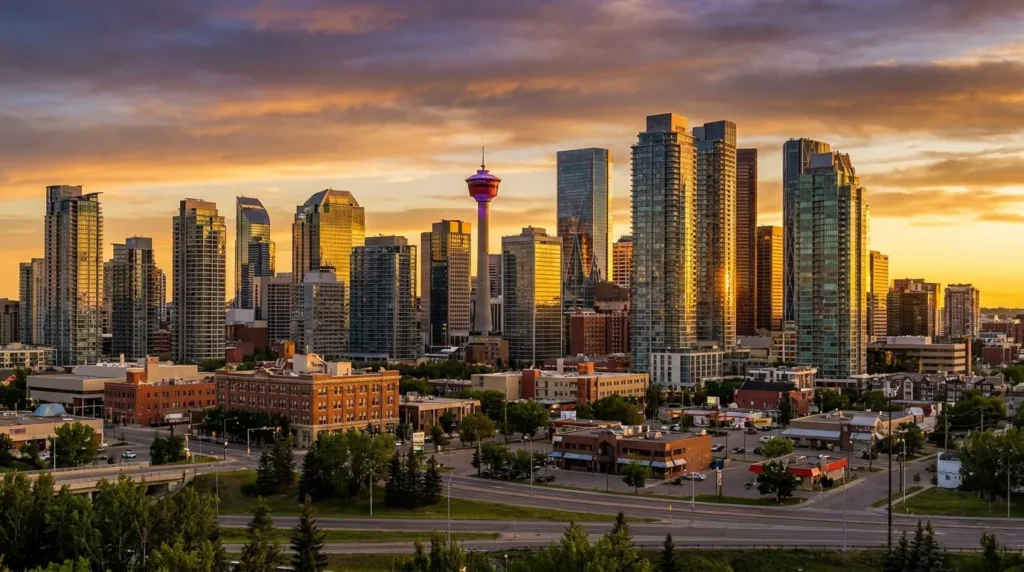
Beltline is Calgary's cultural engine: restaurants, bars, music venues, galleries, and the largest festival in western Canada right next door.

17 Avenue SW concentrates the dining scene. Korean, Vietnamese, Japanese, Italian, Latin American, and Middle Eastern restaurants coexist within a few blocks. The diversity reflects recent immigration to Calgary and is among the richest in the city.

Nightlife is strong. 4 Street SW and 17 Avenue itself concentrate bars, craft breweries, lounges, and live music venues. The National and Commonwealth Bar & Stage are well-known addresses for newcomers to the city.

The neighborhood sits next to Stampede Park, where the Calgary Stampede takes place in July, the largest rodeo in the world and the city's main cultural event. Beltline fills up with visitors during those ten days and takes on a unique energy.

Notable dishes
  • Calgary donair
  • Beef dip
  • Caesar (Canadian drink with Clamato)
  • Bannock
  • Calgary-style Cantonese ginger beef
Annual events
  • Calgary Stampede
  • Sled Island Music & Arts Festival
  • Lilac Festival on 4 Street SW
  • Beakerhead
  • Beltline Urban Murals Project

What to see and do

Attractions are concentrated within short walks: an iconic tower, parks, urban murals, and Stampede Park next door.

The Calgary Tower marks the northern edge of the neighborhood, with an observation deck and a revolving restaurant. From Beltline, it is walkable. Just to the west, the renovated Glenbow Museum reopened and covers the history and art of western Canada.

17 Avenue SW is an attraction in itself, with shops, cafes, and the Beltline Urban Murals Project scattered across alleys and walls. Central Memorial Park, with its fountain and historic library, is the green oasis in the middle of the neighborhood.

Stampede Park, on the eastern border, hosts events all year: concerts, fairs, conferences, and the Stampede itself in July. Further north, the Bow River is nearby and offers a riverside walk toward Prince's Island Park.

  1. 1Calgary Tower
  2. 2Stampede Park and BMO Centre
  3. 3Beltline Urban Murals Project
  4. 4Central Memorial Park
  5. 517 Avenue SW (Red Mile)
  6. 6Glenbow Museum
Parks & green spaces
  • Central Memorial Park
  • Haultain Park
  • Tomkins Park
  • Connaught Park
  • Prince's Island Park (nearby)

Immigrant communities

Beltline is one of Calgary's most diverse neighborhoods, with a strong Filipino, Indian, Chinese, Latin American, and African presence among newcomers.

Calgary is one of the Canadian cities that receives the most immigrants per capita, and Beltline tends to be the urban gateway. Filipinos form the largest community, with stores, Catholic churches, and active associations across several parts of the city.

The Indian and Pakistani presence is strong, especially among technology, engineering, and healthcare professionals. Chinese communities concentrate retail in Chinatown, a short distance to the north. There are also growing groups of Venezuelans, Colombians, Brazilians, Nigerians, and Syrians.

Organizations such as the Calgary Catholic Immigration Society and the Centre for Newcomers offer English classes, job-search assistance, and mentorship. Consulates from several countries serve residents directly in Calgary or through the jurisdiction of Edmonton and Vancouver.

8,500
Foreign-born residents
estimated
Top countries of origin
  • Philippines
  • India
  • China
  • United Kingdom
  • United States
  • Nigeria
  • Venezuela
  • Brazil
Foreign consulates
  • Consulate General of the Philippines in Calgary
  • Consulate of the United States in Calgary
  • Honorary Consulate of Brazil in Calgary
  • Honorary Consulate of Mexico in Calgary
  • Honorary Consulate of Italy in Calgary
  • +1 more
Community organizations
  • Calgary Catholic Immigration Society
  • Centre for Newcomers
  • Immigrant Services Calgary
  • Calgary Bridge Foundation for Youth
  • Calgary Multicultural Centre

Latest posts

Straight from the blog

There are no posts specifically about Beltline yet. In the meantime, check out our latest posts.