Visto n' Visa
Blog
Notícias e artigos
Destinations
Careers
Immigrants

Want to live and work in Salina?

Personalized immigration plan with eligible visas, costs, and next steps for your goal!

If you are not eligible, you will know exactly why and what to do to improve your approval chances.

Save up to 12 hours in meetings

No pointless assessments.

Save up to 90%

Save money on vague or unfocused consultations

Avoid Fraud and Mistakes

One mistake can cost you your visa

Total Impartiality

Zero commercial bias

Decide with peace of mind

No toxic urgency

Fast and Accurate

Answers in minutes, no guesswork

Salina's Population Profile and Immigrant Communities

Salina has a white majority of German, Swedish, and Czech descent, with a growing Hispanic presence. The population is predominantly Christian, with strong Lutheran, Catholic, and Methodist communities. A small and stable city.

The city has around 46,000 residents, with little variation from year to year. The demographic base is predominantly white, descended from German, Swedish, and Czech immigrants who settled Kansas in the 19th century. This heritage shows up in surnames, the architecture of some churches, and seasonal festivals.

The Hispanic community, mainly Mexican and Central American, is the most visible minority and has been growing steadily. It is concentrated in the northern part of the city and around employers such as Tony's Pizza (Schwan's). There is also a small Vietnamese community tied to parishes and small businesses, along with international students at the local colleges.

The city skews relatively young, with a median age close to the national figure, and has a healthy mix of families with children, young professionals in the aviation sector, and retired residents. It is not a college town in the classic sense, but Kansas Wesleyan and Kansas State Salina bring moderate student turnover.

Languages spoken
  • English
  • Spanish
  • Vietnamese
  • German (heritage)
Main religions
  • Protestantism (Lutheran, Methodist, Baptist)
  • Catholicism
  • Evangelical churches
  • No religion

Day-to-Day Cost of Living in Salina

Salina is one of the most affordable cities in the United States. Rent, groceries, gas, and services fall well below the national average. A car is a significant fixed expense.

The cost of living in Salina is consistently below the American average. Rent is probably the most advantageous item: one- or two-bedroom apartments go for amounts that would cover only a compact studio in large cities. Entire houses are also affordable to rent, especially in older neighborhoods near downtown.

Groceries are reasonable, with Dillons (a Kroger chain), Walmart, Sam's Club, and Aldi handling most shopping needs. Local restaurants are inexpensive, with full lunches at modest prices. Electric bills run above average in summer due to near-mandatory air conditioning, and gas heating adds up in winter.

The major additional expense is a car: fuel, insurance, and maintenance. Almost no one in Salina gets by without a personal vehicle, and public transit covers little ground. Healthcare costs are close to the Kansas average, with employer plans providing solid coverage for those working in manufacturing, healthcare, or education.

Salina

Where to Live in Salina: Neighborhoods and Housing Styles

Salina has affordable and varied housing, from older bungalows near downtown to newer suburbs in the south. Most immigrants start by renting a small house or an apartment in residential complexes.

South Salina, around Magnolia Road and Ohio Street, concentrates the newer neighborhoods, with larger homes, wide streets, spacious lots, and well-rated schools. It is the preferred area for established families and healthcare and aviation professionals. Country Club Estates is the most expensive strip, with homes near the golf course.

The downtown and northern areas have historic homes, many in Craftsman and Victorian styles, at low prices but often requiring renovation. Neighborhoods like Old Town and the area around Iron Avenue attract those who value proximity to cafes, the Stiefel Theatre, and a more community-oriented neighborhood life. Rents are lower here.

For newcomers, the practical approach is to rent first in complexes along Belmont Boulevard or Crawford Street, get to know the city, and then decide whether to buy. Buying a home in Salina is within reach even on a median income, and inventory is plentiful. Local agencies such as Coldwell Banker Antrim-Piper and Wilson Realty dominate the market.

Recommended neighborhoods
  • South Salina (Magnolia Road)
  • Country Club Estates
  • Downtown / Old Town
  • Indian Rock
  • Schilling area

Salina's Job Market: Industry, Healthcare, and Aviation

Salina's economy revolves around manufacturing, food processing, healthcare, aviation, and logistics. Regular openings exist for both skilled and unskilled labor, with a low unemployment rate.

Manufacturing is the backbone of the city. Schwan's Company operates Tony's Pizza there, one of the largest frozen pizza plants in the world. Great Plains Manufacturing, now part of Kubota, produces agricultural equipment and employs a large workforce. Philips Lighting, Exide Technologies, and Salina Vortex are also historic employers in the industrial sector.

Salina Regional Health Center is the largest healthcare employer, with a hospital, satellite clinics, and constant demand for nurses, technicians, physicians, and administrative staff. Aviation is another pillar: Salina Regional Airport hosts the Kansas State University Polytechnic Campus, with aviation programs, and aeronautical maintenance companies such as 1 Vision Aviation.

Logistics and trucking benefit from the city's position on I-70. The Walmart Distribution Center, carriers, and warehouses offer CDL and operations positions. Average wages are lower than in large cities, but the cost of living offsets the difference. Functional English is important; on many production lines there are Hispanic coworkers and bilingual supervisors.

Dominant sectors
  • Manufacturing
  • Food processing
  • Healthcare
  • Aviation and technical education
  • Logistics and transportation
Major employers
  • Schwan's / Tony's Pizza
  • Salina Regional Health Center
  • Great Plains Manufacturing (Kubota)
  • Kansas State University Polytechnic
  • Philips Lighting
  • +1 more

Education in Salina: Schools, Colleges, and Technical Training

Salina has two public school districts, three university campuses, and strong technical education tied to aviation. Schools are generally well rated by Kansas standards, with affordable tuition at private institutions.

Salina USD 305 manages the public school network, with Salina South High and Salina Central High as the main schools. The district is stable, offering music programs, sports, and AP courses. USD 306 serves neighboring areas. Catholic schools such as Sacred Heart Junior-Senior High and St. Mary's Grade School are traditional private options with moderate tuition.

Kansas Wesleyan University is a small private Methodist university in the south-central part of the city, offering undergraduate programs in business, nursing, biology, and education. Kansas State University Polytechnic Campus, adjacent to the airport, is a nationally recognized institution in aviation, mechatronics, manufacturing engineering, and professional piloting.

Salina Area Technical College offers technical training in healthcare, welding, HVAC, freight transportation, and information technology, with short programs focused on direct employment. For immigrants, this technical path is often the fastest route to entering the local job market with a recognized credential.

Notable universities
  • Kansas Wesleyan University
  • Kansas State University Polytechnic Campus
  • Salina Area Technical College

Healthcare in Salina: Regional Hospital and Clinic Network

Salina is a regional healthcare hub for central Kansas, with a mid-sized hospital, multiple clinics, dentists, and specialists. It serves not only the city but dozens of surrounding counties.

Salina Regional Health Center is the main hospital, with approximately 350 beds, a 24-hour emergency department, maternity ward, surgical center, oncology, and cardiology. It is affiliated with larger networks for complex cases, with transfers to Wichita, Kansas City, or Denver when needed. The Tamko Cancer Center is part of the complex.

Primary care is covered by clinics such as Salina Family Healthcare Center, a Federally Qualified Health Center that serves low-income patients on a sliding payment scale. Private groups such as Salina Pediatric Care and Salina Health Education Foundation, along with solo practices, are also available. For many uninsured immigrants, the FQHC is the point of entry.

The Veterans Affairs operates an outpatient clinic in the city. Dentists and opticians are plentiful and relatively affordable compared to metropolitan areas. Wait times are reasonably short by American standards, without the long queues common in large cities. Spanish interpreters are available at the hospital and the FQHC.

Healthcare index58.0 / 100
  • Life expectancyyears at birth
    78.4yrs
  • Doctors per 1kpracticing physicians
    3.7
  • Health spendper capita, per year
    $13,473
  • Public systemoverall quality rating
    Fair

Safety in Salina: A Quiet City with a Few Areas to Watch

Salina is considered safe by American standards. Violent crime is low, and the main concern is property crime in certain areas. Residential neighborhoods are generally calm day and night.

Salina's crime rate is below that of larger cities such as Wichita or Topeka. Violent crimes occur but at low volumes, and most incidents involve theft, vehicle break-ins, and petty shoplifting. Areas in the northern part of the city, particularly around North Broadway, have higher rates and warrant caution at night.

Southern and central residential neighborhoods are quiet, with attentive neighbors and regular patrols. The Salina Police Department maintains a visible presence and runs community programs, including Spanish-speaking teams. The Saline County Sheriff covers the surrounding rural areas. Emergency response (911) is fast.

Natural hazards are part of life in Kansas: the city sits in Tornado Alley, with sirens activated during alerts, mainly between April and June. Nearly every home has a basement or shelter, and schools and employers have established protocols. Localized flooding occurs near the Smoky Hill River. Winter brings occasional snowstorms and ice.

5.8
Homicides per 100k
per year
Safety index
62.0
Crime index
38.0
Safer neighborhoods
  • Downtown Salina (revitalized commercial district)
  • Country Club Heights
  • Magnolia Hills
  • Georgetown (residential neighborhood)
  • Neighborhoods near Kansas Wesleyan University
Areas to avoid
  • Industrial areas near the former Schilling Air Force Base at night
  • Isolated stretches north of North Street after dark

Getting Around Salina and Beyond

Salina is a car-dependent city. Public transit is limited, but the road network is easy to navigate and the regional airport connects to Denver and Chicago. I-70 and I-135 provide quick access to other cities.

Owning a car in Salina is not a luxury, it is a practical necessity. Distances are short, traffic is light, free parking is available almost everywhere, and the city is laid out on a grid, making navigation straightforward. Ninth Street and Santa Fe Avenue run through downtown, while Crawford Street and Magnolia Road connect east and west.

Public transit is available through Salina CityGo and OCCK, with bus routes and on-demand service for seniors and people with disabilities, but coverage and frequency are not sufficient to replace a car for regular commuting. Cycling works within the city in mild weather, with trails such as the Lakewood Park Trail and Indian Rock Trail.

For travel out of the city, Salina Regional Airport offers daily flights to Chicago and Denver via SkyWest. I-70 leads to Topeka, Kansas City, and Denver, and I-135 heads south to Wichita in just over an hour. Greyhound and Jefferson Lines serve interstate bus routes.

14 min
Avg commute
36
Walkability
Airports
  • SLN — Salina Regional Airport
  • Bike infrastructure

What the climate is like living in Salina

Salina has a semi-arid continental climate typical of the Kansas plains, with very hot and dry summers, cold and windy winters, and a severe spring tornado season.

Summer in Salina runs from June through September, with highs between 90°F and 97°F and moderate humidity. Short but intense thunderstorms are common in June. Nights cool to around 66°F to 70°F. Wind is constant across the plains, helping evaporate moisture but also drying out vegetation. Air conditioning is essential.

Winters are cold. Lows range from 18°F to 28°F from December through February, with Arctic waves pushing temperatures to -4°F. Annual snowfall accumulates between 14 and 18 inches, melting relatively quickly. Wind increases the wind chill effect significantly. Central heating is standard. Spring brings a real tornado risk, peaking in April and May.

For residents, planning should include strong air conditioning, robust heating, a tornado shelter (basement), and wind-appropriate clothing. Salina is a plains city with an agricultural economy and a very low cost of living. Fall is the most comfortable season.

Sunny days / year218 days
Avg high (°F)
  • 44°J
  • 45°F
  • 58°M
  • 70°A
  • 77°M
  • 90°J
  • 93°J
  • 93°A
  • 87°S
  • 70°O
  • 58°N
  • 49°D
Avg low (°F)
  • 25°J
  • 23°F
  • 36°M
  • 46°A
  • 56°M
  • 68°J
  • 72°J
  • 71°A
  • 65°S
  • 48°O
  • 37°N
  • 30°D
Rainfall (")
  • 1"J
  • 1"F
  • 2"M
  • 2"A
  • 7"M
  • 3"J
  • 3"J
  • 2"A
  • 2"S
  • 1"O
  • 1"N
  • 1"D

Cultural Life in Salina: Festivals, Arts, and Community

Salina has a surprisingly active cultural scene for its size, with theater, museums, arts festivals, and a strong network of churches. Social life centers on family, high school sports, and local events.

The Smoky Hill River Festival, held in June at Oakdale Park, is the region's best-known cultural event and draws tens of thousands of visitors with music, crafts, and food. The Stiefel Theatre for the Performing Arts, downtown, hosts national acts and regional companies throughout the year. The Salina Art Center maintains exhibitions and programming for children.

The city has many active churches, and community life revolves significantly around them, particularly Sacred Heart Cathedral, First United Methodist, and Hispanic parishes such as St. Mary Queen of the Universe. High school sports, especially football and basketball, draw large crowds on Friday nights in the fall.

Dining options include classics such as The Cozy Inn (sliders since 1922), Martinelli's Little Italy, Cocina Mexicana, and downtown cafes like The Vault. Nightlife is modest, with a handful of bars and local breweries such as Blue Skye Brewery. Those seeking a more cosmopolitan scene travel to Wichita or Kansas City on weekends.

Salina

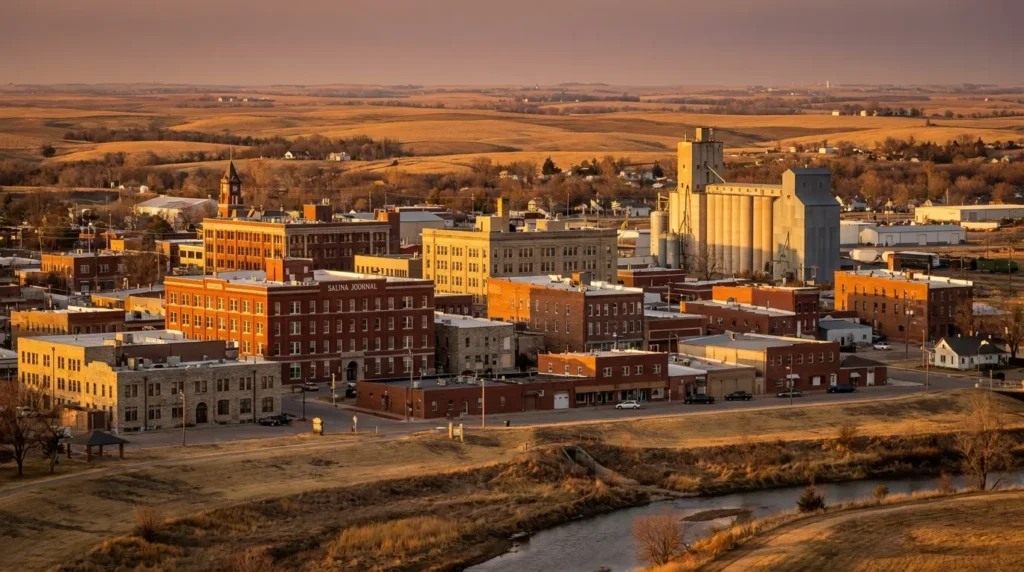
Salina is a regional hub in central Kansas with the Smoky Hill River and Stiefel Theatre

At the junction of I-70 and I-135, Salina offers the Stiefel Theatre, Rolling Hills Zoo, and the Smoky Hill River Festival. Moderate pace of life, agricultural roots, and the Kansas State Polytechnic campus.

Salina sits at the intersection of interstates I-70 and I-135, a position that makes it a center for services, healthcare, and education in central Kansas. The Stiefel Theatre for the Performing Arts on Santa Fe Avenue is the cultural anchor, hosting national touring shows. The Smoky Hill Museum, housed in an Art Deco building from the former US Post Office, documents the history of the plains and Swedish settlers.

The Smoky Hill River Festival, held in June at Oakdale Park, is the largest event on the calendar, drawing art, music, and over one hundred thousand visitors across four days. Rolling Hills Zoo, west of town along Hedville Road, combines a zoo with a natural history museum and is a standard destination for families from across the state.

The Kansas State University Salina Aerospace and Technology Campus, built on the former Schilling AFB, trains pilots and aerospace engineers. The Salina Art Center is free admission and features contemporary art exhibitions. Lakewood Park and Indian Rock Park, with its carved stone sculpture, organize recreational and running activities throughout the city.

  1. 1["Smoky Hill Museum"
  2. 2"Salina Art Center"
  3. 3"Rolling Hills Zoo"
  4. 4"Oakdale Park"
  5. 5"Stiefel Theatre for the Performing Arts"
  6. 6"Lee District Park"
Nightlife3.0 / 10
Parks & green spaces
  • ["Oakdale Park (historic park along the Smoky Hill River)"
  • "Lakewood Park and Lakewood Discovery Center"
  • "Sunset Park"
  • "Indian Rock Park"
  • "Bill Burke Park"
  • +1 more

Latest posts

Posts about Kansas

Coverage and updates related to this destination.

Showing content from Kansas, as there is no specific data for Salina yet.