Visto n' Visa
Blog
Notícias e artigos
Destinations
Careers
Immigrants

Want to live and work in Waterloo?

Personalized immigration plan with eligible visas, costs, and next steps for your goal!

If you are not eligible, you will know exactly why and what to do to improve your approval chances.

Save up to 12 hours in meetings

No pointless assessments.

Save up to 90%

Save money on vague or unfocused consultations

Avoid Fraud and Mistakes

One mistake can cost you your visa

Total Impartiality

Zero commercial bias

Decide with peace of mind

No toxic urgency

Fast and Accurate

Answers in minutes, no guesswork

Waterloo's population: among Iowa's most diverse

About 71% white, 16% Black (the highest proportion among the state's larger cities), 8% Hispanic, 2% Asian. Recent refugees from the Congo, Myanmar, and Sudan.

Waterloo is one of Iowa's most ethnically diverse cities. About 71% of the population is white, 16% Black (the highest proportion among the state's larger cities), 8% Hispanic, and 2% Asian. The Black community has deep historical roots in the Great Migration of the early 20th century, when African Americans from Mississippi, Alabama, and other parts of the South came to work at the Illinois Central Railroad and Waterloo's industries.

The Hispanic community has grown over recent decades, with Mexicans, Salvadorans, and Guatemalans working at Tyson, in construction, and in restaurants. Refugees from the Congo, Burundi, Sudan, Ethiopia, and Myanmar (Karen and Karenni) have arrived in more recent waves through programs administered by Catholic Charities and Lutheran Services in Iowa. There is also a Vietnamese and Laotian community dating back to the 1970s and 1980s. Bosnians arrived in the 1990s.

Brazilians are rare. Religious life is diverse by Iowa standards. African American Baptist churches (Antioch Baptist, Payne Memorial AME) have a strong presence on the East Side. There are Catholic churches (St. Mary's, Queen of Peace), Lutheran, Methodist, and Presbyterian congregations. Mosques (Islamic Center of Waterloo-Cedar Falls), Burmese and Laotian Buddhist temples, and Hispanic and African Pentecostal churches round out the landscape. Politically, the city tends Democratic in its core, with more conservative surrounding rural areas.

Languages spoken
  • English
  • Spanish
  • Karen and Karenni (Myanmar)
  • Swahili and French (Congolese refugees)
  • Arabic and Somali
  • +2 more
Main religions
  • Protestant Christian (African American Baptist, Lutheran, Methodist)
  • Catholic Christian
  • Unaffiliated
  • Muslim (refugees and Bosnian community)
  • Buddhist (Southeast Asian)
  • +1 more

Cost of living in Waterloo: among the lowest in the United States

Very affordable rents, homeownership within reach. Food and gas below national averages. Moderate state tax. Heating bills weigh in during the harsh winter.

Waterloo is one of the most affordable cities in the United States. A one-bedroom apartment runs between USD 600 and USD 900 per month. A three-bedroom rental house is typically USD 900 to USD 1,400. Buying is very accessible: a modest home in neighborhoods like Highland, Lincoln Park, or Walnut Ridge starts around USD 100,000 to USD 170,000. Historic homes in areas like Highland can be real bargains.

Grocery shopping at Hy-Vee, Fareway, Aldi, Walmart, and ethnic markets (Latino, Asian, African) is inexpensive. A meal at a popular restaurant runs USD 10 to USD 17. Local spots include Newton's Paradise Cafe, Lava (Mediterranean), Galleria de Paco, Brown Bottle (an institution), and Texas Roadhouse. Craft breweries such as SingleSpeed Brewing (with locations in Cedar Falls and Waterloo), Roll With It, Cup of Cheer, and Lark Brewing serve as community gathering spots.

Iowa's state income tax goes up to 5.7% (on a declining trajectory). Sales tax in Waterloo is about 7%. The electric bill with MidAmerican Energy is reasonable, but winter heating (natural gas) adds up due to intense cold. Summer air conditioning is also a factor. Health insurance through an employer at John Deere, Tyson, or a hospital is the norm. Overall cost of living is well below national averages for a city of this size.

86Cost index (US = 100)14% below US average
CategorySingleCoupleFamily (2 + 2)
iHousing$1,118$1,290$1,634
iFood$326$654$1,187
iTransport$430$732$947
iHealthcare$241$482$903
iChildcare$1,566
iOther$732$1,316$1,849
Monthly total$2,847$4,474$8,086

Source: U.S. BLS Consumer Expenditure Survey 2023 + BEA Regional Price Parities 2023 · Estimates in USD, monthly.

Housing in Waterloo: affordable historic homes, newer suburbs, and neighboring Cedar Falls

Highland, Lincoln Park, and Walnut Ridge are traditional neighborhoods. Cedar Falls (adjacent city) has top-rated schools and a university presence. Homes are very affordable. Some East Side areas call for care.

Waterloo has distinct neighborhoods. Highland, on the west side, is one of the most attractive areas, with historic homes from the 1900s to 1940s on tree-lined streets. Lincoln Park, to the north, features family homes. Walnut Ridge, on the far west, is newer and suburban. The East Side has older, more affordable homes, with some well-maintained areas and others facing more challenges (some tougher pockets near industrial zones). The South Side is a mix of industrial and residential uses.

Cedar Falls, a city adjacent to Waterloo to the west (about 15 minutes away), has a different profile. Because of the University of Northern Iowa, it has a more academic character and is pricier than Waterloo, with neighborhoods like College Hill, Janesville Road, Greenhill, and Northern Estates. Its public schools rank among the best in the state. Families who can buy in Cedar Falls generally prefer it for the schools. Hudson, Evansdale, and Janesville are other nearby small towns.

The market is calm with good inventory. A typical application requires a credit score, proof of income, and references. For recent immigrants at Tyson or John Deere without a U.S. credit history, many landlords accept advance payment or a co-signer. Listings are found on Zillow, Realtor.com, Apartments.com, the Waterloo-Cedar Falls Courier, and in Hispanic, Congolese, and Karen Facebook groups. Attention should be paid to Cedar River flood zones mapped by FEMA.

Recommended neighborhoods
  • Highland (historic, tree-lined)
  • Lincoln Park (family-friendly)
  • Walnut Ridge (new, suburban)
  • West Waterloo (preferred residential area)
  • Cedar Falls College Hill (university neighborhood)
  • +3 more

Job market in Waterloo: John Deere, Tyson, agribusiness, and healthcare

John Deere Waterloo Works manufactures tractors for the world. Tyson Foods processes meat at scale. UnityPoint Allen and MercyOne are major hospitals. UAW and unions are strong.

John Deere Waterloo Works is the city's largest employer, with thousands of unionized workers (UAW Local 838). It is the company's largest tractor factory, producing models ranging from compact units to giants destined for farms in Brazil and around the world. Wages at John Deere are considered among the region's best, with robust benefits. Historic strikes, including the 2021 work stoppage that lasted more than a month, have defined the relationship between the union and the company.

Tyson Foods operates one of the largest meat processing plants in the United States in Waterloo, with more than 2,500 workers. It employs many Hispanic, African, and Myanmar immigrants. Wages start around USD 18 to USD 22 per hour, with benefits. The plant gained national attention during the COVID-19 pandemic due to serious outbreaks. Other industries include CNH Industrial (also tractors), Bertch Cabinet Manufacturing, and Standard Distribution.

UnityPoint Allen Hospital and MercyOne Northeast Iowa are the two major hospitals. Waterloo Community School District and Hawkeye Community College are large education employers. The University of Northern Iowa in neighboring Cedar Falls also employs many workers. For those with basic English, openings exist at Tyson, restaurants, construction sites, hospital support roles, and services. The minimum wage follows the federal rate of USD 7.25 per hour, but most openings start at USD 14 to USD 18 per hour.

Dominant sectors
  • Heavy manufacturing (John Deere, CNH)
  • Meat processing (Tyson)
  • Healthcare and hospitals
  • Education (UNI in Cedar Falls, public schools)
  • Agribusiness and cooperatives
  • +2 more
Major employers
  • John Deere Waterloo Works
  • Tyson Foods (meat processing)
  • UnityPoint Allen Hospital
  • MercyOne Northeast Iowa
  • CNH Industrial
  • +5 more

Education in Waterloo: mixed district schools, University of Northern Iowa in neighboring Cedar Falls

Waterloo Community Schools is large and diverse. Cedar Falls Community Schools ranks among the state's best. UNI in Cedar Falls is a public university. Hawkeye Community College serves technical and transfer students.

Waterloo Community School District is the main district, with East High and West High as the high schools. It serves a diverse population, with strong ESL programs for refugees and recent immigrants. Quality varies across schools, with some well-ranked and others facing challenges typical of industrial cities with economic inequality. For top-tier schools, Cedar Falls Community Schools (in the neighboring city) is the preferred option: Cedar Falls High School ranks among the state's best.

Private schools include Columbus Catholic High (in Waterloo), Don Bosco Catholic High (in nearby Gilbertville), Valley Lutheran High (Cedar Falls), and several Catholic elementary schools. Private school tuition ranges from USD 4,000 to USD 11,000 per year. English as a Second Language (ESL) programs serve Karen, Congolese, Sudanese, and Hispanic students. Bishop Heelan, in Sioux City, is a more distant Catholic reference school.

The University of Northern Iowa (UNI), in Cedar Falls (15 minutes away), is the nearest flagship institution, with about 9,000 students. It is well known for its education programs (which have trained many Iowa teachers), business, sciences, and the arts. More affordable and smaller than Iowa State or the University of Iowa, with a more regional profile. Hawkeye Community College, headquartered in Waterloo, offers technical programs (nursing, welding, diesel mechanics, programming) and a bridge to a bachelor's degree at an accessible cost.

Notable universities
  • University of Northern Iowa (Cedar Falls, nearby)
  • Hawkeye Community College (Waterloo)
  • Wartburg College (Waverly, nearby)
  • University of Iowa (Iowa City, 1.5 hours)
  • Iowa State University (Ames, 1.5 hours)

Healthcare in Waterloo: two major hospitals serve the region

UnityPoint Allen and MercyOne Northeast Iowa are the primary hospitals. Complex cases transfer to UIHC in Iowa City. Good regional coverage. Community clinics serve immigrants.

Waterloo has a solid healthcare network for a city of its size. UnityPoint Health Allen Hospital has about 250 beds, with a 24-hour emergency room, ICU, cardiology, and maternity services. MercyOne Northeast Iowa Medical Center is the other major facility, also with emergency, oncology, and various specialties. Both serve the Cedar Valley region (Waterloo, Cedar Falls, and surrounding smaller towns). Several private clinics handle outpatient care.

For highly complex cases (advanced transplants, specialized pediatric oncology, serious trauma), patients are transferred to the University of Iowa Hospitals and Clinics in Iowa City (about 1.5 hours away) or to Mayo Clinic in Rochester, Minnesota (about 2.5 hours away). Community clinics such as Peoples Community Health Clinic provide primary care for low-income and undocumented patients, using a sliding-scale fee and a multilingual staff (Spanish, Karen, Swahili).

Iowa expanded Medicaid through the Iowa Health and Wellness Plan. The ACA Marketplace (HealthCare.gov) is the path for self-employed workers. Refugees receive initial coverage through Refugee Medical Assistance. Employer-sponsored plans through John Deere, Tyson, hospitals, and UNI are standard for the middle class. Prescriptions are available at CVS, Walgreens, Hy-Vee Pharmacy, and Walmart. Telemedicine is widely used. Foreign prescriptions must be validated by a U.S. physician.

Healthcare index62.0 / 100
  • Life expectancyyears at birth
    78.4yrs
  • Doctors per 1kpracticing physicians
    3.7
  • Health spendper capita, per year
    $13,473
  • Public systemoverall quality rating
    Fair

Safety in Waterloo: mixed picture, quieter western neighborhoods, East Side warrants attention

Crime above Iowa average, concentrated in some East Side areas. Western neighborhoods and Cedar Falls are quiet. Tornadoes in spring, harsh winters, Cedar River flooding.

Waterloo has a higher crime rate than other Iowa cities, reflecting its profile as an industrial city with historical inequality. Violent crime is concentrated in some East Side areas, with much lower rates in neighborhoods like Highland, Lincoln Park, Walnut Ridge, and throughout Cedar Falls. Neighborhood choice matters more here than in other Iowa cities. Cedar Falls is particularly safe, with very low crime rates due to its university presence.

The most common crimes are car break-ins (leaving a laptop or bag in plain sight invites theft), residential burglaries without alarms, armed robberies in specific areas, and occasional fights. Drug trafficking at certain locations generates incidents. The Waterloo Police Department has a community policing program and has been working on juvenile violence reduction. Homelessness is visible in some areas, with programs like House of Hope and the Salvation Army serving that population.

Weather risk is serious. Tornadoes in spring (April through June) strike northeastern Iowa. The 2020 derecho (the same storm that devastated Cedar Rapids) hit Waterloo with force. Cedar River floods severely affected the city in 2008 and 2016, with low-lying downtown areas submerged. Winter is harsh: temperatures below zero for weeks, frequent snow, and ice. Summer can bring heat waves and severe storms. A weather alert app and flood insurance are essential.

5.8
Homicides per 100k
per year
Safety index
50.0
Crime index
50.0
Safer neighborhoods
  • Highland
  • Kimball Avenue corridor
  • South Hill residential pockets
  • Cedar Heights (Cedar Falls, proximity)
  • Greenhill (Cedar Falls)
  • Prospect Hills
Areas to avoid
  • Stretches of the East Side along East 4th Street late at night
  • Industrial areas near Westfield Avenue after business hours
  • Parts of the Logan Avenue corridor at night

Transportation in Waterloo: car essential, basic MET bus service, small ALO airport

A car is standard. MET Transit covers basic routes. Waterloo Regional Airport (ALO) has limited flights. Cedar Rapids (CID), 50 minutes away, offers more options.

Waterloo is built around the car. Distances between neighborhoods, factories, and Cedar Falls are manageable, but life without a vehicle is difficult. Traffic is light, with little congestion even during peak hours. Parking is easy and free almost everywhere. Used cars are available at dealerships along San Marnan Drive or University Avenue, which connects Waterloo to Cedar Falls.

MET Transit operates city buses in Waterloo and Cedar Falls, with limited coverage. The fare is about USD 1.50. Service works well on main routes but is weak in the suburbs. For cycling, the Cedar Valley Nature Trail connects Waterloo to Cedar Rapids through several small towns, and the Cedar River Recreation Trail runs through the city. Uber and Lyft operate but availability is limited. UPRR freight trains still pass through downtown, a legacy of the city's railroad identity.

Waterloo Regional Airport (ALO) has limited commercial flights (American Airlines operates daily service to Chicago O'Hare). For more options, many residents drive to The Eastern Iowa Airport (CID) in Cedar Rapids (about 50 minutes away), which offers more flights to Atlanta, Dallas, Denver, and Minneapolis. Des Moines (DSM) is about 1.5 hours away. International connections require routing through a larger hub. Greyhound and Burlington Trailways serve interstate bus routes.

18 min
Avg commute
36
Walkability
Airports
  • ALO — Waterloo Regional Airport
  • International airport
  • Bike infrastructure

What the climate is like living in Waterloo

A northeast Iowa city with four distinct seasons, humid summers near 30 degrees Celsius, and long winters with heavy snowfall and bitter wind.

Summers in Waterloo are hot and humid. From June through August, highs range between 27 and 30 degrees Celsius, with regular thunderstorms rolling in from the plains. Central air conditioning is standard in virtually every residence, and isolated heat waves pushing past 33 degrees can occur in July.

Winters are long and harsh. From December through March, lows regularly drop below negative 18 degrees Celsius, and the city accumulates roughly 80 to 100 centimeters of snow per season. Central heating, a heavy coat, waterproof boots, and winter tires are essential parts of daily life.

Spring and autumn are brief but pleasant, with rapid transitions between the extremes. For those coming from warmer climates, the first winter presents a real test of adaptation, though the city's very affordable cost of living and small-town calm make it worthwhile.

Sunny days / year195 days
Avg high (°F)
  • 46°J
  • 51°F
  • 69°M
  • 78°A
  • 85°M
  • 92°J
  • 94°J
  • 95°A
  • 91°S
  • 82°O
  • 66°N
  • 53°D
Avg low (°F)
  • -10°J
  • -11°F
  • M
  • 22°A
  • 34°M
  • 48°J
  • 56°J
  • 54°A
  • 43°S
  • 24°O
  • 12°N
  • D
Rainfall (")
  • 1"J
  • 1"F
  • 2"M
  • 2"A
  • 4"M
  • 4"J
  • 2"J
  • 4"A
  • 3"S
  • 3"O
  • 1"N
  • 1"D

Culture in Waterloo: My Waterloo Days, museums, jazz, and breweries

My Waterloo Days is an annual festival. The historic National Cattle Congress grounds still host events. The Grout Museum District offers quality museums. A revitalized downtown features restaurants and breweries.

My Waterloo Days, an annual festival in early summer, is a tradition featuring music, food, a parade, and fireworks. The National Cattle Congress, a legacy of early 20th-century livestock exhibitions, still holds events on the historic Cattle Congress Grounds. The Sullivan Brothers Iowa Veterans Museum honors the five Sullivan brothers, natives of Waterloo who perished together when USS Juneau was sunk in 1942, and is part of the Grout Museum District.

The Grout Museum of History and Science, the Bluedorn Science Imaginarium, and the Rensselaer Russell House cover history and science. The Waterloo Center for the Arts holds one of the finest collections of Haitian art outside Haiti, a surprising asset for a Midwestern city, along with youth programs and regional art exhibitions. The Cedar Valley Symphony performs regularly. The Waterloo Black Hawks (USHL hockey) play at Young Arena. The Waterloo Bucks compete in collegiate summer baseball.

Downtown Waterloo, revitalized in recent years, features the Cedar Valley SportsPlex, restaurants such as Brown Bottle (classic Italian), Galleria de Paco, Newton's Paradise Cafe, and Lava (Mediterranean), along with breweries like SingleSpeed Brewing (a local institution), Cup of Cheer, Roll With It Brewing, and Lark Brewing. Neighboring Cedar Falls offers more options along Main Street, especially near the University of Northern Iowa. Cultural festivals celebrate the city's diversity, including Latino Heritage and African community events.

Waterloo

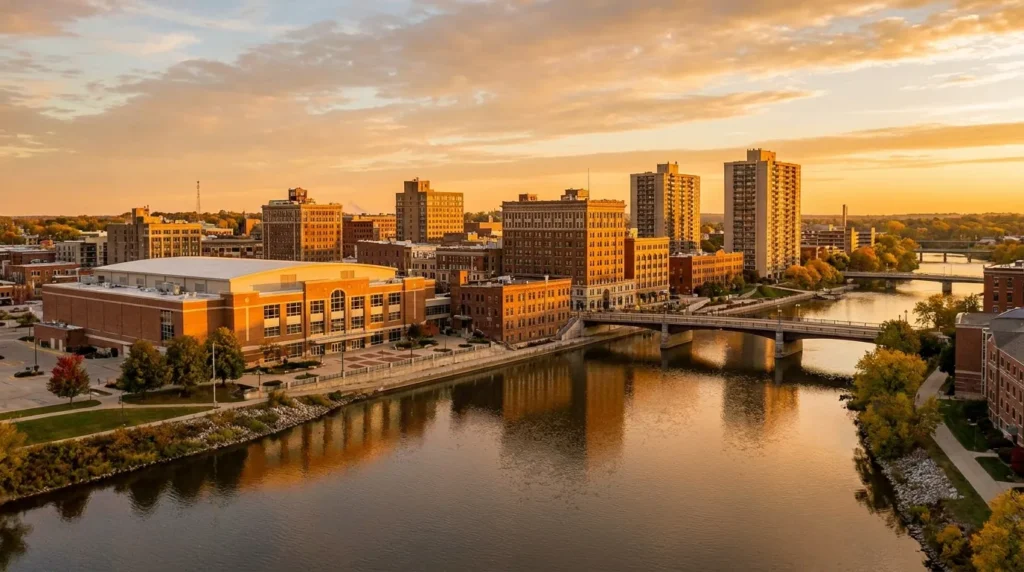
Waterloo offers John Deere history, the Cedar River, and an unexpected multicultural scene

Historic home of John Deere and the Sullivan Brothers Iowa Veterans Museum, Waterloo anchors its cultural life in a revitalized downtown featuring Riverloop Plaza, a farmers market, and the Grout Museum District.

Waterloo is an industrial city in northeast Iowa, with John Deere Tractor Cab Assembly Operations and Tyson Foods among its largest employers. The downtown, bisected by the Cedar River, has been redeveloped over the past two decades with the Riverloop Public Expression Plaza, a riverfront amphitheater, and the My Waterloo Days Festival each June.

The Grout Museum District brings together four venues: the Grout Museum of History and Science, the Sullivan Brothers Iowa Veterans Museum, the Bluedorn Science Imaginarium, and the Rensselaer Russell House. The John Deere Tractor and Engine Museum on West Westfield Avenue is free to visit and draws visitors from across the Midwest.

For everyday life, the RiverLoop Amphitheatre hosts free concerts, Lost Island Waterpark serves as a family destination in summer, and Hawkeye Community College is situated on the city's west side. The Cedar Valley Trails system connects Waterloo to Cedar Falls via more than 100 miles of paved bike paths.

  1. 1["Grout Museum of History and Science"
  2. 2"Sullivan Brothers Iowa Veterans Museum"
  3. 3"Waterloo Center for the Arts (including Haitian Art Collection)"
  4. 4"Lost Island Theme Park"
  5. 5"Phelps Youth Pavilion"
  6. 6"John Deere Tractor and Engine Museum"
Nightlife3.0 / 10
Parks & green spaces
  • ["George Wyth State Park"
  • "Cedar River Greenbelt"
  • "Hartman Reserve Nature Center"
  • "Riverview Park"
  • "Gates Park"
  • +1 more

Latest posts

Posts about Iowa

Coverage and updates related to this destination.

Showing content from Iowa, as there is no specific data for Waterloo yet.