Visto n' Visa
Blog
Notícias e artigos
Destinations
Careers
Immigrants

Want to live and work in Mason City?

Personalized immigration plan with eligible visas, costs, and next steps for your goal!

If you are not eligible, you will know exactly why and what to do to improve your approval chances.

Save up to 12 hours in meetings

No pointless assessments.

Save up to 90%

Save money on vague or unfocused consultations

Avoid Fraud and Mistakes

One mistake can cost you your visa

Total Impartiality

Zero commercial bias

Decide with peace of mind

No toxic urgency

Fast and Accurate

Answers in minutes, no guesswork

Predominantly White Population with Growing Latino Community and Refugee Presence

Mason City has about 27,000 residents, an aging profile, a white majority of German and Scandinavian origin, and a growing Latino minority that now approaches 8% of the population.

The population is around 27,000 people, with a median age above the national average. The predominant ethnic heritage traces back to German, Norwegian, and Dutch immigrants who settled northern Iowa in the 19th century, and surnames like Hanson, Schmidt, and Jensen remain common in school and business directories today.

The most visible minority group is Latino, made up primarily of workers at meat processing and cement plants and their families. Markets, churches, and bilingual services are already part of the landscape. There is also a smaller presence of African Americans, Asians, and some families resettled through federal refugee programs.

Religiously, the city is predominantly Christian, with a strong Lutheran, Catholic, and Methodist presence. Cultural diversity is growing slowly but is noticeable, especially in the public schools, where the number of students with English as a second language increases year after year.

Languages spoken
  • English
  • Spanish
Main religions
  • Lutheranism
  • Catholicism
  • Methodism
  • Other Protestant denominations
  • No declared religion

Cost of Living Well Below the US National Average

Mason City ranks among the most affordable cities in the American Midwest: housing, groceries, and services consistently fall below the national average, and taxes are moderate.

Housing is the item that most favors those who move to Mason City. Three-bedroom homes in decent neighborhoods come at prices that in large cities would barely cover a studio apartment, and a one-bedroom apartment rents at a range accessible even for those earning state minimum wage.

Groceries, transportation, and basic bills fall below the national average. Gasoline is cheaper than on the coasts, electricity costs more in winter due to heating, and health insurance follows the high US standard. Iowa's state income tax is progressive and moderate, with no municipal income tax.

Eating out is affordable at chain restaurants and local diners, and more expensive at the few fine dining spots downtown. For families, the monthly budget stretches much further here than in any mid-sized city on the East Coast or the West Coast.

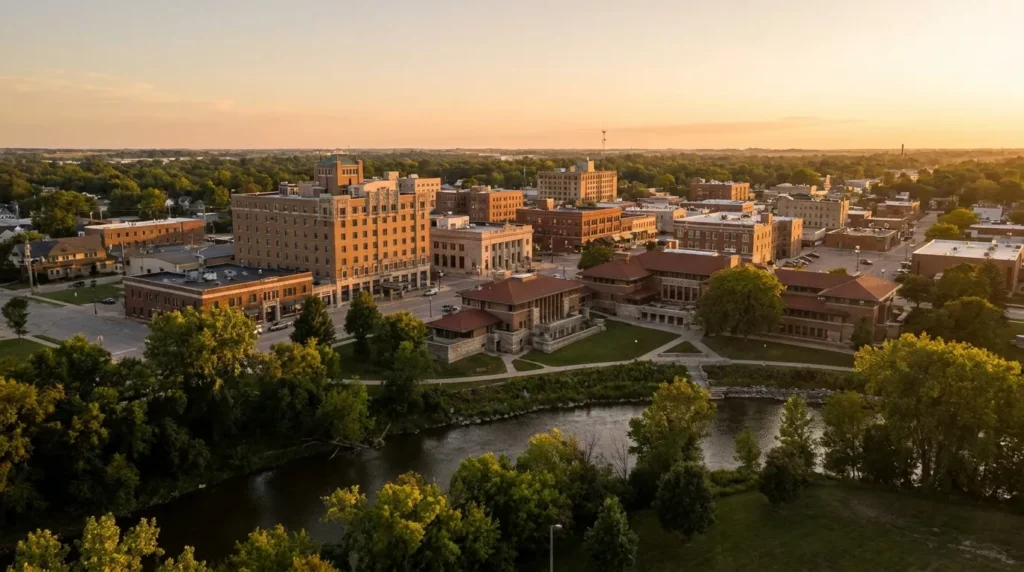
Mason City

Accessible Real Estate Market with Older Housing Stock and Quiet Residential Neighborhoods

The housing stock is dominated by single-family homes built between 1900 and 1970, with low prices, higher property taxes, and well-defined neighborhoods around the downtown area and the lakes.

Most of the city consists of one- or two-story wood-frame houses with basements, detached garages, and yards. The most sought-after neighborhoods are around East Park, Willow Creek, and the southern shore of Clear Lake Drive, with tree-lined streets and well-rated schools within a few blocks.

Those who prefer apartments find modest options near downtown and North Iowa Area Community College, generally in low-rise buildings without elevators. Monthly rent for a family home is usually less than the payment on a new car, making homeownership a popular choice even among young families.

The main consideration is the age of the buildings: many homes need electrical updates, thermal insulation, and roof replacement. A home inspection before purchase is essential, and winter heating costs must factor into budget calculations.

Recommended neighborhoods
  • East Park
  • Willow Creek
  • South Federal
  • Forest Park
  • Highland Park

Heavy Industry, Healthcare, and Food Processing Sustain the Local Economy

Mason City's economy is built on cement, meat processing, a regional hospital, and agricultural logistics, with average wages and stable opportunities for technical and operational workers.

The local economy revolves around three major verticals: cement and construction materials, food processing, and healthcare. Holcim operates one of the largest cement plants in the United States in the city, and Prestage Foods runs a pork processing plant that employs hundreds of people in shifts.

MercyOne North Iowa Medical Center is the single largest employer, offering nursing, technician, administrative, and support service positions. There are also jobs in logistics, agriculture, retail, and at North Iowa Area Community College, which trains most of the local technical workforce.

Average wages fall below those in major US cities, but the cost of living offsets much of the difference. For newly arrived immigrants, factories and processing plants are usually the entry point, with quick hiring and extended hours.

Dominant sectors
  • Cement and construction materials industry
  • Food processing
  • Healthcare and hospitals
  • Technical and community education
  • Agricultural logistics and distribution
Major employers
  • MercyOne North Iowa Medical Center
  • Holcim (cement plant)
  • Prestage Foods of Iowa
  • North Iowa Area Community College
  • Mason City Community School District
  • +1 more

Strong Community College, Functional Public Schools, and Limited Higher Education Options

The system centers on Mason City Community School District schools and North Iowa Area Community College, which trains technicians for the region's industry and healthcare sectors.

The Mason City Community School District serves most of the city's children, with neighborhood schools, school buses, and ESL programs for students with English as a second language. Mason City High School, known as the Riverhawks, offers technical programs, competitive sports, and a traditional marching band tied to the city's musical heritage.

There are also private Catholic schools, aimed primarily at Lutheran and Catholic families. For those seeking bilingual or alternative education, options are limited and depend on commuting to larger cities or homeschooling.

In higher education, North Iowa Area Community College is the main institution, offering technical programs in health, industry, agriculture, and technology, as well as transfer programs to state universities. For a four-year degree, most students go to the University of Iowa, Iowa State University, or the University of Northern Iowa.

Notable universities
  • North Iowa Area Community College
  • Hamilton College (regional campus)
  • Waldorf University (about 30 minutes away, in Forest City)

MercyOne Is the Reference Hospital for All of Northern Iowa

MercyOne North Iowa Medical Center concentrates the main hospital services for the region, with specialized clinics, an emergency room, and a partnership with the MercyOne network statewide.

MercyOne North Iowa Medical Center is the largest hospital in the region and serves as a reference center for several smaller cities in northern Iowa. It has a maternity ward, ICU, cardiology, oncology, orthopedics, and a 24-hour emergency room, as well as outpatient clinics spread throughout the city.

For immigrants with employer-sponsored health insurance, access is generally good and appointment wait times are reasonable compared to major urban centers. Without insurance, emergency care is guaranteed by law, but subsequent costs can be high, as in any part of the United States.

There are also community clinics and state programs such as the Iowa Health and Wellness Plan, which covers low-income adults. Dental and vision care generally requires specific insurance or out-of-pocket payment. Mental health resources in the city are limited, with common waiting lists for psychologists and psychiatrists.

Mason City

Small City with Low Crime Rates and Few Areas of Concern

Mason City is considered safe by American standards, with violent crime rates below the national average and problems concentrated in theft, drugs, and domestic incidents.

The safety profile is typical of a mid-sized Midwest city: low violent crime, occasional vandalism and theft, and localized issues related to drugs and domestic incidents. Policing is municipal with good coverage, and response times are short due to the city's size.

Residential neighborhoods like East Park, Willow Creek, and the lake areas are considered very quiet. Downtown is safe during the day and during event hours, with pedestrian activity and active commerce. At night, some areas near bars and the industrial zone may feel deserted, but rarely present real risk.

As in any American city, the practical recommendation is to keep doors locked, avoid leaving valuables visible in the car, and stay alert on poorly lit streets late at night. For families with children, the general feeling is one of calm and a freedom rarely found in larger cities.

Safer neighborhoods
  • East Park
  • Willow Creek
  • Forest Park
  • Highland Park
  • Historic downtown during the day
Areas to avoid
  • Parts of the southern industrial zone at night
  • Isolated areas of the eastern industrial park after hours

Car-Dependent City with Regional Airport and Highway Connections to Minneapolis and Des Moines

Mason City lacks robust public transit: everything depends on a personal vehicle, but internal distances are short and the location on I-35 and US-18 makes regional travel convenient.

Daily life runs on cars. Wide streets, abundant parking, and very low congestion make getting around the city simple, even in harsh winter conditions. The municipal bus system is small and serves basic routes, catering mainly to seniors and non-drivers.

Mason City Municipal Airport (MCW) has limited commercial flights, generally connecting to Chicago through regional partnerships. For international flights or more options, Minneapolis-St. Paul Airport (MSP, about two hours away) and Des Moines (DSM, about two and a half hours away) are the practical alternatives.

Interstate 35 passes a few kilometers away, connecting directly to Minneapolis to the north and Des Moines and Kansas City to the south. US-18 crosses the city east to west. Bike lanes exist in select stretches, mainly in parks and around the River City Trail, but do not cover the entire urban grid.

Airports
  • MCW — Mason City Municipal Airport
  • MSP — Minneapolis-Saint Paul International (regional, about 2h away)
  • DSM — Des Moines International (regional, about 2h30 away)
  • Bike infrastructure

Climate

Mason City

Birthplace of Music, Prairie School Architecture, and Midwest Agricultural Tradition

Mason City's cultural identity blends the musical heritage of composer Meredith Willson, Frank Lloyd Wright buildings, band festivals, and the hearty cuisine typical of the American Midwest.

Mason City is proudly known as the hometown of Meredith Willson, author of the musical The Music Man, set in an idealized Iowa that blends fiction and local reality. The Music Man Square, downtown, recreates scenes from the musical and receives tourists year-round, and the North Iowa Band Festival fills the streets with music in early summer.

Architecture is another local point of pride. The Park Inn Hotel and the Stockman House, both designed by Frank Lloyd Wright, attract visitors and architects from around the world. The Rock Crest Rock Glen district has the largest collection of Prairie School homes in a single neighborhood in the United States.

At the table, the city follows the Midwest standard: meats, potatoes, corn, and dairy. Diners serve pancakes, hot dish, and bacon-heavy plates. Summer festivals revolve around fair food, live music, and parades, while winter brings hockey events, skiing, and year-end holiday gatherings.

Notable dishes
  • Hot dish (beef, potato, and corn casserole)
  • Pork tenderloin sandwich (breaded loin sandwich)
  • Roasted sweet corn on the cob
  • Loose meat sandwich
  • Hearty pancakes with bacon and maple syrup
Annual events
  • North Iowa Band Festival
  • North Iowa Fair
  • Music Man Square Festival
  • Mason City Farmers Market (seasonal)
  • Christmas by Candlelight Tour

Prairie School Architecture, Music Museums, and Lakes for Summer

The main attractions combine Frank Lloyd Wright's architectural heritage, museums dedicated to music, and parks that bring the downtown to life in the warmer seasons.

The main tourist highlight is the Prairie School architectural complex, featuring the restored Park Inn Hotel, the Stockman House, and the Rock Crest Rock Glen historic district. Guided tours showcase details by Frank Lloyd Wright and architects in his circle, and the visitors center operates year-round.

Music Man Square is a must-visit for those interested in the city's musical history, with sets from the musical, the Meredith Willson Museum, and the house where the composer grew up. For those who prefer nature, East Park and Willow Creek offer trails, picnic areas, and artificial lakes used for fishing, rowing, and ice skating in winter.

The Surf Ballroom, in neighboring Clear Lake, is a historic destination for rock and roll fans: it was where Buddy Holly performed his last show in 1959. Annual festivals celebrate the memory of the event and attract visitors from around the world in the winter and summer months.

  1. 1Park Inn Hotel (Frank Lloyd Wright)
  2. 2Stockman House
  3. 3Music Man Square and Meredith Willson Boyhood Home
  4. 4Charles H. MacNider Art Museum
  5. 5Rock Crest Rock Glen Historic District
  6. 6East Park
Parks & green spaces
  • East Park
  • Willow Creek Park
  • Georgia Hanford Park
  • Cliff Park
  • River City Trail

Small but Growing Latino Community and Scattered Resettled Refugee Presence

Immigrant diversity in Mason City is modest, led by Latinos working in industry and meat processing, with resettled families and Asian-origin healthcare professionals.

The largest immigrant community is Latino, predominantly of Mexican and Central American origin, formed over the last three decades around meat processing plants, the cement industry, and regional agriculture. Markets, taquerias, and Spanish-language churches are already part of daily life, especially around South Federal Avenue.

There is also a presence of Indian and Filipino healthcare professionals affiliated with MercyOne, families resettled through federal refugee programs over the years, and international students connected to North Iowa Area Community College. Together, these groups form a small but visible minority, especially in schools and local commerce.

Services specifically for immigrants are still limited, but Catholic, Lutheran, and state organizations offer support for ESL, basic legal counseling, and social assistance. The advantage of Mason City is the low cost of living and the possibility of buying a home within the first few years, something difficult in larger cities.

1,500
Foreign-born residents
estimated
Top countries of origin
  • Mexico
  • Guatemala
  • El Salvador
  • Philippines
  • India
  • Vietnam
  • Myanmar
Foreign consulates
  • Mexican Consulate General in Saint Paul (jurisdiction)
  • Guatemalan Consulate General in Chicago (jurisdiction)
  • El Salvador Consulate General in Minneapolis (jurisdiction)
  • Philippine Consulate General in Chicago (jurisdiction)
  • Indian Consulate General in Chicago (jurisdiction)
Community organizations
  • Catholic Charities of the Archdiocese of Dubuque
  • Lutheran Services in Iowa
  • Iowa Migrant Movement for Justice
  • North Iowa Area Community College — ESL programs
  • United Way of North Central Iowa

Latest posts

Posts about Iowa

Coverage and updates related to this destination.

Showing content from Iowa, as there is no specific data for Mason City yet.