Visto n' Visa
Blog
Notícias e artigos
Destinations
Careers
Immigrants

Want to live and work in Marshalltown?

Personalized immigration plan with eligible visas, costs, and next steps for your goal!

If you are not eligible, you will know exactly why and what to do to improve your approval chances.

Save up to 12 hours in meetings

No pointless assessments.

Save up to 90%

Save money on vague or unfocused consultations

Avoid Fraud and Mistakes

One mistake can cost you your visa

Total Impartiality

Zero commercial bias

Decide with peace of mind

No toxic urgency

Fast and Accurate

Answers in minutes, no guesswork

Demographics: Small City with a Strong Latino Presence and European Roots

Predominantly white population of European descent, with a significant Hispanic community that has grown since the 1990s around industrial employment.

Marshalltown's demographic profile has changed considerably over the past three decades. The city was almost entirely white, populated by descendants of German, Irish, and Scandinavian settlers, until the 1990s, when the JBS plant (formerly Swift) began recruiting Latino workers for its meatpacking operations. Today roughly one-third of the population is Hispanic, primarily of Mexican and Central American origin.

That composition is visible throughout downtown commerce and in the city's southern neighborhoods: Mexican bakeries, taquerias, specialty markets, and churches with Spanish-language services. A small but growing Karen-Burmese community, refugees resettled in the 2000s, is also present and works mainly in food processing plants.

The median age is younger than the Iowa average, driven by Latino families. English and Spanish are the two dominant languages on the street, with functional bilingualism in nearly all downtown businesses.

Languages spoken
  • English
  • Spanish
  • Karen
  • Burmese
Main religions
  • Roman Catholic
  • Lutheran
  • Methodist
  • Baptist
  • Hispanic Evangelical

Low Cost of Living by American Standards

Marshalltown is one of Iowa's most affordable cities, with rent, housing, and basic expenses well below the US national average.

The cost of living in Marshalltown ranks among the lowest for a city with full urban infrastructure in the United States. A two-bedroom apartment typically rents well below what is paid in Des Moines or Cedar Rapids, and full houses are affordable even for families with median industrial incomes.

Food, fuel, and basic utilities follow the rural Midwest pattern: inexpensive compared to large cities, with the added advantage of proximity to local agricultural producers. Supermarkets such as Hy-Vee and Fareway offer competitive prices, and farmers markets run through the summer.

The main drawback is winter heating: long, harsh winters mean high natural gas bills from November through March. Iowa property taxes are moderate, and state incentives exist for first-time homebuyers.

Marshalltown

Affordable Housing in Traditional Residential Neighborhoods

Older single-family homes dominate the market, with prices well below the national average and inventory concentrated in established neighborhoods.

The Marshalltown real estate market is dominated by wood-frame single-family homes, many built between 1900 and 1960, on generous lots with yards and garages. Purchase prices are very low by American standards: working-class families can buy with standard financing.

Neighborhoods on the north side of the city, near Riverview Park and the Iowa Veterans Home, tend to have older, well-maintained houses. The south and southeast concentrate more affordable housing and the bulk of the Latino community. Apartments make up a small share of the housing stock, concentrated near downtown and in newer complexes near US-30.

After the 2018 tornado, several areas were rebuilt with new homes, and the city offers programs to incentivize renovation of historic downtown properties. Those arriving to work in the factories typically rent first in central neighborhoods and buy after a year or two.

Recommended neighborhoods
  • North End
  • Riverview Park area
  • Downtown Historic District
  • Woodbury
  • South Center Street corridor

Stable Industrial Jobs in Meatpacking, Heavy Machinery, and Healthcare

Economy anchored by three major industrial employers and a regional hospital, with accessible entry-level wages for workers arriving without advanced qualifications.

The Marshalltown labor market is predominantly industrial. JBS operates one of the region's largest pork processing plants and employs thousands of people, serving as the main entry point for newly arrived immigrants. Lennox International has a heating and cooling equipment factory in the city, and Emerson (formerly Fisher Controls) manufactures high-precision industrial valves.

UnityPoint Health Marshalltown is the regional hospital and one of the city's largest white-collar employers, alongside Marshalltown Community College and the public school district. For those with limited English, factory floor jobs are the most common path in, offering formal benefits, union membership, and frequent overtime.

Downtown commerce and the service sector, including mechanics, construction, and restaurants, have offered entrepreneurial opportunities to the Hispanic community over the past few decades, with several dozen Latino-owned businesses now operating in the city.

Dominant sectors
  • Meat processing
  • Heavy equipment manufacturing
  • Healthcare
  • Education
  • Retail
  • +1 more
Major employers
  • JBS USA
  • Lennox International
  • Emerson Automation Solutions (Fisher)
  • UnityPoint Health Marshalltown
  • Marshalltown Community School District
  • +1 more

Robust Public Schools and a Regional Community College

Public school system with bilingual programs, a two-year community college, and proximity to state universities.

The Marshalltown Community School District operates the city's public schools, with Marshalltown High School as the single secondary campus. Given the district's demographic composition, it has established bilingual programs and ESL courses for newly arrived students, an important advantage for immigrant families.

Marshalltown Community College, part of the Iowa Valley Community College District, offers two-year technical degrees and transfer pathways to four-year universities. The most in-demand programs are nursing, industrial manufacturing, and information technology, aligned with the local job market.

For four-year higher education, the main options within about an hour and a half are Iowa State University in Ames, the University of Iowa in Iowa City, and the University of Northern Iowa in Cedar Falls, all with strong international exchange programs and affordable in-state tuition.

Notable universities
  • Marshalltown Community College
  • Iowa State University (Ames, 60 min)
  • University of Northern Iowa (Cedar Falls, 90 min)

Regional Hospital and Accessible Primary Care

UnityPoint Health Marshalltown is the regional hospital, with 24-hour emergency care, maternity services, and specialties. Outpatient access is reasonable.

The local health system centers on UnityPoint Health Marshalltown, a community hospital with 24-hour emergency care, a surgical center, maternity services, and several clinical specialties. For complex cases, patients are frequently referred to UnityPoint in Des Moines or to the university hospitals in Iowa City.

Primary care is available through UnityPoint's own clinics, Primary Health Care (a federally qualified health center with bilingual services and income-based fees), and private practices. Primary Health Care is the most important resource for uninsured immigrants, as it operates on a sliding-scale fee structure and provides interpreters.

As throughout the United States, the system operates through private health insurance, Medicaid (for low-income residents), or Medicare (for seniors). Workers at JBS, Lennox, or Emerson receive employer-sponsored plans; those without insurance can access the community clinic or Iowa's Hawki program for children.

Marshalltown

Safe City by American Standards, with Quieter and Busier Areas

Crime rates within the average for small Midwestern cities, with quiet residential neighborhoods and some more isolated industrial areas.

Marshalltown is considered safe by American standards for cities of comparable size. Violent crime is low and concentrated in domestic incidents or drug-related cases, while property crimes (vehicle theft, residential break-ins) track the Iowa average.

Residential neighborhoods to the north and west of downtown, including the Riverview Park and Marshall Country Club areas, are traditionally quiet. Downtown is safe during the day and on event nights, but as with any urban center, normal nighttime awareness is advisable.

Isolated areas near industrial plants and empty stretches along the railroad tracks see less activity after business hours and are best avoided on foot at night. The municipal police maintain a visible presence and operate a community policing program in neighborhoods with higher immigrant populations.

Safer neighborhoods
  • North End
  • Riverview Park area
  • Marshall Country Club area
  • Woodbury
  • West End residential
Areas to avoid
  • Isolated industrial stretches to the south near JBS after business hours
  • Empty areas along the railroad tracks at night

Car-Oriented City with Amtrak Service and Road Connection to Des Moines

Mobility depends almost entirely on a personal vehicle; an Amtrak station on the California Zephyr line and limited municipal bus service are available.

Marshalltown is designed around the car. Internal distances are short, but continuous sidewalks and bike infrastructure are limited outside the downtown core. Nearly every resident depends on a vehicle for work, shopping, and school, and parking is free across most of the city.

The Amtrak station on the California Zephyr line provides daily connections east to Chicago and west to Denver and the Bay Area, which is rare for a city of this size. Local public transit is operated by Marshalltown Municipal Transit, with weekday bus routes within the city that are adequate for seniors and non-drivers but limited for commuters.

The nearest commercial airport is Des Moines International (DSM), about an hour's drive via US-30 and I-35. For international flights, most residents travel to Chicago O'Hare or Minneapolis-Saint Paul.

Airports
  • MIW — Marshalltown Municipal Airport (general aviation)
  • DSM — Des Moines International (60 minutes)
  • CID — Cedar Rapids (90 minutes)

Climate

Marshalltown

Midwestern Culture with a Strong Latino Flavor in Commerce and Food

Typical small Iowa city cultural life, with community events, strong school sports, and an increasingly Mexican culinary scene.

Marshalltown's culture blends the traditional Midwest, school sports, Lutheran and Methodist churches, and Fourth of July celebrations with the Latino life that has flourished since the 1990s. The Marshall County Courthouse is the focal point for civic celebrations, and downtown has gained new energy with cafes, a brewery, and authentic Mexican restaurants.

The Iowa Veterans Home, a century-old state institution, is part of the local identity and organizes community events throughout the year. The city also has the Orpheum Theater Center, a restored 1949 venue that hosts theater, music, and independent film.

On the food side, options range from authentic taquerias serving Jalisco- and Guerrero-style cooking to traditional steakhouses and the iconic Taylor's Maid-Rite, a must-stop for the loose-meat sandwich, a regional Iowa dish served there since 1928.

Notable dishes
  • Loose-meat sandwich (Maid-Rite)
  • Carnitas and al pastor tacos
  • Pork tenderloin sandwich
  • Iowa sweet corn
  • Mexican birria
Annual events
  • Marshalltown Oktoberfest
  • Fiestas Patrias (September)
  • Linn Creek Family Fest
  • Marshall County Fair
  • Downtown Christmas Stroll

Attractions Centered on the Historic District, Parks, and Civic Landmarks

A Neo-Gothic courthouse, a restored theater, local museums, and good urban parks make up the city's main attractions.

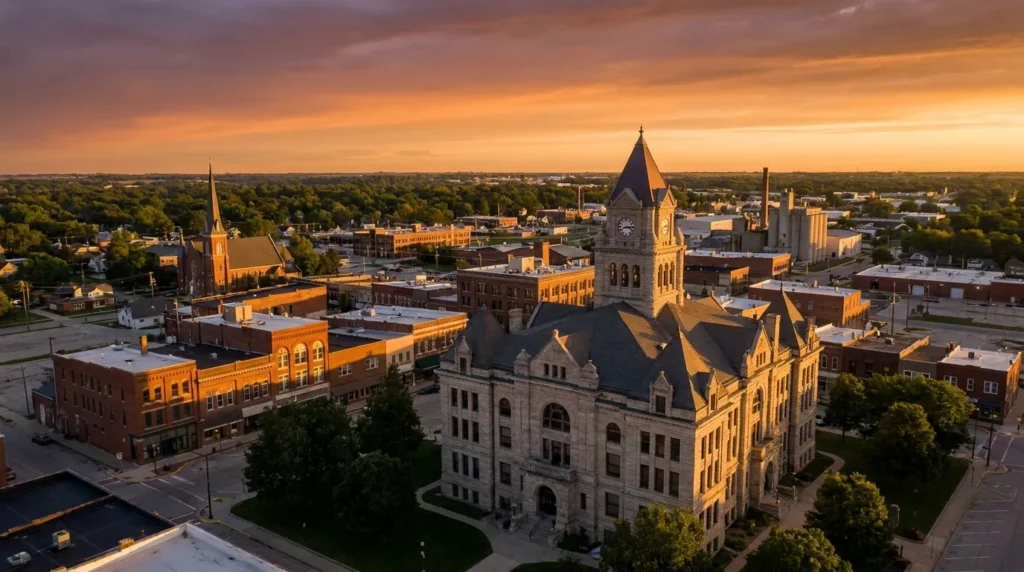
The Marshall County Courthouse is Marshalltown's most recognizable attraction, an 1886 Neo-Gothic building listed on the National Register of Historic Places and rebuilt after the 2018 tornado. The Orpheum Theater Center, a restored 1949 Main Street venue, is the heart of the cultural scene with theater, music, and film programming.

The Historical Society of Marshall County operates a local history museum with exhibits on county settlement, early industry, and the arrival of immigrant communities. Grimes Farm and Conservation Center, maintained by the county, is a nature reserve with hiking trails, bird watching, and educational programs.

For sports and outdoor recreation, the Iowa River Trail connects several parks, and Riverview Park is the city's main green space, with playgrounds, sports fields, and a picnic area along the Iowa River.

  1. 1Marshall County Courthouse
  2. 2Orpheum Theater Center
  3. 3Historical Society of Marshall County Museum
  4. 4Grimes Farm and Conservation Center
  5. 5Iowa Veterans Home grounds
  6. 6Taylor's Maid-Rite (since 1928)
Parks & green spaces
  • Riverview Park
  • Grimes Farm and Conservation Center
  • Iowa River Trail
  • GrimesFarm Pollinator Habitat
  • Mowry Pioneer Park
  • +1 more

Established Immigrant Community with a Strong Latino Presence and Burmese Refugees

About one-fifth of the city's population was born outside the United States, with Mexicans and Central Americans forming the dominant group and a growing Karen-Burmese community.

Marshalltown is an emblematic case of a Midwestern industrial city transformed demographically over three decades by immigration. The Hispanic community, composed mainly of Mexicans from Jalisco, Michoacan, and Guerrero, along with Salvadorans, Guatemalans, and Hondurans, is now a structural part of the city's economy and identity, with churches, bilingual schools, its own businesses, and growing political influence.

In the 2000s, federal refugee resettlement programs brought Karen and Karenni families from Myanmar, who settled primarily around industrial jobs and formed a small but cohesive community with a Karen Baptist church and their own organizations.

For newcomers, the most useful resources are Primary Health Care (a federal clinic with interpreters), schools with ESL programs, and Catholic parishes with Spanish-language masses. A Mexican consular mobile service visits Iowa periodically, with permanent consulates in Omaha (Nebraska), Chicago, and Saint Paul (Minnesota) serving residents from other countries as well.

5,500
Foreign-born residents
estimated
Top countries of origin
  • Mexico
  • El Salvador
  • Guatemala
  • Honduras
  • Myanmar (Burma)
  • Sudan
  • Vietnam
Foreign consulates
  • Mexican Consulate General in Omaha (NE) — jurisdiction includes Iowa
  • Salvadoran Consulate General in Aurora (IL)
  • Guatemalan Consulate General in Chicago (IL)
  • Honduran Consulate General in Chicago (IL)
  • Thai Consulate in Chicago (regional jurisdiction)
Community organizations
  • Primary Health Care Marshalltown (federal bilingual clinic)
  • Iowa Migrant Movement for Justice (Des Moines)
  • LULAC Council 308 Marshalltown
  • Catholic Charities of the Archdiocese of Dubuque
  • Marshalltown Education Partnership (ESL and family liaison programs)

Latest posts

Posts about Iowa

Coverage and updates related to this destination.

Showing content from Iowa, as there is no specific data for Marshalltown yet.