Visto n' Visa
Blog
Notícias e artigos
Destinations
Careers
Immigrants

Want to live and work in Iowa City?

Personalized immigration plan with eligible visas, costs, and next steps for your goal!

If you are not eligible, you will know exactly why and what to do to improve your approval chances.

Save up to 12 hours in meetings

No pointless assessments.

Save up to 90%

Save money on vague or unfocused consultations

Avoid Fraud and Mistakes

One mistake can cost you your visa

Total Impartiality

Zero commercial bias

Decide with peace of mind

No toxic urgency

Fast and Accurate

Answers in minutes, no guesswork

Iowa City Population: Young, Cosmopolitan, and Relatively Diverse

About 78% white, 8% Asian (strong international student presence), 7% Black, 6% Hispanic. Students from around the world. More diverse than the rest of Iowa.

Iowa City has a different ethnic profile from the rest of the state due to the university. About 78% of the population is white, 8% Asian, 7% Black, and 6% Hispanic. The Asian community is large for a city of this size, with Chinese, Korean, Indian, Vietnamese, and Taiwanese students and researchers connected to the University of Iowa. Asian markets (Hy-Vee has a dedicated section, alongside Oasis Falafel and Asia Market) and temples serve the community.

The Black community includes long-established African Americans, students and professionals in medicine and law, and African refugees (Sudanese, Congolese, Somali) who settled through resettlement programs. The Hispanic population has grown over recent decades, with Mexican, Salvadoran, and Guatemalan communities. The overall diversity is well above the Iowa average, driven in part by graduate students in engineering, sciences, medicine, and the Iowa Writers' Workshop.

Religious life covers the full spectrum. Large Catholic parishes (St. Mary's, St. Patrick's), Lutheran, Methodist, Presbyterian, and Episcopal congregations are present. There are mosques (Islamic Center of Iowa City), a Hindu temple (Hindu Temple of Eastern Iowa), a Sikh gurdwara, a Buddhist temple, a synagogue (Agudas Achim), and several evangelical churches. Politics lean strongly Democratic, in contrast to the state's rural areas. The city is widely known for being inclusive and progressive.

Languages spoken
  • English
  • Spanish
  • Mandarin and Cantonese
  • Korean
  • Hindi and Telugu
  • +2 more
Main religions
  • Protestant Christian (Lutheran, Methodist, Presbyterian, Episcopal)
  • Catholic Christian
  • No religion
  • Muslim
  • Hindu
  • +2 more

Cost of Living in Iowa City: Higher Than Other Iowa Cities, Still Affordable

Rents have risen due to student demand. Food and gas are standard. Moderate state taxes. Heating bills are significant in winter. Better restaurant options than other cities in the state.

Iowa City is more expensive than other Iowa cities of comparable size due to student demand. A one-bedroom apartment runs between USD 900 and USD 1,400 per month, with newer buildings near campus (Hawks Ridge, Aspire, Latitude) reaching USD 1,500. A three-bedroom rental house typically falls between USD 1,500 and USD 2,500. Purchasing is more difficult than in Cedar Rapids: a modest home in Manville Heights, Goosetown, or Northside starts around USD 240,000 to USD 380,000.

Grocery options include Hy-Vee, New Pioneer Co-op (organic, local cooperative), Trader Joe's, Aldi, and Fareway. New Pi, as the co-op is locally known, is a local institution stocking organic and locally sourced products. A meal at a popular restaurant runs USD 13 to USD 22. The city has better dining options than other Iowa cities of comparable size: Pullman Bar and Diner, Hamburg Inn No. 2, Bluebird Diner, Devotay, and Atlas. Craft breweries (Big Grove, Backpocket, Wilson's Orchard) are well established.

Iowa levies a state income tax of up to 5.7%. Sales tax in Iowa City is around 7%. The electric bill with MidAmerican Energy is reasonable; natural gas heating in winter adds up. Health insurance without employer coverage is expensive, though University of Iowa Health Care and UIHC employees receive excellent plans. International students typically purchase a plan through the university. A significant portion of the population walks or cycles, which reduces transportation costs considerably.

86Cost index (US = 100)14% below US average
CategorySingleCoupleFamily (2 + 2)
iHousing$1,118$1,290$1,634
iFood$326$654$1,187
iTransport$430$732$947
iHealthcare$241$482$903
iChildcare$1,566
iOther$732$1,316$1,849
Monthly total$2,847$4,474$8,086

Source: U.S. BLS Consumer Expenditure Survey 2023 + BEA Regional Price Parities 2023 · Estimates in USD, monthly.

Housing in Iowa City: Historic Neighborhoods, University Apartments, and Coralville

Manville Heights, Goosetown, Longfellow, and Northside are traditional neighborhoods. Apartments near campus dominate the rental market. Coralville and North Liberty are suburban options.

Iowa City has well-defined neighborhoods. Manville Heights, on the west side, is the traditional upscale area, with large homes on tree-lined streets near UIHC. Goosetown and Northside have charming older homes. Longfellow, to the south, is family-friendly and tree-lined. Peninsula, to the north, is a newer planned neighborhood in New Urbanism style with homes of various typologies. College Hill, in the center, caters to students.

Apartments near campus dominate the rental market. Newer buildings such as Aspire, Hawks Ridge, Latitude, and Vue offer studio, one-, and two-bedroom units with gyms, pools, and access to Cambus (the free university bus system). Homes built between the 1900s and 1940s have been subdivided into apartments throughout several neighborhoods. Coralville, a city immediately adjacent to Iowa City on the north, offers newer and more affordable homes, with a shopping center (Coralville Mall) and easy access to I-80. North Liberty, farther north, has grown significantly in recent years.

The market moves quickly in August with the start of the academic year. A typical application requires a credit score, proof of income, and a co-signer for students or advance payment. Immigrants without a U.S. credit history may need a co-signer. Sites such as Zillow, Apartments.com, Iowa Realty, and the university's own service (UI Off-Campus Listings) cover the market. Cambus, the free UI bus system, shapes neighborhood choice for students without a car.

Recommended neighborhoods
  • Manville Heights (upscale, near UIHC)
  • Goosetown (historic)
  • Northside (charming, near campus)
  • Longfellow (family-friendly, tree-lined)
  • Peninsula (new, New Urbanism)
  • +3 more

Job Market in Iowa City: University, Hospital, and a Growing Startup Scene

University of Iowa and UIHC are the region's largest employers. Pearson, ACT, and Procter & Gamble also operate here. Growing startup scene. Unemployment is among the lowest in the U.S.

The University of Iowa is the region's largest employer, with more than 25,000 employees including hospital staff. UI Health Care (UIHC), the hospital and academic complex, is the second-largest employer in the state and a national reference center. Physicians, nurses, researchers, technicians, and administrative staff are in demand, with salaries above the Iowa average. The university also attracts international students and researchers from across the world.

Pearson Education has a large operation in Iowa City, serving as a hub for educational testing. ACT, Inc., the organization that administers the ACT standardized test, is headquartered in Iowa City. Procter & Gamble operates a plant in the city producing consumer goods including mouthwash. NCS Pearson, Genencor (biotechnology), and various technology and healthcare companies round out the employer base. The region has a growing startup scene, with incubators and the Iowa Startup Accelerator.

For those with basic English proficiency, there are positions in hospitality, restaurants, services, construction, the hospital (support roles), and retail. The minimum wage follows the federal rate of USD 7.25 per hour, though it is very rare to find employment paying that little. Positions typically start at USD 14 to USD 18 per hour. International students with an F-1 visa may work 20 hours on campus during the semester. CPT and post-graduation OPT are common pathways for further work authorization.

Dominant sectors
  • Higher education (University of Iowa)
  • Healthcare and medicine (UIHC, national reference)
  • Research and development
  • Educational testing (ACT, Pearson)
  • Biotechnology and pharmaceuticals
  • +2 more
Major employers
  • University of Iowa
  • UI Health Care / UIHC (hospital system)
  • Pearson Education
  • ACT, Inc.
  • Procter & Gamble
  • +5 more

Education in Iowa City: Well-Rated Public District and the State's Flagship University

Iowa City Community School District ranks among the best in the state. Regina Catholic is the main private option. University of Iowa is the public flagship, with world-renowned programs.

Iowa City Community School District is one of the best public districts in the state, with schools such as City High (in Longfellow), West High (on the west side), and Liberty High (in North Liberty). The schools serve a diverse population, with ESL, AP, and IB programs. The city maintains a strong commitment to public education. For suburban options, Clear Creek Amana and Solon Community Schools are also well regarded.

Private schools include Regina Catholic Education Center (elementary through high school), Heritage Christian School, and Iowa City Christian. Private school tuition ranges from USD 6,000 to USD 14,000 per year. Montessori and Waldorf programs are also available. Spanish and Mandarin immersion programs exist in some public schools. The diversity of the public school system here is among the highest in Iowa.

The University of Iowa, with approximately 30,000 students, is the state's public flagship. It has strong programs in medicine (top 30 nationally), law, creative writing (the Iowa Writers' Workshop is a world reference), engineering, nursing, dentistry (one of the best dental schools in the country), and public health. The Carver College of Medicine is highly respected. Tuition for Iowa residents is significantly lower than for out-of-state students. Kirkwood Community College, with a campus in Iowa City, offers technical programs and a pathway to a bachelor's degree.

Notable universities
  • University of Iowa (public flagship)
  • Kirkwood Community College (Iowa City Campus)
  • Cornell College (Mount Vernon, nearby)
  • Coe College (Cedar Rapids, nearby)
  • Mount Mercy University (Cedar Rapids, nearby)

Healthcare in Iowa City: UIHC Is a National Reference Center

UI Health Care is one of the best hospitals in the Midwest, with national recognition. Mercy Iowa City also serves the area. Excellent coverage by U.S. standards.

Iowa City has one of the best healthcare networks in the Midwest, anchored by University of Iowa Hospitals and Clinics (UIHC). With more than 800 beds, UIHC is a regional and national academic reference hospital, with centers of excellence in oncology (Holden Comprehensive Cancer Center), cardiology, transplantation (liver, kidney, heart), neurology, ophthalmology, and pediatrics (Stead Family Children's Hospital, a 14-floor facility). It serves complex cases from across the Midwest.

Mercy Iowa City, a Catholic hospital with about 200 beds, complements the system with emergency services, surgery, and maternity care. Several private clinics and specialists are concentrated near UIHC. The city has one of the highest physician-to-resident ratios in the state. Telemedicine is widely available, with UIHC serving patients throughout Iowa and neighboring regions. For extremely complex cases, transfer to Mayo Clinic in Rochester, about 3 hours away, is an option.

Iowa expanded Medicaid through the Iowa Health and Wellness Plan. The ACA Marketplace (HealthCare.gov) is the path for self-employed individuals. UIHC has a financial assistance program for patients without coverage or with low income. International students purchase a plan through UI Student Health Insurance. Refugees receive initial coverage through the Refugee Medical Assistance program. Prescriptions are available at CVS, Walgreens, Hy-Vee Pharmacy, and the UIHC Pharmacy.

Healthcare index70.0 / 100
  • Life expectancyyears at birth
    78.4yrs
  • Doctors per 1kpracticing physicians
    3.7
  • Health spendper capita, per year
    $13,473
  • Public systemoverall quality rating
    Good

Safety in Iowa City: One of Iowa's Safest Cities

Low crime overall. University city with typical issues: drinking, weekend vandalism, some theft near campus. Spring tornadoes and Iowa River flooding are the main environmental risks.

Iowa City is considered one of the safest cities in Iowa. The violent crime rate is low, below both the state and national averages. Neighborhoods such as Manville Heights, Goosetown, Longfellow, Peninsula, Coralville, and North Liberty are quiet. Walking downtown at night is safe, especially around the Ped Mall and near campus, where foot traffic remains heavy until late. The Iowa City Police, Coralville Police, and UI Department of Public Safety patrol the region.

The most common crimes are typical of a university city: bar fights, weekend vandalism on game days, bicycle theft (a serious issue requiring a U-lock), and theft from student apartments left unlocked. Public intoxication on game nights generates incidents. The university's Nite Ride program provides safe transportation at night. The city has strong programs against gender-based violence, including the Rape Victim Advocacy Program.

The real risk is meteorological. Tornadoes in spring (April through June) affect eastern Iowa, and Iowa City has experienced alerts and nearby touchdowns. In 2006, an F2 tornado struck the southern part of the city. Flooding of the Iowa River, which runs through campus, was catastrophic in 2008, closing theaters and several facilities for years. Winter brings blizzards, ice, and intense cold. Summer can bring heat waves and severe storms. A weather alert app is essential for anyone living in the area.

5.8
Homicides per 100k
per year
Safety index
66.0
Crime index
34.0
Safer neighborhoods
  • Northside Historic District
  • Goosetown
  • Manville Heights
  • Longfellow
  • Court Hill
  • Coralville (nearby)
Areas to avoid
  • Parts of Downtown (Pedestrian Mall) late at night during bar closing hours
  • Industrial areas near South Riverside Drive after business hours

Transportation in Iowa City: Excellent Transit by U.S. Standards, Strong Cycling Culture

Cambus (free UI system), Iowa City Transit, and Coralville Transit provide solid coverage. Cycling is a serious option. Eastern Iowa Airport (CID) in Cedar Rapids. I-80 runs through the region.

Iowa City has the best public transportation in Iowa. Cambus, the free system operated by the University of Iowa, serves campus, dormitories, and nearby neighborhoods. Iowa City Transit covers the rest of the city. Coralville Transit connects Coralville. Together, the three systems make it possible to live without a car in much of the region, something rare in the American Midwest. The Iowa City Transit fare is USD 1, with free transfers.

Cycling is a serious mode of transportation. Trails such as the Iowa River Corridor Trail, Court Hill Trail, and Clear Creek Trail connect neighborhoods across the city. Iowa City has been designated a Bicycle Friendly Community by the League of American Bicyclists. Several bike shops (World of Bikes, Geoff's Bike and Ski) serve residents and students. Uber and Lyft operate reliably. Traffic is light even during peak hours. Downtown parking is metered or available in garages.

Eastern Iowa Airport (CID), in Cedar Rapids about 30 minutes away, is the airport serving Iowa City. Flights connect to Chicago, Atlanta, Dallas, Denver, Minneapolis, and Phoenix. A connection through a major hub is required for international travel. There is no Amtrak service through Iowa City. I-80 runs through the city, providing access to Chicago (3.5 hours) and Omaha (4 hours). Greyhound and Burlington Trailways serve interstate bus routes.

17 min
Avg commute
55
Walkability
Airports
  • CID — The Eastern Iowa Airport (in Cedar Rapids, approximately 19 miles away)
  • Bike infrastructure

What the climate is like living in Iowa City

A university city in eastern Iowa with four distinct seasons, humid summers near 30 degrees Celsius, and harsh winters with heavy snowfall.

Summers in Iowa City are hot and humid. From June through August, highs range between 27 and 30 degrees Celsius, with regular afternoon thunderstorms. Central air conditioning is standard in apartments and campus housing, and occasional heat waves above 33 degrees occur in July.

Winters are long and severe. From December through March, lows regularly drop below minus 15 degrees Celsius, and the city accumulates around 80 centimeters of snow per season. Central heating, a heavy coat, waterproof boots, and winter tires are essential parts of daily life.

Spring and fall are brief but scenic on campus, with red foliage in autumn. For those relocating from warmer climates, the first winter is a genuine test of adaptation, but life centered around the university and its prestigious hospitals makes the city attractive to students and professionals alike.

Sunny days / year198 days
Avg high (°F)
  • 47°J
  • 52°F
  • 70°M
  • 79°A
  • 85°M
  • 91°J
  • 96°J
  • 97°A
  • 93°S
  • 84°O
  • 68°N
  • 59°D
Avg low (°F)
  • -10°J
  • -8°F
  • 11°M
  • 23°A
  • 35°M
  • 50°J
  • 57°J
  • 55°A
  • 44°S
  • 25°O
  • 14°N
  • D
Rainfall (")
  • 2"J
  • 2"F
  • 3"M
  • 3"A
  • 5"M
  • 4"J
  • 3"J
  • 3"A
  • 4"S
  • 3"O
  • 2"N
  • 2"D

Culture in Iowa City: Literature, Hawkeyes Football, Festivals, and a Progressive Scene

UNESCO City of Literature, home of the Iowa Writers' Workshop. Hawkeyes football energizes the city. Jazz Festival and Witching Hour. Strong restaurant and craft beer scene.

Iowa City is the only UNESCO City of Literature in the United States, a designation earned thanks to the Iowa Writers' Workshop, a master's program in creative writing founded in 1936, the first of its kind in the U.S. Alumni include Flannery O'Connor, Raymond Carver, Marilynne Robinson, John Irving, and dozens of Pulitzer Prize winners. Prairie Lights, a historic independent bookstore, regularly hosts readings by major authors. The Mill, a historic bar, served as a literary gathering place until it closed in 2020.

Iowa Hawkeyes football dominates the fall calendar. Kinnick Stadium, with more than 69,000 seats, fills every Saturday during the season. The Iowa Wave tradition, in which the entire stadium waves to the children at Stead Family Children's Hospital (which overlooks the stadium), has become an emotional symbol of the city. Basketball is also strong, with Carver-Hawkeye Arena supporting competitive men's and women's programs.

Cultural festivals animate the calendar throughout the year. The Iowa City Jazz Festival (July), free and held at the Pedestrian Mall, is a major event. The Witching Hour Festival (October) brings experimental art. The Mission Creek Festival combines music and literature. The Pedestrian Mall, in the center of the city, concentrates restaurants, bars, and shops. The Englert Theatre is the historic performance stage. Hancher Auditorium hosts Broadway productions and ballet. Restaurants such as Pullman, Hamburg Inn No. 2, Bluebird, Devotay, and Atlas anchor the dining scene.

Iowa City

What to see in Iowa City, a university town and literary capital

Iowa City is the cultural capital of the state, home to the University of Iowa and the Iowa Writers' Workshop. A UNESCO City of Literature, former territorial capital, with a strong literary and sports scene.

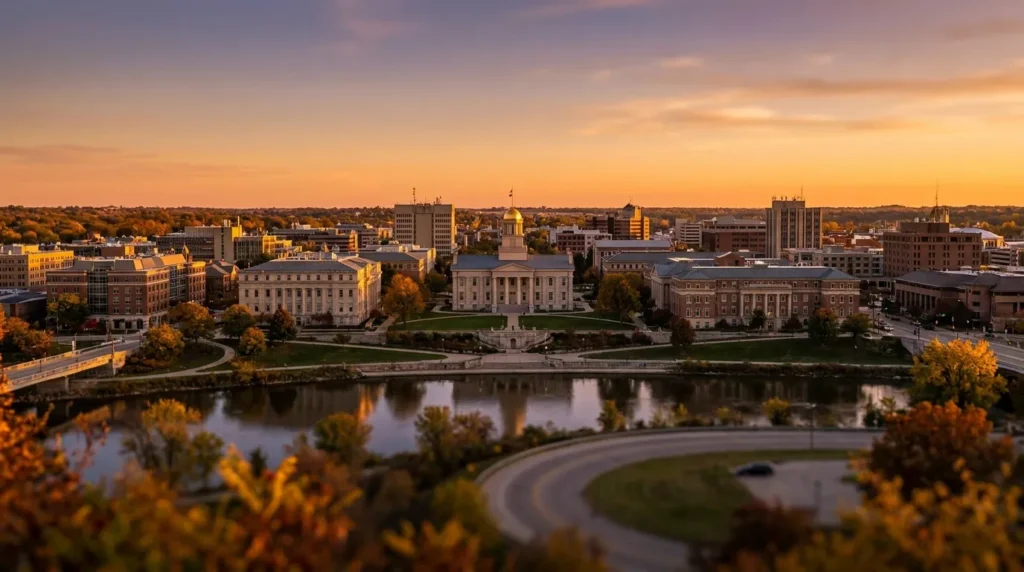
The Old Capitol Building, former seat of the territorial and state government, anchors the University of Iowa campus at the center. The Pentacrest groups four buildings around it. The Iowa Writers' Workshop, the oldest creative writing program in the United States, made Iowa City the first UNESCO City of Literature in the Americas in 2008.

The Stanley Museum of Art reopened in 2022 with a modern art collection and features a Jackson Pollock mural among its highlights. The Englert Theatre on Washington Street hosts concerts, while FilmScene screens independent cinema. Hancher Auditorium, rebuilt after the 2008 flood, hosts opera, dance, and concerts.

Kinnick Stadium, home of the Iowa Hawkeyes football team, holds 70,000 people on game days and is known for the Wave for the Kids tradition, in which the entire stadium waves to the Stead Family Children's Hospital next door. The Iowa River runs through downtown, with the Pedestrian Mall, City Park, and the Park Road Bridge. The Amana Colonies, a heritage German communal colony, are within 30 minutes.

  1. 1["Old Capitol Museum"
  2. 2"University of Iowa Pentacrest"
  3. 3"Stanley Museum of Art"
  4. 4"Englert Theatre"
  5. 5"FilmScene"
  6. 6"Iowa City Public Library"
Nightlife6.0 / 10
Parks & green spaces
  • ["Hickory Hill Park"
  • "City Park"
  • "Terry Trueblood Recreation Area"
  • "Waterworks Prairie Park"
  • "Wetherby Park"
  • +1 more

Latest posts

Posts about Iowa

Coverage and updates related to this destination.

Showing content from Iowa, as there is no specific data for Iowa City yet.