Visto n' Visa
Blog
Notícias e artigos
Destinations
Careers
Immigrants

Want to live and work in Council Bluffs?

Personalized immigration plan with eligible visas, costs, and next steps for your goal!

If you are not eligible, you will know exactly why and what to do to improve your approval chances.

Save up to 12 hours in meetings

No pointless assessments.

Save up to 90%

Save money on vague or unfocused consultations

Avoid Fraud and Mistakes

One mistake can cost you your visa

Total Impartiality

Zero commercial bias

Decide with peace of mind

No toxic urgency

Fast and Accurate

Answers in minutes, no guesswork

Council Bluffs population profile: Midwestern majority with a growing Hispanic base

A city of just over sixty thousand residents, predominantly white, with an established Hispanic community and a steady flow of new residents from the greater Omaha metro area.

The composition is typical of the American Midwest: a white majority with German, Irish, and Scandinavian roots, along with families whose presence dates to the railroad expansion of the 19th century. English dominates daily life, but Spanish appears in schools, businesses, and signage at several grocery chains.

The Latino community, composed primarily of Mexican and Central American residents, is concentrated in southern neighborhoods and plays a significant role in the meatpacking, construction, and service sectors. Smaller communities of African and Southeast Asian immigrants are also present, connected to refugee resettlement programs in the Omaha region over recent decades.

The median age is pulled upward by established families, but younger adults choosing Council Bluffs as a more affordable alternative to Omaha are contributing to gradual renewal. Protestant Christianity is the predominant faith, with a strong Catholic presence on the Hispanic side and evangelical congregations spread across various neighborhoods.

Languages spoken
  • English
  • Spanish
Main religions
  • Protestantism
  • Catholicism
  • No religion
  • Other Christian religions

Cost of living in Council Bluffs: among the most affordable in the metro area

Rent, groceries, and household bills fall below the national average. The household economy favors those who work in Omaha and live on the Iowa side.

Council Bluffs is regionally known as the affordable option within greater Omaha. One- and two-bedroom apartments in residential neighborhoods rent for considerably less than comparable units across the river, and single-family homes with yards are within reach for those with stable income and a solid credit history.

Grocers such as Hy-Vee, Walmart, and Aldi cover the essentials at competitive Midwestern prices. Fuel tends to be cheaper in Iowa than in coastal states, and natural gas used for winter heating carries a stable rate. Local restaurants and national chains offer meals at reasonable prices.

Iowa's sales tax sits near the national average, and a state income tax applies, unlike in some neighboring states. Even so, the combination of lower rent and manageable bills stretches income further here than in major cities on either coast.

86Cost index (US = 100)14% below US average
CategorySingleCoupleFamily (2 + 2)
iHousing$1,118$1,290$1,634
iFood$326$654$1,187
iTransport$430$732$947
iHealthcare$241$482$903
iChildcare$1,566
iOther$732$1,316$1,849
Monthly total$2,847$4,474$8,086

Source: U.S. BLS Consumer Expenditure Survey 2023 + BEA Regional Price Parities 2023 · Estimates in USD, monthly.

Housing in Council Bluffs: yards, single-family homes, and rents below the national average

A market dominated by single-family homes in quiet neighborhoods, with growing apartment supply near the river. Buying typically costs less than renting in Omaha.

Most of the housing stock consists of one- and two-story homes with garages and yards, built between the 1950s and 1990s. Neighborhoods such as Bloomer, Manawa, and the area around Lake Manawa attract established families and offer calm streets well suited for households with young children.

Rental options include modern apartment complexes near Interstate 80 and duplexes on residential streets. Prices vary with proximity to Omaha and main arterials, but remain significantly lower than Nebraska-side equivalents. Local real estate agencies and platforms such as Zillow and Apartments.com provide a clear picture of the market.

Homeownership is achievable for immigrants with documented income, a Social Security number, and an established credit history. Regional lenders such as Mutual of Omaha Bank and Iowa credit unions serve local buyers with competitive financing.

Recommended neighborhoods
  • Bloomer
  • Lake Manawa
  • Twin City
  • Loess Hills
  • Downtown Council Bluffs
  • +1 more

Job market in Council Bluffs: logistics, gaming, and technology operations

An economy tied to rail transportation, casinos, data centers, and the diversified industry of the greater Omaha metro. Operational positions are consistently available.

The city is the historic home of Union Pacific Railroad, which maintains a major rail operation there, and hosts casinos such as Harrah's and Ameristar, significant employers in hospitality, food service, and security. Distribution centers along Interstate 29 generate ongoing demand for drivers, forklift operators, and warehouse supervisors.

Google operates a data center in the city, and regional technology companies attract qualified professionals for infrastructure and operations roles. Methodist Jennie Edmundson Hospital employs healthcare workers, and the city government, public schools, and Iowa's state system also provide stable employment.

Crossing into Omaha expands the options considerably, with corporate headquarters including Berkshire Hathaway, Mutual of Omaha, Union Pacific, and ConAgra, alongside hospitals and universities. Residents of Council Bluffs who work across the river typically spend only a few minutes on the daily commute.

Dominant sectors
  • Logistics and transportation
  • Hospitality and gaming
  • Technology and data centers
  • Healthcare
  • Public administration
Major employers
  • Union Pacific Railroad
  • Google Data Center
  • Ameristar Casino
  • Harrah's Council Bluffs
  • Methodist Jennie Edmundson Hospital
  • +1 more

Education in Council Bluffs: solid public schools and accessible community colleges

Two school districts serve most families through public K-12 education. Community colleges operate within the city, and major universities are just a few miles away in Omaha.

The Council Bluffs Community Schools and Lewis Central Community Schools districts cover elementary and secondary education, with schools such as Abraham Lincoln High School and Thomas Jefferson High School. Bilingual programs operate in areas with high Hispanic enrollment, alongside varied extracurricular activities.

For technical training and early college coursework, Iowa Western Community College has a campus in the city offering vocational programs, two-year associate degrees, and transfer partnerships with universities. Tuition is affordable, particularly for Iowa residents.

Larger universities are located across the river. The University of Nebraska Omaha, Creighton University, and Bellevue University enroll students from Council Bluffs daily. For immigrants, the combination of free public K-12 education and low-cost community college is an important point of entry.

Notable universities
  • Iowa Western Community College
  • University of Nebraska Omaha
  • Creighton University
  • Bellevue University
  • Metropolitan Community College

Healthcare in Council Bluffs: a local general hospital and quick access to Omaha's medical centers

The city has its own general hospital and community clinics. Omaha's major medical centers are less than twenty minutes from downtown.

Methodist Jennie Edmundson Hospital is the city's primary hospital, offering an emergency department, maternity services, oncology, and outpatient care. CHI Health Mercy Council Bluffs, affiliated with a regional Catholic health network, and several private clinics in neighborhoods such as Manawa and Lake Manawa round out local options.

For complex cases, residents turn to Omaha hospitals including Nebraska Medicine, Methodist Hospital, and Children's Hospital and Medical Center, all within a short drive. Proximity to these facilities is one reason families with specific medical needs choose to live in Council Bluffs.

The U.S. system operates through private health insurance, typically provided by employers. For immigrants without coverage, community clinics in the area offer sliding-scale fees based on income. Pharmacies such as CVS and Walgreens are present in all major neighborhoods.

Healthcare index62.0 / 100
  • Life expectancyyears at birth
    78.4yrs
  • Doctors per 1kpracticing physicians
    3.7
  • Health spendper capita, per year
    $13,473
  • Public systemoverall quality rating
    Fair

Safety in Council Bluffs: a calm city with localized areas of concern

Crime rates are average for a Midwestern city of this size. Residential neighborhoods are quiet, with issues concentrated in specific areas near the older downtown core.

Council Bluffs presents the profile of a safe mid-size city, with residential neighborhoods where doors are left unlocked and children ride bikes in the street. Violent crime rates fall within the average for similarly sized Midwestern cities, and vehicle break-ins and property theft are the most common incidents.

Areas that warrant more attention are near the older downtown core and along certain stretches of West Broadway. Residential neighborhoods such as Loess Hills, Twin City, and the Lake Manawa area are considered safe for families. The municipal police department maintains community outreach programs with the Hispanic community, including bilingual officers.

For emergencies, 911 operates in English and with interpreters available. The city has its own fire department, and response times in residential areas are fast. Newly arrived immigrants generally settle in without major difficulties by choosing neighborhoods with strong school district ratings.

5.8
Homicides per 100k
per year
Safety index
50.0
Crime index
50.0
Safer neighborhoods
  • Lake Manawa
  • Dodge Park area
  • Twin City Plaza area
  • Neighborhoods near Iowa Western Community College
Areas to avoid
  • Industrial areas along South Main after dark
  • Isolated stretches near the railroad yards

Transportation in Council Bluffs: personal vehicle and a road network integrated with Omaha

A car-dependent city crossed by major interstates. Limited local bus service is available, and flights depart from Omaha's airport just minutes from the city center.

Day-to-day life depends on a personal vehicle. Council Bluffs is traversed by Interstates 29, 80, and 480, making it possible to reach Omaha in ten to fifteen minutes and Des Moines in just over two hours. Parking is abundant and free throughout most of the city.

Council Bluffs Transit provides basic local bus routes with connections to Omaha's Metro Transit system, but frequency and coverage are limited for those relying exclusively on public transportation. Rideshare apps such as Uber and Lyft operate normally, particularly in busier areas.

Eppley Airfield, Omaha's airport, is less than fifteen minutes from downtown Council Bluffs and offers direct flights to major U.S. hubs. For frequent travelers, proximity to the airport is one of the city's practical strengths.

20 min
Avg commute
34
Walkability
Airports
  • OMA — Eppley Airfield (in Omaha, across the river)
  • International airport
  • Bike infrastructure

What the climate is like living in Council Bluffs

Located in western Iowa on the Nebraska border, the city experiences four distinct seasons, with humid summers near 31 degrees Celsius and harsh winters.

Summers in Council Bluffs are hot and humid. Between June and August, highs range from 28 to 31 degrees Celsius, with regular thunderstorms. Heat waves pushing above 35 degrees Celsius occur in July. Central air conditioning is standard in homes throughout the area.

Winters are long and severe, with winds sweeping in from the Great Plains that intensify the cold. Between December and March, lows regularly drop below negative 15 degrees Celsius, and the city accumulates roughly 70 to 90 centimeters of snow per season. Central heating, a heavy coat, and winter tires are essential.

Spring and fall are brief. For those arriving from warmer climates, the first winter is a serious test of cold-weather adaptation, though the affordable cost of living and the quiet pace of a smaller city offset the challenge of the extreme seasonal swings.

Sunny days / year217 days
Avg high (°F)
  • 47°J
  • 58°F
  • 71°M
  • 83°A
  • 86°M
  • 96°J
  • 100°J
  • 100°A
  • 96°S
  • 85°O
  • 69°N
  • 57°D
Avg low (°F)
  • -4°J
  • -6°F
  • M
  • 22°A
  • 35°M
  • 50°J
  • 57°J
  • 55°A
  • 45°S
  • 23°O
  • 15°N
  • D
Rainfall (")
  • 1"J
  • 1"F
  • 2"M
  • 2"A
  • 4"M
  • 3"J
  • 3"J
  • 3"A
  • 3"S
  • 3"O
  • 1"N
  • 1"D

Culture in Council Bluffs: railroad history, riverfront parks, and a shared cultural life with Omaha

A city with its own identity rooted in the railroad and the Missouri River, sharing cultural life with Omaha. Local museums, parks, and festivals shape the annual calendar.

Council Bluffs history is tied to railroad expansion. The Union Pacific Railroad Museum downtown traces that story, and the Historic General Dodge House illustrates how influential families lived in the 19th century. Bayliss Park, at the heart of the city, serves as a gathering place with an illuminated fountain, community events, and seasonal markets.

Outdoor life is strong. Lake Manawa State Park offers a beach, trails, and picnic areas, while the Loess Hills, rare geological formations, draw hikers and cyclists. In summer, music and food festivals take place in parks and downtown, with a notable Hispanic community presence around events such as Cinco de Mayo.

For theater, larger museums, professional sports, and a more diverse dining scene, most residents cross the river to Omaha, home to the Henry Doorly Zoo, the Joslyn Art Museum, and Charles Schwab Field.

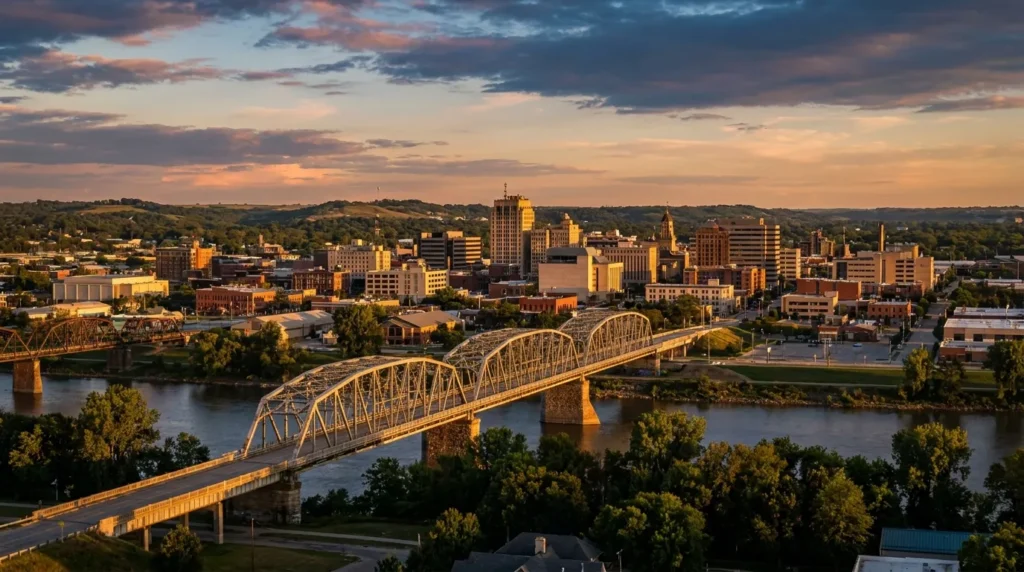
Council Bluffs

Council Bluffs, Iowa's side of the Missouri River

Council Bluffs forms a twin city with Omaha, connected by the Bob Kerrey Pedestrian Bridge, blending railroad history, riverfront casinos, and parks along the Missouri.

The Bob Kerrey Pedestrian Bridge, stretching 900 meters, is the city's landmark, crossing the Missouri River to connect Council Bluffs with the Omaha Riverfront. On the Iowa side, Tom Hanafan River's Edge Park hosts outdoor concerts, especially during summer festivals.

Railroad history is central to the city's identity. The Union Pacific Railroad Museum highlights Council Bluffs' role as the departure point of the first transcontinental railroad in the United States. The Historic General Dodge House and the Squirrel Cage Jail, featuring a rotary design unique in the country, complete the downtown historic circuit.

A short drive across the river lies downtown Omaha, with the Old Market district, the Henry Doorly Zoo and Aquarium (one of the best in the country), Lauritzen Gardens, and the Joslyn Art Museum. Lake Manawa State Park, within Council Bluffs itself, is a reliable destination for boating and camping in the summer.

  1. 1["Union Pacific Railroad Museum"
  2. 2"Golden Spike Monument"
  3. 3"Historic General Dodge House"
  4. 4"Western Historic Trails Center"
  5. 5"Squirrel Cage Jail Museum"
  6. 6"Tom Hanafan River's Edge Park"
Nightlife3.0 / 10
Parks & green spaces
  • ["Lake Manawa State Park"
  • "Tom Hanafan River's Edge Park"
  • "Dodge Park"
  • "Big Lake Park"
  • "Fairmount Park"]

Latest posts

Posts about Iowa

Coverage and updates related to this destination.

Showing content from Iowa, as there is no specific data for Council Bluffs yet.