Visto n' Visa
Blog
Notícias e artigos
Destinations
Careers
Immigrants

Want to live and work in Cedar Falls?

Personalized immigration plan with eligible visas, costs, and next steps for your goal!

If you are not eligible, you will know exactly why and what to do to improve your approval chances.

Save up to 12 hours in meetings

No pointless assessments.

Save up to 90%

Save money on vague or unfocused consultations

Avoid Fraud and Mistakes

One mistake can cost you your visa

Total Impartiality

Zero commercial bias

Decide with peace of mind

No toxic urgency

Fast and Accurate

Answers in minutes, no guesswork

Who lives in Cedar Falls: students, families, and a slowly growing immigrant population

A predominantly white population of German and Scandinavian descent, with an international university presence from China, India, Nigeria, and Latin American countries.

Cedar Falls has around 40,000 residents, a number that swells during the academic year with University of Northern Iowa students. The population is predominantly white, descended from waves of German, Norwegian, and Swedish immigration that settled Iowa in the nineteenth century. The age distribution is balanced between young college students and established families.

The immigrant community is small but diverse, concentrated around the university. Students and researchers from China, India, Nigeria, South Korea, and Latin American countries form the international core. In neighboring Waterloo, there is a significant Bosnian community established since the 1990s, as well as a growing presence of Congolese and Myanmarese refugees who have been resettled there.

English is universal. Spanish appears on some commercial signs and in the public school system. The predominant religion is Protestant Christianity (Lutherans, Methodists, Baptists), with strong Catholicism among families of Irish and German descent. There is also a mosque and Asian cultural centers serving the entire metropolitan area.

Languages spoken
  • English
  • Spanish
  • Mandarin
  • Bosnian
  • Swahili
Main religions
  • Protestant Christianity (Lutherans, Methodists)
  • Roman Catholicism
  • Islam
  • Hinduism
  • No religion

Low cost of living: rent, groceries, and services well below the American average

Cedar Falls ranks among the most affordable cities in the United States, with rent, food, and utilities significantly below the national average.

Cedar Falls is one of the most affordable cities in the American Midwest. Rent for a one-bedroom apartment downtown falls in a modest range, and two- or three-bedroom homes are accessible even for middle-class families. Buying property here is an achievable reality for those with stable income, unlike in major coastal cities.

Groceries, restaurants, and services follow the logic of small-town America: chains like Hy-Vee, Aldi, and Fareway offer basic food at low prices. Eating out is affordable, with diners and casual chains dominating the scene. Ethnic restaurants (Thai, Mexican, Indian) exist but in limited numbers.

The largest unexpected expenses tend to be winter heating (natural gas or electricity), private health insurance, and car ownership, which is practically mandatory outside of campus. Water, internet, and electricity are reliable services at reasonable prices. Those coming from São Paulo, Mexico City, or Buenos Aires will feel relief in their budgets.

Cedar Falls

Where to live: tree-lined residential neighborhoods close to the UNI campus or the historic downtown

Residential neighborhoods spread around the UNI campus and the Main Street District offer rental and purchase options for all profiles.

The Main Street District is Cedar Falls' most charming option. Apartments above shops, restored late-nineteenth-century homes, and proximity to cafes, bars, and the Cedar River Trail. A good choice for young professionals and couples without children who want to walk to the downtown area.

Around the UNI campus, the rental market is dominated by student housing. College Hill concentrates shared houses and small apartments, with a low-key nightlife scene. Neighborhoods like Sartori Park and Greenhill offer spacious family homes with large yards, well-rated public schools, and quiet streets, ideal for families with children.

The northern part of the city, more recently developed, features subdivisions built from the 2000s onward. More space, more car dependence, less neighborhood life. Rentals generally require a cosigner or a deposit of one to two months; purchases typically involve a standard 30-year mortgage as is common in the American market.

Recommended neighborhoods
  • Main Street District
  • College Hill
  • Sartori Park
  • Greenhill
  • Pheasant Ridge
  • +1 more

Economy tied to the university, healthcare, and light industry in northeastern Iowa

The University of Northern Iowa, the regional hospital system, and Waterloo's manufacturing industries dominate the local labor market.

The largest employer in Cedar Falls is the University of Northern Iowa, with thousands of positions in teaching, research, administration, and support services. Surrounding it is a network of educational technology companies, academic publishing, and consulting firms. Neighboring Waterloo concentrates the industrial component, with the John Deere plant being the most coveted job in the region.

Healthcare is the second strongest sector, with hospitals such as UnityPoint Health-Allen and MercyOne Northeast Iowa employing physicians, nurses, technicians, and administrative staff. There is constant demand for licensed nursing professionals in the United States. Retail, hospitality, and construction offer entry points for newly arrived immigrants.

Salaries are modest compared to Chicago or Minneapolis, but the cost of living compensates. For those arriving on skilled work visas (H-1B, O-1, EB-2), opportunities exist primarily at the university, in healthcare, and at a few insurance companies such as CUNA Mutual. The market is smaller, so local networking matters a great deal.

Dominant sectors
  • Higher education
  • Healthcare and hospitals
  • Agricultural and industrial manufacturing
  • Insurance and financial services
  • Retail and hospitality
Major employers
  • University of Northern Iowa
  • John Deere (Waterloo)
  • UnityPoint Health-Allen Hospital
  • MercyOne Northeast Iowa
  • Cedar Falls Community School District
  • +2 more

Solid public education and the University of Northern Iowa as the academic cornerstone

Well-rated K-12 public schools and the presence of UNI make Cedar Falls one of the best educational environments in the Midwest.

The University of Northern Iowa is the soul of Cedar Falls. A public university with around 9,000 students, it offers strong programs in education, business, science, and the arts. It has well-established international programs and tuition costs significantly lower than private universities, attracting students from out of state and abroad.

The Cedar Falls Community School District's K-12 public school system is well rated in the state rankings. Schools such as Cedar Falls High School and Holmes Junior High are among the best in Iowa. For immigrant families, the system offers ESL (English as a Second Language) support and accessible extracurricular programs.

There are also Catholic schools, such as St. Patrick Catholic School, and some homeschooling options supported by the local community. Regional community colleges, such as Hawkeye Community College in Waterloo, offer technical pathways and transfer options to UNI at low cost, an interesting route for newly arrived immigrants seeking requalification.

Notable universities
  • University of Northern Iowa (UNI)
  • Hawkeye Community College (Waterloo, ~10 km)
  • Allen College (Waterloo)

A solid regional hospital system with two major hospitals in the metropolitan area

UnityPoint Health-Allen Hospital and MercyOne Northeast Iowa cover the region; access is good for those with health insurance or Medicaid.

Cedar Falls is served by two main hospital systems based in Waterloo: UnityPoint Health-Allen Hospital and MercyOne Northeast Iowa Medical Center. Both offer 24-hour emergency care, medical specialties, and maternity services. For more complex procedures, patients are referred to university hospitals in Iowa City (University of Iowa Hospitals) or Rochester (Mayo Clinic), both about two hours away.

Access depends heavily on health insurance, as is the case throughout the United States. Those with employer-sponsored insurance or Medicaid (the public program for low-income individuals) receive prompt care. Those arriving without coverage pay for basic visits at community clinics such as the People's Community Health Clinic, which operates on a sliding scale based on income.

Mental health clinics, dentists, ophthalmologists, and physical therapists are available in proportion to the population. Pharmacies such as Hy-Vee Pharmacy, Walgreens, and CVS are ubiquitous. For newly arrived immigrants, understanding health insurance before anything else is a priority, since an uninsured emergency can generate five-figure medical bills.

Cedar Falls

A safe city with low crime rates typical of a Midwestern college town

Crime rates below the American national average; the most common incidents involve petty theft and alcohol-related infractions in the student area.

Cedar Falls ranks among the safest cities in Iowa and the United States as a whole. Violent crime is rare, and the local police maintain a good relationship with the community. Walking through the Main Street District or along the Cedar River trails at night generally feels safe, even when alone.

The most common incidents involve bicycle theft on campus, break-ins targeting unlocked cars, and noise disturbances in College Hill during academic weekends. Neighboring Waterloo has slightly higher rates, particularly in eastern neighborhoods, but nothing comparable to large cities.

Tornadoes are a real concern between April and July. The entire region is part of the Midwest's so-called Tornado Alley, and warning sirens sound regularly during monthly tests. New residents should learn the protocol: a basement or an interior bathroom without windows, monitoring NOAA Weather Radio, and taking warnings seriously.

Safer neighborhoods
  • Main Street District
  • Sartori Park
  • Greenhill
  • Pheasant Ridge
  • Cedar Heights
Areas to avoid
  • Industrial neighborhoods to the south (at night)
  • Areas near the East Waterloo border after dark

A car-oriented city with a good cycling network and a basic local bus system

Car ownership is practically essential; the MET Transit bus system connects Cedar Falls and Waterloo; cycling paths along the Cedar River are excellent.

Cedar Falls is a car-dependent city, like nearly all of the American Midwest. Distances are short, but sidewalks end abruptly and winters make long walks impractical. Those who move here generally purchase a car within the first few months. Parking is easy and free in most parts of the city.

MET Transit offers bus lines connecting Cedar Falls, Waterloo, and the UNI campus. It is functional for students and those living near main routes, but has limited hours with no late-night or full weekend service. Uber and Lyft operate but with few drivers available.

A notable strength is the cycling network. The Cedar Valley Nature Trail and the Cedar River Trail cross the city and connect to regional trails spanning more than 100 kilometers. In summer, commuting to work or class by bicycle is feasible without competing for space with cars. The nearest commercial airports are in Cedar Rapids and Des Moines, roughly one to two hours away by car.

Airports
  • ALO — Waterloo Regional Airport (regional, limited domestic flights)
  • CID — The Eastern Iowa Airport (Cedar Rapids, ~95 km)
  • DSM — Des Moines International (~190 km)
  • Bike infrastructure

Climate

Cedar Falls

University-driven cultural life with summer festivals and a small but vibrant arts scene

UNI-linked events, street festivals in the Main Street District, and an expanding food scene define local culture.

Cedar Falls' cultural scene revolves around the university and the Main Street District. UNI hosts a regular season of theater, classical music concerts, and exhibitions at the Hearst Center for the Arts. The Gallagher Bluedorn Performing Arts Center brings in national shows and ballet. For a small city, the offerings are surprisingly good.

The Main Street District hosts events throughout the year: Saturday farmers markets in summer, outdoor music blocks, and a Christmas parade with lighting in late November. The Sturgis Falls Celebration, in June, is the city's largest festival, with live music, food, and a parade that occupies the downtown area for four days.

The dining scene is still dominated by Midwest standards (meat, corn, potatoes), but Asian, Mexican, and Indian restaurants have grown in recent years, serving the international student community. Regional dishes such as the pork tenderloin sandwich, walking taco, and maid-rite are staples of the local cultural experience.

Notable dishes
  • Pork tenderloin sandwich
  • Maid-rite (Iowa-style sloppy joe)
  • Walking taco
  • Iowa sweet corn
  • Hot beef sundae
  • +1 more
Annual events
  • Sturgis Falls Celebration (June)
  • College Hill Arts Festival (July)
  • Cedar Falls Holiday Hoopla (November/December)
  • Farmers Market on Main (Saturdays, May through October)
  • UNI Homecoming (October)

Cedar River trails, local museums, and the charm of the Main Street District

Attractions are centered on riverside parks, UNI-linked cultural institutions, and the preserved historic downtown.

The Cedar River Trail is Cedar Falls' natural landmark. A paved trail that follows the river for kilometers, connecting parks and crossing historic bridges. Walking, running, or cycling here is part of the local routine. In summer, kayaking and canoeing on the river are popular; in winter, the trail becomes a cross-country skiing path.

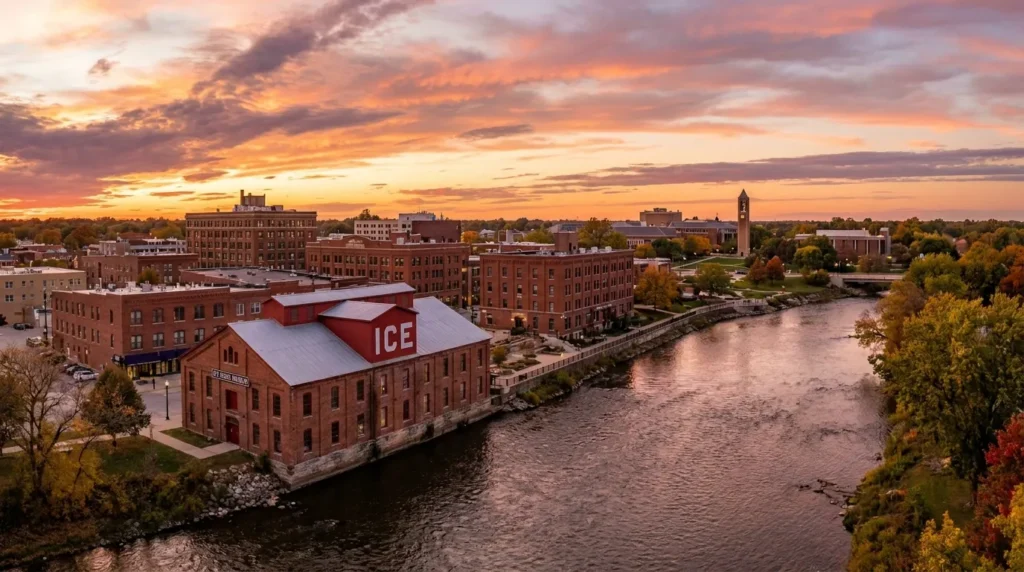
The Hartman Reserve Nature Center offers trails through native forest, birdwatching, and educational activities. The Hearst Center for the Arts and the UNI Gallery of Art organize rotating exhibitions. The Ice House Museum, in a former nineteenth-century ice storage building, tells local history in an accessible and free way.

The Main Street District itself is an attraction: specialty coffee shops, Scratch Cupcakery ice cream shop, independent bookstores, and the Oster Regent Theatre, a restored historic cinema that screens independent films. On good days, sitting at a cafe with a view of the street is Cedar Falls' best entertainment.

  1. 1Cedar River Trail
  2. 2Hartman Reserve Nature Center
  3. 3Hearst Center for the Arts
  4. 4Ice House Museum
  5. 5Main Street District
  6. 6Oster Regent Theatre
Parks & green spaces
  • George Wyth State Park
  • Hartman Reserve Nature Center
  • Pfeiffer Park
  • Sartori Park
  • Island Park
  • +1 more

A small but diverse immigrant community, connected to the university and regional industry

Asian, African, and Latin American immigrants form the international core, with Bosnians and Congolese established in neighboring Waterloo.

The immigrant community in Cedar Falls is proportional to the city's size: small, but surprisingly diverse. The main driver is the University of Northern Iowa, which attracts students and researchers from China, India, South Korea, Nigeria, Vietnam, and various Latin American countries. Around the campus, there are Asian markets, ethnic restaurants, and active international student groups.

Waterloo, adjoining Cedar Falls, has a significant Bosnian community established since the 1990s following the Balkan war, with a mosque, restaurants, and a bakery. The city has also received resettled Congolese, Myanmarese, and Bhutanese refugees over the past 15 years, transforming the demographic profile of the metropolitan area.

For practical support, organizations such as EMBARC Iowa serve immigrant refugees throughout the region, and Catholic Charities of the Archdiocese of Dubuque offers legal assistance, English classes, and help with paperwork. Consulates are located in other cities, so trips to Chicago or Minneapolis for visa matters are part of the routine.

3,500
Foreign-born residents
estimated
Top countries of origin
  • Mexico
  • Bosnia and Herzegovina
  • India
  • China
  • Vietnam
  • Congo (DRC)
  • Nigeria
  • Myanmar
Foreign consulates
  • Mexican Consulate General (Omaha, ~480 km)
  • Indian Consulate General (Chicago, ~430 km)
  • Chinese Consulate General (Chicago)
  • Honorary Consulate of Bosnia and Herzegovina (Iowa)
  • Brazilian Consulate General (Chicago)
Community organizations
  • EMBARC Iowa (Ethnic Minorities of Burma Advocacy and Resource Center)
  • Catholic Charities of the Archdiocese of Dubuque
  • Iowa International Center
  • UNI Office of International Engagement
  • Bosnian Islamic Cultural Center of Waterloo
  • Iowa Bureau of Refugee Services

Latest posts

Posts about Iowa

Coverage and updates related to this destination.

Showing content from Iowa, as there is no specific data for Cedar Falls yet.