Visto n' Visa
Blog
Notícias e artigos
Destinations
Careers
Immigrants

Want to live and work in Opelika?

Personalized immigration plan with eligible visas, costs, and next steps for your goal!

If you are not eligible, you will know exactly why and what to do to improve your approval chances.

Save up to 12 hours in meetings

No pointless assessments.

Save up to 90%

Save money on vague or unfocused consultations

Avoid Fraud and Mistakes

One mistake can cost you your visa

Total Impartiality

Zero commercial bias

Decide with peace of mind

No toxic urgency

Fast and Accurate

Answers in minutes, no guesswork

Who lives in Opelika today

A mid-sized city by Alabama standards, with a mix of white and African American populations and a growing Hispanic community tied to construction and manufacturing.

Opelika is a mid-sized city within the Alabama context, historically marked by the white and African American divide typical of the American South. This heritage is reflected in neighborhoods, churches, and community life, which still organizes largely around religious congregations.

Over the past two decades, the arrival of factories and the expansion of Auburn University in the neighboring city have brought new resident profiles: international students, engineers transferred by multinational companies, and Hispanic families coming primarily from Mexico and Central America, drawn by jobs in construction, meatpacking, and services.

English is the dominant language in daily life, but Spanish appears frequently in supermarkets, public schools, and some churches. The age range is mixed, with a strong presence of young families, retirees seeking low costs, and a growing layer of technology professionals connected to the Auburn-Opelika corridor.

Languages spoken
  • English
  • Spanish
  • Korean
  • Vietnamese
Main religions
  • Protestantism (Southern Baptist)
  • Methodism
  • Catholicism
  • Pentecostalism
  • No religion

Low cost of living even by Alabama standards

Rent, groceries, and services fall well below the national average, making Opelika attractive for those seeking financial stability without sacrificing urban infrastructure.

Opelika ranks among the most affordable cities to live in the United States when compared to large metropolitan areas. House and apartment rents tend to be a fraction of what is paid in cities like Atlanta, Orlando, or Nashville, and buying property is feasible for middle-income earners.

Groceries, gas, restaurants, and personal services are also below the national average. Brands like Walmart, Publix, and Kroger compete in the region, and fast-casual chains coexist with family-owned restaurants downtown. The combined state and municipal sales tax typically falls between 9% and 10%, a weight that appears in the consumer's final bill.

The main additional cost is a car: since public transportation is minimal, nearly every adult needs a personal vehicle. Insurance, maintenance, and fuel enter the monthly budget and offset part of the savings on housing and food.

Opelika

Spacious homes, large lots, and new developments

The market is dominated by single-family homes in residential neighborhoods, with strong expansion of new subdivisions near Interstate 85 and the Auburn border.

The predominant offering in Opelika is the single-family home with a yard, a two-car garage, and three to four bedrooms. Those coming from large cities are often surprised by the lot sizes and the amount of space available at a relatively affordable price. Apartments exist but are concentrated in newer complexes aimed at students and young professionals.

Downtown and its surroundings offer restored historic homes, ideal for those who prioritize walking to cafes, restaurants, and events. Neighborhoods like Northside and areas near Spring Villa Road mix older homes with new construction, while planned developments around Tiger Town concentrate recent expansion.

For rentals, it is common to require proof of income equal to three times the rent, a credit history, and a security deposit. Those arriving without an American credit history often need a co-signer, advance payment for several months, or complexes that accept an employer letter as a guarantee.

Recommended neighborhoods
  • Downtown Opelika
  • Northside
  • Tiger Town
  • Saugahatchee
  • Spring Villa
  • +1 more

Manufacturing, technology, and services drive hiring

The local economy mixes traditional factories, new technology hubs, and the spillover from Auburn University in research, healthcare, and services.

Opelika has a solid industrial base, with tire, auto parts, food, and chemical factories located in industrial parks along Interstate 85. Pharavia, formerly Diversified Products, and the Mando complex, an auto parts supplier, are examples of employers that sustain thousands of positions in the region.

The proximity to Auburn broadens the range of opportunities. The university employs professors, researchers, technicians, and administrative staff, and the surrounding ecosystem generates positions in applied research, engineering, technology, and professional services. The municipal fiber optic network, OPS One, has attracted data centers and IT companies that reinforce this profile.

For newly arrived immigrants, the most common path begins in construction, meatpacking, hospitality, and logistics, sectors that hire with less bureaucracy. Qualified professionals in engineering, healthcare, and technology have more direct routes, but require recognized credentials and, in many cases, visa sponsorship.

Dominant sectors
  • Manufacturing
  • Logistics
  • Healthcare
  • Higher education
  • Information technology
  • +1 more
Major employers
  • East Alabama Medical Center
  • Mando America
  • Pharavia
  • Walmart Distribution Center
  • Opelika City Schools
  • +1 more

Growing public schools and strong universities nearby

Opelika's school system has expanded in recent years, and the presence of Auburn University next door broadens higher education and research options.

Opelika City Schools administers the municipal network, with elementary schools, middle schools, and Opelika High School, which has been investing in technical and vocational programs. Children of immigrants have the right to enroll regardless of their parents' immigration status, and English as a Second Language support is available in schools with higher demand.

The major educational asset of the region is Auburn University, one of the largest public research institutions in the American South, just a few minutes away by car. It attracts international students and professionals from various fields, especially engineering, agriculture, veterinary medicine, and business.

For technical training and short-term programs, Southern Union State Community College has a campus in Opelika and offers programs in healthcare, manufacturing, information technology, and business. It is a common entry point for adults seeking professional requalification or who are validating studies completed in another country.

Notable universities
  • Auburn University (neighboring Auburn)
  • Southern Union State Community College
  • Tuskegee University (nearby)
  • Auburn University at Montgomery

Established regional hospital and community clinics

East Alabama Medical Center is the regional reference, complemented by private clinics, community health centers, and telemedicine.

East Alabama Medical Center, a large general hospital located in Opelika, is the primary healthcare center for the region and serves neighboring cities such as Auburn, Phenix City, and Tuskegee. It has a 24-hour emergency room, maternity ward, cardiac center, and specialized services, along with a network of satellite clinics spread across Lee County.

Access depends, in practice, on the type of health insurance. Those working in formal employment typically have a plan offered by the employer, and there is a federal marketplace for those who need to purchase individual coverage. Immigrants without documentation or without insurance can use community clinics and limited state programs, always with negotiated costs.

For complex cases, it is common to seek larger hospitals in Birmingham, Atlanta, or Montgomery. Telemedicine gained ground in the city after 2020 and now covers a large portion of routine consultations, which is particularly helpful for those who have not yet established a primary care physician.

Opelika

City considered safe in most neighborhoods

Crime rates vary by neighborhood, but most residential areas and the downtown are perceived as calm, with active policing by the municipal department.

Opelika is seen by its residents as a calm city by Alabama standards, especially in residential areas and the surroundings of the revitalized downtown. The municipal police operate visibly and maintain active channels with neighborhood associations and schools.

As in other mid-sized American cities, some older neighborhoods and public housing areas record higher rates of property crimes, and residents recommend extra caution at night on certain streets. The risk is higher for opportunistic crimes, such as vehicle theft and break-ins, than for violent crimes in everyday life.

For newcomers, the standard checklist applies: get to know the neighborhood well before signing a lease, talk to neighbors, avoid leaving valuables visible in the car, and use community safety alert applications. The combination of good lighting, steady foot traffic, and proximity to police helps maintain the positive perception of safety downtown.

Safer neighborhoods
  • Downtown Opelika
  • Northside
  • Saugahatchee
  • Grand National
  • Tiger Town
Areas to avoid
  • Isolated industrial areas near the railroad tracks at night
  • Older stretches of South Opelika with limited street lighting

Car-centric city with a nearby international airport

Public transportation is limited, but Interstate 85 connects Opelika to Atlanta and Montgomery within a few hours, and Atlanta's airport serves international flights.

As in most mid-sized cities in the American South, living in Opelika without a car is difficult. The distances between residential neighborhoods, grocery stores, and workplaces are designed for motorized travel, and continuous sidewalks are concentrated in the historic downtown and some commercial corridors.

Interstate 85 runs through the region and connects Opelika to Atlanta in about two hours and to Montgomery in just over an hour. The most-used airport for international flights is Hartsfield-Jackson in Atlanta, with direct connections to Latin America, Europe, and Asia. On a regional scale, the Auburn municipal airport serves small private flights.

There is a modest bus system called LeeTran, connecting Opelika to Auburn, aimed primarily at students and seniors. For most working-age adults, owning a vehicle, carrying auto insurance, and holding an Alabama driver's license are essential parts of daily life.

Airports
  • AUO — Auburn University Regional Airport (Auburn)
  • ATL — Hartsfield-Jackson Atlanta International (~170 km)
  • MGM — Montgomery Regional Airport (~100 km)
  • Bike infrastructure

Climate

Opelika

Southern culture, college football, and downtown revitalization

Cultural life blends Southern tradition, passion for college football, and a rising dining scene in the downtown area.

Local culture breathes Southern tradition: country music, gospel, backyard barbecue, lively churches on Sundays, and community festivals that fill the streets on marked dates. The downtown was carefully restored over the past two decades and became a gathering point with restaurants, bars, specialty cafes, and galleries.

College football organizes much of the calendar. On autumn Saturdays when Auburn plays at home, the entire city changes pace: heavy traffic, packed restaurants, and residents dressed in orange and blue. Those who move to Opelika tend to absorb this habit even without being fans of the sport.

Events like On the Tracks, seasonal festivals at Courthouse Square, and Christmas in a Railroad Town bring together long-time residents and newcomers. For immigrants, it is a simple way to enter city life without needing to master English in the first few months.

Notable dishes
  • Alabama-style BBQ ribs
  • Fried green tomatoes
  • Shrimp and grits
  • Pulled pork sandwich with white sauce
  • Pecan pie
  • +1 more
Annual events
  • On the Tracks
  • Christmas in a Railroad Town
  • Opelika Songwriters Festival
  • Touch a Truck
  • Independence Day Celebration
  • +1 more

Historic downtown, parks, and nationally recognized golf

The main attractions combine railroad heritage, expansive green spaces, and one of the most respected golf courses in the American Southeast.

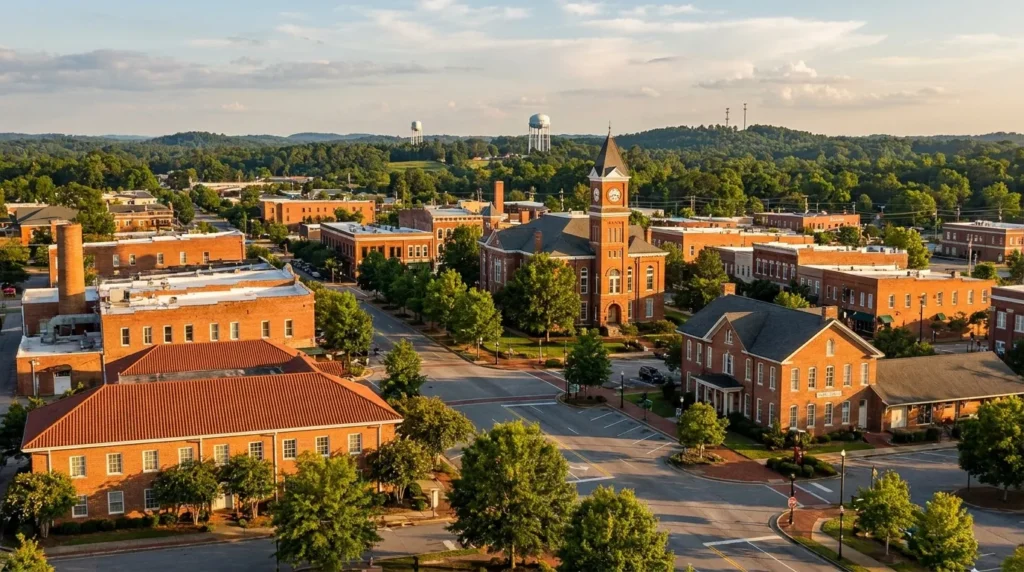
The tourist heart of Opelika is the historic downtown, organized around Courthouse Square, with restored brick buildings, independent shops, bookstores, and restaurants. It is a walk of a few blocks, ideal for getting a sense of the city's spirit in an afternoon.

Grand National, part of the Robert Trent Jones Golf Trail, attracts golfers from across the country and offers broad views over Lake Saugahatchee. For those who prefer nature without a golf club, Spring Villa Park offers trails, picnic areas, and a historic mansion set among the trees, and Floral Park hosts community events throughout the year.

The metropolitan region expands the options with the Jule Collins Smith Museum of Fine Art in Auburn, the Tuskegee National Historic Site dedicated to African American history, and state parks a short drive away. For a weekend trip, Atlanta and the Alabama Gulf Coast are within reach.

  1. 1Downtown Opelika Historic District
  2. 2Courthouse Square
  3. 3Grand National Golf Course
  4. 4Spring Villa Park and Mansion
  5. 5Museum of East Alabama
  6. 6Floral Park
Parks & green spaces
  • Spring Villa Park
  • Floral Park
  • Municipal Park
  • Covington Recreation Center
  • Siddique Park

Strong Hispanic community and a growing presence of other groups

Immigration to Opelika is led by Mexicans and Central Americans tied to manufacturing and construction, with an additional presence of Koreans, Indians, and Vietnamese connected to companies and the neighboring university.

The most visible immigrant community in Opelika is the Hispanic one, with a strong presence of Mexicans, Guatemalans, and Hondurans. They work in construction, meatpacking, restaurants, landscaping, and services, and maintain small grocery stores, restaurants, and Spanish-language churches throughout the city and in Auburn.

Asian companies established in the Auburn-Opelika corridor brought families from South Korea, Japan, Vietnam, and India. Auburn University broadens this profile, welcoming students and researchers from China, Nigeria, Brazil, Colombia, and various African and South Asian countries.

For newcomers, the practical recommendation is to connect early with Catholic parishes offering Mass in Spanish, with Auburn University's Office of International Programs, and with regional nonprofits that provide English classes, legal guidance, and family support. These are typically the entry points to employment, housing, and social networks.

3,500
Foreign-born residents
estimated
Top countries of origin
  • Mexico
  • Guatemala
  • Honduras
  • South Korea
  • India
  • China
  • Vietnam
  • Brazil
Foreign consulates
  • Mexican Consulate General in Atlanta
  • Guatemalan Consulate General in Atlanta
  • Honduran Consulate General in Atlanta
  • South Korean Consulate General in Atlanta
  • Indian Consulate General in Atlanta
  • +1 more
Community organizations
  • Alabama Coalition for Immigrant Justice
  • Catholic Social Services of East Alabama
  • Esperanza House
  • Auburn University Office of International Programs
  • East Alabama Food Bank

Latest posts

Posts about Alabama

Coverage and updates related to this destination.

Showing content from Alabama, as there is no specific data for Opelika yet.