Visto n' Visa
Blog
Notícias e artigos
Destinations
Careers
Immigrants

Want to live and work in Montgomery?

Personalized immigration plan with eligible visas, costs, and next steps for your goal!

If you are not eligible, you will know exactly why and what to do to improve your approval chances.

Save up to 12 hours in meetings

No pointless assessments.

Save up to 90%

Save money on vague or unfocused consultations

Avoid Fraud and Mistakes

One mistake can cost you your visa

Total Impartiality

Zero commercial bias

Decide with peace of mind

No toxic urgency

Fast and Accurate

Answers in minutes, no guesswork

Montgomery's population: Black majority, with strong African American history and culture

About 60% of the population is Black. The Hispanic community is growing; the Asian community remains small. The city is shaped by churches and religious tradition.

Montgomery is one of the few major American cities with a Black majority, at approximately 60% of the population. The white population is around 30%, and there are Hispanic communities (particularly Mexican and Central American), Asian communities (Korean and Vietnamese), and a small African and Caribbean presence. This diversity is reflected in the food, churches, and music.

English is the language of daily life, with a pronounced Southern accent. Spanish appears in markets, restaurants, and construction. The Brazilian community is small, linked primarily to exchange military personnel at Maxwell Air Force Base and Air University. There is no defined ethnic neighborhood, but concentrations exist in the eastern and southern parts of the city.

Religion is central to the community. Black Baptist churches, such as the historic Dexter Avenue Baptist Church, play a major social role, alongside white Protestant, Catholic, and some Latino Pentecostal congregations. Sunday remains a church day for most families. Young families and military personnel add some religious diversity, but the overall environment remains predominantly Christian.

Languages spoken
  • English
  • Spanish
  • Korean
  • Vietnamese
  • Portuguese (small military presence)
Main religions
  • Protestant Christian (Baptist, Methodist, AME)
  • Catholic Christian
  • Pentecostal Christian
  • No religion
  • Muslim

Cost of living in Montgomery: well below the American average

Rent, housing, and food cost less than the national average. Wages are also lower, but the overall balance tends to be favorable.

Montgomery ranks among the least expensive state capitals in the United States. A one-bedroom apartment rents for between USD 800 and USD 1,200 per month. A three-bedroom house to rent runs between USD 1,200 and USD 1,800. Purchasing a family home in desirable neighborhoods such as East Chase, Wynlakes, or Old Cloverdale is significantly cheaper than in Atlanta or Nashville.

Grocery shopping at Publix, Kroger, Winn-Dixie, and Walmart is affordable. A meal at a popular restaurant runs USD 12 to USD 18. Good options for soul food, barbecue (Dreamland, Saw's), and Southern cooking are widely available. Gas prices tend to be among the lowest in the country, below the national average.

Alabama levies a 5% state income tax and a combined sales tax of around 10% (state, county, and city). Electric bills rise significantly in summer due to air conditioning use. Health insurance tends to be the most surprising expense for newcomers: for a family, it can easily reach USD 800 to USD 1,500 per month without employer benefits.

88Cost index (US = 100)12% below US average
CategorySingleCoupleFamily (2 + 2)
iHousing$1,143$1,319$1,670
iFood$334$668$1,213
iTransport$440$747$967
iHealthcare$246$492$923
iChildcare$1,600
iOther$747$1,345$1,890
Monthly total$2,910$4,571$8,263

Source: U.S. BLS Consumer Expenditure Survey 2023 + BEA Regional Price Parities 2023 · Estimates in USD, monthly.

Housing in Montgomery: large homes at low prices, historic neighborhoods near downtown

Suburban residential neighborhoods to the east predominate. Historic neighborhoods near downtown feature charming older homes.

Montgomery is growing eastward, in neighborhoods such as East Chase, Wynlakes, and Halcyon, which offer planned residential homes, nearby retail, and well-regarded private schools. These are preferred by families with children. Closer to downtown, Old Cloverdale and the Garden District feature restored historic homes with wide porches and mature trees.

Apartment seekers find options primarily near Air University, in the Riverwalk District (downtown), and in Eastdale. The rental market is relaxed, with vacancies available most of the time, and there is none of the competitive bidding seen in larger cities. Leases are typically 12 months with a one-month security deposit.

Some areas to the west and north of downtown (West Montgomery) offer cheaper housing but have higher crime rates and fewer services. Newcomers are commonly advised by locals to avoid these areas. Sites such as Zillow, Apartments.com, and Rent.com provide good coverage of the available inventory.

Recommended neighborhoods
  • East Chase (residential, with shops and restaurants)
  • Wynlakes (gated community, family-oriented)
  • Old Cloverdale (historic, charming homes)
  • Garden District (historic, close to downtown)
  • Halcyon (new, planned development)
  • +1 more

Job market in Montgomery: government, military, and the Hyundai plant

The city is driven by state government, Maxwell Air Force Base, the Hyundai plant, and the healthcare sector. Wages are below average, but the cost of living compensates.

Montgomery is a government town. The Alabama state government is headquartered there, employing thousands of civil servants. Maxwell Air Force Base, home to the Air Force's Air University (a senior service school for officers), is another major employer, drawing military personnel, civilians, and contractors. Fluent English speakers find openings with defense and military training contractors.

The Hyundai Motor Manufacturing Alabama plant in Montgomery produces the Sonata, Elantra, and Tucson. Together with suppliers such as Mobis and Glovis, the facility generates thousands of jobs in production, logistics, and quality control. Assembly line wages typically range from USD 22 to USD 30 per hour.

Healthcare (Baptist Health, Jackson Hospital), education (Alabama State, Auburn Montgomery), and retail round out the picture. For those with basic English, there are openings in construction, restaurants, hotels, and cleaning services, with wages above the federal minimum due to demand. Engineers and technical professionals earn less than in Huntsville but benefit from a lower cost of living.

Dominant sectors
  • State government
  • Military and defense (Maxwell AFB)
  • Automotive manufacturing (Hyundai)
  • Healthcare
  • Higher education
  • +1 more
Major employers
  • State of Alabama (government)
  • Maxwell Air Force Base and Air University
  • Hyundai Motor Manufacturing Alabama
  • Baptist Health (hospitals)
  • Jackson Hospital
  • +3 more

Education in Montgomery: public schools with challenges and historically significant universities

City public schools receive mediocre ratings. Many families choose private schools. The city is home to important historically Black universities.

The city's public school district (Montgomery Public Schools) faces longstanding challenges related to funding and academic performance. Many middle- and higher-income families enroll their children in private schools such as Saint James, Trinity Presbyterian, Montgomery Academy, or Alabama Christian Academy. In the neighboring Pike Road district, public schools receive better ratings.

Alabama State University, located in Montgomery, is one of the country's leading HBCUs (Historically Black Colleges and Universities), offering programs in education, music, political science, and health. Auburn University at Montgomery (AUM) is a regional campus of Auburn University, with programs in business, nursing, education, and computer science. Air University, located within the military base, provides graduate-level education for officers.

Tuition at ASU for international students is approximately USD 17,000 per year, and at AUM approximately USD 22,000, both below the national average. Community colleges such as Trenholm State offer quick technical programs and pathways to bachelor's degrees.

Notable universities
  • Alabama State University (HBCU)
  • Auburn University at Montgomery (AUM)
  • Faulkner University
  • Huntingdon College
  • Trenholm State Community College
  • Air University (Maxwell AFB)

Healthcare in Montgomery: regional hospitals and private clinics

Baptist Health and Jackson Hospital serve the region. The system is private and insurance-dependent. The state did not expand Medicaid, limiting options for lower-income residents.

The American healthcare system operates through private insurance, and Montgomery is no exception. Baptist Medical Center South is the city's largest hospital, offering a 24-hour emergency department, a cardiovascular center, and oncology services. Jackson Hospital, the older facility, serves much of the downtown area. Maxwell AFB also has a hospital for military personnel and their dependents.

Those employed in formal jobs typically receive health insurance covering consultations, tests, surgery, and partial medication costs. Walk-in clinics (American Family Care, MedHelp) handle quick visits. Specialists generally require appointments scheduled weeks in advance. Private medical offices are available throughout the city.

Alabama did not expand Medicaid under the Affordable Care Act, so those earning modestly but above the poverty line may find themselves without coverage. Community clinics (Health Services Inc.) operate on a sliding-scale fee basis. Generic medications are inexpensive at Walmart, Costco, and CVS pharmacies. Obtaining travel or health insurance from the first day of arrival is advisable.

Healthcare index60.0 / 100
  • Life expectancyyears at birth
    78.4yrs
  • Doctors per 1kpracticing physicians
    3.7
  • Health spendper capita, per year
    $13,473
  • Public systemoverall quality rating
    Fair

Safety in Montgomery: wide variation by neighborhood, homicide rate above average

Eastern and southern neighborhoods are quiet. The west and parts of the north have high crime rates. Families choosing where to live should research the specific area carefully.

Montgomery's safety profile resembles that of other Southern capitals: good neighborhoods are genuinely quiet, but the city has areas with high levels of violence. The homicide rate exceeds the national average, concentrated in certain neighborhoods to the west and north. Neighborhoods such as East Chase, Wynlakes, Old Cloverdale, and Garden District are safe for walking and for children.

Downtown has improved in recent years, with more evening activity around bars and games at Riverwalk Stadium. Even so, parking in well-lit areas and remaining aware of the surroundings is recommended. West Montgomery and parts of North Montgomery are areas residents commonly advise avoiding for living and leisure.

Theft from parked vehicles, break-ins at unoccupied residences, and package theft from doorsteps (porch pirates) are the most common crimes. Doorbell cameras (Ring, Nest) are standard equipment. Spring tornadoes are a genuine concern: having an in-home shelter or a clear emergency plan is worthwhile.

5.8
Homicides per 100k
per year
Safety index
34.0
Crime index
66.0
Safer neighborhoods
  • Cloverdale
  • Old Cloverdale
  • Hampstead
  • Wynlakes
  • Eastchase
  • Old Alabama Town historic area
Areas to avoid
  • West Montgomery areas at night
  • Stretches of Mobile Highway
  • Parts of South Court Street
  • Industrial areas along Day Street

Transportation in Montgomery: car-dependent, with a small airport

The city is designed around the car. Public transit is minimal. Montgomery Regional Airport (MGM) offers flights to nearby hubs, and Atlanta serves as the main international gateway.

Montgomery is a spread-out city where nearly every resident depends on a car. The main routes are I-65 (north-south), I-85 (toward Atlanta), and US-231. Traffic is light, without the congestion typical of larger cities. Parking is easy and generally free, even downtown.

The city bus system (Montgomery Transit) covers central areas and some routes to the east, but it is limited and few working residents rely on it. Uber and Lyft provide good coverage across the city. There is no subway or light rail system. Bike paths exist in parks such as Riverwalk but are not part of the daily commute infrastructure.

Montgomery Regional Airport (MGM) is small and operates flights to Atlanta, Charlotte, Dallas, and Washington (Reagan). For international connections, most travelers use Hartsfield-Jackson Atlanta International Airport (ATL), about two and a half hours by car, or Birmingham-Shuttlesworth International Airport (BHM), about an hour and a half away. Car rentals at both airports are straightforward.

21 min
Avg commute
35
Walkability
Airports
  • MGM — Montgomery Regional Airport
  • Bike infrastructure

What the Climate Is Like Living in Montgomery

Montgomery has a humid subtropical climate, with long, very hot and humid summers, short mild winters, and well-distributed rainfall with afternoon thunderstorms in summer.

Summer runs from May through September. High temperatures typically range between 31°C and 34°C (88–93°F), with high humidity pushing the heat index above 38°C (100°F) in July. Late-afternoon rain and thunderstorms are common. Air conditioning runs nearly continuously.

Winter is short and mild, from December through February, with highs between 13°C and 16°C (55–61°F) and lows around 2°C to 5°C (36–41°F). Light frosts occur in brief windows and snow is virtually nonexistent. A mid-weight jacket is sufficient.

The region sits in Dixie Alley, and spring brings a real tornado risk in March and April. Annual rainfall exceeds 1,380 mm (54 in). For residents, reliable air conditioning, an identified tornado shelter, and attention to severe weather alerts are practical necessities.

Sunny days / year218 days
Avg high (°F)
  • 59°J
  • 65°F
  • 71°M
  • 76°A
  • 84°M
  • 89°J
  • 92°J
  • 92°A
  • 88°S
  • 78°O
  • 67°N
  • 62°D
Avg low (°F)
  • 42°J
  • 47°F
  • 52°M
  • 55°A
  • 64°M
  • 71°J
  • 74°J
  • 74°A
  • 69°S
  • 60°O
  • 48°N
  • 45°D
Rainfall (")
  • 5"J
  • 6"F
  • 5"M
  • 4"A
  • 4"M
  • 5"J
  • 3"J
  • 5"A
  • 4"S
  • 4"O
  • 3"N
  • 5"D

Culture in Montgomery: civil rights, Shakespeare theater, and the Deep South

A city defined by African American history, with memorials, museums, and a notable theater. Southern food, gospel music, and religious tradition shape daily life.

Montgomery's culture revolves around three pillars: civil rights history, Southern tradition, and Shakespeare theater. The National Memorial for Peace and Justice (dedicated to the history of racial terror and lynching in the United States) and the Legacy Museum, both operated by the Equal Justice Initiative, are essential stops that leave a deep impression on visitors. Martin Luther King Jr.'s home on Dexter Avenue is open to the public as a museum.

The city is home to the Alabama Shakespeare Festival, one of the largest professional theaters in the South, offering seasons of Shakespeare, classics, and new productions. Old Alabama Town preserves 19th-century homes and structures. The Hank Williams Museum honors the country singer born in the surrounding area, and Riverwalk Stadium hosts games for the Montgomery Biscuits, a Minor League Baseball team.

The food is pure Southern: shrimp and grits, fried chicken, collard greens, rib barbecue with sweet sauce. Restaurants such as Chris' Hot Dogs (open since 1917), Martin's, and Filet & Vine are part of the local fabric. Gospel music still fills churches on Sundays, and college football (Auburn Tigers vs. Alabama Crimson Tide) remains a defining local passion.

Montgomery

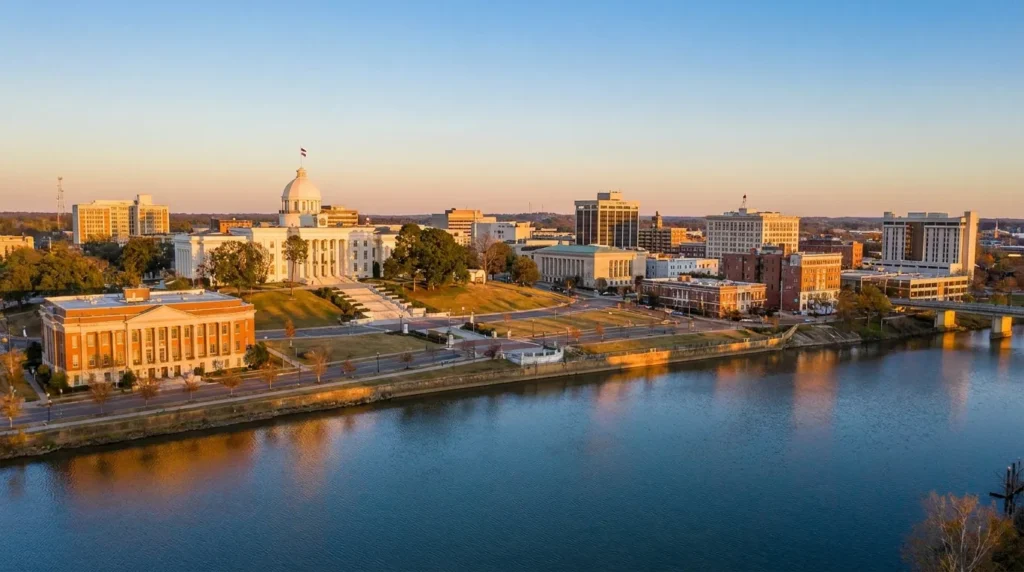
Montgomery Attractions: Alabama's Capital and Civil Rights Landmark

Montgomery is the capital of Alabama and a central stage of the civil rights movement. Its attractions combine historical memorials, in-depth museums, and antebellum architecture.

The National Memorial for Peace and Justice and the Legacy Museum, both operated by the Equal Justice Initiative, form the essential visiting axis. The memorial honors victims of lynching across the United States, while the museum connects slavery to contemporary mass incarceration. The Dexter Avenue King Memorial Baptist Church, where Martin Luther King Jr. preached, stands within walking distance of the Alabama State Capitol.

The Rosa Parks Museum, on the campus of Troy University, recreates the 1955 bus boycott. The Freedom Rides Museum occupies the former Greyhound bus station where Freedom Riders were attacked in 1961. The First White House of the Confederacy and the Hank Williams Museum reveal other, more conflicted layers of local memory.

Day-to-day cultural life centers on Riverfront Park, the Alabama Shakespeare Festival at Wynton M. Blount Cultural Park, and the Montgomery Performing Arts Centre. Restaurants in Cloverdale and Old Cloverdale anchor the dining scene, and the Montgomery Biscuits, a Double-A baseball team, offer accessible evenings at the ballpark.

  1. 1["Rosa Parks Museum"
  2. 2"Dexter Avenue King Memorial Baptist Church"
  3. 3"Civil Rights Memorial Center"
  4. 4"Equal Justice Initiative Legacy Museum and Memorial"
  5. 5"Hank Williams Museum"
  6. 6"Alabama State Capitol"
Nightlife5.0 / 10
Parks & green spaces
  • ["Riverfront Park"
  • "Blount Cultural Park"
  • "Lagoon Park"
  • "Vaughn Road Park"
  • "Oak Park"
  • +1 more

Latest posts

Posts about Alabama

Coverage and updates related to this destination.

Showing content from Alabama, as there is no specific data for Montgomery yet.