Visto n' Visa
Blog
Notícias e artigos
Destinations
Careers
Immigrants

Want to live and work in Mobile?

Personalized immigration plan with eligible visas, costs, and next steps for your goal!

If you are not eligible, you will know exactly why and what to do to improve your approval chances.

Save up to 12 hours in meetings

No pointless assessments.

Save up to 90%

Save money on vague or unfocused consultations

Avoid Fraud and Mistakes

One mistake can cost you your visa

Total Impartiality

Zero commercial bias

Decide with peace of mind

No toxic urgency

Fast and Accurate

Answers in minutes, no guesswork

Mobile's Population: African American, White Southern, and Catholic Heritage

Approximately 51% Black and 41% White. A strong Catholic tradition rooted in French colonial settlement. The Hispanic and Vietnamese communities are growing.

Mobile has a more balanced demographic profile than other large Alabama cities: approximately 51% of the population is Black, 41% White, with Hispanic (around 3%) and Asian presence. The Vietnamese community is notable, particularly in Bayou La Batre, to the south, tied to shrimp and crab fishing since the 1970s. Vietnamese fishers became part of the Gulf Coast's identity.

Due to French and Spanish heritage, Mobile is one of Alabama's most Catholic cities, with a tradition distinct from the Protestant Baptist faith dominant elsewhere in the state. There are historic Catholic churches such as the Cathedral of the Immaculate Conception. African American and White families share parishes and Catholic schools.

The Brazilian community is small, connected to Airbus employees and students at the University of South Alabama. There is no Brazilian neighborhood, but Latin grocery stores can be found on the west side of the city. Mexicans and Central Americans work in construction, restaurants, and fishing.

Languages spoken
  • English
  • Spanish
  • Vietnamese
  • French Creole (small tradition)
  • Portuguese (small presence)
Main religions
  • Protestant Christian (Baptist, Methodist, AME)
  • Catholic Christian (strong tradition)
  • Non-religious
  • Buddhist (Vietnamese community)

Cost of Living in Mobile: Well Below the American Average

Rent and home prices are lower than most coastal US cities. Food and gas follow Southern norms. Homeowner's insurance is expensive due to hurricane risk.

Mobile is one of the most affordable coastal cities in the United States. A one-bedroom apartment rents for between USD 800 and USD 1,200 per month. A three-bedroom house runs between USD 1,300 and USD 1,800 to rent. Buying a home in desirable neighborhoods such as Spring Hill, West Mobile, or Daphne (across the bay) is quite accessible by American standards.

Groceries at Publix, Winn-Dixie, Greer's (a local chain), and Walmart are affordable. Seafood is abundant and inexpensive: oysters, shrimp, snapper, and crab appear in any restaurant. A meal at a casual local restaurant runs USD 12 to USD 20. Gas prices tend to be among the lowest in the country, below the national average.

One detail that catches newcomers off guard: homeowner's insurance, particularly wind and flood coverage, is considerably more expensive in Mobile than in non-coastal cities. Some neighborhoods near the bay require separate flood insurance. Alabama imposes a 5% state income tax and a combined sales tax of around 10%. Health insurance without employer benefits is a significant expense.

88Cost index (US = 100)12% below US average
CategorySingleCoupleFamily (2 + 2)
iHousing$1,143$1,319$1,670
iFood$334$668$1,213
iTransport$440$747$967
iHealthcare$246$492$923
iChildcare$1,600
iOther$747$1,345$1,890
Monthly total$2,910$4,571$8,263

Source: U.S. BLS Consumer Expenditure Survey 2023 + BEA Regional Price Parities 2023 · Estimates in USD, monthly.

Housing in Mobile: Historic Older Homes and New Family Suburbs

Charming historic homes in neighborhoods like Oakleigh and Midtown. Suburbs like Spring Hill and West Mobile feature large homes and well-regarded schools.

Mobile has attractive historic neighborhoods, with homes from the 1850s to the 1920s, wide porches, and trees draped in Spanish moss. The main ones are Oakleigh Garden District, De Tonti Square, and Old Dauphin Way, near downtown. Midtown features homes from the 1940s to 1960s, bistros, shops, and a more walkable atmosphere. Spring Hill, at higher elevation, is a traditional family neighborhood with well-regarded private schools.

West Mobile is growing with new subdivisions, shopping (Bel Air Mall), and higher-rated public schools. Across the bay on the Eastern Shore, Daphne, Fairhope, and Spanish Fort offer large homes, newer retail, and top-ranked schools in the state. Many families choose to live there and cross the Jubilee Parkway bridge daily to work in Mobile.

New apartments are rising downtown, near Cooper Riverside Park and Hank Aaron Stadium. The rental market is accessible. Landlords require an application, proof of income, and generally one month's deposit. Sites such as Zillow, Apartments.com, and Trulia cover the local inventory well.

Recommended neighborhoods
  • Spring Hill (traditional, with private schools)
  • Midtown (older homes, walkable)
  • Oakleigh Garden District (historic)
  • West Mobile (new subdivisions, families)
  • Daphne (Eastern Shore, quiet)
  • +2 more

Job Market in Mobile: Port, Aviation, Steel, and Healthcare

The city is driven by the port, the Austal shipyard, the Airbus plant, ArcelorMittal, and hospitals. The minimum wage follows the federal rate, but there is demand for labor.

Mobile is a city of heavy industry and logistics. The Port of Mobile, managed by the Alabama State Port Authority, is the ninth-largest in the US by tonnage. It handles coal, steel, timber, containers, and vehicles, generating thousands of direct and indirect jobs. Austal USA, an Australian-American shipyard, builds Navy vessels (Littoral Combat Ships) and employs thousands.

Airbus has an A220 and A320 assembly plant in Mobile, building aircraft for American customers. It is Airbus's only US final assembly line. Airlines, parts, tooling, and air logistics revolve around it. ArcelorMittal and Outokumpu maintain stainless steel operations in the region. There are also heavy chemical industries (BASF, Evonik).

Healthcare carries significant weight, with Mobile Infirmary, USA Health (linked to the University of South Alabama), and Springhill Medical Center. For those with basic English, positions are available in construction, restaurants (especially in Gulf Shores in the summer), hotels, housekeeping, and fishing. The minimum wage follows the federal rate of USD 7.25, but competition for labor pushes actual wages higher.

Dominant sectors
  • Port and maritime logistics
  • Aerospace industry (Airbus)
  • Shipbuilding and naval construction
  • Steel and metallurgy
  • Healthcare
  • +2 more
Major employers
  • Austal USA (shipyard)
  • Airbus (A320 assembly plant)
  • Alabama State Port Authority
  • ArcelorMittal
  • Mobile Infirmary Medical Center
  • +3 more

Education in Mobile: Mixed Public Schools and a Growing Local University

Public schools in the urban core show mixed performance. Families turn to Catholic schools or move to the Eastern Shore. The University of South Alabama is the main local institution.

Mobile County Public Schools, the city's district, has mixed performance. Magnet schools (Murphy, Davidson) are well-regarded, but overall quality is uneven. Many Catholic families enroll their children in schools such as McGill-Toolen and UMS-Wright. Middle- and upper-income families frequently choose to live in Baldwin County (Daphne, Fairhope, Spanish Fort), where public schools rank among the best in the state.

The University of South Alabama (USA) is the main public university, with approximately 14,000 students and strong programs in medicine, engineering, nursing, and business administration. It operates its own university hospital. Spring Hill College, a historic Jesuit institution, is the city's private Catholic college, founded in 1830, with a humanities-focused curriculum.

Tuition at USA for international students runs around USD 27,000 per year. Community colleges such as Bishop State and Coastal Alabama offer technical programs and pathways to bachelor's degrees at low tuition. Those seeking fast vocational training (welding, aircraft mechanics) will find options tied to the Airbus plant and the Austal shipyard.

Notable universities
  • University of South Alabama (USA)
  • Spring Hill College
  • Mobile College
  • Bishop State Community College
  • Coastal Alabama Community College

Healthcare in Mobile: Three Major Hospitals and a University Medical Center

Mobile Infirmary, USA Health, and Springhill Medical form the main network. Standard American private system, with coverage through employer plans.

Mobile has three major hospitals. Mobile Infirmary Medical Center is the largest private hospital in the region, with 24-hour emergency care and cardiac and oncology centers. USA Health, linked to the University of South Alabama, is a university hospital with research programs and residents. Springhill Medical Center rounds out the network. For children, there is Children's and Women's Hospital, affiliated with USA.

The system is private and insurance-based, generally provided by employers. For quick visits, walk-in clinics (American Family Care, MedHelp) are found throughout the city. Specialist appointments require scheduling weeks in advance. Telemedicine grew significantly after the pandemic, with platforms such as Teladoc and Doctor on Demand.

Alabama did not expand Medicaid, so childless adults with low income above the poverty line may have no coverage. Community clinics (Franklin Primary Health Center) offer sliding-scale fees. Generic medications are inexpensive at Walmart, Costco, and CVS. Those arriving from abroad should obtain insurance from the first day to avoid unexpected bills.

Healthcare index60.0 / 100
  • Life expectancyyears at birth
    78.4yrs
  • Doctors per 1kpracticing physicians
    3.7
  • Health spendper capita, per year
    $13,473
  • Public systemoverall quality rating
    Fair

Safety in Mobile: Varies by Neighborhood, Eastern Shore Very Safe

Crime rates are above the national average in some zones. Neighborhoods like Spring Hill and West Mobile are safe. The Eastern Shore is very safe.

Mobile has crime rates above the national average, concentrated in neighborhoods on the west and north sides of the urban core. The safest areas within the city are Spring Hill, West Mobile, and the Eastern Shore (Daphne, Fairhope, Spanish Fort), which appear in rankings of the safest suburbs in the South. Violent crime is concentrated in specific areas and does not significantly affect tourists or newcomers.

Downtown has improved with the revitalization of Cooper Riverside Park, Hank Aaron Stadium, and Dauphin Street, with bars and live music at night. Parking in well-lit areas is advisable, and general awareness is recommended. Walking during the day in Bienville Square or Cathedral Square is comfortable.

The most common crimes are car break-ins, burglaries of unoccupied homes, and package theft from doorsteps. Video doorbells (Ring, Nest) are standard equipment. Hurricanes (between August and October) are a greater concern than crime, and those living near the bay should have an evacuation plan. A weather alert app is essential.

5.8
Homicides per 100k
per year
Safety index
40.0
Crime index
60.0
Safer neighborhoods
  • Spring Hill
  • Midtown
  • West Mobile
  • Oakleigh Garden District
  • Old Dauphin Way Historic District
  • Tillmans Corner
Areas to avoid
  • Trickem (north Mobile)
  • Prichard areas at night
  • Stretches of central Government Street after dark
  • Parts of Toulminville

Transportation in Mobile: Car-Dependent, with a Small Airport

A spread-out city where everyone drives. Public transit is limited. Mobile Regional Airport (MOB) serves nearby hubs, and New Orleans covers international connections.

Mobile is a car-dependent city. The main arteries are I-10 (west to New Orleans, east to Pensacola), I-65 (north to Birmingham), and US-90. The bay bridge (Jubilee Parkway) and the Wallace Tunnel are the two ways to cross to the Eastern Shore. Rush hour can be difficult, especially when there are accidents.

The Wave bus system serves some central areas but is limited. Uber and Lyft operate well. There are bike paths in parks (Cooper Riverside, Langan Park), but the city was not designed for cycling. Distances and the humid heat also make walking difficult.

Mobile Regional Airport (MOB) offers flights to Atlanta, Charlotte, Dallas, Houston, and Washington. For international connections, many travelers use New Orleans airport (MSY), about two and a half hours by car, or Pensacola (PNS), about one hour away. The newer airport at Brookley, closer to downtown, is absorbing more commercial flights.

22 min
Avg commute
36
Walkability
Airports
  • MOB — Mobile Regional Airport
  • BFM — Mobile Downtown Airport
  • International airport
  • Bike infrastructure

What the Climate Is Like Living in Mobile

Mobile has a humid subtropical climate close to the Gulf, with very hot and muggy summers, short mild winters, and one of the highest average rainfall totals in the United States.

Summer is long and oppressive, lasting from May through October, with highs between 31°C and 34°C and very high humidity. Heat index values exceed 40°C in July, and afternoon thunderstorms are nearly a daily occurrence. Industrial-grade air conditioning is essential.

Winter is short and mild, from December through February, with highs between 16°C and 19°C and lows around 6°C to 9°C. Frost is rare and snow almost never falls. A light jacket suffices, and central heating sees very limited use.

Mobile is one of the rainiest cities in the United States, with over 1,750 mm of annual precipitation. Hurricane season (June through November) is the primary real risk, as storms like Katrina and Ivan have left lasting marks. Those living here should plan for robust air conditioning, a home prepared for wind and flooding, and a clear evacuation plan during hurricane season.

Sunny days / year219 days
Avg high (°F)
  • 61°J
  • 65°F
  • 71°M
  • 75°A
  • 83°M
  • 88°J
  • 89°J
  • 90°A
  • 87°S
  • 80°O
  • 69°N
  • 65°D
Avg low (°F)
  • 46°J
  • 50°F
  • 56°M
  • 59°A
  • 67°M
  • 74°J
  • 76°J
  • 77°A
  • 72°S
  • 63°O
  • 53°N
  • 50°D
Rainfall (")
  • 5"J
  • 4"F
  • 5"M
  • 5"A
  • 5"M
  • 5"J
  • 6"J
  • 7"A
  • 5"S
  • 4"O
  • 3"N
  • 5"D

Culture in Mobile: Mardi Gras, Gulf Seafood, and Colonial Heritage

America's oldest carnival, with historic mystic societies. Seafood and Creole cuisine. The French Catholic tradition shapes architecture and the local calendar.

Mobile's culture revolves around Mardi Gras. The carnival begins on January 6 (Epiphany) and runs through Fat Tuesday, with parades by mystic societies such as the Order of Myths, the Mobile Carnival Association, and the Comic Cowboys. Floats throw MoonPies (local sweet cookies) and beads to the crowd. The Mobile Carnival Museum, downtown, tells the full history.

The food is Gulf-style: fresh oysters (Wintzell's Oyster House is an institution), stuffed shrimp, gumbo, jambalaya, grilled fish, and po'boys influenced by New Orleans Cajun cuisine. Restaurants such as Felix's Fish Camp and Dauphin's, atop the Trustmark building, offer bay views. Local craft beer is growing with Iron Hand and Braided River.

The Mobile Museum of Art, the USS Alabama Battleship (a battleship turned memorial), and Bellingrath Gardens (historic gardens to the south) draw visitors. Live music appears downtown, especially during BayFest (a music festival, when it occurs) and the Mobile Jazz Festival. College football (Auburn, Alabama, South Alabama) and the NCAA Senior Bowl, which showcases college players, bring the city together.

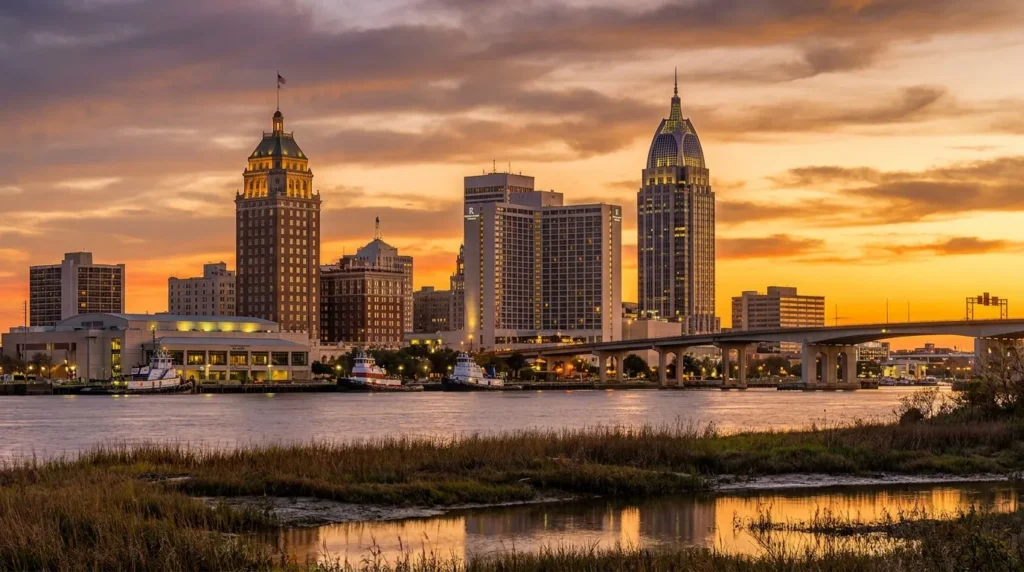
Mobile

What to See in Mobile: French Colonial Heritage and the Gulf of Mexico

Mobile is Alabama's oldest city, founded by the French in 1702. It is the birthplace of American Mardi Gras, carrying French, Spanish, and British colonial heritage alongside an active port on the bay.

The USS Alabama Battleship Memorial Park preserves the World War II battleship and the submarine USS Drum. The History Museum of Mobile, housed in the former City Hall, chronicles 300 years of colonial history. The Mobile Carnival Museum documents that Mardi Gras began in Mobile in 1703, more than a decade before New Orleans.

The De Tonti Square neighborhood and the Oakleigh Historic District feature antebellum homes and cotton-era mansions. The Cathedral Basilica of the Immaculate Conception and the Bragg-Mitchell Mansion are essential stops. The Mobile Museum of Art, located in Langan Park, holds a strong American art collection. For families with children, the Gulf Coast Exploreum Science Center is a popular destination.

A 30-minute drive leads to Bellingrath Gardens and Home, with 65 acres of formal gardens along the Fowl River, especially striking in winter during the Magic Christmas in Lights event. Gulf beaches at Dauphin Island and Gulf Shores are about an hour away. Daily life moves to the rhythm of the port, hurricane season, and Mardi Gras in February.

  1. 1["USS Alabama Battleship Memorial Park"
  2. 2"Mobile Carnival Museum"
  3. 3"History Museum of Mobile"
  4. 4"Bellingrath Gardens and Home"
  5. 5"GulfQuest National Maritime Museum of the Gulf of Mexico"
  6. 6"Mobile Museum of Art"
Nightlife6.0 / 10
Parks & green spaces
  • ["Bellingrath Gardens and Home"
  • "Langan Park"
  • "Mobile Botanical Gardens"
  • "Cooper Riverside Park"
  • "Public Safety Memorial Park"
  • +1 more

Latest posts

Posts about Alabama

Coverage and updates related to this destination.

Showing content from Alabama, as there is no specific data for Mobile yet.