English
 Português
 Español


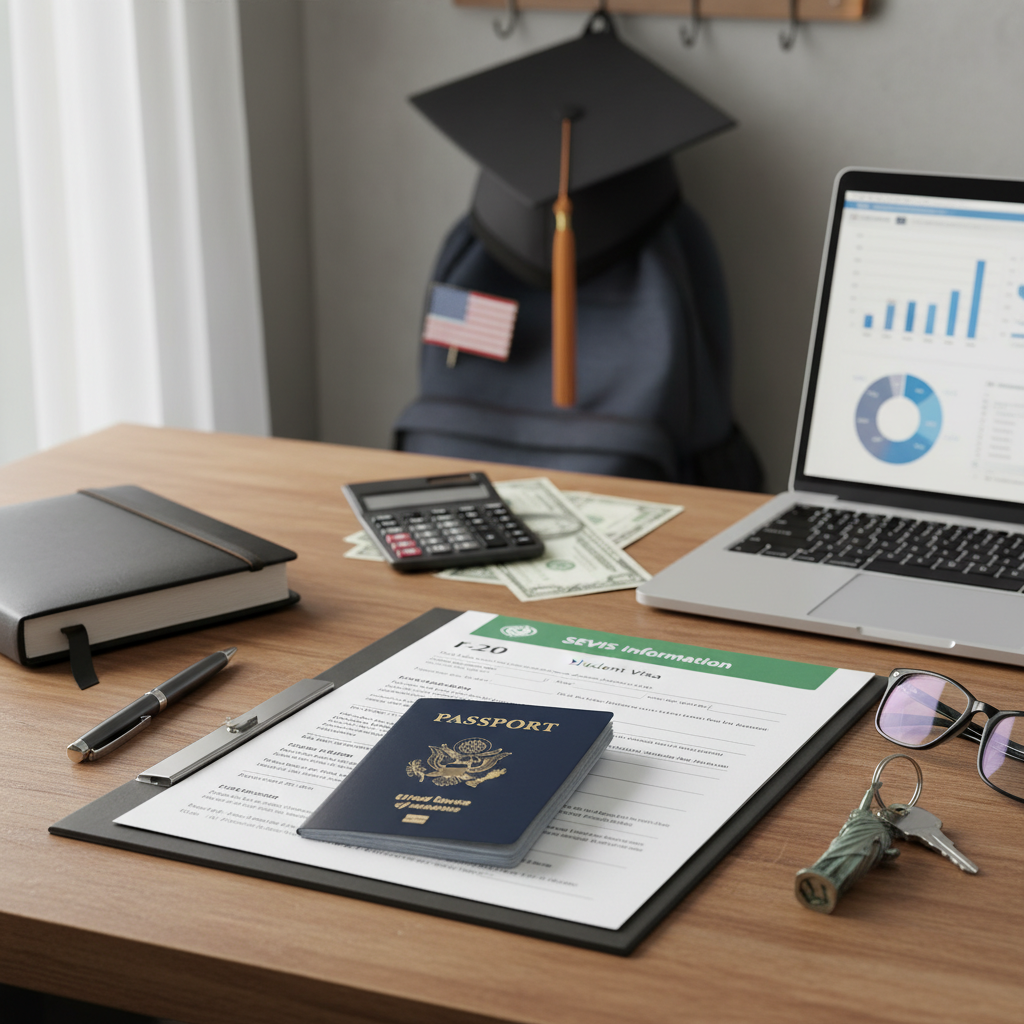
Attending High School in the United States has become a concrete goal for thousands of families seeking English fluency, a differentiated academic education, and a qualified pathway to American universities. The decision, however, goes far beyond enrolling in a school: it involves choosing between a cultural exchange program and direct enrollment, obtaining the correct visa, paying official fees, and understanding immigration rules specific to minors. This guide covers everything a student and their family need to know to plan this journey safely in 2026.
What Is American High School
High School corresponds to the final four years of basic education in the United States, serving students between the ages of 14 and 18. The structure is organized into grades with distinct names and a specific role in each student’s academic trajectory.
- Freshman (9th grade, 14-15): adaptation to the curriculum, choosing first electives, and introduction to sports and clubs.
- Sophomore (10th grade, 15-16): deeper engagement with required subjects and the beginning of standardized testing such as the PSAT.
- Junior (11th grade, 16-17): the most academically decisive year, with SAT, ACT, and Advanced Placement exams.
- Senior (12th grade, 17-18): college applications, completion of the senior project, and graduation ceremony.
Unlike Brazil, where high school lasts three years and is largely standardized, the American system combines required subjects with a wide range of electives. This allows students to build a personalized transcript, which is essential for admission to selective universities.
Immigration Pathways for Brazilians
There are two main legal pathways for a Brazilian teenager to legally study at an American high school, each with distinct rules and relevant practical implications.
F-1 Student Visa
The F-1 is the standard nonimmigrant visa for full-time academic study, including high school. It is issued to students who enroll directly in a school certified by the SEVP (Student and Exchange Visitor Program) and who maintain active academic status.
The most important rule for high school is the limitation imposed by federal law: the F-1 visa can only be used at public schools for a maximum of 12 months and requires the family to fully reimburse the per-capita cost of education to the school district. At private schools, whether religious or secular, there is no such time limit, and the student may complete all four years of high school.
J-1 Cultural Exchange Visa
The J-1 Secondary School Student category is for official cultural exchange programs with a maximum duration of one academic year. The student lives with a voluntary host family, attends an American public school without paying tuition, and participates in cultural activities coordinated by a sponsoring organization approved by the State Department.
The J-1 is generally more affordable and socially immersive, but comes with two important restrictions: the student does not choose the city or school, and upon completing the program, typically must return to Brazil to finish high school.
Real Costs in 2026
Financially planning for High School in the U.S. requires separating three expense blocks that are often confused: consular costs, school costs, and living costs.
Official Immigration Fees
The student must pay fixed amounts even before the consular interview.
- SEVIS I-901: $350 for F-1 and $220 for J-1, paid to ICE before the visa interview.
- MRV (Machine Readable Visa): consular application fee paid to the State Department.
- Reciprocity: there is no reciprocity charge for Brazilians applying for F-1 or J-1 visas, but the rule is reviewed periodically.
Tuition and School Costs
At public schools via F-1 with direct enrollment, the school district charges the annual per-capita cost, which varies by state and typically amounts to several thousand dollars per school year. At private day schools, tuition can vary significantly by region, academic prestige, and available programs. Boarding schools add housing, meals, and activities to that figure.
Housing and Living Expenses
Students at day schools depend on a private host family, student housing where available, or rental accommodation accompanied by a legal guardian in the U.S. Boarding schools include housing in the tuition. J-1 programs provide a voluntary host family at no additional housing cost, which significantly reduces the overall budget.
How to Choose Between Public and Private School
The choice between public and private school profoundly affects the educational experience, the budget, and even visa viability.
Public Schools
Funded by local taxes, public schools strongly reflect the quality of the district in which they are located. Districts in wealthier neighborhoods typically offer extensive infrastructure, a robust Advanced Placement catalog, well-equipped laboratories, and competitive sports teams. For the Brazilian student on an F-1 visa, however, the 12-month federal limit remains in effect, making this a practical option only for short experiences or for the final year of high school. For J-1 students, public school is the standard channel.
Private Schools
Without the F-1 time limit, private schools allow students to complete all four years. They typically offer smaller class sizes, differentiated curricula, international programs (such as the IB), individualized academic support, and greater accessibility for international students. The cost, however, is significantly higher and requires multi-year financial planning.
The Step-by-Step Process
The documentary and logistical journey from the family’s decision to departure requires attention to deadlines and dependencies. This sequence organizes the critical steps.
- Academic evaluation: translated school transcripts, an English proficiency test (TOEFL Junior, Duolingo English Test, or equivalent), and recommendation letters.
- School application: candidacy, interview (often by video), a possible admission test, and a formal acceptance letter.
- Form I-20 issuance: document generated by the SEVP-certified school that ties the student to a specific institution and enables the F-1 application.
- SEVIS I-901 payment: completed online at the ICE portal, with proof of payment presented at the interview.
- DS-160 form: filled out on the State Department website, generates the barcode required for scheduling.
- Consular appointment: scheduling at the CASV for biometric collection and at the embassy or consulate for the interview.
- Consular interview: the officer evaluates ties to Brazil, the family’s financial capacity, genuine academic purpose, and the plan to return after completing studies.
- Departure and admission: the student may enter the U.S. up to 30 days before classes begin; the CBP border officer makes the final admission in F-1 or J-1 status.
Extracurricular Activities and College Impact
American High School values the well-rounded student. Sports, academic clubs, volunteering, the school newspaper, bands, theater, and computer science are not extras: they are a structural part of the college admissions file. Selective universities look for depth and leadership in a few activities rather than a superficial list of many. For Brazilian students, this is a cultural turning point, since a strong academic transcript alone, as is common in Brazil, is not sufficient in the U.S.
Cultural Adjustment and Family Support
The teenager’s emotional maturity is just as decisive as the documentation. Homesickness, initial culture shock, differences in study methods, and climate are real variables. J-1 exchange programs provide structured support through local coordinators, while direct F-1 enrollments require the family to hire a guardian service or have a legal guardian residing in the U.S., especially for day schools.
Pathways After High School
Completing American high school opens doors that go beyond the diploma. On an F-1 visa, the student can transfer status to an American university without returning to Brazil; the new school simply needs to issue a new Form I-20. On a J-1 visa, returning to the home country is the rule, with a possible requirement to fulfill two years of physical presence in Brazil before returning to the U.S. on certain visas, depending on the program circumstances.
American High School offers deep linguistic immersion, robust academic preparation, and a competitive edge for admission to universities in the U.S. and Europe. With sound financial planning, a conscious choice between F-1 and J-1, and adequate support during the stay, this journey can be both educational and transformative for the student’s adult life.
Learn more about F-1
- Duration
- Duration of studies
- OPT (STEM)
- Up to 3 years of work
- CPT
- Work during studies
- Processing
- 2-8 weeks
About the author

Victoria Harper
Editor-in-Chief
As a journalist and lead editor at Visto n’ Visa, Victoria helps ensure that immigration topics are covered in a clear, trustworthy, and easy-to-understand way. Her focus is on delivering useful, human, and relevant content for people exploring new paths abroad.