Visto n' Visa
Blog
Notícias e artigos
Destinations
Careers
Immigrants

Want to live and work in Marrero?

Personalized immigration plan with eligible visas, costs, and next steps for your goal!

If you are not eligible, you will know exactly why and what to do to improve your approval chances.

Save up to 12 hours in meetings

No pointless assessments.

Save up to 90%

Save money on vague or unfocused consultations

Avoid Fraud and Mistakes

One mistake can cost you your visa

Total Impartiality

Zero commercial bias

Decide with peace of mind

No toxic urgency

Fast and Accurate

Answers in minutes, no guesswork

African American, Latino, and Vietnamese mosaic in Jefferson Parish

Marrero's population is predominantly African American, with a growing presence of Latino and Vietnamese communities, reflecting the multiethnic profile of the West Bank of New Orleans.

Marrero has a demographic profile that blends historical roots with more recent waves of immigration. The African American population is the largest, a legacy of decades as a working-class neighborhood in the post-segregation era. Latino families, primarily from Honduras, Mexico, and Cuba, grew significantly after Hurricane Katrina in 2005, drawn by reconstruction work.

The Vietnamese community carries significant weight throughout the West Bank, with a strong presence in Marrero and neighboring Gretna. Buddhist temples, Asian fish markets, and Vietnamese bakeries (banh mi) are part of everyday life. There are also smaller communities of Filipinos, Brazilians, and Central Americans.

English is the predominant language at work and in schools, but Spanish and Vietnamese circulate in commerce and churches. Roman Catholicism is the majority religion, a French and Spanish heritage of the region, followed by Baptist and historically African American Protestant denominations.

Languages spoken
  • English
  • Spanish
  • Vietnamese
  • Louisiana Creole (residual use)
Main religions
  • Roman Catholicism
  • Baptist and evangelical Protestant
  • Buddhism (Vietnamese community)
  • African American Pentecostal churches
Cost of living below the US national average

Marrero offers housing, transportation, and food at lower prices than the city of New Orleans and the United States average, though homeowners insurance and property taxes are notable expenses.

Marrero ranks among the most affordable areas in the greater New Orleans metropolitan area. Rent for a two-bedroom apartment is typically well below what is charged in Uptown or the French Quarter, and buying a home is also more feasible: modest properties on residential streets are priced significantly lower than on the east bank.

Grocery costs follow the South's average, with the added advantage of Vietnamese and Latino ethnic markets that sell fresh produce at competitive prices. Local po'boy, fried chicken, and Cajun food restaurants are inexpensive compared to tourist-oriented options in downtown New Orleans.

The main budget pressures are homeowner's insurance, elevated due to hurricane and flood risk, and car insurance, which is high throughout Louisiana. Electricity bills tend to rise sharply in summer due to mandatory air conditioning from May through September.

Marrero

Ranch homes, single-story houses, and yard neighborhoods

Marrero's housing stock is dominated by ranch-style single-family homes with yards on quiet residential streets, along with condos and apartments along Lapalco Boulevard.

Most of Marrero consists of single-family homes on mid-size lots, with garages for one or two cars. The predominant style is the American ranch, built between the 1960s and 1980s. Neighborhoods such as Ames, Estelle, and Tallow Creek exemplify this profile well.

For renters, there are apartment complexes scattered along Lapalco and Barataria Boulevards, with competitive pricing. Some newer areas near Avondale and Estelle Park offer gated communities with shared pools. Mobile homes in organized parks exist, but are a minority.

Newly arrived immigrants typically start by renting in complexes near Lapalco, where buses and shops are within walking distance. Buying a home in Marrero is feasible for those with dual incomes or stable employment, with federal FHA financing being the most common entry point for families with only a few years in the country.

Recommended neighborhoods
  • Estelle
  • Ames
  • Tallow Creek
  • Neighborhoods near Barataria Boulevard
  • Residential areas along Ames Boulevard

Healthcare, shipbuilding, and port logistics

The local economy revolves around healthcare, shipbuilding and repair, retail trade, and logistics linked to the Port of New Orleans, with many residents crossing the river for jobs on the other side.

Marrero lacks a corporate hub of its own, but is plugged into the West Bank economy, which combines healthcare, heavy industry, and services. West Jefferson Medical Center is one of the largest direct employers, with a hospital, clinics, and laboratories. Shipbuilding and repair, a historical legacy of the Mississippi, still employs many workers at shipyards in Avondale and Harvey.

The retail and restaurant sector along Lapalco and Manhattan Boulevard absorbs less-skilled labor, with positions at Walmart, Rouses, and Winn-Dixie supermarkets, as well as fast food chains. General construction is booming in the ongoing post-Katrina recovery, with high demand for masons, electricians, and roofers.

Many residents work across the river: tourism, hospitality, university hospitals, and public administration in New Orleans. Immigrants find relatively quick entry in construction, cleaning, restaurants, and elder care, with wages above the federal minimum but below the US urban average.

Dominant sectors
  • Healthcare and hospital
  • Construction and renovation
  • Shipbuilding and repair
  • Retail trade
  • Logistics and port
Major employers
  • West Jefferson Medical Center
  • Ochsner Health (regional network)
  • Jefferson Parish Public School System
  • Walmart Supercenter
  • Rouses Markets
  • +1 more

Jefferson Parish public schools and community colleges

Education in Marrero is served by the Jefferson Parish Public School System, with nearby community colleges and New Orleans universities just minutes away by car.

Children attend public schools in the Jefferson Parish Public School System, which operates units such as L.W. Higgins High School and Marrero Academy for Advanced Studies. The system faces typical challenges of diverse urban districts, but offers magnet programs and charter schools that compete for students.

For technical and vocational education, Delgado Community College has accessible campuses in the metropolitan area, with programs in nursing, welding, accounting, and technology. Adult immigrants often use Delgado as a stepping stone to higher degrees, in addition to the English as a Second Language classes offered by the district.

Research universities are across the river: Tulane, Loyola, University of New Orleans, and Xavier University of Louisiana. Daily commuting is feasible, and many West Bank students make that trip. The state TOPS scholarship program serves Louisiana residents who complete high school with strong grades.

Notable universities
  • Delgado Community College (regional campus)
  • Tulane University (New Orleans)
  • Loyola University New Orleans
  • University of New Orleans
  • Xavier University of Louisiana
  • Nunez Community College (Chalmette)

Regional hospitals and community clinic network

West Jefferson Medical Center is the local healthcare hub, complemented by the Ochsner network and community clinics that serve uninsured populations on a sliding-scale fee basis.

West Jefferson Medical Center is the hospital reference for the west bank, with an emergency room, maternity ward, and surgical specialties. The Ochsner Health network, dominant in the region, operates outpatient clinics and the large Ochsner Medical Center in Jefferson, across the river.

For immigrants without health insurance, there are federally qualified community health center (FQHC) options such as Daughters of Charity, which apply sliding-scale fees based on income. Walgreens, CVS, and Walmart pharmacies offer vaccinations and basic consultations at predictable prices, with no insurance required.

Emergency care is universal under federal law: the emergency room cannot turn away patients for inability to pay, though the bill arrives afterward. Mental health, dental, and vision care remain gaps for those without insurance, and many people combine community clinics with return trips to their home country for elective procedures.

Marrero

Quiet neighborhoods with concentrated areas of concern

Marrero has mixed crime rates: residential neighborhoods such as Estelle are quiet, while some areas near commercial corridors and industrial zones require more caution at night.

The image of the greater New Orleans area in crime news tends to be more alarming than the day-to-day reality in Marrero. Newer and more southerly residential neighborhoods, such as Estelle and the condos near Barataria, have calm routines, organized communities, and low rates of violent crime.

Areas of concern are concentrated in commercial corridors at night, especially near some sections of Westbank Expressway and in industrial areas without activity after business hours. Vehicle theft and opportunistic theft are the most common complaints, rather than violent crime.

Jefferson Parish Sheriff covers Marrero. Basic precautions such as not leaving visible items in the car, avoiding walking alone in poorly lit areas, and knowing one's neighbors address most of the risk. Immigrants can file a police report even without documents, and since 2013 the Jefferson Parish Sheriff has offered bilingual service at some units.

Safer neighborhoods
  • Estelle
  • Tallow Creek
  • Residential areas south of Lapalco Boulevard
  • Neighborhoods near Avondale Park
Areas to avoid
  • Nighttime sections of Westbank Expressway with no activity
  • Isolated industrial areas near the Mississippi River
  • Closed commercial parking lots after business hours

Car-dependent city with a bridge to New Orleans

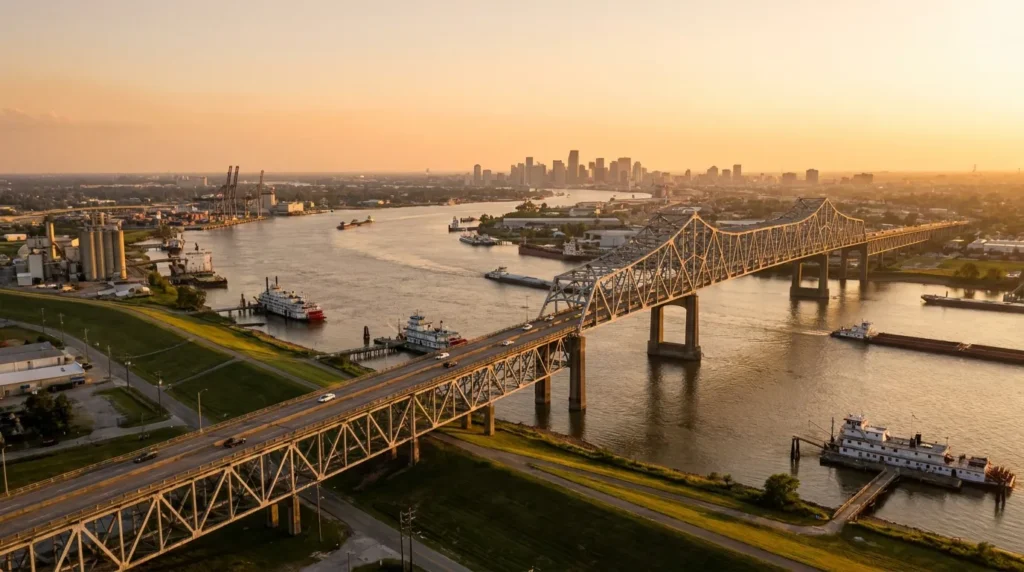
Marrero is a car-dependent community, connected to New Orleans by the Crescent City Connection and the Huey P. Long Bridge, with limited bus coverage from Jefferson Transit.

Owning a car in Marrero is practically mandatory. The main roads are Lapalco Boulevard, Barataria Boulevard, and US-90 Business (Westbank Expressway), which run east to west through the city and connect to the bridge. The Crescent City Connection takes drivers directly into downtown New Orleans in just a few minutes outside of peak hours.

Jefferson Transit operates bus lines connecting Marrero to Gretna and to the east bank transfer terminal, where riders can connect to New Orleans' RTA system. It works, but requires patience: low frequencies and long routes. There are no urban rail lines or metro in the area.

Louis Armstrong New Orleans International Airport (MSY) is located in Kenner, across the river, about 30 minutes away by alternative routes. For short distances, cycling is feasible on some streets, but bike lane infrastructure is limited, and summer heat discourages long walking or biking trips.

Airports
  • MSY — Louis Armstrong New Orleans International (in Kenner, ~30 min)
  • NEW — Lakefront Airport (general aviation, ~40 min)

Climate

Marrero

Cajun, Creole, and Asian fusion in everyday life

Marrero's culture is a West Bank blend of Cajun-Creole tradition, African American street music, and Vietnamese and Latino influence, with a vibrant calendar of regional festivals.

Cultural life in Marrero breathes what defines southern Louisiana: music, food, and religiosity intertwined. Brass and zydeco bands play in bars and neighborhood parties, and the year-round calendar is marked by Mardi Gras, with Krewe parades on the West Bank that rival the most famous ones on the east bank in community flavor.

Local cuisine is a marriage of traditions. Gumbo, jambalaya, and po'boys are found in corner diners; banh mi and pho in Vietnamese bakeries; tacos and Honduran baleadas in Latino markets. Eating out is part of the identity, even among families on tight budgets.

Catholicism underlies many celebrations, but the Vietnamese Buddhist presence has added lunar festivals that have become part of the local calendar. Events such as the Vietnamese Lunar New Year at Mary Queen of Vietnam across the river, and the Mardi Gras parades on Westbank Expressway, are highlights of shared cultural life.

Notable dishes
  • Gumbo
  • Jambalaya
  • Shrimp and oyster po'boy
  • Crawfish boil
  • Banh mi
  • +2 more
Annual events
  • Krewe of Grela (Mardi Gras parade on the West Bank)
  • Krewe of Choctaw
  • Westbank Heritage Festival (Gretna)
  • Vietnamese Lunar New Year (metro area)
  • Jefferson Parish Fair

Swamps, parks, and gateway to New Orleans

Marrero is an ideal base for exploring Barataria swamps, West Bank parks, and being 20 minutes from the French Quarter, Garden District, and other New Orleans attractions.

Marrero's geographic advantage is being positioned between two worlds: the natural Barataria swamps and the urban energy of New Orleans. Jean Lafitte National Historical Park and Preserve, at the Barataria unit, is just to the south, with boardwalk trails through cypress, alligators, and migratory birds.

Within the city and surroundings, parks such as Mel Ott Park in Gretna, Lafreniere Park across the river, and the sports field complex on Lapalco offer space for running, biking, and taking children. Fishing in nearby bayous is a traditional hobby for local families.

Crossing the bridge, the full range of New Orleans tourism becomes accessible: the French Quarter, Garden District, City Park, museums, legendary restaurants, and steamboat rides on the Mississippi. In 20 to 30 minutes, one can go from suburban calm to the most famous cultural center in the American South.

  1. 1Jean Lafitte National Historical Park and Preserve (Barataria Preserve)
  2. 2Bayou Segnette State Park (Westwego, nearby)
  3. 3Mel Ott Park (Gretna)
  4. 4Old Gretna Historic District
  5. 5French Quarter in New Orleans (20-30 min)
  6. 6Audubon Zoo (New Orleans)
Parks & green spaces
  • Barataria Preserve
  • Bayou Segnette State Park
  • Avondale Playground
  • Mel Ott Park
  • Estelle Playground

Hondurans, Vietnamese, and a Latino-Asian mosaic

Marrero is home to one of the largest Honduran communities in the United States, established Vietnamese communities, a Mexican and Cuban presence, and community organizations that support newcomers.

The West Bank of New Orleans is a national reference for immigrant diversity, and Marrero is at the heart of that reality. Hondurans form one of the densest Latin American communities in the United States: bakeries, baleada restaurants, and Spanish-language masses are part of daily life. Mexicans and Cubans round out the Latino presence, with strong involvement in construction, restaurants, and care services.

The Vietnamese community is the result of decades of arrivals following the Vietnam War, with a Catholic and Buddhist religious foundation. Vietnamese fishermen dominate part of Louisiana's coastal shrimping industry, and their markets on Westbank Expressway are essential stops for home cooks. Filipinos, Brazilians, and Central Americans have smaller but active communities.

Organizations such as the Hispanic Apostolate, Catholic Charities Archdiocese of New Orleans, and Vietnamese Initiatives in Economic Training (VIET) assist with ESL, legal advice, housing, and healthcare. Consulates in the greater New Orleans metropolitan area serve most of the nationalities present.

6,500
Foreign-born residents
estimated
Top countries of origin
  • Honduras
  • Vietnam
  • Mexico
  • Cuba
  • Nicaragua
  • El Salvador
  • Philippines
  • Brazil
Foreign consulates
  • Honduran Consulate in New Orleans
  • Mexican Consulate General in New Orleans
  • El Salvador Consulate in New Orleans
  • Nicaraguan Consulate in New Orleans
  • Brazilian Consulate General in Houston (jurisdiction)
  • +1 more
Community organizations
  • Hispanic Apostolate of New Orleans
  • Catholic Charities Archdiocese of New Orleans
  • Vietnamese Initiatives in Economic Training (VIET)
  • Mary Queen of Vietnam Community Development Corporation
  • Puentes New Orleans
  • Jefferson Parish Human Services Authority

Latest posts

Straight from the blog

There are no posts specifically about Marrero yet. In the meantime, check out our latest posts.