Visto n' Visa
Blog
Notícias e artigos
Destinations
Careers
Immigrants

Want to live and work in Kuna?

Personalized immigration plan with eligible visas, costs, and next steps for your goal!

If you are not eligible, you will know exactly why and what to do to improve your approval chances.

Save up to 12 hours in meetings

No pointless assessments.

Save up to 90%

Save money on vague or unfocused consultations

Avoid Fraud and Mistakes

One mistake can cost you your visa

Total Impartiality

Zero commercial bias

Decide with peace of mind

No toxic urgency

Fast and Accurate

Answers in minutes, no guesswork

Young population, growing rapidly and increasingly diverse

Kuna is predominantly of European descent, but has a significant Hispanic community and a young age profile, with many families with school-age children.

Most Kuna residents have European ancestry, reflecting Idaho's historical settlement patterns. The Hispanic community, composed mainly of descendants of Mexican workers who came to the Treasure Valley for agriculture in the 1970s and 1980s, is the most significant minority group and maintains a visible presence in commerce and schools.

The age profile is young compared to the state average. The median age is close to 30, driven by young families who moved from Boise and Meridian in search of homeownership. Households with three or more children are common, and the Kuna school district is among the fastest-growing in Idaho.

English dominates daily life, but Spanish appears naturally in commerce, churches, and public services. Diversity is still limited, so those coming from highly multicultural regions may find it unfamiliar at first, but the city is welcoming and newcomers integrate quickly through schools and local churches.

Languages spoken
  • English
  • Spanish
Main religions
  • Christianity (Mormon LDS)
  • Christianity (Evangelical)
  • Christianity (Catholic)
  • No religion

Cost of living below Boise, but rising driven by the real estate market

Kuna is cheaper than Boise and Meridian in housing and services, but population growth has been pushing rents and home prices upward in recent years.

Kuna's main financial advantage is still housing costs. Three-bedroom homes with yards are priced lower than in Boise and well below Meridian, which explains why so many young families have moved here over the past five years. Buyers also find lower per-square-foot prices, especially in western subdivisions.

Groceries, gas, and utilities follow Treasure Valley averages. The Albertsons and Walmart in Kuna cover the basics, and those wanting specialty markets or Asian groceries drive to Meridian or Boise. Water bills tend to be higher in summer due to yard irrigation.

The hidden variable in any household budget is the car. Without real public transportation, each adult in the household needs a vehicle, with gas, insurance, and maintenance costs. Those coming from large cities with metro systems need to recalculate monthly expenses to include daily fuel costs to Boise or Meridian.

Kuna

New homes in planned subdivisions dominate the market

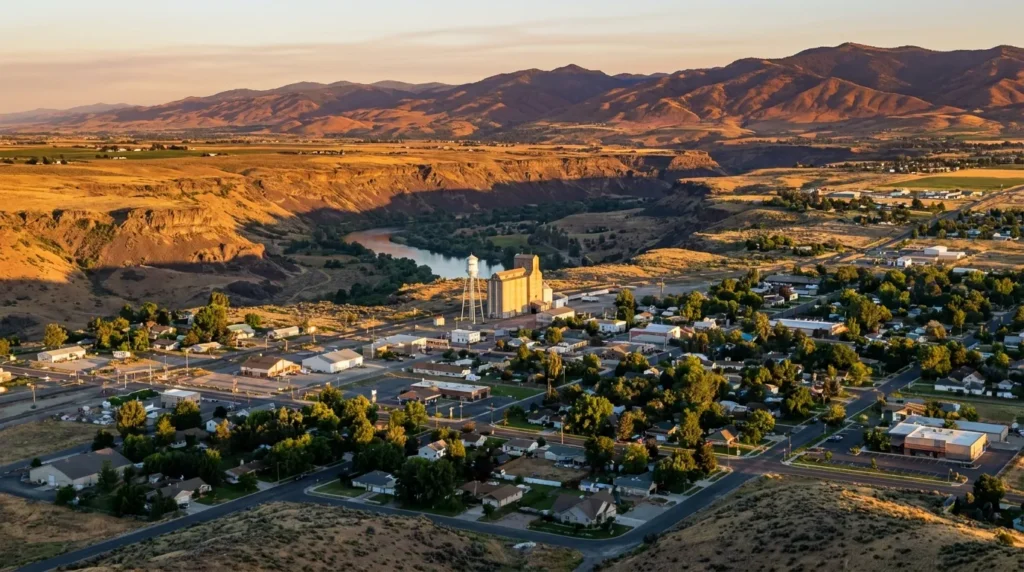
Kuna consists almost entirely of single-story or two-story homes in suburban subdivisions, with few apartments and a growing stock of new construction.

Kuna's housing market is dominated by single-family homes with two-car garages. The newest neighborhoods are to the west and south, in planned subdivisions such as Falcon Crest, Bridgetower, and areas near Linder Road. Homes generally have three to four bedrooms and a medium-sized yard.

Apartments are scarce. Those needing to rent a smaller unit typically find options in complexes near the old downtown, but supply is limited and moves quickly. For a newly arrived immigrant without a car or established American credit, the most common path is renting a room in a shared house before signing an independent lease.

Buying requires mortgage pre-approval, and for immigrants without a long U.S. credit history, a larger down payment is often required. Areas near the historic core (Avalon Street, Main Street) have older and more affordable homes; newer subdivisions command higher prices but come with well-rated public schools.

Recommended neighborhoods
  • Historic downtown (Avalon Street)
  • Falcon Crest
  • Bridgetower
  • Western subdivisions (Linder Road)
  • South of Kuna Road

Small local job market; most residents work in Boise or Meridian

Kuna has local jobs in education, retail, services, and agriculture, but most residents commute daily to Boise, Meridian, or Nampa.

Kuna's own economy is modest. The largest local employers are the Kuna School District, the city government, grocery chains such as Albertsons and Walmart, and surrounding agricultural operations. Restaurants, gas stations, and small clinics round out local employment.

Most adults work elsewhere. The most common destination is Boise, with its corporate center, state offices, and hospitals. Meridian concentrates jobs in tech, retail, and logistics, and is 15 minutes away by car. Nampa, to the west, has light industry and factory jobs. The average commute for a Kuna resident is between 25 and 45 minutes.

For newly arrived immigrants, the most accessible entry-level jobs are in construction, seasonal agriculture, cleaning services, hospitality in Boise, and warehouse operations in Meridian. Those with fluent English find more opportunities in administrative retail and call centers in the capital.

Dominant sectors
  • Public education
  • Agriculture
  • Retail
  • Construction
  • Services
Major employers
  • Kuna School District
  • City of Kuna
  • Albertsons
  • Walmart
  • Treasure Valley agricultural operations

Growing public schools and higher education 30 minutes away in Boise

Kuna has its own growing municipal public school system and relies on Boise and Nampa for higher education, with Boise State University as the primary option.

Primary and secondary education is covered by the Kuna School District, which operates several elementary schools, a middle school, and Kuna High School. The district has been investing in new construction to keep pace with population growth, and average quality is considered good by rural Idaho standards.

Charter schools and religious schools are also available in the area. Homeschooling, a common practice in Idaho, has an active community in Kuna, with parent groups organizing joint activities and teaching cooperatives.

For higher education, leaving the city is necessary. Boise State University, 30 minutes by car, is the largest public university in the state and offers undergraduate and graduate programs in a wide range of fields. The College of Western Idaho in Nampa is the alternative for technical programs and two-year community college courses. Families prioritizing university access factor commute time into their home-buying decisions.

Notable universities
  • Boise State University (in Boise, 30 min)
  • College of Western Idaho (in Nampa, 25 min)
  • Northwest Nazarene University (in Nampa)

Basic local care, with referral hospitals in Boise and Meridian

Kuna has primary care clinics and urgent care facilities, but complex cases or hospital admissions go to the major hospitals in Boise (St. Luke's, Saint Alphonsus) and Meridian.

For routine appointments, vaccinations, and outpatient care, Kuna has private clinics and urgent care facilities that handle day-to-day demand. Pediatric care and local dental services are also available. Pharmacies at Albertsons and Walmart fill common prescriptions.

For serious emergencies, hospital admissions, childbirth, and medical specialties, residents go to Boise or Meridian. The two major hospital systems in the region are St. Luke's Health System and Saint Alphonsus Health System, both with modern facilities and maternity units. Drive time to the nearest emergency room in Meridian is about 15 minutes.

For immigrants without health insurance, the American system is expensive. Idaho offers limited state programs for low-income residents, and there are regional community health clinics that provide care on a sliding-fee scale. Obtaining employer-sponsored health coverage as soon as possible, or exploring the individual market at healthcare.gov, is recommended.

Kuna

Quiet city with low crime rates by American standards

Kuna is considered safe, with crime below the national average and a profile typical of a small suburban city, with no areas known to be dangerous.

Kuna has a reputation as a safe city. Violent crime is low, and the most common incidents are petty theft, occasional vandalism, and traffic violations. The local police force is small, but Ada County's sheriff's department covers the surrounding area, and response times are reasonable.

Like any fast-growing city, Kuna faces the challenge of expanding subdivisions with limited infrastructure. Some newer areas have limited street lighting and few sidewalks, which requires extra caution at night. However, no neighborhood has a reputation as a danger zone.

For those coming from large cities, the general feeling is of classic American suburban safety: leaving a front door unlocked is not unusual, children riding bikes on the street unsupervised is common, and residential burglaries are the exception. Basic precautions such as storing bicycles out of sight and not leaving valuables visible in the car are sufficient.

Safer neighborhoods
  • Historic downtown (Avalon Street)
  • New western subdivisions
  • Bridgetower
  • Falcon Crest
  • Residential neighborhoods north of downtown
Areas to avoid
  • Isolated rural road stretches at night
  • Industrial areas with poor lighting

Car-dependent city with no meaningful public transportation

Kuna is entirely dependent on private automobiles, with no urban bus network and road connections via Kuna-Mora Road and I-84 to Boise.

There is no urban bus network in Kuna. Valley Regional Transit operates in Boise, Meridian, and Nampa, but coverage for Kuna is minimal. For any practical routine, a car is required, and families typically have two vehicles to cover work and school.

The main connection to the metropolitan area is via Kuna-Mora Road and Ten Mile Road to Interstate 84, which runs east-west through the Treasure Valley. By car, Boise is about 30 minutes away, Meridian 15 minutes, and Nampa 20 minutes. Peak-hour traffic on these corridors exists but is not severe.

The airport serving Kuna is Boise Airport (BOI), about 35 minutes by car. International flights generally require a connection in Salt Lake City, Seattle, or Denver. For short trips on foot or by bike, the historic downtown has limited bike lanes and decent sidewalks, but most new subdivisions do not connect safely to commercial areas.

Airports
  • BOI — Boise Airport (35-minute drive)
  • Bike infrastructure

Climate

Kuna

Small Western town culture with strong rural traditions

Kuna maintains a rural Western identity with rodeo, community festivals, and cuisine typical of the Treasure Valley, shaped by agriculture and Hispanic influence.

Cultural life in Kuna revolves around community events, schools, and churches. The highlight of the year is Kuna Days, a late-summer festival with a parade, street food, a car show, and outdoor concerts. The local amateur rodeo is also a tradition, reflecting the city's agricultural roots.

Food follows the rural Idaho standard. Potatoes in all forms are ubiquitous (the region is the largest potato producer in the U.S.), backyard barbecue is a summer staple, and Mexican cuisine has a strong presence due to the historic Hispanic community. Taquerias and Latin grocery stores dot the city.

For broader cultural experiences such as museums, theaters, and concerts, residents drive to Boise, which has an active cultural scene, or to Nampa, home to regional festivals. Kuna serves as a residential base; weekend entertainment happens in the surrounding area and nearby nature.

Notable dishes
  • Idaho baked potato and all its variations
  • Tacos al pastor from local taquerias
  • Grilled Snake River trout
  • American backyard BBQ
  • Finger steaks (Idaho specialty)
Annual events
  • Kuna Days (annual late-summer festival)
  • Kuna Christmas Tree Lighting
  • Summer community rodeo
  • Snake River Stampede (nearby, in Nampa)
  • Treasure Valley Hispanic Cultural Center events

Federal bird reserve, municipal parks, and access to the Snake River

Kuna's main attraction is the Snake River Birds of Prey reserve, a natural raptor sanctuary south of the city, complemented by local parks and Snake River access.

Kuna's signature attraction is the Morley Nelson Snake River Birds of Prey National Conservation Area, a federal reserve 25 minutes south of the city. It is one of the largest raptor nesting areas in the United States, with falcons, eagles, and hawks, and features trails with canyon overlooks above the Snake River. Admission is free and the experience is remarkable.

Within the city limits, Kuna City Park is the hub of community life, with playgrounds, courts, and picnic areas. The Indian Creek Greenbelt follows the waterway running through the city and offers walking and short cycling routes, connecting the historic downtown to the school district neighborhood.

For a more ambitious weekend, Boise is 30 minutes away with museums, a botanical garden, and the famous Boise River Greenbelt. The Bruneau Dunes, giant sand dunes in southeastern Idaho, make for a good day trip, and the Bogus Basin ski resort opens in winter about an hour away by car.

  1. 1Morley Nelson Snake River Birds of Prey National Conservation Area
  2. 2Kuna Caves (lava cave south of the city)
  3. 3Indian Creek Greenbelt
  4. 4Kuna City Park
  5. 5Swan Falls Dam (on the Snake River)
  6. 6Celebration Park (nearby archaeological park)
Parks & green spaces
  • Kuna City Park
  • Indian Creek Greenbelt
  • Crimson Point Park
  • Bernie Fisher Park
  • Trails along the Snake River Canyon

Small immigrant community, with a historic presence of Mexicans and Central Americans

Kuna has a small immigrant community, dominated by Mexicans and Central Americans connected to agriculture, with consular services and nonprofits concentrated in Boise.

Immigration in Kuna follows the Treasure Valley pattern: the largest historic presence is Mexican, partly connected to regional agriculture and partly representing generations born in the area who moved to the city seeking more affordable housing. Central Americans, primarily Guatemalans and Salvadorans, form the second most visible group.

More recent communities include Filipinos connected to healthcare services in Boise, Indians from the tech sector who chose Kuna for its lower costs, and refugees resettled in the Treasure Valley over recent decades from countries such as Afghanistan, Syria, Congo, and Ukraine. The Brazilian contingent is small and dispersed across the metropolitan area.

Consular services and most support organizations are located in Boise. The practical path for a newly arrived immigrant is to connect with local churches, English learning programs at the public library, and regional organizations such as the Idaho Office for Refugees and the Hispanic Cultural Center of Idaho, both in Nampa and Boise.

1,500
Foreign-born residents
estimated
Top countries of origin
  • Mexico
  • Guatemala
  • El Salvador
  • Philippines
  • India
  • Ukraine
  • Afghanistan
  • Canada
Foreign consulates
  • Mexican Consulate in Boise
  • Other consulates under Seattle jurisdiction
  • Other consulates under Salt Lake City jurisdiction
  • Other consulates under Portland (Oregon) jurisdiction
Community organizations
  • Idaho Office for Refugees (Boise)
  • Hispanic Cultural Center of Idaho (Nampa)
  • Catholic Charities of Idaho
  • International Rescue Committee (Boise)
  • Global Talent Idaho
  • Kuna Public Library (ESL programs)

Latest posts

Straight from the blog

There are no posts specifically about Kuna yet. In the meantime, check out our latest posts.